
Key Takeaways:
- Hand, machine, and laser engraving are distinct methods, and some contemporary engravers combine them.
- Engraving does not automatically increase a pistol’s value; originality, attribution, workmanship, condition, and documentation matter.
- Engraving must not obscure or alter a firearm’s serial number, and protected artwork or insignia may require permission.
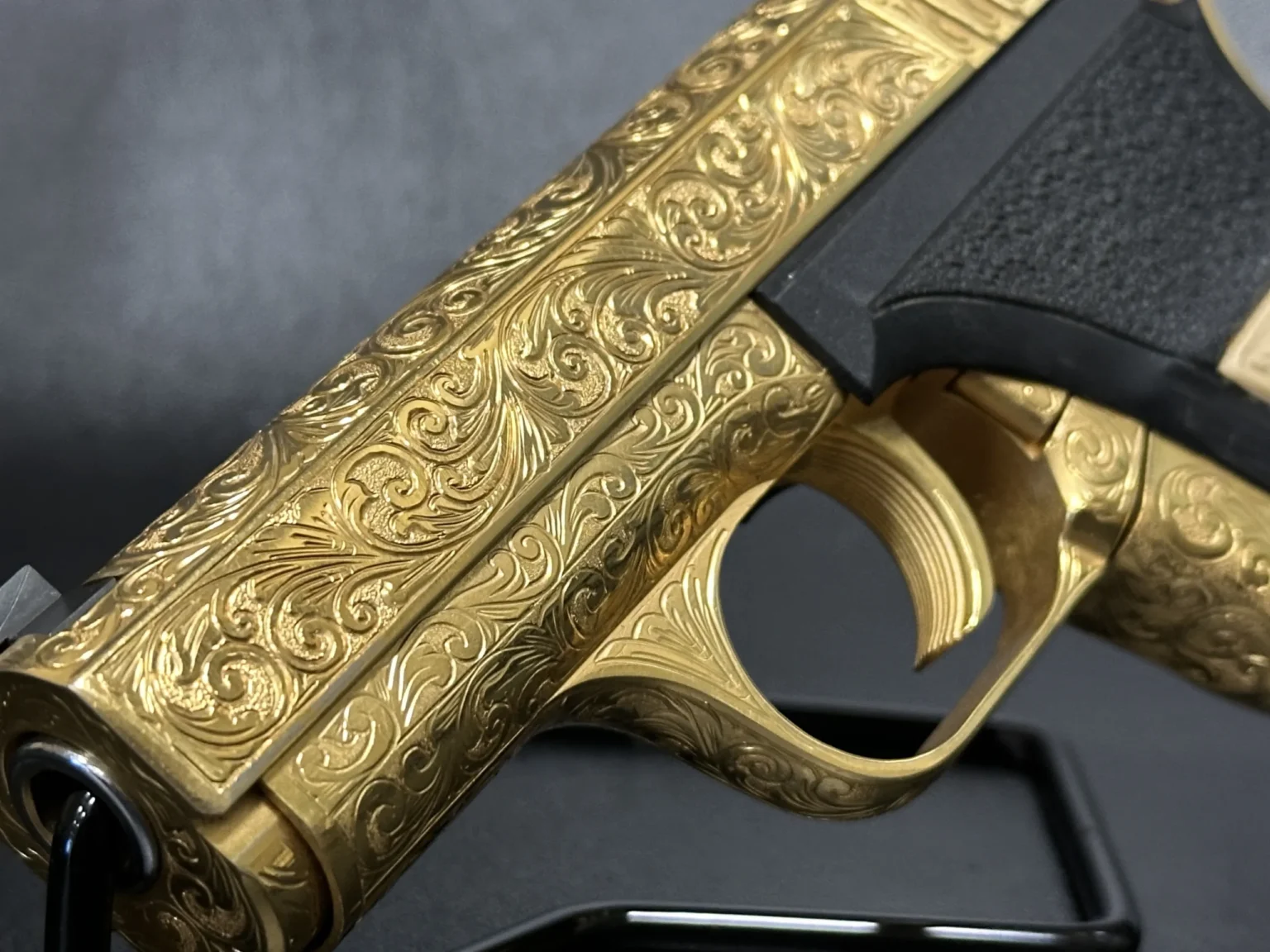
Custom pistol engraving combines decorative art with precision metalwork. The strongest examples do more than cover a firearm with ornament: they adapt the design to the pistol’s proportions, existing markings, finish, and intended use.
A Long Tradition of Decorated Arms
Weapons have been decorated across cultures for centuries. Historically, embellished arms served as signs of status, diplomatic gifts, ceremonial objects, and expressions of personal identity. Decoration on working weapons was generally planned so that it did not interfere with their function.[1]
Engraving is only one method of embellishment. Historic arms may also incorporate carving, chiseling, gilding, silvering, inlay, bluing, and etching. These terms are not interchangeable. Engraving cuts lines directly into a surface with a hardened tool, traditionally called a burin or graver. Etching removes exposed metal through a chemical process.[2]
Firearms became an important field for engravers by the early modern period. By the nineteenth century, American manufacturers were commissioning scrollwork, hunting scenes, inscriptions, and precious-metal inlay.
Gustave Young is among the best-documented engravers associated with nineteenth-century American firearms. Born in Germany, he immigrated to the United States in 1852 and engraved for Colt from 1853 to 1858, becoming the company’s principal engraving contractor during the latter part of that period. He later worked for Colt again and also engraved for Smith & Wesson and the New Haven Arms Company.[3]
The Metropolitan Museum of Art holds 25 inked impressions, known as pulls, that preserve examples of engraved firearms ornament associated with Young and his teacher, Ernst Moritz. The impressions record scrollwork and hunting scenes applied to lockplates, receivers, hammers, barrel tangs, and other components.[3]
Hand, Machine, and Laser Engraving
Contemporary firearm decoration may be produced through hand engraving, mechanically guided cutting, computer-controlled machining, laser engraving, or a combination of methods.[4]
Hand engraving gives the artist direct control over the depth, width, taper, and direction of each cut. Traditional tools may be pushed by hand, driven with a hammer, or assisted by pneumatic equipment. Background removal, relief carving, shading, and precious-metal inlay can create considerable depth and contrast.
Machine engraving is useful when a design must be repeated consistently. Computer-controlled equipment can produce lettering, borders, and complex patterns with a high degree of uniformity.
Laser engraving follows a digital design and can create detailed imagery or text efficiently. Some contemporary workshops combine laser or machine removal with hand-cut finishing. For that reason, the word “engraved” alone does not explain how a firearm was decorated.[4]
Technique should not be confused with quality. A poorly designed hand engraving is still poor work, while carefully planned machine or laser engraving can be clean and visually effective. The appropriate method depends on the firearm, the design, the desired depth, and whether the commission is intended as a singular artwork or a repeatable production pattern.
Planning a Custom-Engraving Commission
A sound design begins with the firearm’s architecture. The slide, frame, cylinder, barrel, backstrap, trigger guard, and grip panels offer different surfaces and limitations. Existing factory markings must be incorporated into the layout rather than treated as obstacles.
Before cutting begins, the owner and engraver should agree on:
- The components and surfaces to be decorated
- The approximate percentage of coverage
- The method or combination of methods to be used
- The depth and relief of the engraving
- The design of borders, scrollwork, lettering, or pictorial scenes
- Any gold, silver, or other inlay
- The background and final surface treatment
- Whether the engraver will sign the work
- The documentation supplied with the completed firearm
Names, dates, monograms, and presentation inscriptions should be checked carefully. Once cut into metal, even a minor spelling or spacing error may be difficult to correct without leaving evidence of the alteration.
Choosing an Engraver
A portfolio should be examined through detailed, close-range photographs. Overall views can conceal uneven borders, inconsistent shading, poorly terminated scrolls, and awkward transitions around screws, contours, and factory markings.
The engraver should identify how each example was produced. If the work combines laser, machine, and hand cutting, that should be stated plainly. Owners commissioning hand engraving should also determine how much of the design will actually be cut by hand.
A written proposal should define the design, technique, materials, price, expected completion schedule, and responsibility for finishing or refinishing. It should also specify how the firearm will be received, recorded, stored, and returned.
Engraving and Collector Value
Engraving does not automatically increase a pistol’s market value. Artistic quality and added cost do not necessarily translate into a higher resale price.
Original factory engraving is materially different from later aftermarket decoration. For qualifying Colt firearms, an archive letter may document original specifications, shipping information, engraving, and other special features. The available information depends on what survives in the records for the individual firearm.[5]
Before altering an older, rare, or apparently factory-engraved pistol, the owner should research its original configuration. Modern engraving, polishing, refinishing, or replacement parts can permanently change the physical evidence on which authentication depends.
Documentation is therefore essential. Records for a new commission should include the engraver’s name, completion date, invoice, approved design, detailed photographs, techniques used, materials added, and any refinishing performed. Signed documentation will help later owners distinguish commissioned work from undocumented alteration.
Can Anything Be Engraved on a Firearm?
No. A design must respect required identifying marks, applicable law, intellectual-property rights, and the physical limitations of the firearm.
Federal law prohibits specified conduct involving firearms whose manufacturer’s or importer’s serial number has been removed, obliterated, or altered.[6] Decorative work should never cut through, cover, distort, or otherwise compromise the serial number.
Logos, heraldic devices, military insignia, and copyrighted artwork should not be reproduced without determining whether permission is required. The engraver must also ensure that the proposed location and depth of the work are appropriate for the component.
Custom pistol engraving is most successful when the design is restrained, the method is accurately represented, and the completed work is fully documented. For collectors, attribution and provenance matter as much as visual impact.
Frequently Asked Questions
Custom pistol engraving is the application of decorative patterns, images, or inscriptions to a pistol. The work may be completed by hand, machine, laser, or a combination of methods.
Neither method is automatically superior. Quality depends on the design, execution, desired depth, and purpose of the commission.
Not necessarily. Poorly executed or undocumented aftermarket engraving can reduce collector interest, while documented work by a respected engraver may have independent appeal.
No. A design must not compromise required identifying marks, and permission may be needed to reproduce copyrighted artwork, trademarks, insignia, or other protected material.
Research its history and original configuration before making permanent changes. Engraving or refinishing a rare or historically significant pistol can remove evidence needed for authentication.
Sources
- Dirk H. Breiding, “The Decoration of Arms and Armor,” Heilbrunn Timeline of Art History, Metropolitan Museum of Art, October 2003.
- Dirk H. Breiding, “Techniques of Decoration on Arms and Armor,” Heilbrunn Timeline of Art History, Metropolitan Museum of Art, October 2003.
- Metropolitan Museum of Art, “Twenty-Five Inked Impressions (or ‘Pulls’) of Engraved Firearms Ornament,” accession nos. 2002.233.2–.26.
- Mark Hardig, “The Resurgence of Firearm Engraving,” American Rifleman, October 7, 2023.
- Colt’s Manufacturing Company, “Archive Services.”
- Office of the Law Revision Counsel, U.S. House of Representatives, “18 U.S.C. § 922(k)—Unlawful Acts.”