
Key Takeaways:
- Hand and laser engraving are production methods, not quality grades. The design, execution, and suitability of the process determine the result.
- A factory letter reports information contained in surviving manufacturer records. It does not automatically prove later ownership, engraving attribution, or complete provenance.
- Document a collectible firearm before authorizing irreversible engraving. Preserve photographs, configuration details, invoices, artwork, and records identifying every process used.
Engraving is often discussed as a contest between traditional craftsmanship and modern technology. That framing is too simple. Hand and laser engraving are different production methods, each capable of excellent or mediocre work. For a firearms collector, the important questions are how the decoration was executed, who performed it, when it was added, and what documentation supports those conclusions.
Hand-Cut Engraving
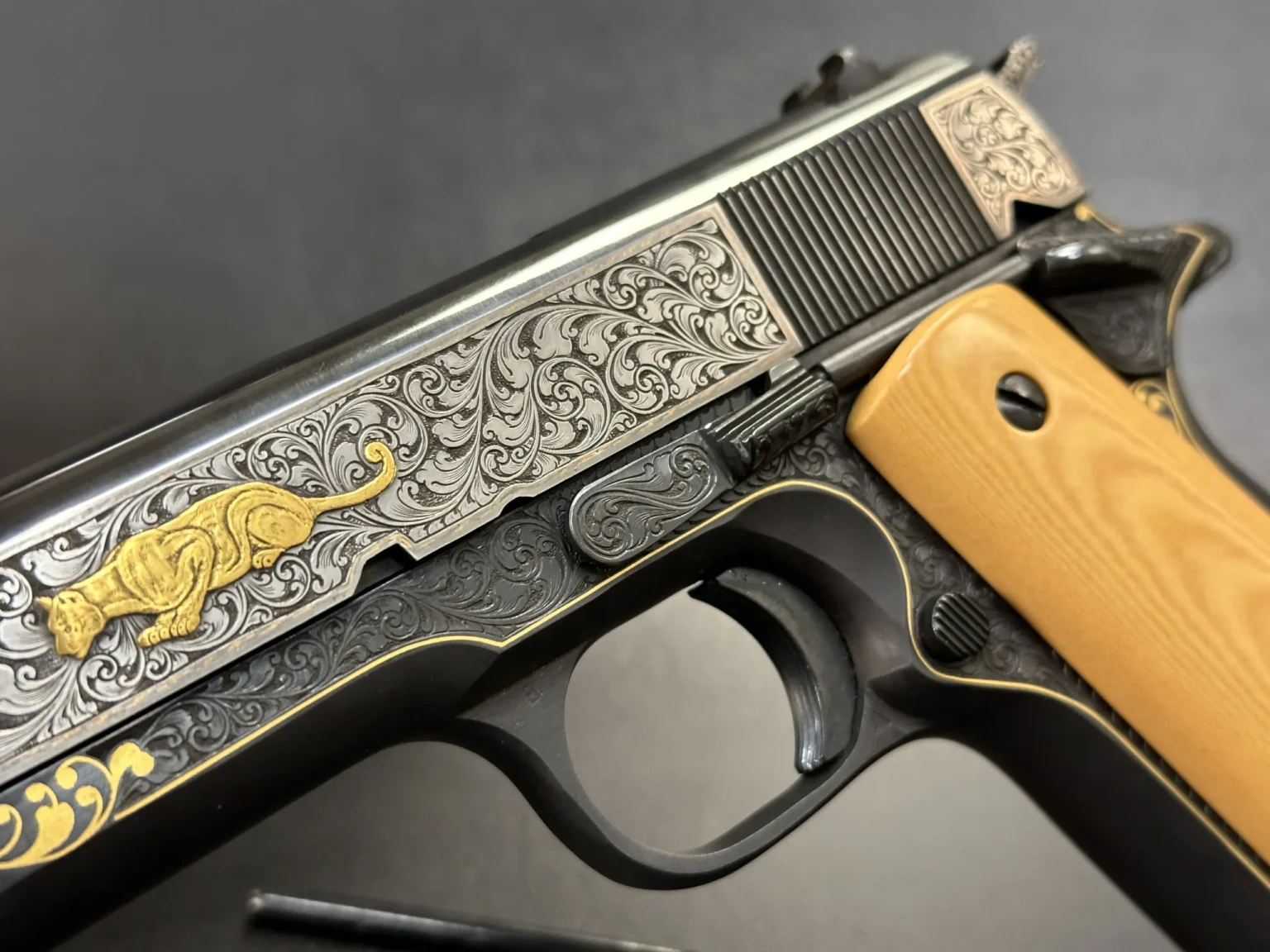
Traditional hand engraving uses a sharpened graver to remove metal under the engraver’s control. Some artists push the tool directly. Others use pneumatic equipment that supplies repeated impacts while the artist guides the graver through the material. GRS operating instructions make this distinction clear: the powered handpiece advances the tool, but the operator remains responsible for its direction and control.[1]
The engraver controls the line through tool geometry, angle, movement, and power. This permits continuous changes in width, depth, and direction. The finished work can therefore express an individual artist’s design judgment rather than simply reproduce a digital file.
That human control does not make every hand-cut engraving valuable. Poor layout, weak cutting, inappropriate refinishing, or undocumented aftermarket work can diminish a firearm’s collector appeal. “Hand engraved” describes a process, not a guarantee of artistic merit, historical importance, or market value.
When a firearm is represented as the work of a particular engraver, attribution should rest on documentation. Useful evidence includes an invoice, dated correspondence, photographs of the work in progress, an artist’s certificate, or a verifiable entry in the engraver’s records. A signature or recognizable style may support an attribution, but neither should be treated as conclusive in isolation.
Laser Engraving and Laser Marking
Laser terminology is frequently used imprecisely. Laser marking is the broader category. A laser may change the appearance of a surface by removing material, stripping a coating, producing oxidation, or causing another physical or chemical change. Laser engraving is a form of laser marking in which material is ablated to create a recessed design.[2]
This distinction matters. A dark laser mark with little measurable depth is not equivalent to a deeply engraved surface simply because both were produced with a laser.
Laser results depend on the interaction between the beam and the workpiece. Wavelength, pulse duration, power, focus, speed, material, coating, and number of passes can all affect the result.[2] Fiber-laser systems are commonly used to mark and engrave metals. Commercial industrial systems can create fine lettering and decorative designs, remove surface layers, or produce deeper recesses when configured for material removal.[3]
Laser systems are particularly effective when a project requires repeated designs, precise lettering, controlled placement, or variable information such as individual serial numbers. A digital design can be applied consistently across an edition while still allowing selected details to change from one object to the next.[2]
Laser work is not automatically shallow, inexpensive, or inferior. Nor is it automatically flawless. Poor artwork, incorrect settings, inadequate fixturing, excessive heat, or careless finishing can produce an unattractive result. As with hand engraving, quality depends on design, execution, and the suitability of the process for the object.
Identifying the Process
Magnification may reveal evidence of how an engraving was made, but no single visual feature is definitive.
Hand-cut lines may show changes in width and depth, tapered terminations, displaced metal, or minor variations in spacing. Laser work may show highly regular repeated elements, pulse overlap, raster structure, or a characteristic surface texture. Those observations can be useful, but they are not proof.
A skilled engraver can produce remarkably regular handwork. A laser can reproduce intentional line variation. Polishing, refinishing, inlay, background treatment, or later hand cutting may alter or obscure the original evidence. Some firearms also combine laser and hand processes.
When the production method materially affects a purchase, visual inspection should be supported by documentation and examination by someone familiar with the relevant manufacturer, engraver, and period.
Documentation and Factory Originality
For collectible firearms, the distinction between factory engraving and later decoration can be more important than the distinction between hand and laser work.
Where original manufacturing records survive, a factory letter may provide serial-number-specific information about the firearm’s date or original configuration. The Cody Firearms Records Office supplies manufacturing dates and configuration data from surviving original records for specified Winchester, Marlin, L.C. Smith, Ithaca, Savage, and A.H. Fox firearms.[4]
The scope of those records varies by manufacturer, model, serial-number range, and period. A factory letter should therefore be read for exactly what it establishes. It does not automatically prove subsequent ownership, an undocumented engraving attribution, or every event in the firearm’s later history.
Before commissioning new engraving on a collectible firearm, document its existing condition and markings. Photograph all surfaces, record the serial number and configuration, and investigate available factory records. Engraving is a subtractive and generally irreversible alteration. Once original finish, markings, or surface evidence has been removed, it cannot be restored as original.
For new work, retain:
- The engraver’s or shop’s invoice
- Dated photographs taken before, during, and after the work
- Approved drawings or digital artwork
- A description of the processes used
- The engraver’s signature or certificate, when applicable
- Records of refinishing, plating, inlay, or other associated work
If a project combines laser and hand engraving, the documentation should identify which elements were produced by each method.
Choosing a Method
Hand engraving is appropriate when the identity and interpretation of an individual artist are central to the commission. It is particularly suited to designs requiring continuously varied cuts, direct adaptation to irregular surfaces, or substantial artistic discretion.
Laser engraving is appropriate when consistency, precise typography, repeatable placement, or production across multiple objects is the priority. It can also be used as one stage of a hybrid process, with hand cutting added to selected areas.
Durability depends on depth, material, location, finish, and use—not simply on whether a graver or laser created the design. A shallow surface mark may wear regardless of method, while a sufficiently deep engraving can remain legible under extended handling.
Care and Preservation
Engraved surfaces should not be aggressively polished. The Canadian Conservation Institute warns that polishing is abrasive and necessarily removes some original surface. Polishing compounds can also lodge in engraved recesses, where residues may contribute to corrosion or obscure detail.[5]
Fingerprints, dust, salts, and moisture can also damage metal surfaces. Bare ferrous metal may benefit from a sparingly applied light oil, distributed with a soft cloth and wiped to remove excess.[5] Historically important, plated, inlaid, or actively corroding firearms should be evaluated before any substantial cleaning or restoration.
The central point is straightforward: neither method carries automatic prestige. Hand engraving can document the work of an individual artist. Laser engraving can provide precision, consistency, and meaningful depth. For collectors, accurate attribution, appropriate workmanship, preservation of original material, and reliable documentation matter more than the label attached to the tool.
Frequently Asked Questions
Laser marking includes processes that alter a surface’s appearance. Laser engraving specifically removes material to create a recessed mark.
No. Collector value depends on factors including workmanship, authorship, originality, condition, provenance, and market demand.
Magnification may reveal useful characteristics, but no single visual feature is conclusive. Documentation and qualified examination provide stronger evidence.
A factory letter reports information found in the surviving records for a particular firearm. Its evidentiary value is limited to the information and record coverage described in the letter.
Avoid aggressive or abrasive polishing because it removes surface material and can leave residue in engraved recesses. Historically important, plated, inlaid, or corroding firearms should be assessed before substantial cleaning.
Sources
- Glendo LLC, “GraverMach AT: Original Instructions,” GRS, 2022.
- Rüdiger Paschotta, “Laser Marking: Engraving, Ablation, Surface Modification, Applications,” RP Photonics Encyclopedia.
- TRUMPF, “Laser Marking,” technical booklet.
- Buffalo Bill Center of the West, “Cody Firearms Records Office,” Cody Firearms Museum.
- Canadian Conservation Institute, “Caring for Metal Objects: Preventive Conservation Guidelines for Collections,” Government of Canada.