
Key Takeaways:
- A famous model is not automatically rare; scarcity must be established for the specific configuration.
- Original condition and credible provenance can materially influence collector interest and value.
- Completed sales of genuinely comparable revolvers provide better evidence than asking prices or exceptional auction records.
“Investment-grade” is not a formal classification, and it should never be interpreted as a promise of appreciation. A revolver earns serious collector interest through a combination of authenticity, rarity, condition, originality, provenance, and demand.
The National Park Service identifies authenticity, rarity, condition, and popularity as principal influences on collectible-firearm value.[1] These factors must be assessed together. Rarity without demand may mean little, while an uncommon and well-documented variation of a familiar model may command a substantial premium.
Condition Is More Than Appearance
Collector condition is not the same as mechanical function. Evaluation should consider original finish, sharpness of markings, bore quality, grips, screws, mechanical integrity, and evidence of alteration.
The National Rifle Association publishes separate grading standards for antique and modern firearms. Those standards emphasize original configuration and surviving factory finish. They also recognize that small differences in condition can materially affect value.[2]
A refinished revolver may look better than an untouched example while possessing less historical integrity. Polishing can soften markings and edges; rebluing can conceal prior corrosion; and replacement grips, sights, barrels, or internal parts can change the firearm’s original configuration.
Claims such as “98 percent condition” are meaningful only when based on a recognized grading system. Detailed photographs and a written description of specific wear are more reliable than an unsupported percentage.
Rarity Must Be Demonstrated
A famous model is not necessarily rare. Genuine scarcity generally belongs to a specific variation: an early serial number, unusual barrel length, scarce chambering, documented factory engraving, special finish, military marking, presentation inscription, or another verifiable feature.
Consequently, the correct question is not whether a particular model is collectible. It is what distinguishes the individual revolver from other examples of that model.
Published production figures also require scrutiny. Different totals may describe frames manufactured, completed revolvers, serial-number ranges, or firearms actually shipped. When conflicting figures cannot be resolved through reliable documentation, they should not be repeated as established facts.
Provenance Must Connect the Story to the Firearm
Provenance is evidence linking a particular firearm to an owner, institution, event, or historically significant use. A story, even a plausible one, is not provenance by itself.
The National Firearms Museum cautions that documents and photographs concerning a famous person do not necessarily establish a connection to the firearm accompanying them. The essential question is whether the evidence identifies that particular gun, preferably through a serial number, inscription, distinctive feature, or documented chain of custody.[3]
Strong provenance can include contemporary correspondence, inventories, photographs, institutional records, receipts, prior auction catalogs, and estate documents. Each piece should be examined for authenticity, relevance, and continuity.
Colt Python
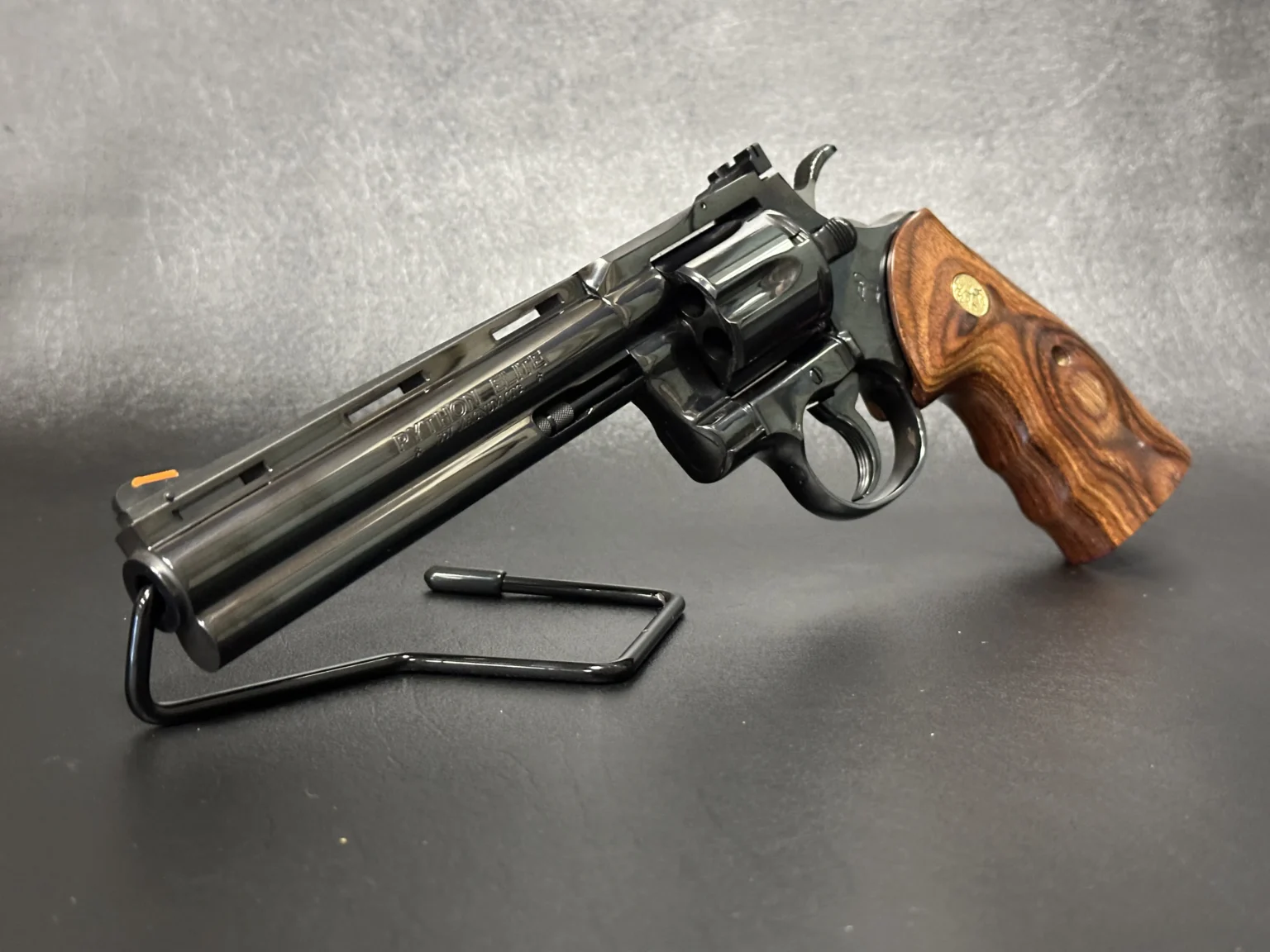
Colt introduced the .357 Magnum Python in 1955. Original production ended completely by 2005, and Colt reintroduced a revised Python in 2020.[4] The original and current-production revolvers are therefore separate collecting categories.
Vintage Python values can vary substantially according to production period, barrel length, finish, original stocks, mechanical condition, factory configuration, and accompanying materials. Early serial numbers and unusual configurations may bring prices far above those achieved by standard examples.
A documented 1955 Python with two-digit serial number 69 sold through Rock Island Auction Company for $34,500 in December 2021.[5] That result should not be treated as a general Python valuation. It concerned an exceptional first-year example with an unusually low serial number.
This distinction is fundamental: an extraordinary auction result establishes what one particular firearm brought under one set of circumstances. It does not establish the value of every revolver bearing the same model name.
Smith & Wesson Triple Lock
Smith & Wesson introduced the .44 Hand Ejector First Model in 1908. Originally cataloged as the .44 New Century, it became known among collectors as the “Triple Lock” because of its additional locking point between the yoke and ejector-rod shroud.[6]
Smith & Wesson began replacing it with the .44 Hand Ejector Second Model in 1914. The Second Model eliminated both the ejector-rod shroud and the third locking point.[6] These identifiable mechanical differences, not vague claims about superior craftsmanship, explain the First Model’s historical interest.
Individual Triple Locks must still be evaluated by chambering, barrel length, sights, finish, condition, originality, and documentation. The model’s short production period does not make every surviving example equally scarce or valuable.
Colt Single Action Army
Colt introduced the Single Action Army in 1873 and reports delivering more than 30,000 revolvers under U.S. government contracts between 1873 and 1891.[7]
Because the Single Action Army has an extensive production history, identification must go beyond the model name. Generation, serial range, configuration, caliber, markings, finish, condition, and provenance can place two outwardly similar revolvers in entirely different collecting categories.
A documented early military revolver, a factory-engraved commercial example, and a later-production Single Action Army may share the same basic design while having little else in common from a valuation standpoint.
Smith & Wesson Model 29
Smith & Wesson introduced its .44 Magnum revolver in 1955, later designating it the Model 29. The company states that demand increased sharply following the revolver’s association with the 1971 film Dirty Harry.[8]
That cultural connection helped establish lasting recognition, but recognition is not rarity. Collectors must distinguish early production, uncommon barrel lengths, special finishes, presentation sets, documented factory variations, and high-condition examples from ordinary production guns.
Korth Revolvers
Willi Korth began developing his revolver during the mid-1960s. The current German manufacturer describes its production as combining modern machinery with traditional gunsmithing and substantial handwork.[9]
Korth revolvers represent high-end modern manufacture rather than a single historically scarce model. Their retail cost and production quality may support collector interest, but neither guarantees future appreciation. Each example must be assessed according to model, age, configuration, documentation, condition, and evidence from completed secondary-market transactions.
Price is not provenance, and expense is not rarity.
A Disciplined Buying Process
Before assigning value, document the revolver’s serial number, markings, caliber, barrel length, finish, sights, grips, proof marks, accessories, and mechanical condition.
Next, investigate originality. Warning signs include softened lettering, rounded edges, dished screw holes, finish over pitting, mismatched wear, nonfactory engraving, replaced components, and altered barrels.
Historical or celebrity associations should be accepted only when the evidence connects the individual firearm to the claimed owner or event. Seller statements and family traditions may offer research leads, but they are not substitutes for documentation.
Finally, compare completed sales involving genuinely similar firearms. Production period, configuration, originality, condition, documentation, and sale terms must all be considered. Asking prices are not proof of market value, and record auction results are usually poor comparables for ordinary examples.
Preservation Is Part of Value
Improper storage can permanently damage a collectible revolver. National Park Service conservation guidance explains that changes in temperature and relative humidity can cause wooden components to split, shrink, or develop mold, while high humidity and pollutants can promote corrosion on metal surfaces.[10]
The same guidance recommends recording a firearm’s condition and documenting maintenance. Substantial dismantling or conservation should be handled by someone experienced with historic firearms.[10]
Receipts, photographs, auction catalogs, correspondence, and other records should remain organized with the revolver. Once documentation becomes separated from the object, its evidentiary value may be difficult to recover.
The Collector’s Standard
A serious collectible revolver combines demonstrable authenticity, meaningful scarcity, original condition, credible documentation, and established demand. Reputation alone is insufficient.
This standard excludes many attractive and expensive firearms. It also explains why two examples of the same model can achieve radically different prices.
Buy the firearm’s evidence, not its mythology. Verify rarity, treat originality and condition as separate questions, and compare like with like. Appreciation may follow, but it should never be assumed.
Frequently Asked Questions
A collectible revolver combines authenticity, meaningful scarcity, original condition, credible provenance, and established demand. No single factor determines value by itself.
Refinishing can reduce historical integrity by removing original finish or softening markings and edges. Factory refinishing and documented period restoration require case-specific evaluation.
A low serial number may increase collector interest when it establishes early production or another documented distinction. It does not guarantee rarity or value on its own.
Documents should connect directly to the firearm through its serial number, inscription, distinctive features, or a documented chain of custody. An ownership story without that connection is not verified provenance.
No. Past sales and collector demand can inform a valuation, but they cannot guarantee future appreciation.
Sources
- National Park Service, “Arms Collecting,” Springfield Armory National Historic Site.
- Jim Supica, National Firearms Museum, “Evaluating Firearms Condition”.
- Jim Supica, National Firearms Museum, “Pieces of History”.
- American Rifleman, “ARTV Preview: The Colt Python; Smith & Wesson Model 648-2; Pattern 1853 Enfield,” August 11, 2020.
- Joel R. Kolander, Rock Island Auction Company, “Top 10 Most Expensive Colt Python Revolvers Ever Sold at Rock Island Auction Company”.
- American Rifleman, “Smith & Wesson’s Three Hand-Ejector Revolvers”.
- Colt’s Manufacturing Company, “The Colt Story: Timeline”.
- Smith & Wesson, “Our Story and History Since 1852”.
- Korth, “About Us”.
- National Park Service, Caring for Historic Longarms: Storage and Handling, Conserve O Gram 10/1.