

Key Takeaways:
- First Generation production ran from 1873 through 1941, ending at serial number 357859.
- Second Generation revolvers were produced from 1956 through 1974 and generally carry an “SA” serial-number suffix.
- Third Generation production began in 1976, but transitional parts and changing serial formats mean identification requires more than the serial number alone.
Colt introduced the Single Action Army in 1873 after the U.S. government selected the .45-caliber revolver as a standard military sidearm. Colt records more than 30,000 government deliveries between 1873 and 1891.[1] The revolver’s collector history is conventionally divided into First, Second, and Third Generation production.
The Single Action Army is a fixed-cylinder revolver that requires the hammer to be cocked manually before each shot. Cartridges are inserted individually through a loading gate, and cases are removed one at a time with the ejector rod.[2]
The three-generation system provides a useful classification framework, but serial-number format should not be considered in isolation. Cylinders, barrels, grip frames, and other components have often been replaced or exchanged during the revolvers’ working lives.[3]
First Generation: 1873 to 1941
First Generation production began at serial number 1 and concluded at 357859 in 1941. Colt manufactured 357,859 revolvers during the period, although a limited number were assembled later from remaining prewar components.[3][4]
The earliest revolvers have a screw entering the front of the frame to retain the cylinder base pin. Colt began phasing in a spring-loaded transverse latch during the early 1890s, and the latch became standard in 1896. Both arrangements therefore appear on First Generation revolvers.[5]
Collectors commonly call the screw-retained configuration a “black-powder frame,” but that name is misleading. The base-pin retention system does not establish whether a revolver was intended for black-powder or smokeless-powder ammunition. Colt did not warrant the Single Action Army for smokeless powder until 1900, beginning around serial number 192000.[5]
The original military configuration had a 7½-inch barrel. Colt introduced the 5½-inch barrel in 1875 and made the 4¾-inch barrel a standard option in 1879.[5] Collectors frequently call these configurations “Cavalry,” “Artillery,” and “Civilian,” respectively, but those terms do not by themselves establish a revolver’s military service or factory designation.
First-generation revolvers appeared in numerous chamberings. The five produced in the greatest numbers were .45 Colt, .44 WCF, .38 WCF, .32 WCF, and .41 Colt.[3] The WCF abbreviation stands for Winchester Center Fire. The same cartridges are also commonly identified as .44-40, .38-40, and .32-20.
Barrel markings deserve close examination because many surviving revolvers have been rebarreled or rechambered. A period-correct barrel does not necessarily mean that it was installed when Colt originally shipped the revolver.
Second Generation: 1956 to 1974
Colt returned the Single Action Army to production in 1956. The new serial sequence began at 0001SA, with the “SA” suffix separating postwar production from the original numerical sequence.[3]
Second Generation revolvers retained the removable cylinder base-pin bushing used in First Generation guns. Most components from the first two generations were interchangeable, which complicates the examination of revolvers repaired or rebuilt with parts from both periods.[3][5]
Second Generation cylinders provide useful identification evidence. Colt stamped the Rampant Colt on the rear face. Cylinder fronts made during the first years of production carried assembly numbers, while examples produced from 1958 onward generally received the final digits of the revolver’s serial number.[6] These markings can identify a Second Generation cylinder, but they cannot prove that the cylinder is original to the frame.
The Second Generation line initially consisted of .45 Colt and .38 Special revolvers with 5½-inch and 7½-inch barrels. Colt later added the 4¾-inch barrel, .44 Special, and .357 Magnum. The adjustable-sight New Frontier entered production in 1961.[4]
Colt ended regular Second Generation production in 1974 at serial number 73319SA. Manufacture was suspended during 1975 while the company replaced worn production equipment.[4]
Third Generation: 1976 to the Present
Third Generation production began in 1976 at serial number 80000SA. Colt changed the barrel and frame thread pitch from 20 to 24 threads per inch. The company also redesigned the hand and corresponding cylinder ratchet and replaced the removable cylinder bushing with a press-fitted bushing.[3][5]
The initial serial sequence reached 99999SA in 1978. Colt then moved the letters to the front and continued with an SA-prefix sequence. When that sequence reached SA99999 in the 1990s, Colt adopted a split format, placing an “S” before the number and an “A” after it.[3]
Early Third Generation revolvers require particular care during identification. Colt used some remaining Second Generation frames in early Third Generation production, resulting in transitional revolvers with SA-suffix serial numbers. A suffix alone therefore does not prove that a revolver belongs to the Second Generation.[6]
Later Third Generation production returned to a removable cylinder bushing. Although some collectors use the term “Fourth Generation” for later revolvers, Colt continued to classify them as Third Generation because the return to the earlier bushing did not establish a new factory generation.[5]
Third Generation production has not been uninterrupted. Colt removed the Single Action Army from its standard catalog in 1982 but continued accepting certain Custom Shop orders. The revolver returned to the catalog in 1993.[5] Colt was still producing Third Generation revolvers when American Rifleman published its 150th-anniversary history in 2023.[4]
Identifying a Collectible Example
Examination should begin with the complete serial number and every location where it appears. The frame, trigger guard, and backstrap should be compared before considering the cylinder, barrel, grips, screws, and internal components.
Patent dates do not establish when a revolver was manufactured. Current-production Single Action Army revolvers continue to carry dates associated with patents from 1871, 1872, and 1875. Colt also cautions that serial-number lookups provide approximate dates because revolvers were not necessarily assembled or shipped in numerical order.[7]
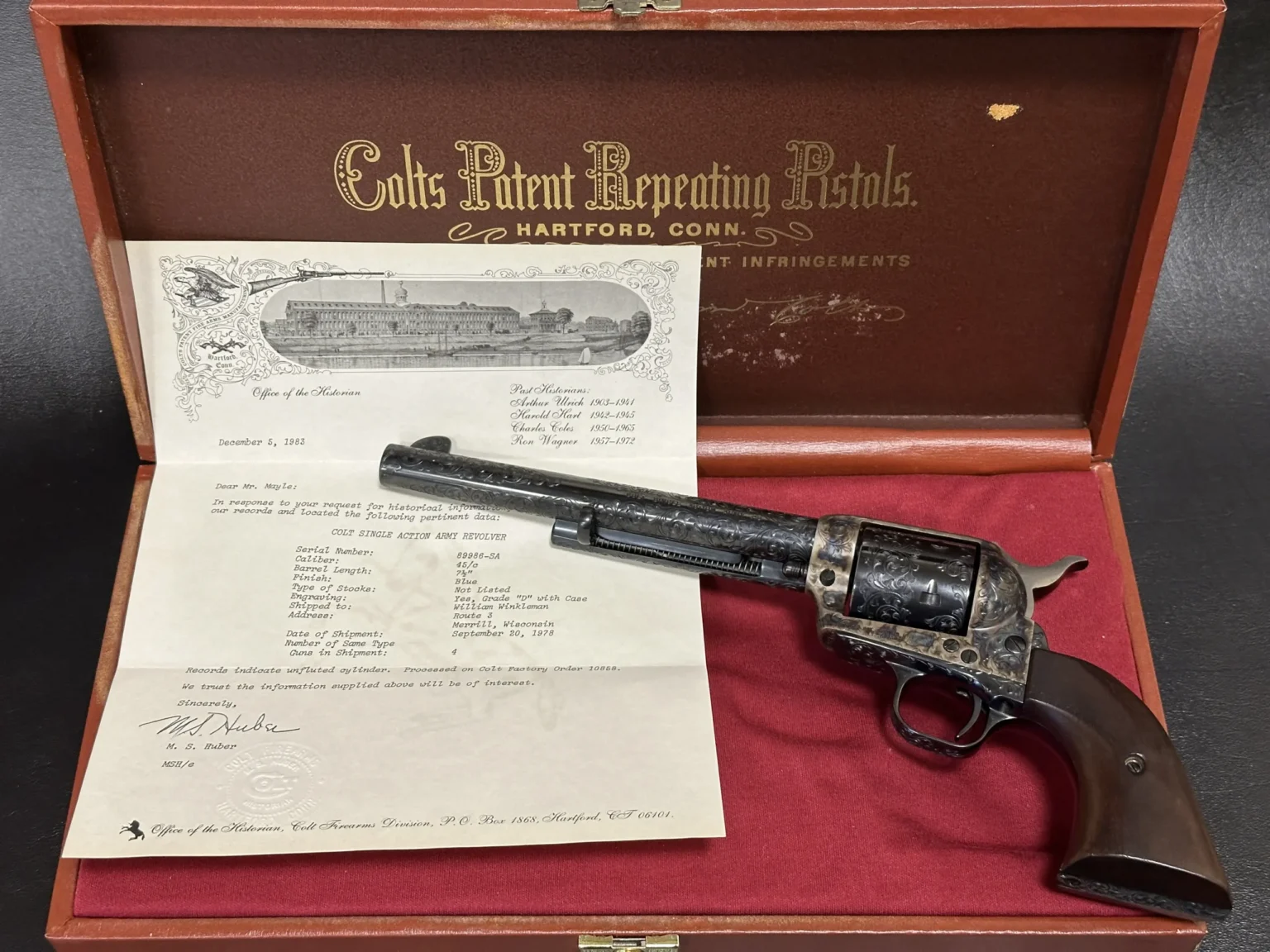
A Colt archive letter can document the original caliber, barrel length, finish, stocks, shipping date, shipping destination, and recorded special features. It does not ordinarily provide a chain of individual ownership.[7]
The archive letter should be compared with the firearm itself. Differences in caliber, barrel length, finish, stocks, or engraving may show that the revolver was altered after leaving the factory. Colt’s records also confirm that such changes are common among older firearms.[7]
The First Generation encompasses original production from 1873 through 1941. The Second Generation covers the postwar return from 1956 through 1974. The Third Generation began in 1976 and remains Colt’s designation for subsequent production. Serial numbers narrow the possibilities, but an accurate classification depends on the revolver’s complete physical configuration and documented factory history.[3][6][7]
Frequently Asked Questions
First Generation production ran from 1873 through 1941, Second Generation from 1956 through 1974, and Third Generation began in 1976.
No. Transitional frames, replacement cylinders, and exchanged components can make the serial number misleading.
Second Generation revolvers generally have an “SA” suffix and characteristic cylinder markings. Early Third Generation examples may also have an “SA” suffix, so cylinder construction and other features must be examined.
An archive letter may document the original caliber, barrel length, finish, stocks, shipping date, destination, and recorded special features. It does not ordinarily establish a complete ownership history.
No. Although some collectors use that term for later revolvers, Colt continued to classify them as Third Generation.
Sources
[1] Colt’s Manufacturing Company. “The Colt Story.” Colt’s Manufacturing Company, n.d.
[2] Colt’s Manufacturing Company. Single Action Army Revolver Safety and Instruction Manual. n.d., pp. 6, 20–25.
[3] Venturino, Mike. “Colt’s Single Action Army.” Handloader, vol. 53, August–September 2018.
[4] Hacker, Rick. “150 Years of the Colt Single Action Army.” American Rifleman, January 3, 2023.
[5] Venturino, Mike “Duke.” “A Colt Single-Action Primer.” American Handgunner, n.d.
[6] Hacker, Rick. “Collecting Second Generation Colt Single Action Army Revolvers.” American Rifleman, November 12, 2022.
[7] Colt Archive Properties. “About the Archive Letter.” Colt Archive Properties, n.d.


5 Responses
I have a Colt SAA buntline special.45 serial number S A60491 can not get a date of manufacture on it , I think it was made in the mid 1980’s . I would like to know for sure it’s date.
For definitive information, your best option is to contact the Colt Archives directly. They maintain the original factory records and can provide an official letter detailing the exact date of manufacture and original configuration of your Colt SAA. It’s the most reliable way to confirm the production date with certainty.
Colt Archives
screw retaining cylinder pin did not continue till 1941. i stopped reading right there. crazy wrong
i have a colt saa with the serial number sa37874 is this legit?
you should know the answer by reading the article.