
Key Takeaways:
- A factory letter reports information found in surviving records associated with a firearm’s serial number.
- It does not independently prove that the firearm retains its original parts, finish, engraving, or configuration.
- Collectors should compare the letter with the firearm and preserve supporting records in a documented provenance file.
If you’ve spent any time around serious gun collectors, you’ve probably heard someone drop the term factory letter like it’s some secret handshake. And honestly? They’re not wrong. These letters are kind of the Rosetta A factory letter can be one of the most useful records accompanying a collectible firearm. It may connect a serial number to surviving factory information concerning configuration, manufacture, or shipment. That connection can clarify a firearm’s history, but it must be interpreted carefully.
A letter is evidence of what appears in an archival record. It is not a blanket certificate that every component currently on the firearm is original, nor does it establish a complete history of ownership.
What the Records May Contain
The information available depends on the manufacturer, record type, and survival of the underlying documents. A factory letter may report:
- Model and caliber
- Barrel length, finish, stocks, or other recorded features
- Manufacturing, warehousing, or shipping dates
- Shipping destination
- Special-order features or engraving
The absence of a detail from a letter does not necessarily mean the feature was absent from the firearm. It may mean that the factory did not record the information or that the relevant record no longer survives.
Dates also require precise interpretation. Winchester’s surviving records include both warehouse ledgers and serial-number-application ledgers. The warehouse records may contain configuration and manufacturing information, while the serial-number-application records identify when a serial number was applied.[1] Those dates should not automatically be treated as interchangeable with a shipping date.
Colt Archive Letters
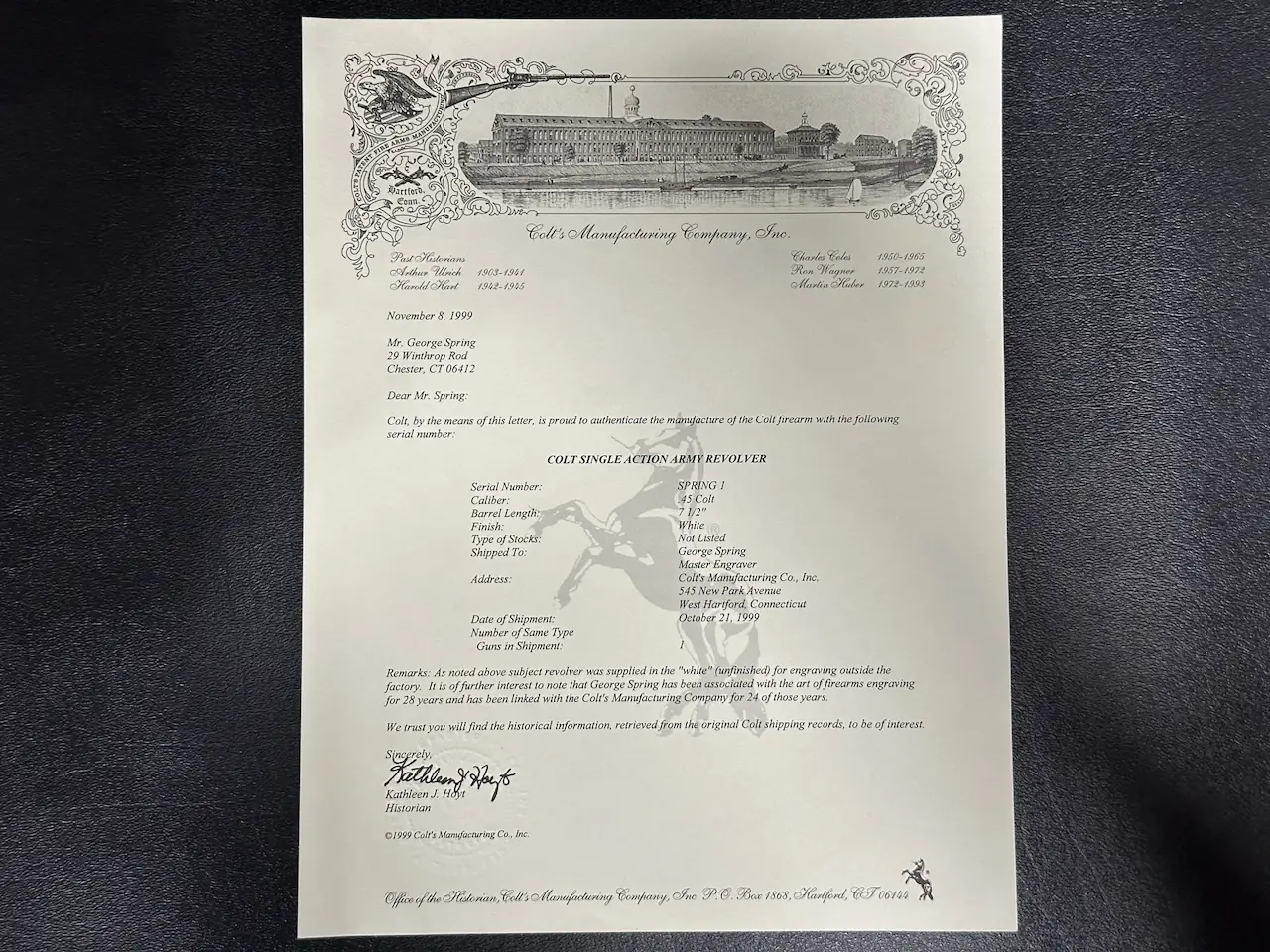
Colt Archive Services researches surviving company records and issues serial-specific letters describing documented specifications and delivery information. Colt states that its archive letters may also identify special features and custom engraving, although the available information varies by firearm.[2]
Colt’s online serial-number lookup is a different resource. The company warns that the lookup database is not comprehensive and that its information is approximate. For more definitive information, Colt directs owners to its archive service.[3]
Even a detailed Colt letter should be read literally. If it lists a particular caliber, barrel length, finish, or destination, it establishes what the surviving factory record reports. It does not independently prove that the firearm remains in that configuration today.
The firearm must therefore be examined against the letter. Serial and assembly numbers, markings, dimensions, finish, engraving, sights, stocks, and mechanical features should be checked for consistency. Any discrepancy should be documented and investigated.
Winchester Records
Winchester records demonstrate why collectors must identify the exact type of archival evidence behind a letter. Surviving warehouse ledgers contain configuration information and manufacturing dates for certain models and serial-number ranges. Separate serial-number-application ledgers may provide only the date on which the serial number was applied.[1]
Coverage is incomplete. The official serial-range guide identifies missing entries and gaps within the records. It also shows that some Winchester ranges have both warehouse and serial-number-application information, while others have only one record type.[1]
Consequently, two letters for firearms of the same model may contain substantially different amounts of information. A sparse letter is not necessarily defective; the underlying factory entry may itself be limited.
A Factory Letter Is Not Complete Provenance
Provenance is the ownership history of an object from its creation to the present.[4] A factory letter may supply an early point in that history, but it rarely establishes the entire chain.
A recorded shipping destination does not necessarily identify the first retail purchaser. It may identify a distributor, dealer, institution, or other consignee. Later ownership must be supported through additional documentation such as:
- Purchase receipts and bills of sale
- Period correspondence and inventories
- Military, police, or institutional records
- Auction catalogs and lot records
- Service and repair documentation
- Period photographs
- Published collection records
Complete provenance is unusual. The Smithsonian notes that incomplete ownership histories are more common than complete ones and that some gaps may never be resolved.[4] Missing history should remain identified as missing rather than filled with assumptions.
What a Letter Cannot Establish by Itself
A factory letter does not automatically prove:
- That the firearm retains all original parts
- That its present finish is factory-applied
- That engraving was performed at the factory unless the record says so
- That it belonged to a particular person
- That it was used in a specific event
- That every seller’s description is accurate
- That it commands a predetermined market premium
A historically plausible story is not the same as documented provenance. A matching name, appropriate date, or geographic connection may justify further research, but it does not establish ownership or use.
Similarly, a serial number can connect a firearm to an archival entry only if the number is genuine, correctly read, and properly associated with the firearm. Altered markings, replaced components, duplicate numbering practices, and recording errors must be considered during physical examination.
Assessing the Firearm Against the Letter
The proper method is to compare the archival record with the physical firearm. Begin with the serial number and recorded model, then examine every feature described in the letter.
A matching configuration strengthens the conclusion that the firearm is consistent with the surviving factory record. It does not eliminate the possibility of a skillful restoration or the later installation of period-correct parts.
A discrepancy may indicate alteration, repair, replacement, refinishing, or an incomplete factory record. It should not be concealed or explained away without evidence. The most reliable collection files separate documented facts from informed opinions and unresolved questions.
Building a Provenance File
The original letter should be preserved with supporting documentation. A well-organized file may include:
- The original factory letter
- A high-resolution digital copy
- Photographs of the firearm and its markings
- Prior sales records
- Auction descriptions and catalog pages
- Correspondence and invoices
- Records of restoration, repair, or replaced parts
- Relevant archival and published references
- A dated chronology of verified ownership
Auction descriptions and dealer statements should be retained as records of how the firearm was represented, not treated as independent proof of every claim they contain.
The Value of Disciplined Documentation
A factory letter is most useful when treated as an archival record rather than a collectible accessory. Its importance lies in the specific information it documents and in how closely that information corresponds with the firearm.
The right question is not whether a firearm “has a letter.” It is what the underlying record establishes, what it leaves unresolved, and whether the physical evidence agrees with it.
Frequently Asked Questions
A factory letter reports information found in surviving manufacturer or archival records. Its contents may include configuration, manufacturing dates, shipment details, or special features.
No. It documents the archival record but does not prove that every present component or finish is original.
No. Provenance is the firearm’s ownership history from its creation to the present, while a factory letter usually documents only part of that history.
Record coverage varies by manufacturer, model, serial-number range, and document type. Some records are detailed, while others contain limited information or have gaps.
Collectors should compare its information with the firearm’s serial numbers, markings, dimensions, finish, and other physical features. The letter should be preserved with photographs, sales records, and other supporting documentation.
Sources
- Cody Firearms Records Office, Buffalo Bill Center of the West, “Winchester Available Serial Number Ranges.”
- Colt’s Manufacturing Company, “Archive Services.”
- Colt’s Manufacturing Company, “Serial Number Lookup.”
- Smithsonian Institution, National Collections Program, “Provenance.”