
Key Takeaways:
- The Mauser Model 98 directly influenced the development of the U.S. Model 1903 Springfield.
- Walther advanced double-action semiautomatic pistols with the PP, PPK, and later P38.
- A collectible firearm’s markings, configuration, condition, and provenance matter more than its reputation alone.
Germany’s influence on firearms design is substantial, but it is best understood through specific, documented achievements rather than broad claims about national character. The strongest evidence begins with identifiable designers and manufacturers: Paul Mauser’s bolt-action rifles, Carl Walther’s double-action pistols, Heckler & Koch’s postwar operating systems, Korth’s small-scale revolver production, and ZEISS’s development of riflescopes.
For collectors, these names are only starting points. Historical importance and market desirability depend on the individual firearm, its markings, configuration, condition, production history, and documented provenance.
Mauser and the Model 98
Paul Mauser’s Model 98 was introduced in 1898. Its principal features included a manually operated bolt, front locking lugs, a three-position wing safety, and an internal magazine. Mauser also offered the Model 98 system for hunting rifles during the year of its introduction.[1]
The design’s international influence can be demonstrated directly. After evaluating the performance of Spanish Mauser rifles during the Spanish-American War, the United States developed the Model 1903 Springfield. The National Park Service describes the resulting rifle as based on the German Mauser action.[2]
That influence should not be exaggerated into a claim that all subsequent bolt-action rifles are copies of the Model 98. Different manufacturers adopted, modified, or rejected particular Mauser features according to their own requirements. The documented connection to the M1903 Springfield is nevertheless clear evidence that Mauser’s work affected military rifle development outside Germany.
For collectors, “Model 98” does not identify a single uniform product. The system appeared in military and sporting arms made across different periods and markets. Manufacturer markings, proof and acceptance stamps, serial-number relationships, stock configuration, caliber, and later alterations must therefore be evaluated firearm by firearm.
Walther and the Double-Action Pistol
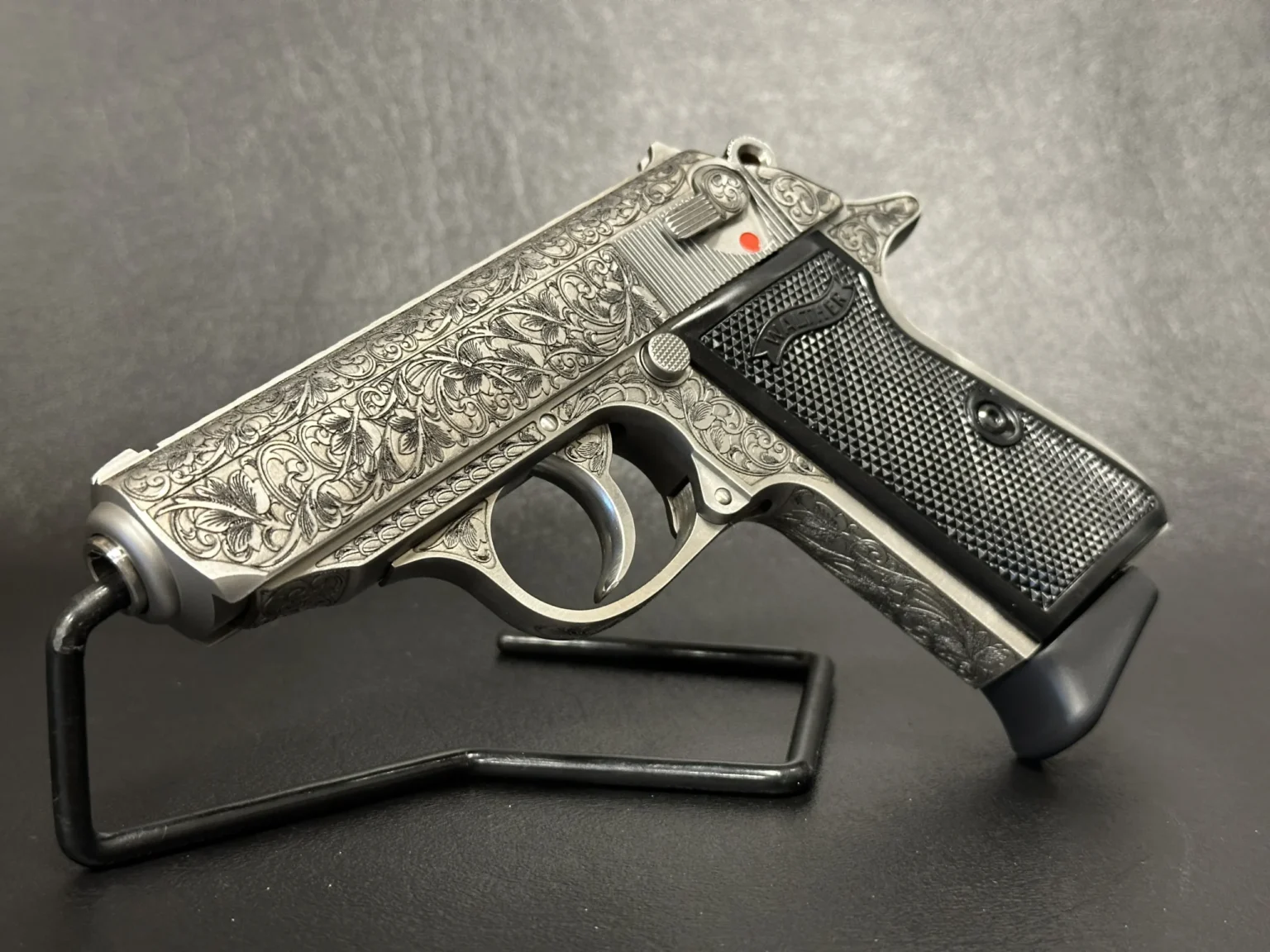
Carl Walther introduced the double-action PP in 1929 and followed it with the shorter PPK in 1931.[3] In these pistols, a long initial trigger pull could cock and release the hammer. After the first shot, slide movement cocked the hammer for subsequent single-action fire.
The arrangement was important because it offered an alternative to carrying a conventional single-action pistol with its hammer already cocked. It did not make the PP or PPK inherently safe under every circumstance; safe handling still depended on the pistol’s condition, mechanical operation, and the user’s conduct.
Walther subsequently developed the P38 as a German military service pistol. The design incorporated a double-action first shot and a safety-decocking system. It became the intended successor to the Luger-pattern P08, and wartime demand led to production by Walther, Mauser, and Spreewerk.[3]
Those multiple manufacturers and changing production conditions created distinct collecting categories. A P38’s maker code, production period, military acceptance marks, serial numbers, finish, and components can materially affect its historical interpretation. The model name alone is insufficient.
The PPK acquired an additional cultural identity through James Bond. In the 1962 film Dr. No, Bond is issued a 7.65 mm Walther PPK.[4] That association contributed to the pistol’s recognition beyond firearms circles, but it does not establish the rarity or value of any surviving example.
Firearms Industry Under National Socialism
Any account of German industrial achievement during the Second World War requires historical discipline. Technical accomplishment should not be confused with approval of the regime that commissioned or used the equipment.
German manufacturers operated within the political and economic system of Nazi Germany. ZEISS’s institutional history states that the company’s precision instruments were incorporated into weapon systems under the regime’s control and acknowledges the use of forced labor during the war.[5]
This context matters to collectors and historians. Military firearms are evidence of manufacturing and design, but they are also artifacts of the governments, institutions, and conflicts that produced them. Responsible collecting preserves both dimensions.
Heckler & Koch and Postwar Development
Heckler & Koch was founded in Oberndorf am Neckar in 1949.[6] The company subsequently became closely associated with roller-delayed blowback firearms, including the G3 rifle and MP5 submachine gun.
The MP5 is chambered in 9×19 mm and uses a roller-delayed blowback action. Factory specifications identify semiautomatic, fully automatic, and three-round-burst configurations within the broader product family.[7] The rollers delay the opening of the bolt after firing; they do not create a conventional locked-breech connection between the bolt and barrel.
No responsible account should describe the MP5, or any firearm, as incapable of malfunction. Ammunition, magazines, component wear, fouling, damage, and maintenance can affect every mechanical system. The MP5’s historical importance instead rests on the continued professional use and development of its basic operating system over several decades.
Heckler & Koch followed a different technical path with the HK416. Development began in 2002, initially under the designation “HK M4,” and series production commenced in 2004.[8] The HK416 retains the general layout associated with the M16 and M4 family while employing an indirect gas-operated system and a locked rotating bolt.[9]
The HK416 is therefore not simply an updated MP5 or G3. It represents a separate operating approach applied to an established rifle format. Its development illustrates how German manufacturers have combined existing platforms with revised mechanical systems rather than always beginning with a completely new design.
Korth and Small-Scale Revolver Production
Willi Korth began developing a revolver during the mid-1960s. The present manufacturer describes its production philosophy in terms of selected materials, individual fitting, modern machinery, and extensive handwork. The company has continued under Martin Rothmann’s direction since 2008.[10]
These are manufacturer statements and should be treated as descriptions of Korth’s intended production standards, not as independent proof that every Korth revolver is mechanically superior or especially valuable.
A collectible Korth must still be evaluated according to its exact model, serial number, configuration, mechanical condition, finish, accessories, factory documentation, and provenance. Reputation cannot replace inspection.
German Optics and the Complete Shooting System
German influence on firearms also extends to optical sights. ZEISS records that it built early riflescopes based on the Beaulieu-Marconnay design in 1892. The company produced variable-magnification military riflescopes in 1907 and introduced variable-magnification hunting scopes in 1922.[11]
These developments matter because a rifle and its sighting equipment operate as a system. Magnification, optical clarity, mechanical adjustment, mounting integrity, and repeatability can materially affect practical performance.
Optics can also be historically important in their own right. A period-correct scope, mount, case, or accessory may help document the original purpose and configuration of a rifle. Conversely, a later scope or altered mounting system may show that the firearm was modified after leaving the factory.
The Collector’s Standard: Evidence Before Reputation
A collectible German firearm should be evaluated as an individual historical object. The manufacturer and model establish a general category, but the physical evidence determines what the particular firearm is.
Relevant evidence may include:
- Manufacturer, proof, and military acceptance markings
- Serial numbers on the receiver and major components
- Caliber and chamber markings
- Stock, grip, barrel, sight, and safety configuration
- Evidence of refinishing, rebuilding, or replacement parts
- Period accessories and packaging
- Factory records, invoices, inventories, or official correspondence
- Documented ownership history
Factory archives can be especially valuable, but they are rarely complete. ZEISS, for example, maintains historical production and supply lists for portions of its output. Depending on the record series, those documents may include serial numbers, recipients, equipment, and delivery dates.[12] The absence of a surviving record does not prove that an item is false; it means the claimed history remains unconfirmed by that archive.
In the United States, federal “curio or relic” status must also be understood correctly. The Bureau of Alcohol, Tobacco, Firearms and Explosives generally recognizes firearms at least 50 years old, in their original configuration, as curios or relics. Other firearms may qualify because of museum interest, rarity, novelty, or association with a historical person, period, or event.[13]
Curio-or-relic classification is a legal designation. It is not a certificate of authenticity, originality, condition, or investment value.
The best collecting decisions follow a simple rule: reputation creates interest, but evidence establishes identity. A Mauser, Walther, Heckler & Koch, Korth, or period German optic may be historically important, but the strength of the individual object depends on what can be demonstrated, not on what a seller, owner, or repeated online account claims.
Frequently Asked Questions
Introduced in 1898, the Model 98 became an influential bolt-action rifle system. The U.S. Model 1903 Springfield was based on the German Mauser action.
Walther introduced the PP in 1929 and the shorter PPK in 1931. Both employed a double-action first-shot system.
The MP5 uses a roller-delayed blowback action. Its rollers delay bolt opening rather than creating a conventional locked breech.
ZEISS produced early riflescopes in the nineteenth century and later developed variable-magnification models. Period-correct optics and mounts can help document a rifle’s historical configuration.
Collectors should examine markings, serial numbers, configuration, condition, alterations, and supporting records. Manufacturer reputation alone does not establish authenticity, originality, or value.
Sources
- Mauser, “125 Years of MAUSER 98: The Secret Mauser Formula”.
- National Park Service, Springfield Armory National Historic Site, “The 1903 Springfield Rifle”.
- Carl Walther, “Company—The First Century”.
- EON Productions, “Dr. No”.
- ZEISS, “History: Journey Through the Evolution of Optics”.
- Heckler & Koch, “Heckler & Koch Celebrates 75th Anniversary”.
- Heckler & Koch, “MP5”.
- Marc Roth, “G95k—The New Standard Assault Rifle of the Bundeswehr Special Forces”.
- Heckler & Koch, “HK416”.
- Korth, “About Us”.
- ZEISS, “Riflescopes—How It All Began”.
- ZEISS Archives, “Historical Production and Supply Lists”.
- Bureau of Alcohol, Tobacco, Firearms and Explosives, “Curios & Relics”.