

Key Takeaways
- A famous model name does not automatically make an individual firearm rare or collectible.
- Serial numbers, markings, components, condition, and provenance should be evaluated together.
- Military originals, commercial versions, and later reproductions may belong to entirely different collecting categories.
A serious firearm collection is not defined by a universal checklist. Collectors differ in focus, while individual firearms vary substantially in originality, condition, provenance, and historical importance. The following designs are reference points for understanding major developments in military, sporting, and civilian firearms, not ranked acquisition or investment recommendations.
1. Colt Model 1911
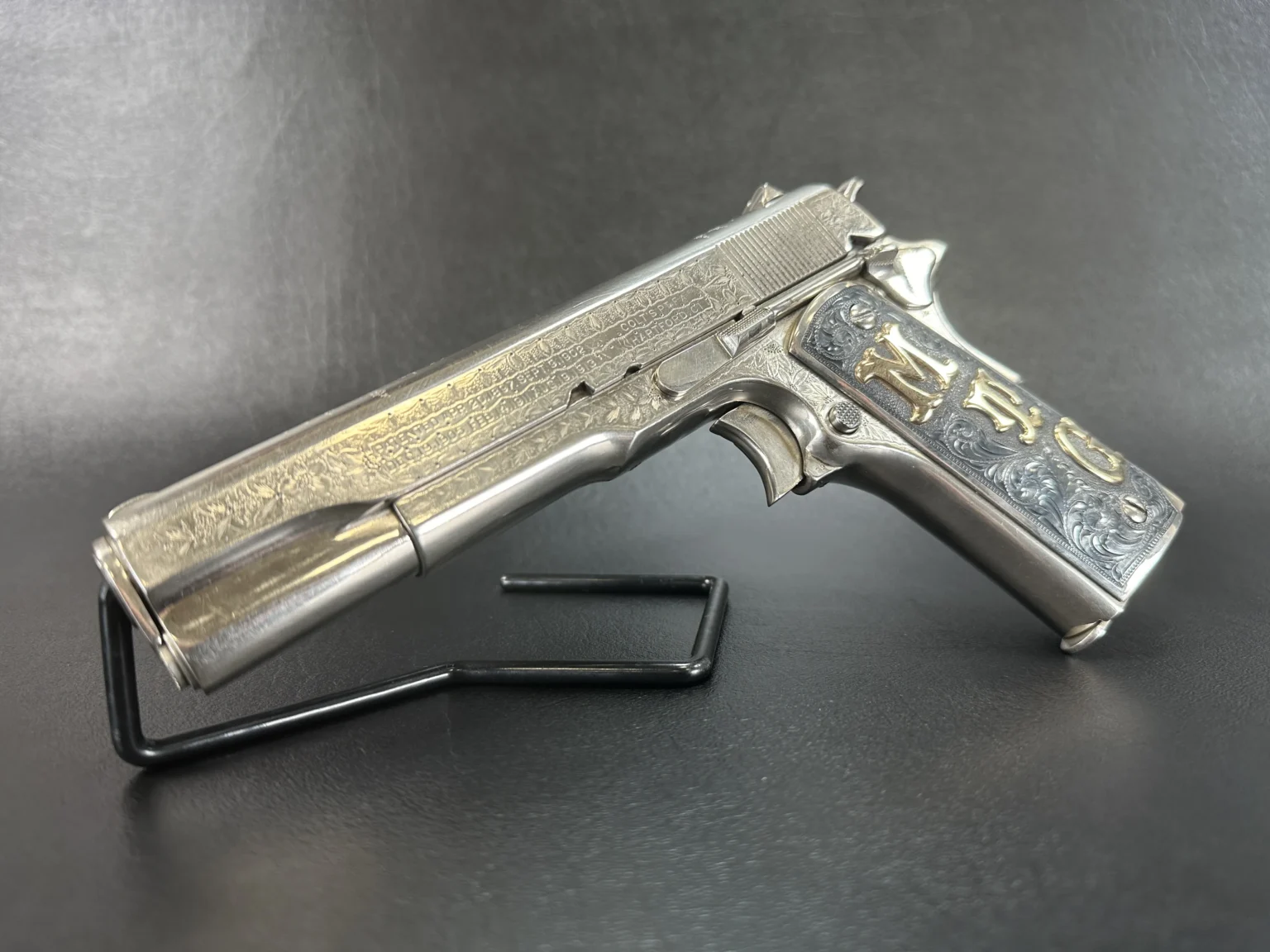
Designed by John M. Browning, the Model 1911 was adopted as the standard U.S. military sidearm in 1911. Colt expanded production during World War I, and Colt and other manufacturers produced approximately 1.8 million M1911A1 pistols during World War II.[1]
For collectors, “1911” identifies a design family rather than a single uniform firearm. Manufacturer, serial range, inspection and acceptance marks, finish, arsenal alterations, and component consistency must all be examined. A documented military pistol and a later commercial 1911 may share the same basic mechanism while occupying entirely different collecting categories.
2. Remington Model 870
Remington introduced the Model 870 Wingmaster in January 1950 as a successor to the Model 31. The design team included L. Ray Crittendon, Phillip Haskell, Ellis Hailston, and G. E. Pinckney. The initial line comprised 15 sporting and law-enforcement configurations in 12, 16, and 20 gauge; 28-gauge and .410-bore versions followed in 1969.[2]
The 870’s numerous field, trap, skeet, police, military, commemorative, and premium-grade variants make it a collecting field in its own right. Early production, scarce grades, documented institutional use, and factory-original special configurations deserve closer examination than ordinary field guns.
3. Kalashnikov AKM
The AKM was developed from the earlier AK-47 and entered service in 1959. It is a gas-operated, selective-fire rifle chambered for the 7.62×39mm M1943 cartridge and normally fed from a 30-round detachable magazine. Its pressed receiver, external rivets, and commonly encountered slant muzzle compensator help distinguish it from earlier AK-47 production.[3]
Collectors should not use “AK-47” as a generic label for every Kalashnikov-pattern firearm. Russian AKM and AKMS rifles, Chinese Type 56 variants, East German MPiKM rifles, Polish PMKM rifles, Romanian production, Yugoslav or Serbian M70 rifles, and commercial semiautomatic derivatives are separate identification categories.[3]
Country of manufacture, arsenal markings, receiver construction, selector markings, serial number, configuration, and import history are essential. Superficial resemblance alone does not establish a firearm’s national origin or military provenance.
4. Glock 19
Glock’s polymer-framed service-pistol system emerged in the early 1980s and was accepted by the Austrian military in 1983. Glock opened its U.S. headquarters in Smyrna, Georgia, in 1985.[4]
The Glock 19 is the compact 9×19mm member of that family. Glock lists a standard 15-round magazine and a 4.02-inch barrel for current production, although features and dimensions vary by generation and configuration.[5]
Most Glock 19 pistols are working firearms rather than established rarities. Early-generation examples, documented agency-issued pistols, unusual factory configurations, and limited editions are more plausible areas of collector interest. Generation, proof marks, factory labels, original magazines, packaging, and accessories should be evaluated together.
5. Winchester Model 70
Winchester began Model 70 production in 1936. The company identifies it as its first centerfire bolt-action rifle designed specifically for sporting use and records the early adoption of the name “The Rifleman’s Rifle.”[6]
The original design was discontinued after 1963, followed by a revised Model 70 in 1964. Winchester restored a controlled-round-feed action with claw extraction to parts of the line in 1994.[7] These production changes make period and configuration central to valuation and historical interpretation.
“Pre-’64” is useful shorthand, but it is not a complete assessment. Chambering, grade, barrel markings, stock configuration, serial number, finish, and alterations must also be considered.
6. Ruger 10/22
Ruger’s records place the beginning of 10/22 production in 1964 and identify the rifle’s chambering as .22 Long Rifle.[8] Its long production history has produced numerous factory configurations and an extensive aftermarket.
Originality is consequently important. Early carbines, uncommon factory variants, commemoratives, and complete examples retaining their boxes and accessories may be more historically interesting than extensively modified rifles.
Ruger cautions that its serial-number table provides approximate shipment periods. Firearms were not necessarily manufactured or shipped in strict numerical order, so a serial number alone does not prove an exact production date.[8]
7. AR-15
The AR-15 emerged from Eugene Stoner’s work at ArmaLite. A Colt ArmaLite Model 01 in the Smithsonian’s National Museum of American History is recorded as a .223-caliber rifle made by Colt in 1960, with Stoner identified as the licensee.[9]
Colt acquired exclusive manufacturing and marketing rights to the AR-15 from ArmaLite in 1961 and received its first major U.S. government contract for M16 rifles in 1963.[1]
Collectors must distinguish early ArmaLite development, Colt military production, Colt commercial rifles, and later AR-pattern firearms. “AR-15” and “M16” are not interchangeable descriptions. Maker, receiver markings, serial range, fire-control configuration, barrel features, and period-correct components require individual verification.
8. M1 Garand
John C. Garand, chief civilian engineer at Springfield Armory, developed the semiautomatic .30-caliber rifle adopted by the U.S. Army in 1936. The gas-operated M1 used an eight-round clip and fired substantially faster than the Army’s preceding standard-issue bolt-action rifle.[10]
The National Park Service records that Springfield Armory M1 serial number 87 was the first production-line rifle to pass function firing, on July 21, 1937. Its Springfield Armory collection also documents experimental carbines, selective-fire developments, sniper variants, and other departures from the standard service rifle.[11]
For collectors, a receiver’s manufacturer and serial number are only the beginning. Barrel date, drawing numbers, inspection marks, stock cartouches, finish, and evidence of arsenal work must be evaluated together. A genuine service rifle assembled with replacement components remains historically legitimate, but it should not be described as an untouched original example without supporting evidence.
9. Mossberg Model 500
Mossberg introduced the Model 500 pump-action shotgun in 1961. The company reports that it became its most successful firearm and eventually surpassed 10 million units. The Model 500 also formed the basis for later military-oriented 500, 590, and 590A1 shotguns.[12]
As with the Remington 870, ordinary sporting versions are common. Early production, scarce factory packages, documented law-enforcement or military use, and unusual original configurations may carry greater collector interest.
Receiver markings, barrel and magazine-tube configuration, stock type, safety arrangement, and documentary history should be checked carefully. Military-style features do not, by themselves, prove military issue.
10. Smith & Wesson M&P Shield
Smith & Wesson introduced the original M&P Shield on April 12, 2012. The first models were slim, polymer-framed pistols offered in 9mm and .40 S&W with 3.1-inch barrels. The 9mm version used seven- or eight-round magazines; the .40 S&W version used six- or seven-round magazines.[13]
The Shield is historically relevant as an early, commercially successful example of the modern slim defensive-pistol category, but standard examples are not inherently rare. Early production, unusual factory variants, documented institutional use, and complete limited editions are more likely to attract specialized collector attention.
What Ultimately Matters
None of these models is automatically collectible simply because it is famous. Collectibility depends on the specific firearm.
Serial numbers should be checked against appropriate factory or archival records. Markings and components should correspond to the claimed period. Restoration, replacement parts, refinishing, and undocumented provenance should be recognized rather than ignored. A common firearm with documented history may be more significant than a supposedly rare example supported only by an appealing story.
Frequently Asked Questions
Collectibility generally depends on rarity, originality, condition, historical significance, and documented provenance. The model name alone is not enough.
No. Many standard examples are common, while particular production periods, variants, or documented firearms may be scarce.
No. Age can matter, but originality, condition, rarity, provenance, and collector demand are often more important.
A serial number may help establish an approximate production or shipment period, but it does not prove that every component is original. Factory records, markings, configuration, and physical evidence should also be examined.
No. The AKM was developed from the AK-47 and entered service in 1959, with identifiable differences that include its pressed receiver and external rivets.
Sources
- Colt’s Manufacturing Company, “Timeline”.
- American Rifleman, “The Remington 870: Greatest Pump Shotgun Ever Made?”, October 30, 2020; originally published as “Tops in the Blind & Field: The Remington 870,” September 2003.
- Small Arms Survey, with technical assistance from the National Firearms Centre, Royal Armouries, “Kalashnikov AKM (& Close Derivatives)”.
- Glock, “Glock: Commitment to Perfection—History”.
- Glock, “G19: Technical Data”.
- Winchester Repeating Arms, “Historical Timeline: 1900–1949”.
- Winchester Repeating Arms, “Historical Timeline”.
- Sturm, Ruger & Co., “10/22 Rifle Serial Number History”.
- Smithsonian Institution, National Museum of American History, “Colt ArmaLite AR-15 Model 01”.
- National Archives and Records Administration, “John C. Garand and the M-1”.
- National Park Service, Springfield Armory National Historic Site, “M1 Rifle Variations and Experimental Models”.
- O.F. Mossberg & Sons, “Mossberg at 100”.
- Smith & Wesson, “Smith & Wesson Unveils New M&P Shield Pistol”.

One Response
Always wanted a Garand. Ended up with a Mauser K98- fo figure. The rest of the list
matches.