
Key Takeaways:
- A box should match the firearm’s manufacturer, model, configuration, serial number, and production period before being treated as original.
- Factory letters may verify recorded configuration and shipping information, but they generally do not authenticate standard packaging or establish a complete ownership history.
- Preserve boxes and paperwork in a cool, dry, stable environment without tape, glue, rubber bands, direct sunlight, or unnecessary alterations.
Original packaging can strengthen the appeal of a collectible firearm, but only when the box is authentic, appropriate to the production period, and credibly associated with the gun. A box is not automatically valuable simply because it is old, and there is no reliable percentage that can be applied across the market.
The effect depends on the firearm, the packaging, and the evidence connecting them.
Why Completeness Matters
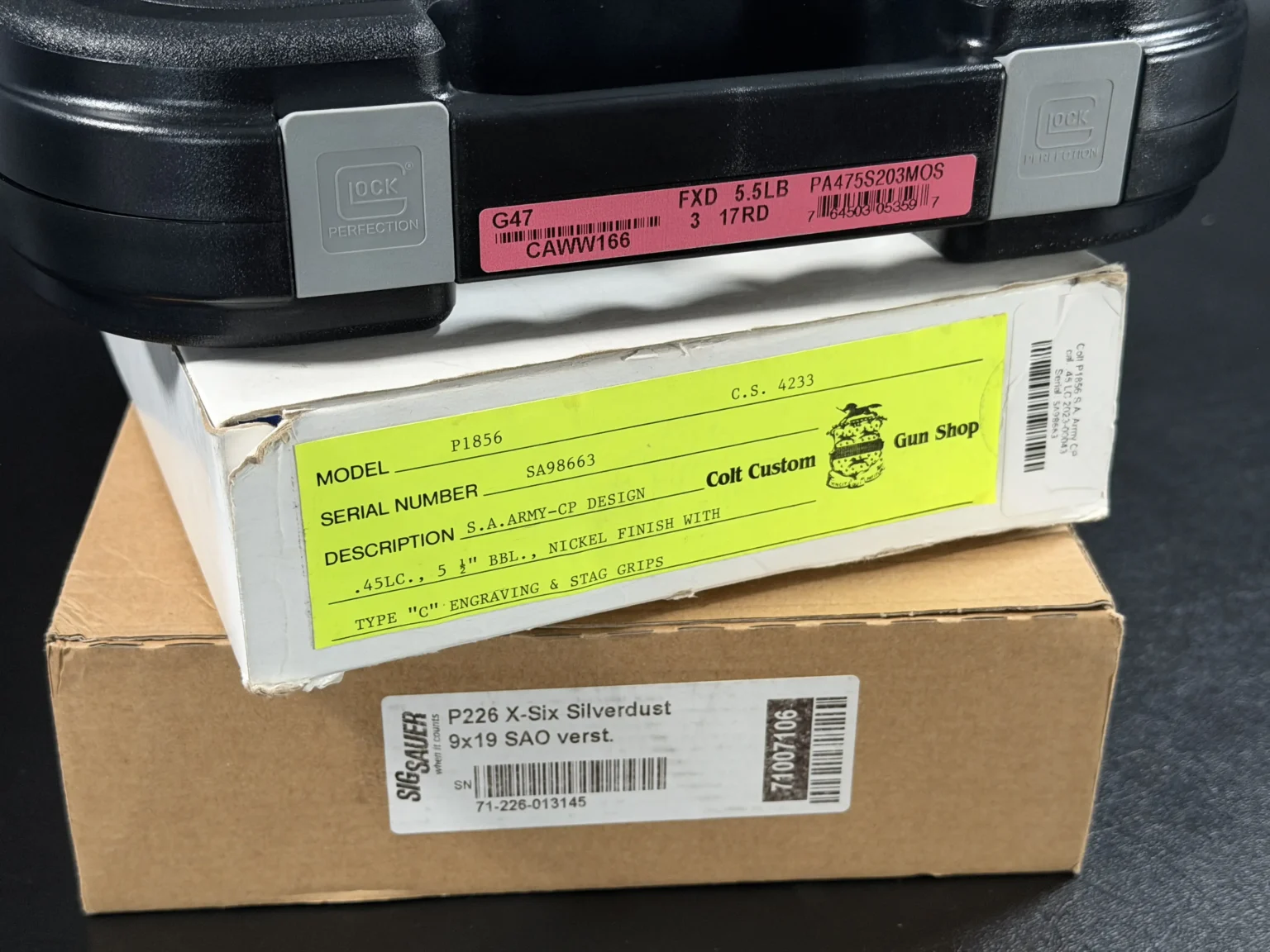
Boxes, labels, manuals, tools, test targets, and other factory-supplied materials can preserve information that is no longer apparent from the firearm alone. A surviving label may identify the model, caliber, barrel length, finish, or serial number. Instructions and accessories can also help establish how the manufacturer originally delivered and presented the firearm.
For established collecting categories, completeness may be important to top-tier value. In an examination of Second Generation Colt Single Action Army revolvers, American Rifleman states that an example positioned to command top value should ideally be unfired and accompanied by its original box and factory papers.[1]
That principle should not be converted into a universal pricing formula. The importance of packaging varies by manufacturer, model, production period, condition, and collector demand.
The Box Must Be Correct
A serial-numbered box that matches the firearm is generally more significant than an unnumbered period box. Even then, matching numbers are evidence of association rather than conclusive proof. Labels can be replaced or reproduced, and an authentic period box can be paired with a different firearm years later.
Period correctness is therefore essential. Colt used several box styles during Second Generation Single Action Army production. According to American Rifleman, black boxes were used from 1955 through 1964, stagecoach boxes from 1965 through 1973, and wood-grain boxes beginning in 1973. The publication also warns that reproduction boxes exist and emphasizes that the right box must accompany the right firearm.[1]
A genuine Colt box from the wrong period may remain collectible in its own right, but it should not be described as original to a firearm it could not have accompanied.
Collectors should compare:
- The firearm’s serial number with every number on the box and label.
- The model, caliber, barrel length, and finish with the label description.
- The box style and construction with documented examples from the applicable period.
- The interior insert with the firearm’s frame and barrel configuration.
- The included manuals and accessories with the model and production era.
Inconsistencies do not always prove fraud. Boxes may have been replaced by dealers, damaged during shipment, or separated from their original firearms. They do, however, require explanation before the packaging can be treated as original.
Factory Letters: Useful but Limited
A factory letter can provide evidence about a firearm’s original configuration and shipment. Colt Archive Properties states that its letters may report the original caliber, barrel length, finish, stocks, custom features, shipping date, and shipping destination.[2]
This information can help determine whether a firearm remains consistent with the surviving factory record. It may also reveal later changes to the barrel, caliber, finish, grips, or embellishment.
A Colt letter does not authenticate ordinary packaging. Colt expressly states that its records do not document standard boxes, box labels, or included paperwork. The company also notes that its archive letters generally do not trace later owners.[2] A letter may verify the firearm’s recorded configuration without proving that a particular box has remained with it since shipment.
Record coverage also varies. The Cody Firearms Records Office reports that early surviving Winchester records may contain configuration details such as caliber, barrel type, trigger type, and special-order features. Many later Winchester records contain only serial-number application or manufacturing information. Winchester Model 21 records are a notable exception because final-inspection records and, in some cases, original order sheets survive.[3]
Before ordering a factory letter, collectors should confirm that records exist for the relevant manufacturer, model, and serial-number range.
Assessing Authenticity and Condition
Packaging should be examined as a separate collectible artifact. Important considerations include:
- Correct typography, colors, graphics, and label layout.
- Appropriate cardboard, printing, adhesive, and construction.
- Evidence that a label has been removed, altered, or replaced.
- Consistency between the box’s wear and its claimed history.
- Presence and condition of original inserts, wrapping, and paperwork.
- Documentation connecting the firearm and packaging before the current sale.
Wear does not prove authenticity. A genuine box can survive in excellent condition, while a reproduction can be artificially aged. Authentication should depend on documented period characteristics rather than appearance alone.
Condition also affects usefulness. A readable, undisturbed label can provide more identifying evidence than one that is missing or badly damaged. Original inserts and intact paperwork generally make the package more complete, but replacement components should be identified as replacements.
Preserving Boxes and Paperwork
Historic packaging is vulnerable to moisture, unstable temperatures, light, adhesives, and improper handling. The Library of Congress recommends keeping paper artifacts in a cool, relatively dry, clean, and stable environment. It specifically advises avoiding attics, basements, direct or intense light, rubber bands, pressure-sensitive tape, and glue.[4]
Boxes should be supported rather than compressed. Loose manuals, targets, receipts, and letters can be stored in properly sized archival enclosures. Fragile packaging may be placed inside a larger acid- and lignin-free storage container, provided that the original box is not altered in the process.
Collectors should not tape torn corners, replace labels, write additional information on original packaging, or attempt cosmetic restoration without qualified conservation advice. A well-intentioned repair can remove historical evidence and create doubts about authenticity.
Photograph the firearm, box, label, and accessories individually and together. Record all identifying numbers and retain invoices, prior catalog descriptions, factory letters, and correspondence. These records help preserve the association if the components are later stored separately.
The Practical Standard
Keep every original item supplied with a collectible firearm, but evaluate each component critically. The strongest package combines:
- A firearm consistent with its recorded configuration.
- Packaging appropriate to the production period.
- Matching identifying information.
- Correct manuals, inserts, and accessories.
- A credible history connecting the components.
- Clear disclosure of replacements, reproductions, and uncertainties.
An original box is not a substitute for provenance, nor does a factory letter prove that a box belongs to a firearm. When the physical evidence, period references, and surviving factory records agree, however, the complete package can offer collectors a better-documented and more historically informative artifact.
Frequently Asked Questions
It can improve collector appeal, but there is no reliable percentage that applies to every firearm. The effect depends on authenticity, correctness, condition, completeness, and demand.
No. A matching number is useful evidence, but labels can be replaced, altered, or reproduced.
Generally, no. A factory letter may verify recorded configuration and shipping details, but standard packaging information is often absent from surviving records.
Compare its serial number, model information, construction, label, interior, and accessories with the firearm and documented examples from the correct period.
Keep them in a cool, relatively dry, clean, and stable environment with minimal light exposure. Avoid attics, basements, tape, glue, rubber bands, and permanent markings.
Sources
- Rick Hacker, “Collecting Second Generation Colt Single Action Army Revolvers,” American Rifleman, December 5, 2022.
- Colt Archive Properties, “About the Archive Letter”.
- Buffalo Bill Center of the West, Cody Firearms Records Office, “Winchester Factory Records”.
- Library of Congress, Preservation Directorate, “Care, Handling, and Storage of Works on Paper”.