
Key Takeaways:
- “Prototype” is a historical claim that requires supporting physical and documentary evidence.
- Factory records and provenance can establish identity, but each document proves only the information it contains.
- No universal prototype premium exists; every firearm must be valued according to its evidence, condition, significance, and market demand.
Prototype firearms can command substantial prices, but there is no reliable formula for calculating a “prototype premium.” Each example must be evaluated individually. Authentication, historical importance, provenance, originality, condition and collector demand matter more than the prototype label itself.
“Prototype” Is a Claim, Not a Guarantee
The word “prototype” is often used broadly. It may refer to a firearm built during development, an arm submitted for official testing, a pre-production example or an experimental modification of an existing design. Those categories are not interchangeable.
Markings such as “prototype,” “experimental” or “test” are not conclusive by themselves. A credible attribution should be supported by physical characteristics and records created by the manufacturer, designer, government agency or testing institution.
Without that evidence, an unusual firearm may be impossible to distinguish from a privately modified production model.
Documentation Comes First
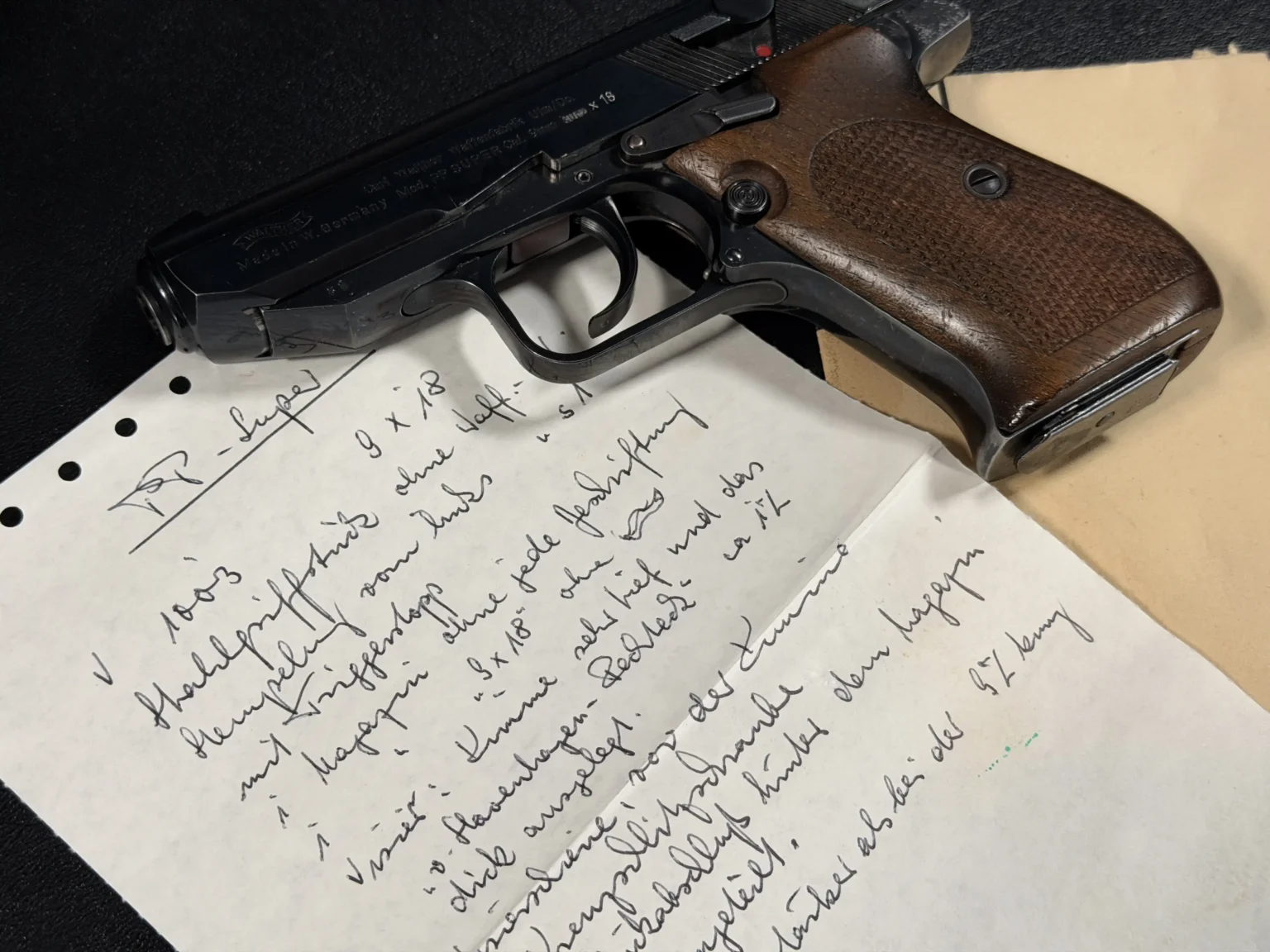
The best evidence identifies the individual firearm through a serial number, experimental designation, photograph or distinctive physical feature. Useful records may include factory ledgers, engineering drawings, test reports, correspondence, inspection documents and government inventories.
Factory letters can confirm important details, but their limitations must be understood. Colt states that its archive letters report surviving information about a firearm’s original specifications and delivery. The company also cautions that the information available varies by firearm.[1]
The Cody Firearms Records Office makes a similar distinction. Some surviving Winchester records contain configuration details such as caliber, barrel type, trigger type and special-order features. Other records provide only the date on which a serial number was applied.[2]
A factory letter therefore proves only what the underlying record establishes. A shipping record does not automatically demonstrate that a firearm was a developmental prototype. Conversely, a missing entry does not conclusively disprove prototype status if the relevant experimental records were kept separately or did not survive.
Provenance Must Connect to the Firearm
Provenance is more than a list of previous owners. It is the documented chain connecting a particular firearm to its claimed history.
Strong provenance should establish:
- Who possessed the firearm.
- When that person or institution possessed it.
- How the firearm passed to its next owner.
- What evidence identifies the same firearm at each stage.
The NRA National Firearms Museum’s valuation guidance notes that historically attributed firearms depend heavily on the quality of the documentation supporting the attribution.[3] This is especially important when a claimed association with a designer, military trial or historical figure accounts for much of the firearm’s value.
An old label, family story or auction description may offer a useful lead, but it is not equivalent to contemporary correspondence, institutional records or photographs identifying the firearm.
Historical Importance and Collector Demand
Rarity alone does not determine value. A firearm may be unique and still attract limited interest. Scarcity creates the possibility of competition, but the final price depends on whether collectors value the manufacturer, designer or historical event represented by the firearm.
A prototype associated with an influential military program may appeal to several collecting communities. An equally scarce workshop experiment from an obscure commercial project may have a much smaller market.
John D. Pedersen’s experimental semiautomatic rifle provides a well-documented example of historical significance. The U.S. Army contracted with Pedersen to develop a rifle in competition with John Garand’s design. According to Springfield Armory National Historic Site, Pedersen presented his delayed-blowback T1 rifle in 1924. The .276-caliber rifle used a toggle mechanism and a 10-round charger. An Army service board recommended it for adoption in April 1928, but it did not prevail against Garand’s rifle in subsequent testing.[4]
The importance of a surviving Pedersen rifle would therefore rest on more than scarcity. Its value would also depend on which experimental model it is, whether its role in the program can be documented, and how much of its original test configuration remains.
Condition and Originality Still Count
Prototype status does not eliminate conventional standards of condition. The NRA’s published guidance explains that condition can materially affect the value of a collectible firearm, particularly among high-condition examples.[5]
Prototype wear must, however, be interpreted carefully. Test firing, hand fitting and period engineering alterations may be legitimate evidence of development. A documented modification made during testing can be historically important, while an undocumented modern repair may reduce confidence and value.
Refinishing can be especially damaging. Polishing, remarking and replacement parts may remove or obscure evidence needed for authentication. The NRA Museum has also warned that ordinary firearms can be altered into more valuable configurations through changes to barrels, finishes, grips, stocks and calibers.[6]
A potentially significant prototype should therefore be examined before restoration, aggressive cleaning or mechanical work is undertaken.
Why Auction Comparisons Can Mislead
Production firearms often have numerous comparable sales. Genuine prototypes rarely do. Two experimental firearms from the same program may represent different stages of development, retain different amounts of original material and have entirely different documentation.
An auction result records what bidders paid for one object under one set of circumstances. It does not establish a standard premium for every firearm carrying the same model name or prototype designation.
Comparing a documented prototype with the average price of a broad production category may produce a dramatic ratio, but the result is rarely a defensible valuation. The comparison may ignore differences in date, condition, originality, provenance and historical importance.
A Practical Standard for Buyers
Before purchasing a purported prototype, a collector should require:
- Precise identification of the firearm and its developmental role.
- Detailed photographs and an in-person examination.
- Copies of the records supporting prototype status.
- A provenance chronology separating documented facts from later attribution.
- Confirmation that markings and physical features correspond with the records.
- Disclosure of restoration, replacement parts and later modifications.
- Comparisons limited to firearms with genuinely similar documentation and significance.
- Independent review by a specialist without a financial interest in the transaction.
The essential rule is simple: pay for evidence, not terminology. “Prototype” can describe an important artifact of firearms development, but the word creates no value by itself. The premium belongs to the firearm whose identity, history, and originality can withstand serious examination.
Frequently Asked Questions
A prototype is generally associated with the development or testing of a firearm design. Its precise role should be established through reliable records and consistent physical evidence.
No. Value depends on authentication, provenance, originality, condition, historical importance, and collector demand, not rarity alone.
Not necessarily. A factory letter proves only the information contained in the surviving manufacturer records.
Provenance connects a specific firearm to its claimed development, testing, or ownership history. Weak or incomplete provenance increases uncertainty and may reduce buyer confidence.
Yes. Refinishing, replacement parts, or undocumented repairs may remove evidence needed to authenticate the firearm and assess its originality.
Sources
- Colt’s Manufacturing Company, “Archive Services”.
- Buffalo Bill Center of the West, Cody Firearms Records Office, “Winchester Factory Records”.
- Jim Supica, NRA National Firearms Museum, “Hard-to-Identify or Value Firearms”.
- National Park Service, Springfield Armory National Historic Site, “Experimental Semi-Automatic Rifle by John Pedersen, 1919–1931”.
- Jim Supica, NRA National Firearms Museum, “Evaluating Firearms Condition”.
- Jim Supica, NRA National Firearms Museum, “Fake!”.