
Key Takeaways
- The Korth Classic is a modern continuation of Willi Korth’s revolver tradition, not the company’s original 1954 model.
- Korth developed its centerfire revolvers during the 1960s and later offered Combat, Sport, and Target configurations.
- Korth manufactures its revolvers in Germany, while Nighthawk Custom serves as the company’s exclusive United States distributor.
The history of the Korth Classic begins not with a single model, but with Willi Korth’s pursuit of a refined German revolver. Korth established his gunmaking business in 1954 and initially produced blank- and gas-firing revolvers. His first cartridge-firing revolvers followed about a decade later.[1] The “Classic” name belongs to the modern continuation of that broader design tradition rather than to Korth’s earliest production.
Willi Korth began developing his centerfire revolver during the 1960s. The design combined double-action operation with extensive machining, fitting, and finishing. Korth revolvers were not intended for high-volume production; they occupied a specialized market defined by craftsmanship and mechanical refinement. The company’s official history identifies the mid-1960s as the formative period for Willi Korth’s revolver design.[2]
By the late 1960s, Korth was producing centerfire revolvers in configurations that established the basic pattern associated with the marque. A published historical survey records five-shot .38 Special and .357 Magnum revolvers made from 1966 through 1968. Later Korth Combat revolvers used six-shot cylinders and were offered in several chamberings, including .22 LR, .22 WMR, .32 S&W Long, .38 Special, and .357 Magnum.[3]
Korth subsequently developed Combat, Sport, and Target configurations. Barrel lengths, sights, grips, and chamberings varied according to their intended purposes. Published documentation from the early 2000s describes Combat revolvers with 3- and 4-inch barrels, along with Sport and Target models fitted with 5¼- or 6-inch barrels. The same account records interchangeable 9mm Luger cylinders for certain .357 Magnum revolvers.[3]
These distinctions matter because the Korth story is sometimes compressed into the inaccurate claim that the company’s original revolver was a .357 Magnum model called the Classic. The historical record instead shows a developing family of revolvers whose names, chamberings, and configurations changed over time. The contemporary Korth Classic draws upon that lineage, but it should not be treated as an unchanged model produced continuously since the 1950s.
Willi Korth died in 1982.[3] The company bearing his name continued under later ownership, and its revolver tradition survived changes in management and manufacturing location. Today, PTW KORTH Technologies GmbH produces Korth firearms in Lollar, Germany.[2]
Korth’s modern American presence is closely connected to Nighthawk Custom. Representatives of the companies met at the SHOT Show in January 2016, beginning a commercial relationship that brought Korth revolvers to a broader American market.[4] Nighthawk became Korth’s exclusive United States distributor, not the owner of Korth or the Classic design, and imports German-built revolvers carrying both companies’ marks.[1]
According to Nighthawk representative Mark Stone, the American company participates in decisions concerning design and cosmetic details. After importation, Nighthawk records each revolver, conducts a quality-control inspection, test-fires it, and supplies a signed test target before shipment.[4] Manufacturing, however, remains with Korth in Germany.
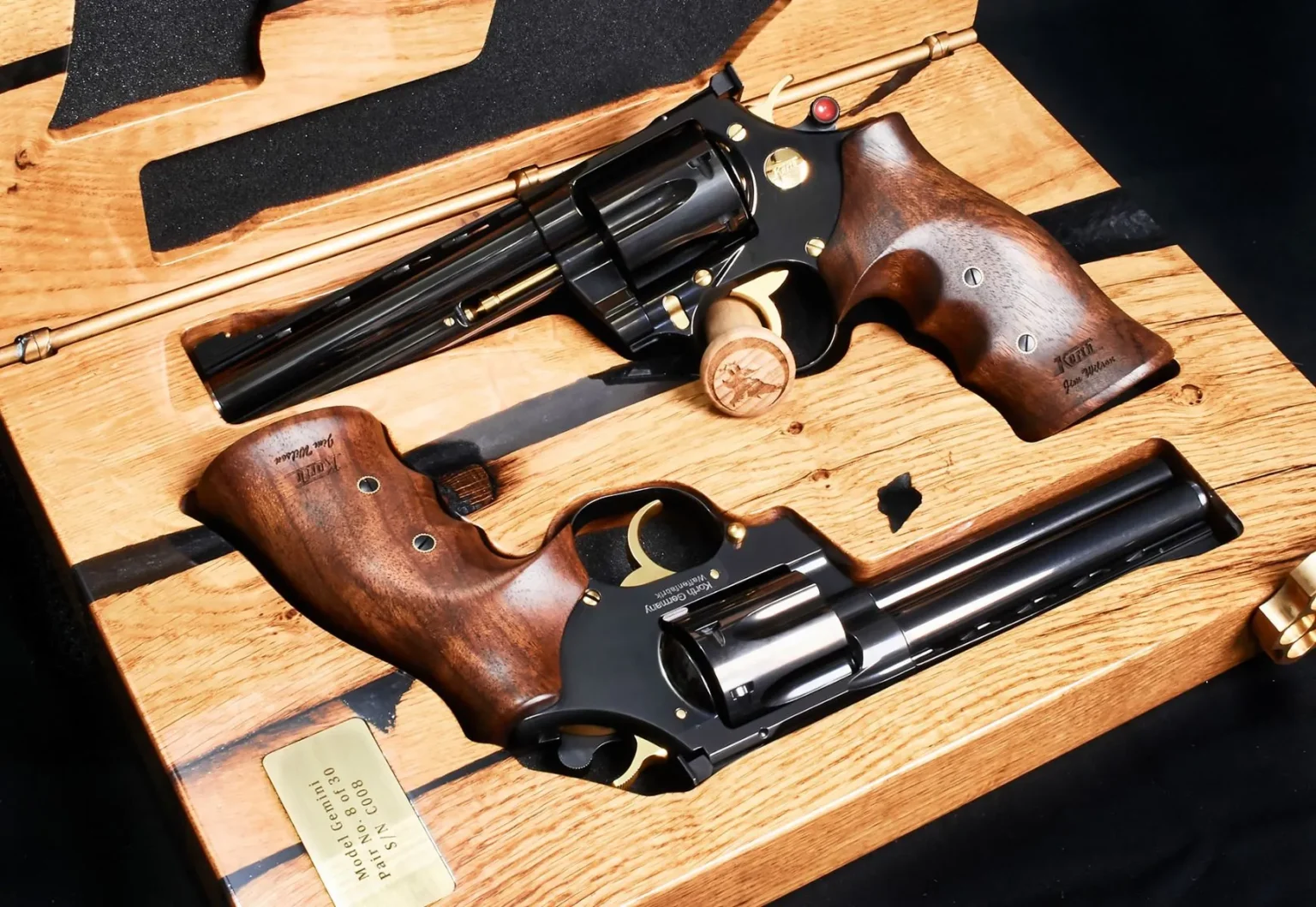
The Classic represents the traditional side of the current Korth range. Its restrained profile distinguishes it from newer models incorporating ventilated barrel shrouds, accessory rails, and overtly contemporary styling. Its identity remains tied to the established Korth pattern: double-action operation, carefully fitted components, a swing-out cylinder, and close attention to timing and alignment.
Korth’s historical importance rests less on production volume than on its labor-intensive manufacturing approach. A 2003 account in Gun Digest reported that approximately 70 percent of Korth revolver production involved manual operations, including component shaping and fitting, quality control, and final assembly.[3] That figure documents the manufacturing process at the time of publication; it should not automatically be applied to every period of Korth production.
For collectors, individual Korth revolvers must be evaluated through their markings, proof dates, serial numbers, configurations, condition, and surviving documentation. A model name alone cannot establish when a revolver was manufactured or whether its barrel, cylinder, grips, or finish are original. Physical examination and authenticated factory documentation remain more reliable than generalized production histories.
The Korth Classic is best understood as a modern expression of a revolver tradition established during the 1960s, not as the company’s original 1954 model. Its significance lies in preserving the proportions, mechanics, and hand-fitted character associated with Willi Korth’s work while continuing as a German-made revolver for contemporary collectors and shooters.
Frequently Asked Questions
Willi Korth established his gunmaking business in 1954. The company initially produced blank- and gas-firing revolvers before introducing cartridge-firing designs.
No. The Classic is a modern continuation of the revolver tradition Willi Korth developed during the 1960s.
Documented chamberings included .22 LR, .22 WMR, .32 S&W Long, .38 Special, and .357 Magnum. Certain .357 Magnum revolvers could also use a properly fitted interchangeable 9mm Luger cylinder.
No. Korth manufactures its revolvers in Germany, while Nighthawk imports, inspects, test-fires, and distributes them in the United States.
Collectors should examine its markings, proof date, serial number, configuration, condition, and documentation. A model name alone cannot establish production date or originality.
Sources
- American Rifleman Staff, “Review: Korth Carry Special,” American Rifleman, May 16, 2023.
- PTW KORTH Technologies GmbH, “About Us,” Korth Arms.
- Raymond Caranta, “The Guns of Europe,” Gun Digest, 57th ed., 2003, pp. 166–169.
- John Taffin, “Engineering Excellence Embraces Artistic Style,” American Handgunner.