
Key Takeaways
- Colt introduced the original Python in 1955, principally chambered for .357 Magnum and compatible with .38 Special ammunition.
- The modern Python, introduced in 2020, resembles the original but uses redesigned, strengthened and simplified internal components.
- Collectors should verify period-correct features, condition and factory documentation instead of relying solely on serial numbers or accessories.
Few postwar American revolvers are as readily identifiable as the Colt Python. Its ventilated barrel rib, full-length underlug and high-polish finish created a distinctive profile, but the Python’s historical importance rests on more than appearance. The original model represented Colt’s effort to build a premium target revolver using skilled hand fitting and finishing; the redesigned version applies modern manufacturing to the same basic concept.
Origins of the Python
Colt began shipping the Python from its Hartford, Connecticut, factory in June 1955. The project originated two years earlier, when Colt sales executive Bill Henry proposed a precision target revolver to factory superintendent Adalbert “Al” Gunther. Because no dedicated experimental budget was available, Colt personnel constructed the prototype from existing components and specially machined parts.[1]
The resulting revolver was a six-shot, double-action design built on Colt’s medium-size frame and chambered principally for .357 Magnum, while also accepting .38 Special ammunition. The original cataloged version had a 6-inch barrel. Colt subsequently expanded the range to include barrel lengths from 2½ to 8 inches.[1]
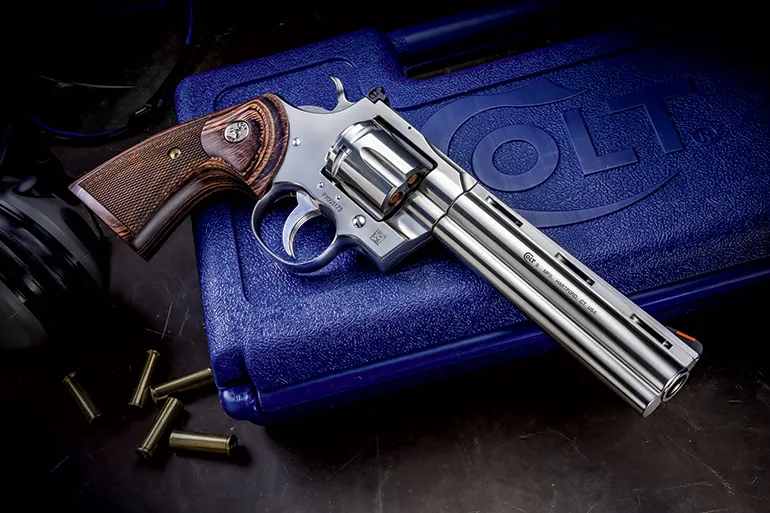
The Python’s barrel assembly established its visual identity. A ventilated rib ran along the top, while the full-length underlug enclosed the ejector rod and placed additional weight beneath the barrel. Adjustable rear sights and a ramp-style front sight reinforced the revolver’s intended role as a premium sporting and target arm.[1]
Construction and Mechanical Character
Original Pythons required substantial hand fitting and finishing. This labor-intensive construction contributed to their smooth actions, precise lockwork and polished appearance, but it also made them expensive to produce. Early revolvers were fitted with fully checkered American walnut stocks bearing gold-colored Rampant Colt medallions. Stock patterns, sights, finishes and other details changed during the model’s long production life.[1]
Colt offered the original Python in several finishes, including Colt Blue, Royal Blue, Bright Nickel, electroless-nickel treatments and stainless-steel variations. The company also produced engraved revolvers, commemoratives and limited editions through its Custom Shop.[1]
Most production Pythons were chambered for .357 Magnum and could also fire .38 Special. Colt additionally manufactured a Python Target variant chambered only for .38 Special. Although Colt advertised other chamberings and constructed experimental revolvers, these prototypes should not be confused with regular commercial production.[1]
The Python’s traditional Colt action was capable of an exceptionally smooth pull when properly fitted, but it was mechanically complex. Sustained use, particularly extensive double-action firing, could eventually affect cylinder timing. Correcting that condition requires a gunsmith familiar with Colt’s older double-action lockwork.[2]
The End of Original Production
Regular Python production diminished near the end of the twentieth century, with limited Custom Shop manufacture continuing afterward. The original production era concluded in 2005, approximately 50 years after the model’s introduction.[3]
That distinction matters to collectors. “Original Python” and “modern Python” describe mechanically different revolvers, even though they share the same name and recognizable external form. An original example should be evaluated according to its particular production period, configuration and documented history—not against generalized descriptions of the model.
The Redesigned Python
Colt reintroduced the Python in 2020. The new revolver preserved the ventilated rib, full underlug, six-round cylinder and broad proportions of the original, but its internal mechanism was redesigned for modern manufacture.[2]
The initial 2020 models were stainless-steel revolvers with 4.25- and 6-inch barrels. Colt’s manual identifies them as single- and double-action, six-shot revolvers chambered for .357 Magnum and suitable for .38 Special and .38 Special +P ammunition. The 4.25-inch model had a stated unloaded weight of 42 ounces, while the 6-inch model weighed 46 ounces. Both used six-groove rifling with a 1:14-inch left-hand twist.[4]
The redesigned action uses fewer and more substantial components than the original system, including a separate cylinder-stop mechanism. Colt also increased the amount of steel in the topstrap by approximately 30 percent and manufactured the barrel as a one-piece component. Modern production relies on computer-controlled machining rather than the extensive hand fitting associated with early Pythons.[2][5]
Colt initially produced the revived Python in stainless steel. In 2024, it added a blued carbon-steel version in 4.25- and 6-inch configurations. Although the finish recalls earlier Royal Blue revolvers, the current blued Python remains part of the redesigned mechanical family introduced in 2020.[5]
Evaluating a Collectible Python
For a vintage Python, condition is only one part of the assessment. Collectors should establish whether the barrel length, finish, stocks, sights and other features are correct for the firearm’s production period. Refinishing, replaced stocks, altered sights, mechanical work and non-factory engraving can materially change how an example is understood and valued.
A serial-number search may provide a general production date, but it does not necessarily establish the revolver’s original configuration. Colt Archive Services can research surviving factory records and issue a letter documenting information such as the original specifications and shipping destination when those records are available.[6]
Boxes, manuals and accessories require the same scrutiny as the firearm. Their presence does not prove that they originally accompanied a particular revolver. Serial-numbered packaging, period-correct labels and a documented chain of ownership provide stronger evidence than an unverified assertion that an accessory is “original.”
Auction prices should also be interpreted narrowly. They record what a specific buyer paid for a particular firearm at a particular sale; they do not establish a universal value. For example, a documented first-year Python bearing serial number 69 realized $34,500 at Rock Island Auction Company in December 2021. Its early production date and two-digit serial number made it materially different from an ordinary production example.[7]
The Colt Python’s collector appeal ultimately comes from a combination of recognizable design, changing factory configurations and two distinct manufacturing eras. The original is a product of Colt’s mid-century hand-fitting tradition. The modern Python is a redesigned revolver that preserves the earlier model’s appearance while using stronger, simplified lockwork and contemporary production methods. Understanding that distinction is the foundation of an accurate appraisal.
Colt began shipping the Python from its Hartford factory in June 1955.
The original production era concluded in 2005 after approximately 50 years.
No. The version introduced in 2020 preserves the original’s recognizable appearance but uses redesigned lockwork and modern manufacturing methods.
Colt’s 2020 manual specifies .357 Magnum, .38 Special, and .38 Special +P ammunition.
Collectors should assess the finish, barrel, stocks, sights, mechanical condition and supporting documentation. A Colt Archive Letter may confirm original specifications and shipping information when factory records survive.
Sources
- American Rifleman, “A Colt’s Python Primer,” June 18, 2018.
- Wiley Clapp, “Colt Python Review,” American Rifleman, March 23, 2020.
- American Rifleman, “Colt’s Pythons: Then & Now,” August 15, 2022.
- Colt’s Manufacturing Company, “2020 Python Operator’s Manual,” 2020.
- Kevin McPherson, “The Return of the Blued Python,” American Rifleman, August 26, 2024.
- Colt’s Manufacturing Company, “Archive Services.”
- Rock Island Auction Company, “Top 10 Most Expensive Colt Python Revolvers Ever Sold.”