
Key Takeaways:
- The Colt Single Action Army and M1911 are mechanically different firearms developed nearly four decades apart.
- The Single Action Army fires the .45 Colt revolver cartridge, while the M1911 was designed for the shorter, rimless .45 ACP cartridge.
- Reliable identification depends on physical characteristics, markings, serial numbers, configuration, and supporting documentation.
“Colt .45” is not a precise model designation. The name has been applied most often to two fundamentally different firearms: the Colt Single Action Army revolver chambered in .45 Colt and the M1911 semiautomatic pistol chambered in .45 ACP. Separated by nearly four decades, they share a manufacturer and nominal caliber but differ in design, ammunition, military role, and collecting history.
The Single Action Army
Colt introduced the Single Action Army in 1873 after the U.S. Army evaluated and selected the design the previous year. William Mason and Charles Brinckerhoff Richards—not Samuel Colt—were responsible for its development. Samuel Colt had died in 1862, more than a decade before the revolver entered production.[1][2]
Mason had previously developed Colt’s Model 1871–72 Open Top, a .44-caliber metallic-cartridge revolver. After the Army sought a more powerful and robust arm, Mason redesigned the frame with a top strap and increased the caliber to .45. The resulting revolver became Colt’s Model 1873, better known as the Single Action Army.[2]
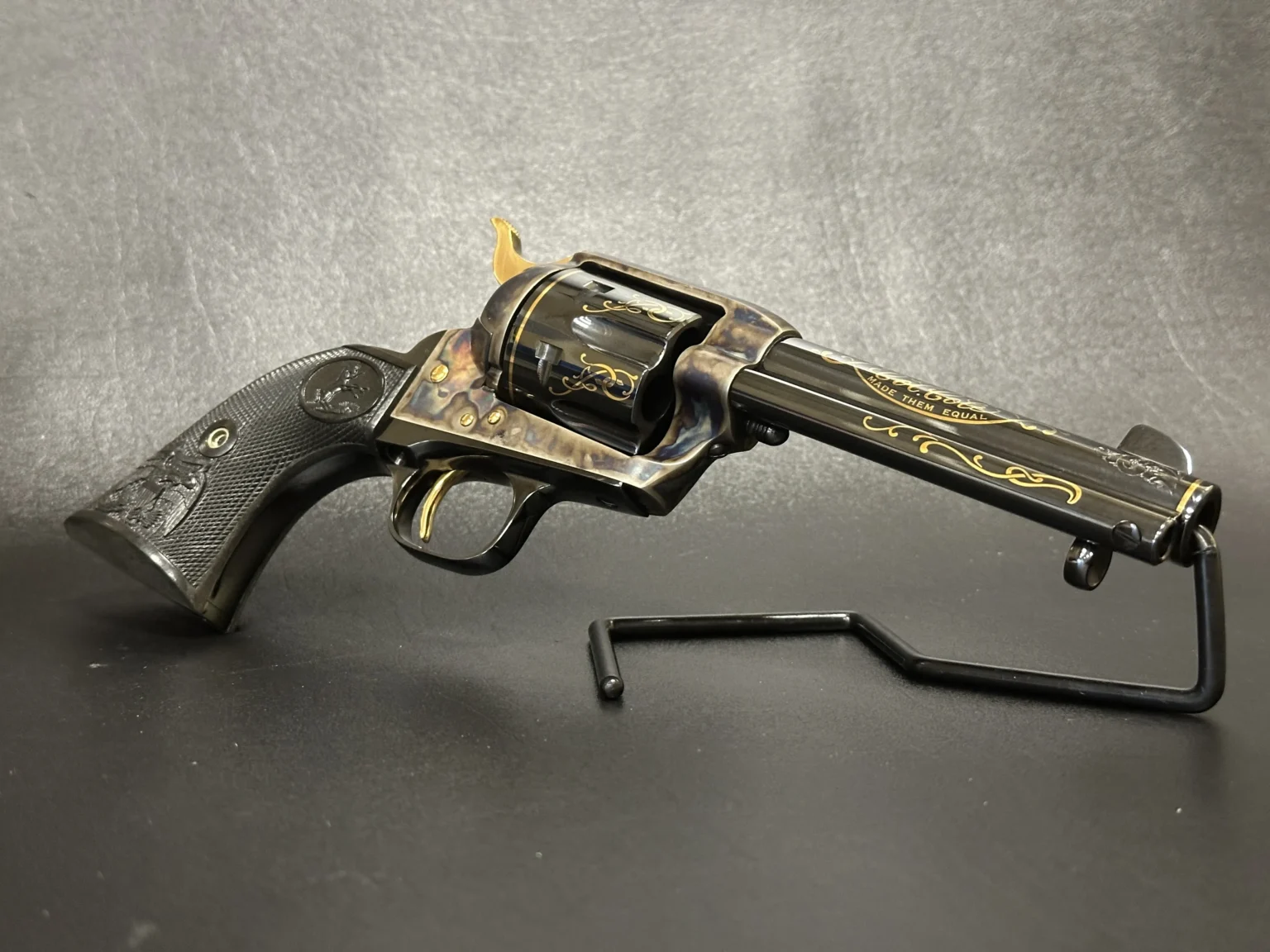
“Single action” describes its operating system: the shooter must cock the hammer before every shot. Cocking the hammer rotates and locks the cylinder; pressing the trigger then releases the hammer. The Army-issued revolvers generally had 7½-inch barrels, although Colt subsequently produced the model in other barrel lengths and chamberings for the commercial market.[3]
The revolver was introduced with the .45 Colt centerfire cartridge. Its self-contained metallic case represented a clear departure from the loose powder, projectile, and percussion cap required by Colt’s earlier cap-and-ball revolvers. Metallic-cartridge handguns already existed, but the Single Action Army became one of the best-known American service revolvers of the cartridge era.
Colt reports that it delivered more than 30,000 Single Action Army revolvers to the U.S. government between 1873 and 1891.[1] Civilian sales and popular culture subsequently broadened the revolver’s identity beyond military service. The names “Peacemaker” and “Colt .45” became closely associated with the model, while Western films and television placed Single Action Army revolvers—or visually similar substitutes—in the hands of fictional lawmen, outlaws, and settlers. Surviving screen-used examples in the Cody Firearms Museum include revolvers from High Noon, Bonanza, and other Western productions.[4]
That familiarity can obscure the model’s considerable variation. Single Action Army revolvers were manufactured in different calibers, barrel lengths, finishes, and configurations. A collector therefore cannot establish originality or rarity from the model name alone. Serial number, markings, physical configuration, condition, and surviving factory documentation must be considered together.
Browning and the M1911
The other major firearm commonly called a “Colt .45” is John Moses Browning’s M1911. Adopted by the U.S. Army in March 1911, it was a magazine-fed, semiautomatic service pistol rather than a revolver. The Army selected it after an extended program of testing and competition intended to replace its service revolvers.[1][5]
The M1911 operates through short recoil. At discharge, its barrel and slide initially recoil together while locked. The barrel then moves downward, disengaging from the slide and allowing the slide to continue rearward. This movement extracts and ejects the fired case, cocks the hammer, and compresses the recoil spring. As the slide returns, it chambers another cartridge from the magazine. Browning’s 1897 patent describes the barrel’s limited longitudinal and vertical movement and its locking relationship with the breech mechanism.[6]
The original military pistol used a seven-round magazine and fired the .45 Automatic Colt Pistol cartridge, commonly called .45 ACP. Despite the similar names, this was not the .45 Colt revolver cartridge associated with the Single Action Army. A Marine Corps historical account describes the .45 ACP as shorter and rimless, distinguishing it from the older .45 Colt revolver round.[7]
The Army and Navy formally adopted the M1911 in 1911, and the Marine Corps began receiving pistols the following year. An updated version, designated the M1911A1, incorporated a shorter trigger, wider sights, a longer grip safety, and a reshaped grip produced in part by its arched mainspring housing. Earlier M1911 pistols and the revised M1911A1 subsequently served alongside one another.[7]
The design remained in American service through two world wars, Korea, and Vietnam. During the Second World War, military demand required production by Colt and several additional contractors. The M1911A1 remained a standard U.S. military sidearm until the armed services began replacing it with the 9 mm M9 during the 1980s, although specialized versions of the M1911 continued in more limited roles.[7][8]
Understanding the Collecting Legacy
The Single Action Army and M1911 occupy distinct places in firearms history. The former represents the transition from percussion revolvers to metallic-cartridge service arms in the post–Civil War period. The latter reflects the military transition from revolvers to recoil-operated semiautomatic pistols in the early twentieth century.
Their collecting markets are equally distinct. With a Single Action Army, the central questions often concern production period, caliber, barrel length, finish, factory configuration, and documented shipment. For an M1911 or M1911A1, collectors must also examine the manufacturer, military inspection and property marks, serial-number range, component variations, and evidence of arsenal rebuilding.
Neither model should be treated as a generic “Colt .45.” Correct identification begins with the firearm itself and continues through documentary evidence. That distinction separates two different operating systems, two different cartridges, and two important chapters in American firearms manufacture.
Frequently Asked Questions
“Colt .45” is an informal name commonly applied to the Colt Single Action Army revolver and the Colt M1911 pistol. It is not a precise model designation.
William Mason and Charles Brinckerhoff Richards developed the revolver for Colt. Samuel Colt died in 1862, before the model entered production in 1873.
No. The .45 Colt is associated with revolvers such as the Single Action Army, while the shorter, rimless .45 ACP was developed for semiautomatic pistols such as the M1911.
The U.S. Army adopted John Moses Browning’s M1911 in March 1911. The pistol was later updated as the M1911A1.
Collectors should examine the firearm’s serial number, markings, caliber, configuration, condition, and production characteristics. Factory records or other reliable documentation may help establish its original configuration and history.
Sources
- Colt’s Manufacturing Company, “Timeline,” entries for 1862, 1873, and 1911.
- Samantha Harper, “William Mason and the Golden Age of Firearms,” Buffalo Bill Center of the West, July 8, 2025.
- Library of Congress, “Military Sidearms, from Revolvers to Semi-Automatic Pistols: Introduction,” research guide.
- Ashley Hlebinsky, “Firearms in Pop Culture,” Buffalo Bill Center of the West, August 18, 2022.
- U.S. Army, “Arming the Army, John M. Browning,” January 12, 2009.
- John M. Browning, “U.S. Patent No. 580,924: Firearm,” patented April 20, 1897.
- Kenneth L. Smith-Christmas, “Colt .45 Leaves the Corps After 77 Years,” Fortitudine, vol. 19, no. 1, Marine Corps Historical Center, Summer 1989, pp. 10–13.
- U.S. Army Acquisition Corps, “9mm Pistol Program (M9 Pistol),” Army Research, Development & Acquisition Bulletin, July–August 1992, p. 29.