
Key Takeaways:
- The U.S. Army adopted the .45-caliber Colt Single Action Army in 1873.
- Colt ended its principal prewar production run in 1941 and returned the revolver to regular production in 1956.
- Serial numbers can help date a revolver, but factory records and credible provenance are essential for verifying originality and historical associations.
Few firearms are as closely associated with the American West as the Colt Single Action Army. Introduced in 1873 and later widely known as the Peacemaker, the six-shot revolver combined a solid frame, self-contained metallic cartridges, and a mechanically straightforward single-action system. Its historical importance rests on more than folklore: the U.S. Army adopted it as a service revolver, Colt produced it in numerous configurations, and its basic form has endured for more than 150 years.
Samuel Colt did not design the Single Action Army. He died in 1862, more than a decade before the model entered production. The revolver emerged from the company he founded, building on Colt’s earlier percussion arms and the cartridge-conversion work undertaken after the Civil War. Colt engineer William Mason patented improvements to the revolver’s ejector assembly in 1872, including the spring-loaded rod used to remove cartridge cases individually from the cylinder.[1]
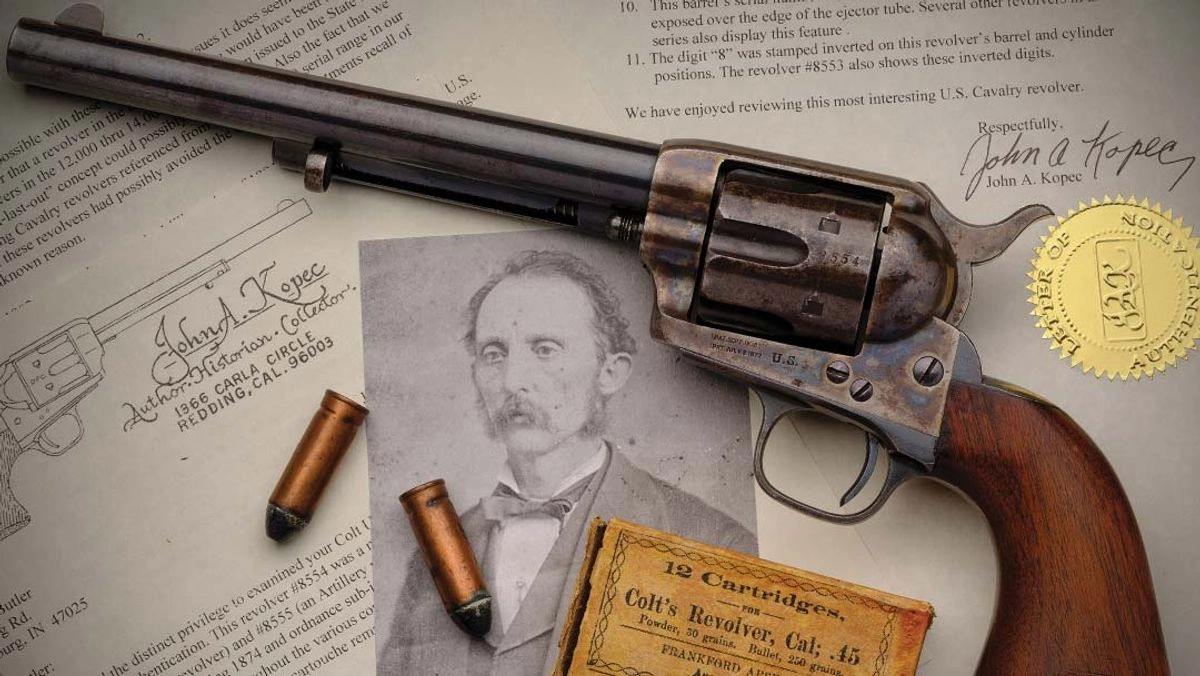
Colt introduced the Single Action Army in 1873 after U.S. military trials. According to the company’s historical record, the government designated it as a standard service revolver and received more than 30,000 examples between 1873 and 1891.[2] The military configuration was chambered for the .45 Colt cartridge and fitted with a 7½-inch barrel. The Army eventually replaced the single-action Colt as its standard revolver with a double-action .38-caliber model in 1892, although altered and refurbished Single Action Armys remained in government service afterward.[3]
The revolver’s operation was conventional but effective. Before each shot, the user manually cocked the hammer. That movement rotated the cylinder and aligned the next chamber with the barrel. Cartridges were inserted and removed through a loading gate on the right side of the frame, while an ejector rod beneath the barrel pushed out fired cases one at a time. This arrangement was slower to reload than later swing-out-cylinder revolvers, but it was mechanically simple and well suited to the manufacturing capabilities of its period.[1]
Although the .45 Colt military model established the revolver’s reputation, commercial production expanded into numerous chamberings and configurations. Standard barrel lengths came to include 4¾, 5½, and 7½ inches. Colt also produced target, engraved, nickel-finished, and special-order variants. Short-barreled revolvers without conventional ejector assemblies became known as Sheriff’s or Storekeeper’s Models, but collectors should not apply those names indiscriminately to every shortened Single Action Army. Colt’s own manuals distinguish these configurations by barrel length, frame type, and the presence or absence of an ejector rod.[4]
Surviving period examples demonstrate the range of finish and ornament available. A documented 1874 revolver in the Metropolitan Museum of Art, serial number 4519, has a 7½-inch barrel, .45-caliber chambering, steel and iron construction, and wood grips.[5] More elaborate Colt firearms could receive scroll engraving, precious-metal inlay, or other decoration from skilled specialists working in the company’s Hartford operation. Such treatment was generally reserved for deluxe, exhibition, or presentation arms rather than ordinary military revolvers.[5]
The Single Action Army’s association with the frontier is genuine, but individual ownership claims require caution. The model was available to soldiers and civilians during the late nineteenth century, yet later assertions connecting particular revolvers to famous lawmen or outlaws are not self-proving. A period-correct serial number establishes an approximate production date—not who carried the firearm. Photographs, shipping records, contemporary correspondence, inventories, or an unbroken chain of documented ownership are necessary before a celebrated attribution should be accepted.
The first principal production period ended in 1941 as Colt redirected manufacturing capacity toward wartime requirements. By then, the company had produced more than 350,000 Single Action Army revolvers in multiple calibers.[6] A more exact total of 357,859 is reported by the Autry Museum of the American West and established specialist histories, although a small number of revolvers assembled from remaining parts complicates any perfectly clean cutoff between prewar and postwar production.[7]
Colt returned the model to regular production in 1956. The first production example of this postwar series, serial number 0001SA, is preserved by the Autry Museum.[7] Collectors generally describe the original production as the First Generation and the 1956 revival as the beginning of the Second Generation. Later manufacturing changes led to the Third Generation designation. These categories are useful, but a revolver should be evaluated through its serial number, markings, physical construction, and factory documentation rather than by generation labels alone.
That distinction matters because the Single Action Army has been repaired, refinished, rebarreled, reconfigured, and copied extensively. Original finish, matching or correctly associated components, factory engraving, unusual chamberings, documented shipment details, and credible provenance can materially affect historical and collector significance. Conversely, an old-looking finish, famous name, or persuasive family story does not establish originality.
Colt’s online serial-number search can provide an approximate manufacturing date, but the company expressly warns that the database is not comprehensive and should not be treated as definitive documentation. Colt Archive Services can search surviving records and issue a letter describing recorded specifications and shipment information for an individual firearm.[8] Even an archive letter must be interpreted carefully: it documents what the factory record contains, not every alteration or ownership change that may have occurred afterward.
The Peacemaker’s popular image was strengthened by twentieth-century Western films and television, which helped create demand for Colt’s 1956 revival.[7] That screen presence often blurred the boundary between documented history and entertainment. The revolver did not single-handedly “win the West,” nor can every famous frontier figure be reliably linked to one. Its importance is substantial without those embellishments.
The Colt Single Action Army remains significant because it joins military history, industrial design, decorative craftsmanship, and popular culture in one enduring firearm. For collectors, its familiarity can be deceptive. The model is instantly recognizable, but establishing the importance of a particular example demands close examination and disciplined documentation. The strongest Single Action Armys are not those with the most dramatic stories; they are those whose stories can be proved.
Frequently Asked Questions
Colt introduced the Single Action Army in 1873 after U.S. military trials. The Army adopted the .45-caliber, 7½-inch-barrel configuration as a service revolver.
No. Samuel Colt died in 1862, more than a decade before the revolver entered production.
The hammer must be manually cocked before each shot. Cocking the hammer also rotates the cylinder to align the next chamber with the barrel.
The principal prewar production period ended in 1941. Colt resumed regular production in 1956.
Collectors should examine its serial number, markings, configuration, condition, and documented ownership history. A Colt Archive Letter may confirm recorded factory specifications and shipment details, but it cannot prove every later ownership claim or alteration.
Sources
- William Mason, “Improvement in Revolving Fire-Arms,” U.S. Patent No. 128,644, July 2, 1872.
- Colt’s Manufacturing Company, “Timeline—1873”.
- Library of Congress, “Military Sidearms, from Revolvers to Semi-Automatic Pistols: A Resource Guide”.
- Colt’s Manufacturing Company, Single Action Army Revolver Instruction Manual.
- Metropolitan Museum of Art, “‘Peacemaker’ Colt Single-Action Army Revolver, Serial No. 4519”.
- Colt’s Manufacturing Company, “Company History”.
- Autry Museum of the American West, “Single Action Army Model Revolver, Serial No. 0001SA”.
- Colt’s Manufacturing Company, “Archive Services” and “Serial Number Lookup”.