

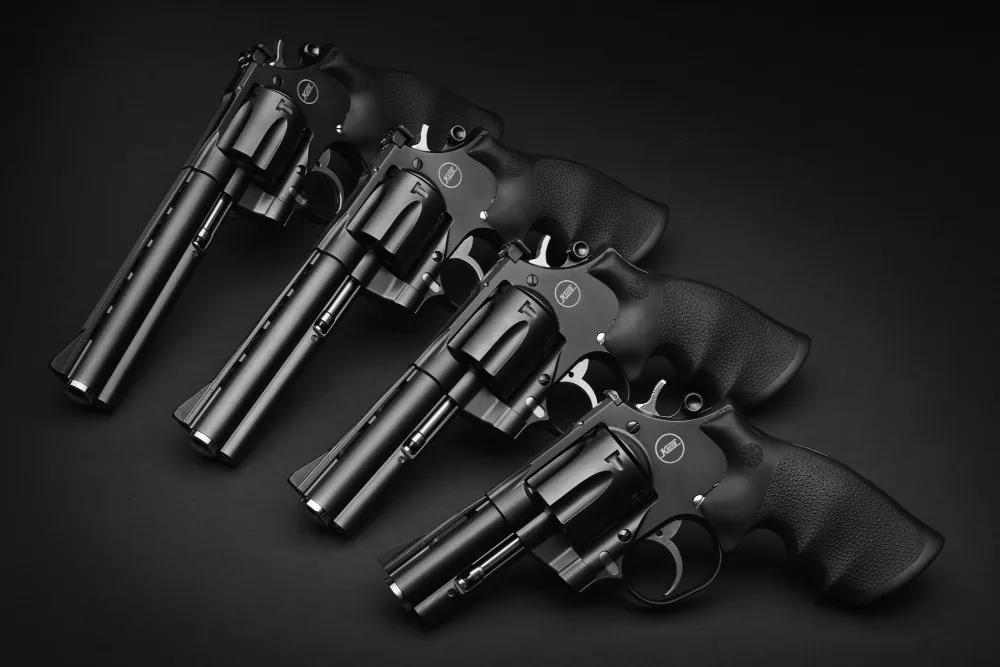
Key Takeaways:
- Single-action and double-action revolvers use different firing sequences; neither design is universally superior.
- Ammunition must match the manufacturer’s instructions for the exact model, even when general cartridge-compatibility standards apply.
- Original configuration, condition, factory records, and documented provenance are central to evaluating a collectible revolver.
A revolver is a handgun with a chambered cylinder that rotates to bring successive cartridges into alignment with the barrel.[1] Although the operating principle is nearly two centuries old, current revolvers range from traditionally styled single-actions to lightweight defensive models and precision-built sporting arms.
Choosing one requires more than comparing caliber or price. Action type, construction, barrel length, capacity, sights, mechanical condition, originality, and documentation all matter.
The Development of the Revolver
Samuel Colt’s American patent specification of February 25, 1836, describes a revolving firearm in which cocking the hammer rotates and aligns a chamber with the barrel.[2] Colt did not originate every revolving-firearm concept, but his designs and manufacturing methods helped establish the revolver as a commercially successful repeating handgun.
Colt’s Hartford armory also contributed to the development of American mass production. Specialized machinery, inspection gauges, division of labor, and standardized components allowed firearms to be produced more consistently and in greater numbers than traditional hand-fitting permitted.[3]
The early Colt percussion revolvers were single-action designs requiring the hammer to be cocked manually before each shot. Colt introduced the Model 1877, its first double-action revolver, in 1877. The Model 1889 followed as Colt’s first double-action revolver with a swing-out cylinder.[4] Variations of these single-action and swing-out-cylinder systems remain in production.
Single-Action and Double-Action Designs
In a conventional single-action revolver, manually cocking the hammer rotates the cylinder, aligns a chamber with the barrel, and prepares the mechanism to fire. The trigger then releases the hammer. Because the trigger performs only the release function, single-action trigger movement is generally shorter than a double-action pull.
A traditional double-action revolver can perform the cocking, cylinder-rotation, and hammer-release sequence through one pull of the trigger. Models with exposed hammers can often also be cocked manually for single-action fire. The current Colt Python, for example, is identified by Colt as a six-shot, single/double-action .357 Magnum revolver.[5]
Neither action type is universally superior. Single-actions preserve a deliberate operating sequence and traditional form. Double-actions permit successive shots without manually cocking the hammer. Trigger quality, cylinder timing, lockup, and overall mechanical condition remain more important than the action label alone.
Materials and Weight
Traditional revolvers are predominantly constructed from steel, but modern designs may combine steel with aluminum alloys and polymer components.
The original Ruger LCR, introduced in 2009, used a polymer fire-control housing, an aluminum frame, and a stainless-steel cylinder. Ruger described the original .38 Special version as a five-shot revolver weighing 13.5 ounces.[6] Its construction demonstrates how manufacturers can reduce weight without abandoning the revolver’s basic mechanical arrangement.
Weight affects both handling and portability. A heavier revolver is more burdensome to carry, but its greater mass generally moderates recoil movement. A lighter revolver is easier to carry but may feel sharper when firing the same cartridge. Grip shape, ammunition, and shooting technique also influence perceived recoil.
For collectors, material and finish must be evaluated for originality. Rebluing, polishing, replaced barrels, altered sights, refinished frames, and nonfactory engraving can reduce historical interest. Documented factory finishes, engraving, or special-order features may have the opposite effect.
Capacity and Configuration
Cylinder capacity depends on chambering, cylinder diameter, frame dimensions, and the model’s engineering. Five- and six-shot cylinders are common, but capacity should always be confirmed from the manufacturer’s specifications for the exact model or catalog number.
Barrel length also affects the revolver’s proportions, balance, sight radius, and ammunition performance. A longer barrel normally provides a longer distance between the front and rear sights, making small alignment errors easier to detect. It may produce greater velocity with a particular cartridge, but the result varies with the ammunition, cylinder gap, and individual firearm. Barrel length alone does not establish mechanical accuracy.
Shorter barrels reduce overall dimensions but provide a shorter sight radius and may produce greater muzzle blast with some loads. The practical choice depends on the revolver’s intended purpose and how well the individual shooter can control it.
Fixed sights are compact and mechanically simple. Adjustable sights permit changes in windage and elevation and are frequently found on sporting and target revolvers. Neither type guarantees that every load will strike at the same point of aim. Bullet weight, velocity, distance, grip, and sight picture can all affect point of impact.
Selecting the Correct Ammunition
Only ammunition expressly approved for the firearm should be used. Barrel markings provide essential information, but the correct manufacturer’s manual should govern whenever compatibility is uncertain.
Some cartridge relationships are recognized by industry standards. SAAMI lists .38 Special ammunition as generally suitable for firearms chambered in .357 Magnum. It also lists .44 Special for .44 Magnum firearms and .45 Colt for firearms chambered in .454 Casull.[7] These relationships do not work in reverse: a cartridge designed for the larger or higher-pressure chambering must not be fired in a firearm marked only for the shorter cartridge.
Model-specific restrictions can override general compatibility guidance. Ruger’s SP101 manual, for example, approves .357 Magnum, .38 Special, and .38 Special +P ammunition in most .357 Magnum SP101 revolvers. The same manual identifies specially marked short-cylinder variants limited to .357 Magnum cartridges with bullets weighing no more than 125 grains and an overall cartridge length no greater than 1.57 inches.[8]
This exception illustrates why ammunition should never be selected merely because it fits into the chamber. The firearm’s exact model, markings, condition, and instructions must be considered.
Modern Safety Mechanisms
Current revolvers may incorporate transfer bars or related mechanisms designed to prevent the hammer from reaching the firing pin unless the trigger is held rearward.
The current Colt Python uses a transfer bar that prevents the hammer from striking the firing pin until the trigger is pressed and held back.[5] Ruger’s New Model single-action mechanism similarly positions its transfer bar between the hammer and firing pin only while the trigger is pulled.[9]
These systems should not be assumed to exist in every revolver, particularly older models. Operating and loading procedures can differ substantially among firearms that appear similar. The correct manual for the specific model is therefore an essential part of responsible ownership and preservation.
Evaluating a Collectible Revolver
A collectible revolver should be examined as both a mechanical object and a historical artifact. Important considerations include:
- Correct model and serial-number markings
- Original caliber, barrel length, finish, sights, and grips
- Matching numbered components where applicable
- Factory proof, inspection, and assembly marks
- Mechanical condition, including cylinder timing and lockup
- Evidence of refinishing, rebarreling, caliber conversion, or action work
- Surviving factory packaging, manuals, tools, and sales records
- Documented ownership or historical association
Claims of originality or provenance require evidence. A family story, dealer statement, or display plaque may provide a useful research lead, but it does not independently prove ownership by a historical person.
Factory records can establish details that the firearm alone cannot. A Colt Archive Letter may document original configuration, shipping date, and shipping destination. Typical recorded specifications can include caliber, barrel length, finish, stocks, and factory-installed special features.[10] Colt’s archive records generally do not provide a complete chain of subsequent private ownership.
Archive findings must also be compared with the firearm itself. If the current barrel length, finish, stocks, or engraving differs from the recorded shipping configuration, the discrepancy should be disclosed rather than explained away.
Terms such as “mint,” “unfired,” “factory engraved,” “prototype,” and “one of a kind” should be used only when supported by persuasive evidence. Limited visible wear does not prove that a revolver is unfired, and elaborate engraving does not establish factory authorship.
Making an Informed Choice
A good modern revolver is not automatically the most powerful, lightest, most expensive, or most heavily promoted model. It is one whose dimensions, action, chambering, construction, and condition suit its intended role.
For a working revolver, mechanical soundness, fit, controllability, approved ammunition, and manufacturer support deserve priority. For a collectible revolver, originality, condition, documented rarity, factory records, and provenance carry greater weight.
In both cases, the exact firearm matters more than its reputation. Careful inspection and reliable documentation remain more valuable than folklore, assumptions, or sales language.
Frequently Asked Questions
A single-action revolver requires the hammer to be cocked manually before each shot. A double-action revolver can cock and release the hammer through the trigger pull.
SAAMI generally recognizes .38 Special as compatible with firearms chambered in .357 Magnum. The firearm’s manual must still be checked for model-specific restrictions.
Not necessarily. Designs such as the original Ruger LCR combine a polymer fire-control housing with an aluminum frame and stainless-steel cylinder.
Important factors include originality, condition, documented rarity, factory records, and provenance. Unsupported claims of historical ownership or factory modification should not be treated as established facts.
It may document a Colt firearm’s original configuration, shipping date, and shipping destination. It generally does not establish a complete history of subsequent ownership.
Sources
- Bureau of Alcohol, Tobacco, Firearms and Explosives, “27 CFR § 478.11—Definition of Revolver.”
- United States Patent Office, Samuel Colt, “Improvement in Fire-Arms, U.S. Patent X9430,” February 25, 1836.
- Eric Hintz, Smithsonian National Museum of American History, “Samuel Colt…and Sewing Machines? Part 1,” June 6, 2012.
- Colt’s Manufacturing Company, “The Colt Story: Company Timeline.”
- Colt’s Manufacturing Company, “Colt Python Operator’s Manual.”
- Sturm, Ruger & Co., “Introducing the Ruger LCR,” January 14, 2009.
- Sporting Arms and Ammunition Manufacturers’ Institute, “Generally Accepted Firearms and Ammunition Interchangeability.”
- Sturm, Ruger & Co., “Ruger SP101 Instruction Manual.”
- Sturm, Ruger & Co., “New Model Single-Six Instruction Manual.”
- Colt Archive Properties, “About the Colt Archive Letter.”

One Response
Good article, especially for novice potential revolver owners. As a lifelong shooter, collector and career police officer I’ve always had an affinity for revolvers. When I started my police career in 1971 my department Chicago mandated revolvers as our service pistols. AS the years went by the switch to semi autos was made in the mid 80s and most though it became a firepower advantage. I wasn’t so sure because when you only had 6 rounds you tended to place more emphasis on accuracy and shot placement.
As for revolver brands Colt and Smith & Wesson always cornered the US market but I have discovered they are not the best. Years ago I obtained a plain Jane entry level Manurhin with a 4″ barrel and fixed sights. That Manurhin IMO is a better quality revolver than anything made in the USA. I now have 3. Not to be limited I bought an early Korth made at Ratzenburg and that revolver took things to a whole different level. The newer Lollar Korths though not as finely blued have a marvelous finish called DLC which IMO is the most durable finish ever. Started with one Korth and now have 4. Somescoff at the price of a Manurhin or Korth but believe me they are worth every penny. The trouble being once you own one of these hand made revolvers you’ll want another.