
Key Takeaways:
- Willi Korth established his Ratzeburg workshop in 1954, initially producing alarm and gas revolvers.
- Korth’s patented trigger system used interchangeable rollers to modify the double-action trigger characteristics.
- Model, proof date, originality, condition, and documentation matter more than the Korth name alone when evaluating an example.
Korth’s reputation rests on unusually refined engineering, extensive hand-finishing, and production on a scale far removed from the mass-market revolver industry. The company’s history began in Ratzeburg, West Germany, where Willi Korth established a small workshop in 1954. Its first products were alarm and gas revolvers derived from a design he developed the previous year. By the mid-1960s, Korth had turned its attention to live-fire sporting revolvers.[1]
The early revolvers established the mechanical principles associated with the Korth name. They were double-action designs built around carefully fitted lockwork rather than conventional high-volume manufacturing methods. A 2003 Gun Digest account described the period’s production as approximately 30 percent machine work and 70 percent manual shaping, fitting, inspection, and assembly. That figure is best understood as a contemporary description of the manufacturing process, not a specification applicable to every Korth made before or since.[1]
A Distinctive Action
Willi Korth’s attention to trigger geometry is documented in German patent DE1904675A1, filed on January 31, 1969, and published on August 20, 1970. The design used a small roller within the trigger mechanism to alter friction and define the pressure point during double-action operation. Interchangeable rollers of different diameters allowed the trigger’s operating characteristics to be changed without redesigning the entire lockwork.[2]
This system helps explain why Korth triggers are frequently treated as a defining feature rather than a secondary refinement. It was not simply a matter of polishing conventional components. The geometry of the action was designed to provide a controlled transition through the double-action stroke.
Period revolvers also incorporated an unusual cylinder-release arrangement positioned beside the hammer, indexed removable cylinders, and double axial cylinder locking. These were practical mechanical features, although their execution required close fitting.[1]
Models and Calibers
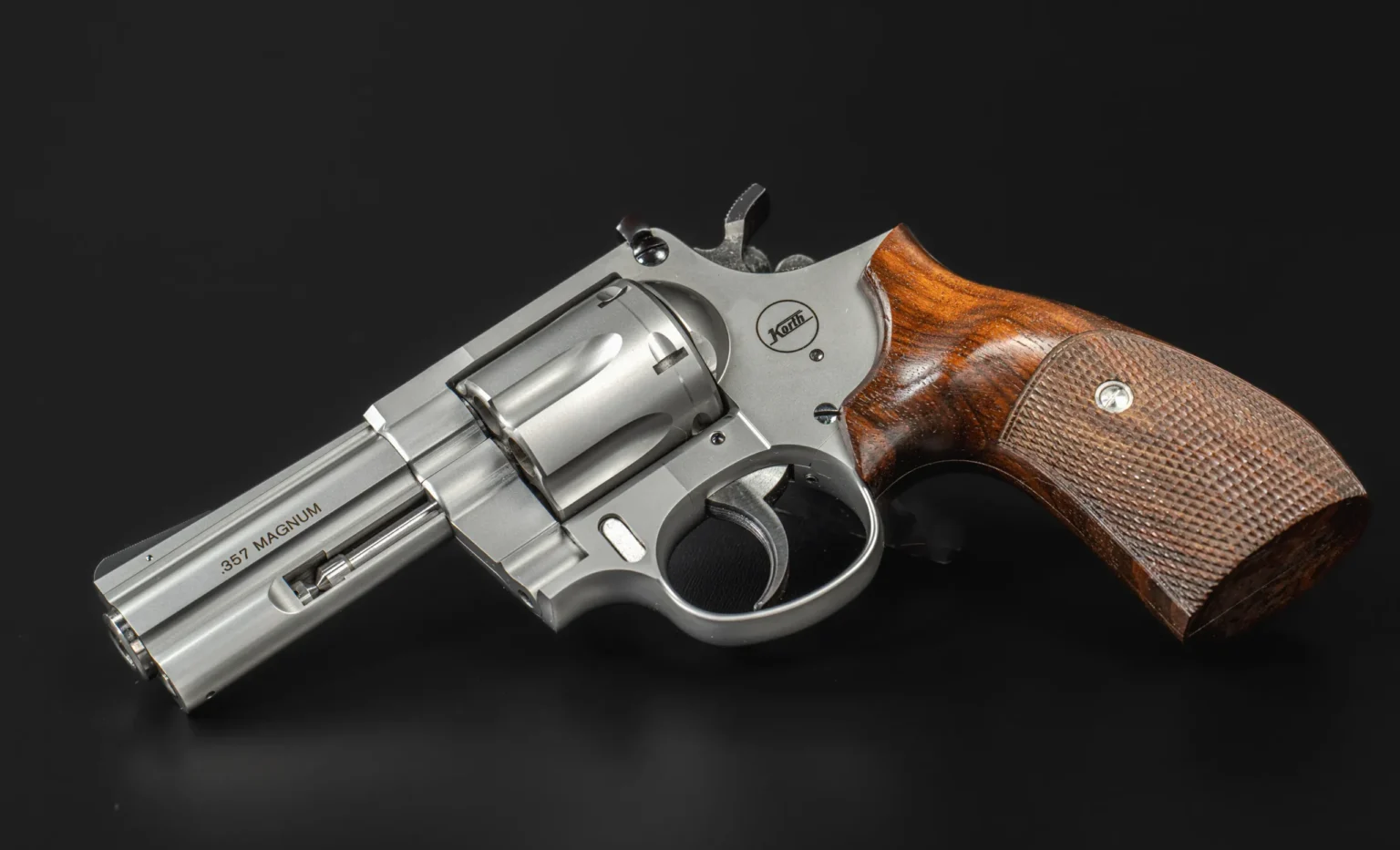
Korth production included considerably more variation than the familiar .357 Magnum Combat revolver. A reference published in 2003 described the four-inch Combat as a six-shot revolver offered at different times in .22 LR, .22 WMR, .32 S&W Long, .38 Special, and .357 Magnum. It also records five-shot .38 Special and .357 Magnum versions made from 1966 through 1968. Target and sporting configurations were offered with longer barrels, adjustable sights, and specialized grips.[1]
Consequently, “Korth Ratzeburg” is not a single model designation. It encompasses multiple generations, chamberings, barrel lengths, sight arrangements, finishes, and mechanical variations produced during the company’s years in Ratzeburg. Assertions about rarity or production must therefore be tied to a clearly identified configuration rather than applied to the marque as a whole.
Interchangeable Cylinders, With Qualifications
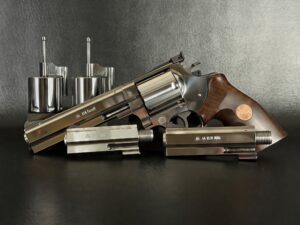
Removable and interchangeable cylinders are among the better-known Korth features, but the system should not be described as universal. Period sources document indexed, readily removable cylinders, while a 2003 test examined a prototype combining a .357 Magnum cylinder and barrel with a 9mm Luger conversion cylinder and corresponding barrel.[1][3]
The present manufacturer continues to offer conversion cylinders, including .38 Special and 9mm Luger versions, but lists them for specific compatible models. A conversion cylinder should therefore be treated as a fitted, model-dependent component, not as an accessory that will necessarily function correctly in any Korth revolver.[4]
From Ratzeburg to Lollar
The Korth name survived substantial corporate change after the original Ratzeburg period. The manufacturer states that Martin Rothmann has continued the company since 2008, combining modern machining with traditional gunsmithing and hand-finishing.[5] The current business, PTW KORTH Technologies GmbH, is based in Lollar, Germany.[6]
That distinction matters to collectors. A modern Korth may preserve elements of Willi Korth’s design philosophy, but it is not a Ratzeburg-made revolver. Place markings, proof marks, serial numbers, mechanical features, and surviving documentation should be examined before assigning a particular production period.
Evaluating a Collectible Korth
A Korth’s desirability cannot be established by the name alone. Serious evaluation begins with the exact model, chambering, barrel length, proof date, serial number, finish, and mechanical generation. Original grips, sights, fitted conversion cylinders, cases, tools, test targets, manuals, and factory correspondence can materially strengthen a revolver’s historical integrity.
Condition also requires more than an attractive exterior. Timing, cylinder lockup, bore condition, chamber condition, screw slots, internal alterations, and evidence of refinishing all deserve inspection. Highly polished surfaces can make later refinishing difficult to recognize, while a replacement cylinder or barrel may affect both originality and function.
Korth revolvers are significant because their reputation is grounded in identifiable design choices and labor-intensive manufacture. Their appeal does not require exaggerated comparisons or promises of automatic appreciation. The strongest examples are those whose configuration, condition, and history can be documented with precision, the same quality that defined the revolvers themselves.
Frequently Asked Questions
The term refers broadly to Korth revolvers produced during the company’s Ratzeburg era. It is not one specific model.
Willi Korth established his workshop in Ratzeburg in 1954. Early production centered on alarm and gas revolvers before the company developed live-fire sporting revolvers.
Willi Korth patented a mechanism using interchangeable rollers to alter the double-action trigger’s pressure point. This was a deliberate engineering feature, not merely polished conventional lockwork.
No. Conversion cylinders are model-dependent and should not be assumed to fit or function correctly in every Korth revolver.
Collectors should verify the model, serial number, proof date, finish, mechanical configuration, originality, and documentation. Any conversion cylinder or replacement component should also be checked for proper fit and provenance.
Sources
- Raymond Caranta, “Korth: Workmanship Supreme,” Gun Digest, 57th Edition, 2003, pp. 165–168.
- German Patent Office, “DE1904675A1: Device for Producing a Pressure Point in a Revolver,” filed January 31, 1969; published August 20, 1970.
- Jens Tigges, “Korth-Revolver in .357 Mag. und 9 mm Luger,” caliber, June 2003, pp. 26–31.
- PTW KORTH Technologies GmbH, “Korth Revolvers and Conversion Cylinders,” official product catalog.
- PTW KORTH Technologies GmbH, “About Korth,” official company history.
- PTW KORTH Technologies GmbH, “Company Imprint,” official corporate and manufacturing information.