
3 Key Takeaways:
- The Volcanic belongs to the documented commercial sequence that preceded the Henry rifle and early Winchester lever actions.
- The Dreyse and Chauchat addressed important military needs, but their designs retained significant mechanical and operational limitations.
- The Liberator and Nambu Type A demonstrate how manufacturing objectives and national military requirements can shape firearm development.
Firearms development is not a straight line of successful inventions. Some weapons introduced useful ideas but failed commercially. Others met an urgent military need despite serious shortcomings. Their importance lies in what they reveal about the problems designers and armies were trying to solve.
The Volcanic Repeater
Volcanic repeating handguns appeared in 1854, followed by the formation of the Volcanic Repeating Arms Company in 1855. Oliver Winchester became an investor, and the business was reorganized as the New Haven Arms Company in 1856. Benjamin Tyler Henry patented his rifle in 1860, and the first Henry rifles were sold in 1862. Winchester Repeating Arms Company succeeded New Haven Arms in 1866 and introduced the Model 1866, the first firearm to bear the Winchester name.[1]
This chronology establishes the Volcanic’s place in the corporate history that produced the Henry and early Winchester rifles. It does not, by itself, prove that every feature of the later rifles originated with the Volcanic. Its importance should therefore be described as part of a documented developmental and commercial sequence—not as the sole invention from which all American lever actions descended.
The Dreyse Needle Rifle
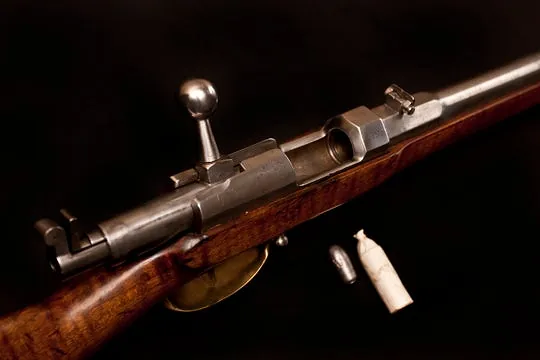
The Prussian Model 1841 Dreyse was a single-shot, bolt-action breechloader. Its name came from the long needle-like firing pin used to ignite the primer within its paper cartridge. The Prussian Army adopted the rifle at a time when muzzle-loading arms remained the military norm.[2]
Loading from the breech eliminated the need to place a cartridge and ramrod down the muzzle after every shot. The design consequently represents an important stage in the transition toward breech-loading military rifles operated by a bolt.
The Dreyse should not be presented as a modern bolt-action rifle in the full sense of the term. It lacked the durable metallic cartridge and effective gas seal found in later systems. Its significance is narrower but firmly established: it demonstrated that a bolt-operated breechloader using self-contained ammunition could be adopted as a military infantry arm.
The Chauchat Model 1915
The French Fusil Mitrailleur Modèle 1915 CSRG, commonly called the Chauchat, was intended to provide infantry with an automatic weapon light enough to accompany an advance. The standard French model fired the 8 mm Lebel cartridge and could be carried and operated by one soldier, although ammunition supply and battlefield employment normally involved additional personnel.[3][4]
Its open-sided, sharply curved magazine exposed cartridges to dirt and physical damage. The weapon also employed a long-recoil operating system and had a relatively low cyclic rate. These characteristics contributed to its mixed reputation. The American .30-06 version suffered additional manufacturing and dimensional problems and should not be treated as mechanically identical in performance to the original French model.[4]
The Chauchat nevertheless filled a genuine wartime requirement. American forces initially lacked sufficient light automatic weapons when they arrived in France and consequently used French 8 mm Chauchats. The American Expeditionary Forces began receiving Browning Automatic Rifles in 1918 as replacements.[3]
Calling the Chauchat either a complete failure or the origin of all modern light machine guns goes beyond the evidence. It was an early, widely fielded attempt to give advancing infantry portable automatic fire, and its weaknesses illustrate the difficulty of making such a weapon light, durable, and reliable under battlefield conditions.
The FP-45 Liberator
The FP-45 Liberator was a smoothbore, single-shot pistol created in 1942 for possible distribution to resistance forces in enemy-occupied territory. Made principally from stamped metal and chambered for the .45 ACP cartridge, it was designed for inexpensive mass production rather than conventional military service.[5]
The Liberator was reloadable, despite often being described as a one-shot disposable weapon. After firing, the user opened the breech and removed the empty case, normally with the wooden dowel supplied in the package. Reloading was slow, and the pistol’s smoothbore barrel limited its practical usefulness to close distances.
General Motors’ Guide Lamp Division received a contract for one million pistols in May 1942. Production began in June and was completed in August. A complete package included the pistol, ammunition, a wooden extraction dowel, and pictorial instructions.[6]
Production volume did not translate into widespread operational use. The Liberator was not issued as a standard American or Allied sidearm, and distribution to resistance organizations was limited.[5][6] Its historical importance lies primarily in its manufacturing concept: it was a weapon designed around extreme simplicity, secrecy, and potential mass distribution.
The Nambu Type A
Kijirō Nambu developed an early Japanese family of self-loading pistols while working at the Tokyo Artillery Arsenal. The first military-size version is now identified by collectors as the Type A, while early examples are informally called “Grandpa Nambus.” Japanese officers were authorized to purchase Nambu pistols for use as sidearms around 1904, but the Type A was not adopted as the army’s universal standard handgun.[7]
The pistol underwent modifications during the following decade. Although the early Nambu was comparatively expensive and never achieved the production scale of later Japanese service pistols, it established the foundation of a recognizable domestic handgun family.
The 8 mm Type 14 was adopted in 1925 and became a standard Japanese service pistol. It remained in use throughout World War II, with more than 300,000 reportedly manufactured according to the National Army Museum.[8]
The Type A’s importance therefore rests on its position at the beginning of Japan’s sustained development of domestically designed self-loading military pistols. It was not simply a failed Type 14, but an earlier design from which Japan’s military handgun program continued to evolve.
Why These Firearms Matter
These weapons did not contribute equally to firearms development. The Volcanic belongs to the documented business sequence that preceded the Henry and Winchester rifles. The Dreyse demonstrated the practicality of a bolt-operated military breechloader. The Chauchat placed portable automatic fire into large-scale wartime service despite serious compromises. The Liberator reduced a clandestine pistol to the requirements of mass production. The Type A marked an early stage in Japan’s development of domestically designed self-loading handguns.
Their histories are more useful without mythology. Each represents a particular response to the technological, manufacturing, or tactical limitations of its time.
Frequently Asked Questions
The Volcanic Repeating Arms Company formed part of the documented business sequence that led to New Haven Arms and Winchester. The evidence does not establish the Volcanic as the sole origin of every later lever-action feature.
The Dreyse was an early military bolt-action breechloader that used a self-contained paper cartridge. Its needle-like firing pin ignited a primer positioned within the cartridge.
No. It had serious shortcomings, and the American .30-06 version was particularly problematic, but the original French model supplied portable automatic fire when such weapons were urgently needed.
It was a single-shot pistol, but it could be reloaded manually. Its slow loading process and smoothbore barrel restricted its practical usefulness to close distances.
The Type A was an early Japanese self-loading pistol that helped establish a domestic handgun-design program. Later development produced the Type 14, which became a standard Japanese service pistol.
Sources
- Winchester Repeating Arms, “Historical Timeline of Winchester Firearms”.
- Military History Institute Prague, “Prussian Infantry Rifle, Model 1841”.
- U.S. Army Center of Military History, The Great War: U.S. Army Artifacts.
- American Rifleman, “This Old Gun: CSRG 1915 Chauchat”.
- Mississippi Armed Forces Museum, “FP-45 ‘Liberator’ Pistol”.
- American Rifleman, “The Liberator Pistol”.
- National Firearms Museum, “Nagoya Army Arsenal Type 14 Nambu Semi-Automatic Pistol”.
- National Army Museum, London, “Japanese Taisho 14 Self-Loading Pistol, 8 mm”.