
Cabot Guns’ Top Firearms: When a 1911 Becomes a Work of Art

Table of Contents

Key Takeaways:

  • Cabot’s aerospace roots changed what a 1911 can be. Born out of Penn United Technologies in 2011, Cabot machines frames and slides from solid billet steel to tolerances tighter than a human hair, so parts interchange between guns while still locking up like a vault. That’s a genuinely different manufacturing philosophy from the hand-fitting tradition at Wilson, Nighthawk, or Les Baer, and it’s the foundation on which everything else in the catalog rests.
  • The exotic builds are where Cabot earns its legend. The Big Bang Pistol Set, a matched right- and left-handed pair carved from a 77-pound chunk of the 4.5-billion-year-old Gibeon meteorite, is widely considered the holy grail of firearm collectibles at around $4.5 million. Add the lunar-meteorite Moonshot, the one-of-a-kind Damascus models, and the South Paw, the world’s only true left-handed 1911, and you’ve got a maker that keeps finding new room in a design everyone thought was fully explored.
  • Collectibility comes down to scarcity, story, and paperwork. Cabot’s production is deliberately small, the brand has cultural reach well beyond the gun world, and every pistol starts life with a clean provenance chain. No appreciation is ever guaranteed, but if you keep the case, documents, and test target together, you’re holding a modern gun that checks more classic collectibility boxes than almost anything else being built today.

There’s a moment every serious collector remembers. The first time you held something that made every other gun in your safe feel ordinary. For a lot of people, that moment involves a Cabot.

Here’s the thing about Cabot Guns. They didn’t set out to build another 1911. The market already had plenty of those, from budget imports to respected custom shops. Cabot set out to build the 1911 as it would exist if money, time, and tooling were no object. A pistol made the way aerospace engineers make turbine components, not the way gunsmiths traditionally file and fit parts at a bench.

Did they pull it off? Well, S.P. Fjestad, the man behind the Blue Book of Gun Values, called their work the finest pistol ever produced. Others have called Cabots the Rolls-Royce of 1911s. That’s heady praise in a market where Wilson Combat, Nighthawk Custom, and Les Baer have spent decades earning their reputations.

So let’s talk about what makes Cabot different, and more importantly, which of their guns deserve a spot on your radar. Whether you’re a collector hunting your next centerpiece or an enthusiast who just appreciates absurd levels of craftsmanship, there’s a lot to chew on here.

A Gun Company Born in an Aerospace Shop

Before we get to the guns themselves, you need to understand where Cabot came from. Because honestly, the origin story explains everything.

Cabot Guns was founded in 2011 by Rob Bianchin, and it grew out of Penn United Technologies, a precision manufacturing operation in western Pennsylvania. Penn United wasn’t a gun company. They made components for aerospace, medical, and nuclear applications. The kind of parts where a tolerance miss doesn’t mean a sloppy trigger; it means a catastrophic failure at 30,000 feet.

Now imagine that level of manufacturing discipline pointed at John Moses Browning’s 110-year-old pistol design. That’s Cabot.

Most custom 1911 makers start with forgings or castings, then machine and hand-fit everything until it runs right. There’s real artistry in that, no question. Cabot took a different road. They machine their frames and slides from solid billet steel, holding tolerances they describe as a fraction of the width of a human hair. The frame-to-slide fit is so consistent that parts mate more precisely than human hands could ever fit them.

The result? You can take the slide off one Cabot and run it on another Cabot frame, and the gun still locks up like a bank vault. Try that with most hand-fitted customs and you’ll be disappointed. Interchangeability at that level of tightness simply wasn’t a thing in the 1911 world before Cabot showed up.

One more detail worth knowing: every Cabot is 100% American made. Not “assembled in America” with parts sourced from wherever. Every pin, spring, and bushing is made from scratch in Pennsylvania. For collectors who care about provenance, and let’s be honest, we all do, that matters.

The Big Bang Pistol Set: The Holy Grail

Let’s start at the top, because no conversation about Cabot is complete without the guns that made them famous far beyond the firearms world.

In 2015, Cabot acquired a 77-pound chunk of the Gibeon meteorite. If you’re not familiar, the Gibeon fell to Earth in what’s now Namibia during prehistoric times, and it’s roughly 4.5 billion years old. Older than the planet’s oceans. Older than basically everything you’ve ever touched. The local Nama people had used fragments of it for tools and weapons for generations before Western science even catalogued the thing.

Cabot looked at that ancient lump of iron-nickel alloy and asked a question nobody had seriously asked before. Could you build a functional firearm out of it?

Plenty of people in the industry quietly assumed the answer was no. Meteorite iron is unpredictable stuff. It has internal fractures, voids, and a crystalline structure (those gorgeous Widmanstätten patterns) that formed over millions of years of slow cooling in space. It’s beautiful, but it’s not exactly ideal gun steel. You can’t just throw it in a CNC machine and hope.

So Cabot didn’t hope. They X-rayed and laser-scanned the meteorite, built 3D models of every component, and used electron-beam welding and EDM wire cutting to coax working parts out of the material. The project took serious engineering muscle, the kind you only have lying around if your parent company builds aerospace components for a living.

The result, unveiled at the 2016 NRA Annual Meetings in Louisville, was the Big Bang Pistol Set. A matched pair of 1911s, one right-handed and one a true mirror-image left-handed gun, with nearly every component carved from that single space rock. And here’s the kicker: both pistols actually fire. These aren’t display dummies. They’re functional firearms made from a 4.5-billion-year-old visitor from the asteroid belt.

The asking price? Around $4.5 million. Experts have called the set the holy grail of firearm collectibles, and it’s hard to argue. There will never be another pair like it. Cabot has said as much. Two guns, one meteorite, end of story.

Is it practical? Of course not. Nobody’s running a meteorite 1911 through a defensive pistol course. But that was never the point. The Big Bang Set is a statement about what American manufacturing can do when somebody refuses to accept the word impossible. It’s also, frankly, one heck of a conversation piece.

The OAK Collection: Where Cabot Gets Truly Wild

The Big Bang Set lives within what Cabot calls the OAK Collection, their line of bespoke, investment-grade builds. Think of OAK as Cabot’s haute couture division. These aren’t catalog guns. They’re one-off and ultra-limited pieces built around rare materials and wild ideas.

The Moonshot 1911 might be the best example after the Big Bang Set itself. This pistol incorporates lunar meteorite, actual material that was blasted off the Moon’s surface and eventually landed on Earth. Cabot had already pioneered meteorite grips before the Big Bang project, so working exotic space material into a pistol was familiar territory. But lunar material? That’s another level of rare. There’s only so much Moon rock on this planet, and most of it sits in government vaults.

Other OAK builds have featured mammoth ivory, rare gemstones, museum-grade Damascus, and engraving work that takes hundreds of hours. Each one is a singular object. If you’re the kind of collector who already owns the standard trophies and wants something nobody else on Earth has, this is the neighborhood you shop in.

You know what’s interesting, though? Even these art pieces shoot. Cabot refuses to build anything that doesn’t function. That philosophy separates them from a lot of high-end “presentation” guns throughout history, which were often beautiful but mechanically indifferent. A Cabot has to run. Period.

The South Paw: Finally, a 1911 Built for Lefties

Now let’s come back down to Earth, both literally and price-wise, because some of Cabot’s most impressive work is also their most practical.

Roughly one in ten shooters is left-handed. For over a century, those folks have made do with a 1911 design that ejects brass across their face and puts every control on the wrong side. Ambidextrous safeties helped a little. But nobody had ever fully committed to the obvious solution: flip the entire gun.

Cabot did. The South Paw is a complete mirror image of the 1911. Not a converted right-handed gun, but a ground-up build where the ejection port, thumb safety, slide stop, and magazine release all sit on the left-hander’s correct side. Cabot re-engineered Browning’s design as if it had been intended for lefties from day one, and they remain the only company in the world producing a true left-handed 1911.

Think about that for a second. The 1911 is arguably the most copied, cloned, and customized pistol design in history. Hundreds of manufacturers have built millions of them. And exactly one company bothered to build it backwards for the 10% of shooters who needed it. That tells you something about how Cabot thinks.

The South Paw S100 launched at a base price of around $4,000, which made it the most accessible route into Cabot ownership at the time. It’s built from billet 416 stainless steel using the same aerospace processes as everything else they make, with a match-grade, hand-fit five-inch barrel and a polished feed ramp. Cabot backs it with an accuracy guarantee of 1.5-inch groups at 25 yards, straight out of the box.

Let me put that guarantee in context. Plenty of custom shops talk about accuracy. Far fewer put a number on it and stand behind it on a production basis. A 1.5-inch group at 25 yards is better than most shooters can hold, which means the gun will never be the weak link. For a southpaw who has spent a lifetime adapting to right-handed hardware, that’s a revelation.

And here’s a fun collector’s angle: the mirror-image engineering developed for the South Paw is exactly what made the Big Bang Set possible. One of those meteorite pistols is a lefty. The humble South Paw is the technical ancestor of a $4.5 million masterpiece. Funny how that works.

The Mirror Image Sets: Two Guns, One Vision

Before the meteorite project, Cabot made waves with their Mirror Image pistol sets, matched pairs consisting of one right-handed and one left-handed 1911, built as twins. One of these sets reportedly set a world record for the highest price ever paid for a new pistol, which is what emboldened Cabot to chase the meteorite idea in the first place.

There’s something almost poetic about a mirrored pair. Collectors have always loved cased sets; think of the dueling pistol tradition, or the engraved presentation pairs of the 19th century. Cabot took that heritage and gave it a modern twist that only their manufacturing approach could deliver. You can’t build a true mirror-image gun by hand-fitting standard parts. You need to manufacture every component in reverse, to identical tolerances. Cabot is set up to do exactly that.

For the collector, a Mirror Image set occupies a sweet spot. It’s rarer and more significant than a single pistol, it displays beautifully, and it carries the same DNA as the most famous gun set ever made. If the Big Bang Set is the holy grail, the Mirror Image sets are the chalices on the same altar.

The Damascus Models: Steel That Tells a Story

If meteorites and mirror images feel a bit much, Cabot’s Damascus line might be the most beautiful middle ground in modern gunmaking.

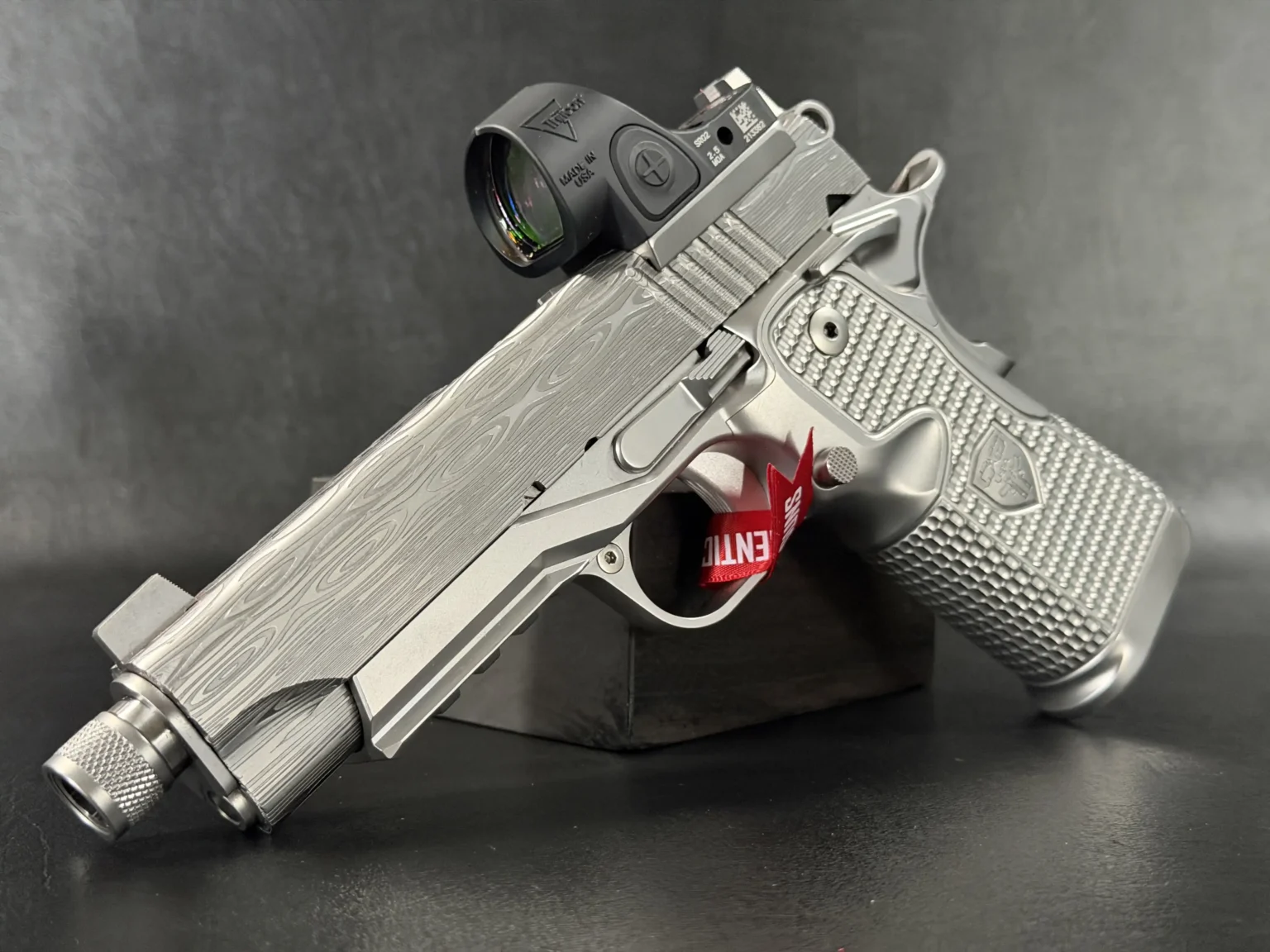
Damascus steel, in its modern form, is made by forge-welding alternating layers of different steels, then folding, twisting, and patterning the billet until the finished surface reveals flowing organic figures. Some layers bring hardness. Others bring flexibility that keeps the hard layers from shattering. The interplay of those properties is what makes Damascus both gorgeous and genuinely difficult to machine. Every billet behaves a little differently, which is a nightmare when your whole brand is built on holding tolerances tighter than a human hair.

Cabot builds Damascus 1911s anyway. Some wear a Damascus slide over a stainless frame; others go full Damascus, top to bottom. Their tenth-anniversary Impact ONE even featured a “meteor shower” pattern worked into the Damascus itself, a nod to the company’s space-rock legacy.

Why does this matter to collectors? Because Damascus sits at the crossroads of ancient craft and modern precision. The technique echoes the legendary blades of Damascus and the pattern-welded swords of medieval Europe, yet Cabot’s execution is pure 21st-century manufacturing. No two Damascus guns are identical. The pattern on your slide exists nowhere else in the universe. In a collecting world that prizes uniqueness, that’s catnip.

A quick practical note: modern Damascus from a maker like Cabot is fully functional gun steel, unlike the antique Damascus shotgun barrels your grandfather warned you about. These guns are built to shoot, and shoot well.

The National Standard and Vintage Classic: The Everyday Masterpieces

Not every Cabot costs as much as a house. The heart of the catalog is a family of “standard” models, and I use that word loosely, that deliver the company’s signature precision in more familiar packages.

The National Standard is probably the purest expression of the Cabot idea. It’s a full-size, all-business 1911 in .45 ACP, machined from billet stainless, with the trademark vault-tight fit and that distinctive Cabot touch: a small engraved star on the face of the guide rod, peeking out beneath the barrel like a maker’s mark. No gimmicks. Just the 1911 executed to a standard Browning himself never had the tooling to reach.

The Vintage Classic leans the other way, toward heritage. Polished flats, classic lines, traditional sights, the kind of gun that looks like it walked out of 1935 but shoots like it was built by a coordinate-measuring machine. Which, in a sense, it was. For collectors who love the romance of the early custom era, the Vintage Classic scratches that itch without the fragility of an actual vintage piece.

Both models typically land in the $4,000 to $6,000 range depending on options, which puts them up against the top tier from Wilson, Nighthawk, and Ed Brown. Is a Cabot “better” than those guns? That’s a campfire argument that’ll outlast the campfire. What’s not debatable is that Cabot’s billet construction and tolerance philosophy are genuinely different, not just a variation on the usual hand-fitting approach. You’re buying a distinct manufacturing ideology, and the market has decided that ideology is worth a premium.

Black Diamond and the Modern Muscle

Cabot also builds for shooters who want modern aggression rather than vintage charm, and the Black Diamond is the flagship of that mood.

Picture a 1911 dressed entirely in black, with crisp machining details, diamond-themed accents, and an attitude that reads more “midnight” than “museum.” It’s the same precision underneath, just wrapped in a darker aesthetic. Models like the Insurrection push further into bold styling territory, with design flourishes you’d never find on a traditional custom gun.

Some purists wrinkle their noses at this stuff, and that’s fine. But here’s a mild contradiction worth sitting with: the collectors who dismiss the flashy models today are often the same folks chasing yesterday’s flashy models at auction. Engraved, gold-inlaid, exotic-gripped guns from past eras are blue-chip collectibles now precisely because they were bold when new. The unusual Cabots of today may well be the sought-after rarities of 2060. Food for thought.

Why Collectors Take Cabot Seriously

Let’s step back and talk about the collecting case, because spending five figures on a modern pistol deserves a clear-eyed look.

First, scarcity is real. Cabot’s production is small by design. Their processes don’t scale the way a mass manufacturer’s do, and the company has shown no interest in chasing volume. Limited supply plus growing reputation is the basic arithmetic of appreciation.

Second, the brand has cultural reach beyond the gun world. The Big Bang Set generated coverage in mainstream and luxury media that most firearms makers could only dream about. When a gun company shows up in luxury lifestyle magazines next to watches and supercars, it’s building the kind of cross-market awareness that supports long-term value. Holland & Holland and Purdey did the same thing in the shotgun world a century ago, and look how that turned out.

Third, condition and documentation are easy. These are modern guns with factory records, presentation cases, and known provenance from day one. Compare that to the detective work involved in authenticating a factory-engraved Colt, and the appeal is obvious. You’re starting a provenance chain, not reconstructing one.

Fourth, and this is the part that’s hard to quantify, Cabot guns have a story. The aerospace origins, the meteorite, the only true left-handed 1911 on Earth. Collectibility runs on narrative. Always has. A gun that makes guests lean in when you tell its story will always outperform a gun that’s merely nice.

Does any of this guarantee appreciation? No. Nothing does, and anyone who promises otherwise is selling something. The high-end custom market has its cycles like everything else. But as modern production guns go, Cabot checks more of the classic collectibility boxes than almost anyone.

What It’s Actually Like to Own One

A quick word on the ownership experience, because spec sheets only tell you so much.

The first thing people notice when they rack a Cabot slide is the absence of slop. There’s no rattle, no grit, no vague spots in the travel. The slide glides like it’s running on bearings, then locks up with a solidity that feels almost hydraulic. It’s a strange sensation if you’ve spent years with production 1911s. Your hands keep expecting looseness that never arrives.

The second thing is the trigger. Cabot fits theirs to break clean and crisp, and the billet construction means the geometry stays put. Nothing settles, nothing shifts. The trigger you have on day one is the trigger you’ll have after ten thousand rounds.

Then there’s the wait. Cabots are not impulse purchases sitting in a display case at your local shop, at least not usually. Most buyers work through a small network of authorized dealers, and custom or upgraded builds take time. Griffin & Howe, the storied gunmaker and retailer, has carried Cabot since just months after the company launched in 2011, and dealers like that can walk you through options, engraving, grip materials, and finishes. Patience is part of the deal. Honestly, it’s part of the charm too. Anticipation has always been half the pleasure of commissioning fine guns, whether it’s a London best shotgun or a Pennsylvania 1911.

One practical tip for collectors: keep everything. The case, the paperwork, the test target, the original grips if you swap them. Modern collectibles live and die by completeness, and thirty years from now, a documented, cased, all-original Cabot will command a meaningful premium over a bare pistol of the same model. We’ve watched this movie before with Colt Pythons and pre-64 Winchesters. Don’t be the guy who threw the box away.

And yes, you should shoot it. That feels counterintuitive when the gun cost more than your first car. But these pistols were engineered to run, and an honestly used Cabot in excellent condition will always have a market. Guns are meant to speak. Even the meteorite ones got fired.

So Which Cabot Should You Chase?

It depends on what kind of collector you are, honestly.

If you want a shooter that doubles as an heirloom, the National Standard or Vintage Classic is the move. You get the full Cabot experience, the billet construction, the accuracy, the little star on the guide rod, in a gun you won’t feel guilty about feeding hardball on Saturday mornings.

If you’re left-handed, this isn’t even a discussion. The South Paw is the only true lefty 1911 in existence, and that distinction alone gives it a permanent place in the design history of the platform. Lefty collectors, your grail has a model number.

If you collect for visual impact, go Damascus. Every one is unique, the craftsmanship story is irresistible, and they photograph like jewelry.

If you’re building a serious investment-grade collection, watch the OAK Collection and the limited sets. The Mirror Image pairs, the anniversary builds, the exotic-material one-offs. These are the pieces that auction catalogs will be writing florid descriptions about in thirty years.

And if you’ve got $4.5 million burning a hole in your pocket? Well, the Big Bang Set exists, and there will never be another. Somebody is going to own the only meteorite pistol set ever made. Might as well be you.

The Bigger Picture

Here’s what sticks with me about Cabot Guns. The 1911 is the most thoroughly explored design in handgun history. By 2011, it seemed like every idea had been tried, every refinement made, every niche filled. Then a Pennsylvania aerospace shop looked at the platform and found room nobody knew was there. Tighter tolerances than hands can achieve. A genuine left-handed gun. Pistols carved from the debris of the early solar system.

That’s the mark of a company worth collecting: not just fine work, but new ideas executed without compromise. Plenty of makers build beautiful 1911s. Cabot builds 1911s that expand what the words “beautiful” and “1911” can mean.

For collectors, that combination of craft, scarcity, and story is about as good as it gets. The only real question is which chapter of the Cabot story you want sitting in your safe. Choose carefully. These guns have a way of making everything next to them look ordinary.


Frequently Asked Questions

What makes Cabot Guns different from other custom 1911 makers?

Cabot grew out of an aerospace manufacturer, so they machine frames and slides from solid billet steel to tolerances tighter than a human hair, rather than hand-fitting forged parts. The result is a fit so consistent that slides and frames interchange between guns without losing that vault-tight lockup.

Are Cabot pistols actually shooters, or just safe queens?

They’re built to run, and Cabot backs models like the South Paw with a 1.5-inch accuracy guarantee at 25 yards right out of the box. Even the $4.5 million meteorite pistols are fully functional and have been fired.

What is the Big Bang Pistol Set?

It’s a matched pair of right- and left-handed 1911s carved almost entirely from a 77-pound piece of the 4.5-billion-year-old Gibeon meteorite, unveiled in 2016. Many experts consider it the holy grail of firearm collectibles, and Cabot will never build another.

Does Cabot really make a true left-handed 1911?

Yes, the South Paw is a complete mirror image of Browning’s design, with the ejection port, thumb safety, slide stop, and magazine release all flipped for lefties. Cabot remains the only company in the world producing one.

How much does a Cabot 1911 cost?

Standard models like the National Standard and Vintage Classic generally land in the $4,000 to $6,000 range depending on options. Limited sets, Damascus builds, and OAK Collection pieces climb well beyond that, all the way up to the multimillion-dollar territory of the Big Bang Set.

Love this article? Why not share it...

Michael Graczyk

As a firearms enthusiast with a background in website design, SEO, and information technology, I bring a unique blend of technical expertise and passion for firearms to the articles I write. With experience in computer networking and online marketing, I focus on delivering insightful content that helps fellow enthusiasts and collectors navigate the world of firearms.

Leave a Reply

Your email address will not be published. Required fields are marked *

Related News

Cabot Guns’ Top Firearms: When a 1911 Becomes a Work of Art

Cabot Guns took aerospace precision to the 1911 platform and built pistols collectors call the Rolls-Royce of the breed, from the billet-machined National Standard to the world’s only true left-handed model. Their crown jewel, the Big Bang Pistol Set carved from a 4.5-billion-year-old meteorite, shows just how far this Pennsylvania maker will go to redefine what a firearm can be.

Read More »

The Finest A. Uberti S.p.A. Firearms That Stood the Test of Time

A. Uberti S.p.A. has spent over six decades crafting the finest reproduction firearms the world has ever seen, turning legendary 19th-century American designs into shootable works of art. From the iconic 1873 Cattleman to the hard-hitting 1874 Sharps, this guide walks through the Uberti models that every serious collector needs to know.

Read More »

Availability Notification

Some pieces never make it to public listing. Join our private notification list to be the first to know when exceptional firearms become available.

Name