
Key Takeaways:
- Laster found his trade through difficulty. Reading was hard for him as a kid, later diagnosed as dyslexia, so he leaned on his hands instead. That path ran from a Quincy jewelry school in 1983, through self-taught steelwork in 2001, to a season studying under Italian masters in 2009.
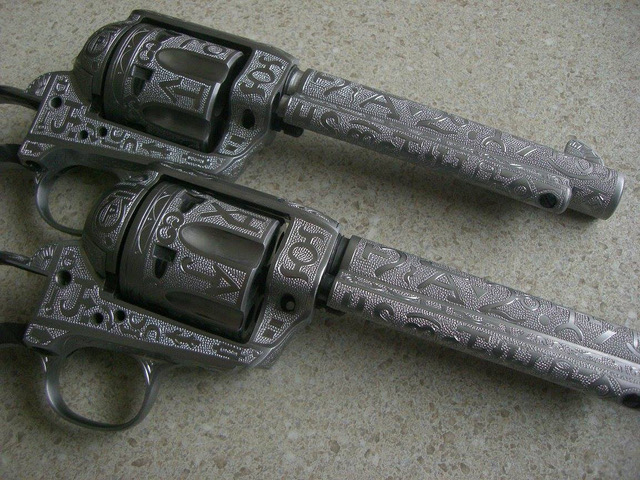
- His signature is regional and personal. Instead of covering a six-shooter with standard scrollwork, he cuts Texas cattle brands into the steel, the same marks that ranching families have burned into hide for generations. He’s done well over 400 of them for Frontier Classics, and the style is what collectors chase.
- The “jet set” part is a workaround, not a gimmick. After retiring to Portugal in 2025, he kept meeting the demand by flying to Dallas-Fort Worth every other month and working two-week stretches on Portugal time, which skips the jet lag. By his account, the guns bring strong money at auction, and he expects to keep cutting as long as people keep asking.
We recently had a chance to talk with Kelly Laster, and he told us his story and asked us to share it with you. Here it is
How Kelly Laster turned a flight schedule into a workbench, and Texas cattle brands into collector gold
Kelly Laster wakes up at 3 a.m. in a Dallas hotel room and tells himself it’s 9 in the morning. By his body’s clock, back in Portugal, it is. He pours coffee, sits down at a vise, and starts cutting steel until the early afternoon, which he counts as a full day’s work ending around 9 at night. Then he sleeps and does it again.
He keeps that up for two weeks, flies home, and comes back two months later. Four to eight finished guns leave the bench each trip. As far as anyone can tell, that makes him the world’s first jet set cattle brand gun engraver, a title he wears with a shrug and a grin.
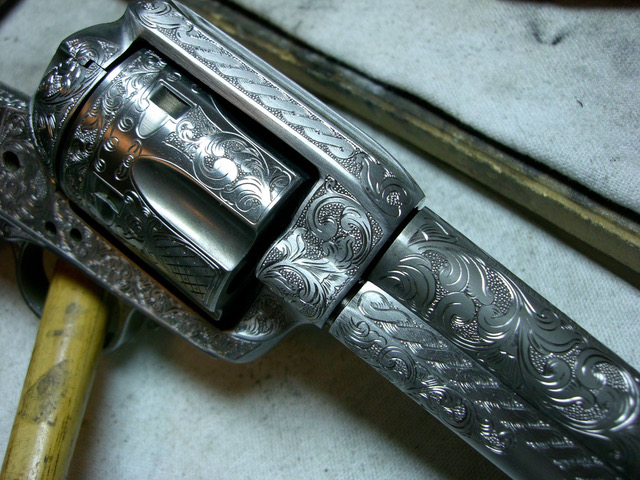
From a reading struggles to an engraver
Laster was born in Granite City, Illinois, in the spring of 1963. School was hard for him in a specific way. Reading didn’t come easily, and the frustration that accompanied it pushed him toward the one place where the work made sense: art. Years later, he learned the name for what he’d been fighting. Dyslexia. By then, he’d already found that his hands were smarter than any worksheet.
That early pull toward making things became a trade. In 1983, he enrolled at Gem City College in Quincy, Illinois, to train as a jeweler and engraver. Gem City is one of those quietly serious places, a horology and jewelry school that has been turning out watchmakers, stone setters, and engravers for generations. The engraving bench handles jewelry and diamond-setting work because the graver is the same tool for both. That overlap shaped how Laster learned: cut clean, cut small, respect the metal.
After college, he opened a small jewelry shop in Collinsville, Illinois, handling both retail and wholesale. He spent the years from 1983 to 2000 in and around the St. Louis jewelry trade, building the muscle memory that fine engraving demands.
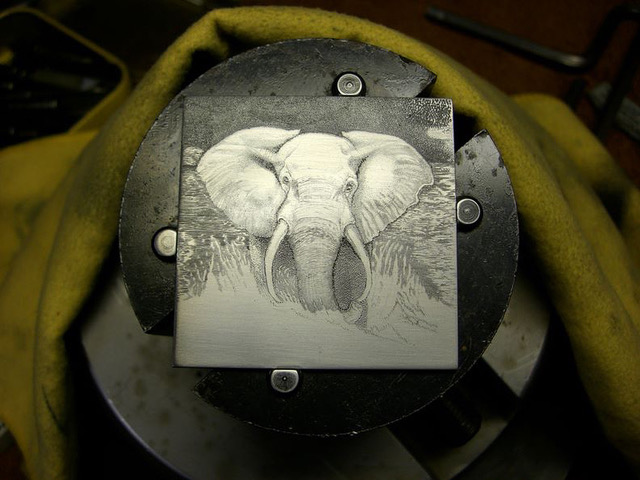
Cutting steel
In 2001, Laster moved to Kentucky and taught himself to engrave firearms. People outside the craft tend to assume gold and steel are close cousins. They aren’t.
“It was a big jump cutting steel, not at all like cutting gold and silver,” Laster said.
Gold gives way under the graver almost willingly. Steel argues back. It dulls tools, demands different angles, and punishes a heavy hand. Learning to read hardened gun steel, and to keep a scroll flowing across a curved cylinder or a fluted barrel, took years of his own trial and error before any formal polish came along.
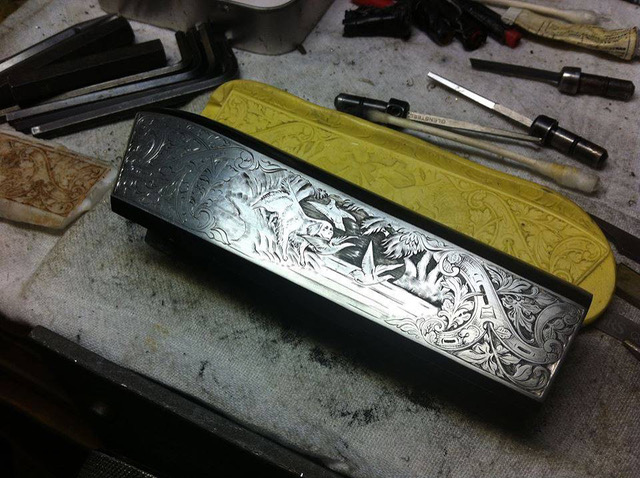
A season in Val Trompia
In 2009, Laster went to Italy to study at the Bottega Incisioni Cesare Giovanelli, the engraving school and studio above Gardone Val Trompia, in the village of Magno di Inzino. The place is something close to hallowed ground in the gun world. It sits on a mountainside in Brescia, the heart of Italian gunmaking, and its master engravers have cut work for some of the most famous names in the business. A large share of Italy’s working engravers passed through its benches.
“My teachers in Italy were unbelievable, true masters of the craft,” Laster said. “I learned so much there.”
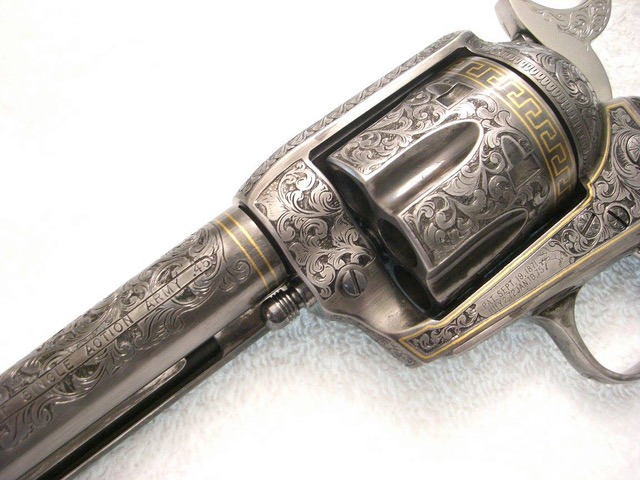
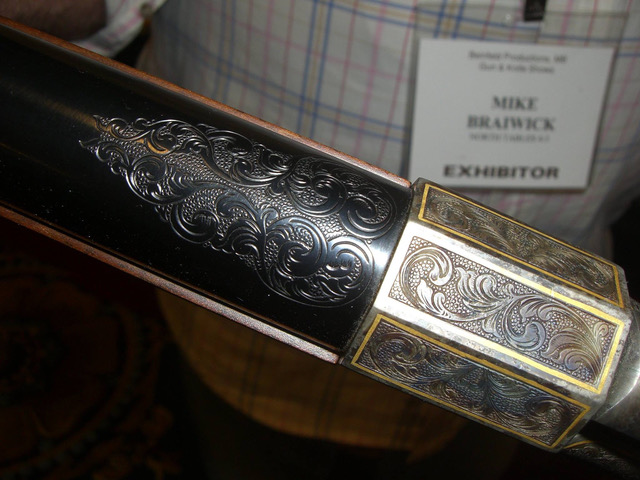
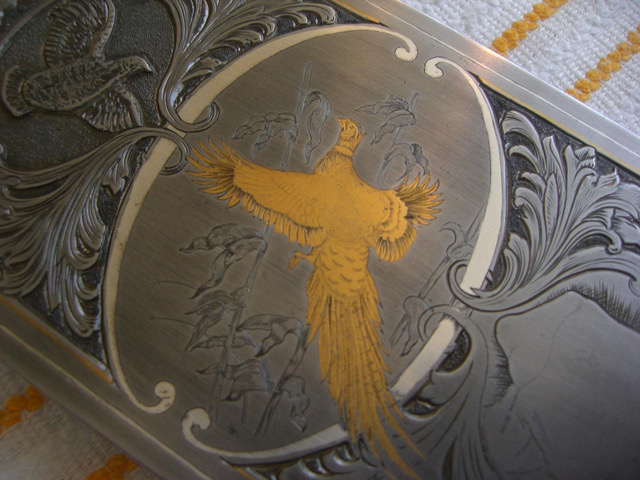
You can see the Italian influence in the way his scroll breathes, the tight backgrounds, the shaded leaves that catch light at an angle. It’s the old Brescian vocabulary, brought home and put to work on American iron.
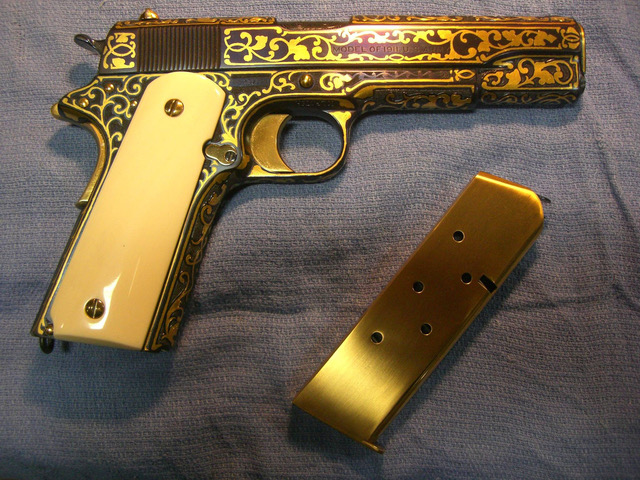
Riding the cowboy circuit
From 2003 to 2017, Laster traveled the Single Action Shooting Society circuit, cutting scrollwork on cowboy guns. SASS, founded in 1987, is the governing body of cowboy action shooting, a sport where competitors dress the part and shoot single-action revolvers, lever guns, and old-style shotguns against the clock. It’s equal parts marksmanship and theater, and the people are the draw as much as the shooting.
“Some of the most wonderful people are in SASS,” he said, and on that point he doesn’t waver.
The exposure helped. Laster’s work was featured in Guns of the Old West in the spring of 2015 and in two issues of SHOOT! magazine over the years, one of which featured his engraving on the cover. For an engraver, a cover is a calling card that money can’t quite buy.
The cattle brand idea
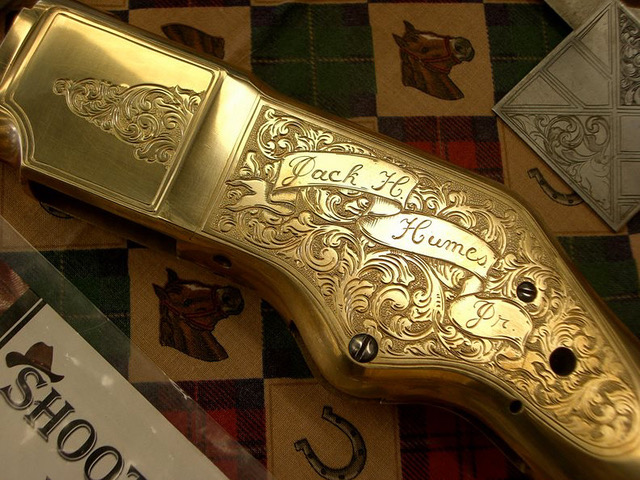
In 2015, Laster started doing something a little different. Instead of covering a six-shooter in traditional scroll, he began engraving Texas cattle brands across the steel. The marks ranching families have burned into hide for a century and a half, laid into a revolver in flowing arrangements. It’s regional, it’s personal, and it photographs beautifully.
The idea found its audience. Since then, Laster has engraved well over 400 guns for Frontier Classics out of Texas in that traditional cattle brand style. That’s not a one-off novelty. That’s a body of work.
Retired, sort of
In 2025, Laster retired and moved to Portugal. He took about a year off. The demand for his cattle brand work didn’t retire with him, though, and after a while, he found a way to keep feeding it without giving up on moving abroad.
So now, every other month, he flies to Dallas Fort Worth and settles in for two weeks at the bench. The trick is that he never leaves Portugal on time. By staying on his home clock, he skips the jet lag entirely.
“I get up at 3 a.m.; that’s 9 a.m. to me; then I work until 3 p.m., which is 9 p.m. to me,” Laster said. “Then I go to sleep and do it all again the next day.”
Two weeks of that yields four to eight finished guns per trip. It’s an odd rhythm, and it works.
What the work brings
The guns have done well at auction. Laster says that last year on GunBroker, a cattle-brand Python he engraved sold for more than $17,000, and a few weeks ago, a cattle-brand Colt Single Action Army went past $12,000. Those figures come from Laster, and auction results swing with the buyers in the room on a given day, so treat them as his account rather than a fixed market rate. Either way, the direction is clear enough. People want the style, and they’re willing to pay for the hand behind it.
It helps that there’s no factory shortcut for this. A roll die can stamp a pattern. A laser can etch one. Neither leaves the shaded, three-dimensional cut of a graver pushed by a person who can read the steel. That difference is most of the value.
One gun at a time
Laster says he plans to finish out this year, which would make 2026 his last year producing this work in the United States. He doesn’t sound entirely convinced by his own deadline.
“I say that now,” Laster said, “but I think I’ll keep on working as long as there is a demand. Hopefully I’ll be around for a long while making America beautiful one gun at a time.”
For a kid who once dreaded a page of text, it’s a fitting place to land. He found the thing his hands could say that words wouldn’t, and people keep lining up to hear it. The flights will probably continue. So will the 3 a.m. coffee.
Frequently Asked Questions
He’s a jeweler turned firearms engraver, born in Granite City, Illinois, in 1963. He’s best known for cutting Texas cattle brands into single-action revolvers.
Engraving cattle brands across cowboy guns, a regional style he started in 2015. He’s done well over 400 of them for Frontier Classics out of Texas.
Reading was hard for him as a kid, and he was later diagnosed with dyslexia, so he leaned on art instead. He trained as a jeweler and engraver at Gem City College in Quincy, Illinois, in 1983.
Gold cuts almost willingly, while steel argues back, dulls tools, and punishes a heavy hand. Laster taught himself the steel side starting in 2001 after years in precious metals.
He trained at Gem City College, then in 2009 studied at the Bottega Incisioni Cesare Giovanelli in Italy, a respected engraving school above Gardone Val Trompia. The Italian schooling shows in his shaded scroll and tight backgrounds.