
Key Takeaways:
- CZ spent most of its history making guns the West couldn’t legally buy. Trade barriers and the Iron Curtain kept these firearms off American shelves until the 1990s, so they arrived with reputations already built over decades on the other side of the world.
- The CZ 75 is the design that made the company famous and got copied everywhere. Because the communist-era patent system blocked foreign protection, manufacturers across Italy, Switzerland, Israel, and beyond built their own versions, and the slide-inside-frame architecture became one of the most borrowed in the handgun world.
- There’s a CZ worth owning at almost every price and purpose. The CZ 75B is the do-everything value pick, the Shadow 2 wins competitions off the shelf, the CZ 457 punches above its price as a rimfire, and short-rail CZ 75s and clean CZ 52s are the collector trophies.
Let’s get started…
A friend of mine bought his first CZ almost by accident. He’d gone to a gun shop to look at a Glock; the clerk had sold out, and there was a CZ 75B sitting in the case for about the same price. He picked it up, racked the slide, and felt the way the thing settled into his hand. He bought it that afternoon and has owned five more CZs since. That story repeats itself in shops all over the country, because the company from a small Moravian town has a knack for making guns that feel right and shoot straight for money that doesn’t make you wince.
CZ stands for Česká zbrojovka, which is just Czech for “Czech armory.” The name has been stamped on aircraft machine guns, Cold War sidearms, .22 trainers, and some of the most dominant competition pistols ever built. Ninety years is a long run, and the company packed a lot into it.
Here’s the thing about CZ. For most of its history, almost nobody in the West could legally buy one. Trade barriers and an Iron Curtain saw to that. So when these guns finally arrived on American shelves in the 1990s, they had reputations already built, refined over decades on the other side of the world. Collectors and shooters here have spent thirty years catching up. This is a tour through the models worth knowing, from the wartime origins to the race guns winning matches right now.
A factory born from fear
The story starts in 1936, with worry about Germany.
Czechoslovakia in the 1930s had a serious arms industry, centered for years around Brno and Strakonice. But Hitler had just remilitarized the Rhineland, and the Czechoslovak government did some grim math about how close its weapons plants sat to a hostile border. The solution was to build a new factory farther east, in the Moravian town of Uherský Brod, well away from German reach. The decision came in June 1936, and the buildings went up fast. Sources put it at roughly 16 weeks from go-to-ground.
The new plant first earned its keep by making aircraft machine guns, demanding precision work that set the tone for everything that followed. Then the Nazis arrived anyway. During the occupation, the factory was forced to produce and repair weapons for German forces, including Czech versions of the Mauser 98 rifle. That’s the dark middle chapter, and it’s worth stating plainly rather than skipping past.
After the war, the company was nationalized under the new communist government. In 1950, the Uherský Brod branch became independent, and over the following years it grew into the main Czechoslovak maker of small arms while older sites faded. One odd wrinkle from this era confuses collectors to this day: for a stretch, the central state agency required that exported guns bear BRNO markings, which is why many Uherský Brod firearms bear a name from another city.
So the factory that became modern CZ was forged by geography, war, and politics, not by some founder’s grand vision. It made the guns the state told it to make. What’s remarkable is how good some of those guns turned out to be.
The CZ 52: a Cold War oddball you can still afford
If you want to hold a piece of early Cold War Czechoslovakia, the CZ 52 pistol is the cheap ticket in, and it’s one of the stranger handguns of its generation.
Officially the vz. 52, it was designed by brothers Jan and Jaroslav Kratochvíl and entered service in 1952. About 200,000 were built over a short run, with most sources placing serious production between 1952 and 1954. It served as the Czechoslovak military sidearm until the early 1980s.
The cartridge tells you a lot about the era. The Czechs originally wanted to build the pistol around 9mm Parabellum. Political pressure from Moscow pushed them to the Soviet 7.62x25mm Tokarev instead, keeping ammunition common across the Warsaw Pact. That round is a screamer, a bottlenecked little thing that can push a light bullet past 1,400 feet per second.
What makes the 52 genuinely unusual is inside. Most pistols of its size and era used a Browning-style tilting barrel. The 52 instead uses a roller-locked short-recoil system, the same broad idea found in the German MG 42 machine gun. Two rollers came in and out to lock the barrel and slide together. It’s overbuilt, mechanically interesting, and not something you see in many handguns.
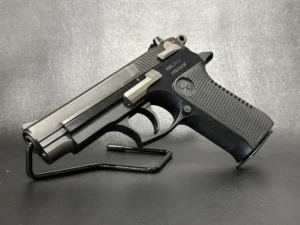
It’s also, let’s be honest, kind of ugly and not especially comfortable. The grip angle is awkward, the bore sits high, and recoil is sharp. The decocker has a reputation that ranges from “use with care” to “don’t trust it,” because worn examples can drop the hammer when you don’t want them to. None of that has stopped the 52 from being a collector favorite, partly because of the engineering and partly because surplus examples flooded into the U.S. at prices that made them impossible to ignore. A clean one with matching numbers, original holster, and two magazines is a satisfying buy.
One naming note that constantly trips people up: there’s also a vz. 52 rifle, a completely different gun. The pistol got called the “CZ 52” partly to keep the two straight on the export market.
The Scorpion vz. 61: a machine pistol that fits in a coat
Now for the gun that’s appeared in more movies than CZ probably ever wanted.
The Škorpion vz. 61 is tiny. It’s a select-fire machine pistol, about the size of a large handgun, that you can fire one-handed or shoulder using a folding wire stock. Miroslav Rybář designed it in the late 1950s, reportedly as part of his graduate thesis work at the military academy in Brno, which is a wild origin story for a weapon adopted by a national army. The design was finalized in 1961, hence the name.
It was meant for people who couldn’t carry a full-size rifle or submachine gun: vehicle crews, drivers, lower-ranking staff, security and special forces. The standard chambering was .32 ACP (7.65mm Browning), an oddly weak round for a military weapon. The choice made sense in context, because Czechoslovak police had used .32 caliber handguns since the 1920s, so the ammunition was already in the system. Later variants came in .380 ACP and 9mm Makarov, and Rybář kept developing the family, including a 9mm Luger version, before his early death in 1970.
The clever bit is a rate-reducing mechanism hidden in the grip. Left alone, a blowback gun this small in this caliber would empty its magazine in a blink, totally uncontrollable. A weight and plunger system in the pistol grip slows the cyclic rate to something a shooter can actually manage. It still runs around 850 rounds per minute, but that’s tame compared to what it would do otherwise.
Roughly 200,000 to 210,000 were built in Uherský Brod between 1961 and 1979, with Yugoslavia producing a licensed version called the M84. The Scorpion’s compact size made it popular with people CZ never intended to sell to, and it turned up in the hands of various armed groups across the 1970s and 1980s. For collectors today, the legal path is a semi-automatic pistol version, and CZ revived the concept entirely with the polymer-framed Scorpion EVO 3, a thoroughly modern 9mm that shares the name and little else.
The vz. 58: the rifle everyone calls an AK and isn’t
This is the one that starts arguments at gun counters.
Glance at a vz. 58 and you’ll swear it’s an AK-47. Same general silhouette, same curved magazine, same 7.62x39mm cartridge. Look closer, and almost nothing matches. The two rifles share no interchangeable parts, not even the magazines. The AK uses a long-stroke gas piston and a rotating bolt. The vz. 58 uses a short-stroke piston and a vertically tilting locking block. They arrived at a similar shape because physics and the same cartridge nudged them there, but the engineering underneath is entirely separate.
Here’s the part that makes Czechs proud. The Soviets pushed Warsaw Pact armies to standardize on the AK. Czechoslovakia said no. It had its own deep tradition in weapons design and chose to build an original rifle that used standard Soviet ammunition while owing nothing to Kalashnikov’s mechanism. Czechoslovakia was the only Warsaw Pact member whose standard rifle wasn’t an AK variant. That’s a genuine point of national engineering pride, and it explains a lot about how the company saw itself.
Development began in 1956 under chief engineer Jiří Čermák at the Konstrukta facility in Brno, under the project codename “Koště,” which means “broom.” The rifle was adopted in 1958, with production at Uherský Brod running from 1959 to 1984. Around 920,000 were made.
Shooters who own the semi-auto versions tend to gush about a few things. It’s light, noticeably lighter than an AK at under 7 pounds. The fit and finish on military examples is excellent, better than most contemporary Eastern Bloc arms. The bolt holds open on an empty magazine, something the AK won’t do. The trade-off is that the original guns came with milled receivers and fixed or side-folding wood-and-plastic furniture, and parts don’t interchange with the giant global AK ecosystem, so accessories cost more and show up less often.
For American buyers, the supply is a little complicated. Many of the semi-auto vz. 58 rifles sold here were newly manufactured by Czech Small Arms (CSA), not by CZ itself, in calibers including 7.62x39mm and .223. They’re well-made, but it’s worth knowing the provenance when you shop.
The CZ 75: the one that changed handguns
Everything above is interesting. This is the gun that made CZ famous, and it deserves the most space.
The CZ 75 began in the late 1960s as a commercial project, which matters because it was never meant for the Czechoslovak army. The state wanted a pistol it could export to the West for hard currency, chambered in the globally popular 9mm Parabellum rather than a Warsaw Pact round. The job went to František Koucký, brought in to design the gun more or less, however he saw fit. He worked with his brother Josef, and the two had a habit of signing patents only with their shared surname.
Koucký borrowed smart ideas and added his own. The frame rails and the camming setup drew on the excellent SIG P210. The high-capacity magazine took cues from the Browning Hi-Power. The trigger mechanism and the overall package were original. Design work ran from the late 1960s, with the gun finalized around 1975, which is where the name comes from. The first pre-production samples carried serial numbers 00001 through 00005, and at least one early gun reportedly ran past 11,000 test rounds without breaking. Production proper got going in the 1976 to 1977 window.
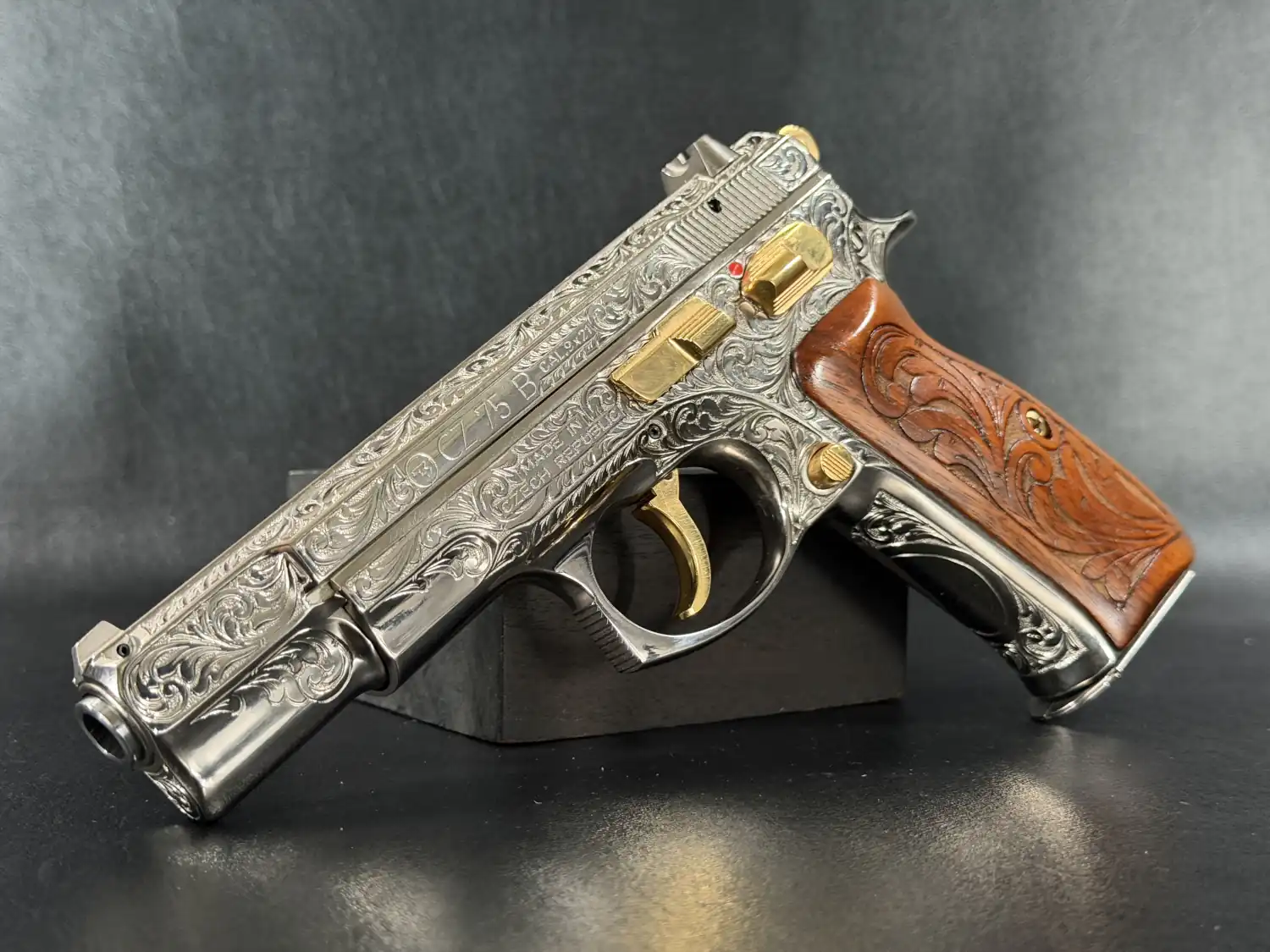
Two features set the 75 apart. First, the slide rides inside the frame rather than wrapping around the outside, the way it does on a 1911 or a Glock. That P210-style arrangement gives the slide a long bearing surface and helps the gun feel locked-up and accurate. Second, the 75 offered a double-action/single-action trigger with the option to carry cocked-and-locked, a flexible setup that wasn’t common in a high-capacity 9mm at the time. The grip geometry is the quiet hero, though. The 75 points naturally for a lot of people, and that’s the thing my friend felt in the gun shop without being able to name it.
There’s a political twist that shaped the gun’s whole history. Because of how the Czechoslovak patent system worked under the regime, the CZ 75 design essentially couldn’t be protected abroad. Koucký and the company were blocked from filing foreign patents. The result was predictable. Once the world saw how good the design was, manufacturers everywhere started building their own versions. Italian, Swiss, Israeli, and other companies produced CZ 75 derivatives, and the basic architecture became one of the most copied in the handgun world. CZ designed a classic and then watched everyone else borrow it freely.
The collector hierarchy within the 75 family is roughly as follows.
The earliest guns, made from 1975 to 1979, are the “short rail” or “slab side” models, distinguished by frame rails that are physically shorter than later versions, plus a rounded trigger guard and a particular hammer shape. Only about 16,000 of these were built, with the last trickling out in early 1980. They were forged from high-quality steel and hand-finished, work that was affordable thanks to cheap labor in socialist Czechoslovakia. Firearms authority Jeff Cooper rated the original short-rail 75 the best 9mm service pistol made, and collectors chase these accordingly.
After that came the “Pre-B” guns, with full-length rails but still no firing pin block safety. Then, in the early 1990s, the CZ 75B arrived, the “B” denoting the internal firing pin safety, and it became the standard production model that most people picture today. There’s a left-handed-friendly CZ 85 variant, compact versions, decocker models, and many others. More than a million CZ 75 pistols of all types have been built. In a nice piece of continuity, CZ announced in 2026 a model called the CZ 75 Legend that brings back the look and the short-rail design of the original.
If you’re buying, a current CZ 75B is one of the better values among full-size steel handguns, full stop. If you’re collecting, the short-rail guns are the prize, and originality matters enormously, so learn the markings and the variant details before you spend.
The competition era: SP-01, Shadow, and the race guns
The CZ 75’s accuracy and grip made it a natural starting point for competition, and over the past twenty years, CZ has turned that potential into a winning machine.
The lineage runs through the CZ 75 SP-01, a full-size, rail-equipped evolution of the 75 introduced in the mid-2000s. The closely related P-01 even earned a NATO stock number and saw service use. From the SP-01, CZ and its custom shop developed the SP-01 Shadow, an all-steel pistol built for the IPSC Production division. It worked. The platform took first place in Production at the 2005 IPSC World Shoot and went on to dominate that division for about a decade.
In 2016, CZ replaced the original Shadow with the Shadow 2. Rather than just hot-rodding the SP-01, the company reengineered it as a purpose-built competition pistol, working closely with shooters on the CZ team and designing it to deliver top performance straight from the box without heavy hand-tuning. The Shadow 2 is all steel, with a low bore axis, an extended barrel, aggressive grips, and a tuned DA/SA trigger. It runs a 17-round magazine, sometimes more with competition mags. CZ claimed top shooters could shave seconds off their stage times compared to the original Shadow.
It backed up the talk. The Shadow 2 became one of the most-used pistols in IPSC Production and Production Optics, carried by champions including Eric Grauffel. CZ later added an optics-ready version in 2020 and a lighter, aluminum-framed Shadow 2 Compact in 2023, as well as a Carry variant aimed at defensive use.
Running alongside the Shadow guns is the Tactical Sport line, the TS and TS2. These are larger single-action-only pistols built on the bigger CZ 97-sized frame, originally centered on .40 S&W, made to rule the Standard, Limited, and Open-adjacent divisions where the Shadow’s size and DA/SA trigger weren’t the right fit. People often assume the Shadow and TS are close relatives. They’re really separate tools for separate jobs.
For a buyer, the Shadow 2 is heavy, which is the entire point. The mass soaks up recoil and keeps the sights flat during fast strings. It’s not a carry gun for most people, and it isn’t trying to be. It’s one of the best out-of-the-box competition pistols you can buy, and that reputation is earned on scoreboards, not in ad copy.
The rimfire quiet achievers: from BRNO trainers to the CZ 457
Not every great CZ is a fighting gun. Some of the company’s most beloved products are humble .22 bolt rifles, and they trace back further than the famous pistols.
The line starts during the war with the Model 1, the ZKM-451, a .22 trainer developed around 1943 to 1944 under German occupation, designed by Josef Koucký. From there came a series of BRNO-branded rimfires. The Model 2, also known as the ZKM 452, arrived in the mid-1950s and ran in regular production for an astonishing stretch, from 1954 all the way to 2011 in its various forms. These were old-school guns of blued steel and walnut, hammer-forged barrels, accurate and tough, and they sold by the hundreds of thousands worldwide even while trade barriers kept them out of American hands.
When CZ-USA opened in the late 1990s, the door finally swung open, and the CZ 452 became a quiet hit in the States, prized for accuracy and value. CZ updated it to the CZ 455 around 2010, and the big change was modularity. The 455 used a CNC-machined receiver to tighter tolerances and, crucially, standardized the receiver footprint, barrels, and triggers across the lineup so you could swap calibers and parts the way Ruger 10/22 owners had long enjoyed. The folks at CZ-USA reportedly pushed for that, eyeing the aftermarket culture around the AR-15 and 10/22.
The current model is the CZ 457, introduced in 2019. It keeps the modular switch-barrel design, adds a short 60-degree bolt throw for better scope clearance, a forward-to-fire safety, and one of the best adjustable triggers in any factory rimfire. Cold-hammer-forged barrels are made in-house, and select match-chambered .22 LR models carry a 1 MOA accuracy guarantee with good ammunition. If you want a serious .22 that won’t embarrass itself next to rifles costing far more, this is one of the first guns I’d point anyone toward.
There’s also the centerfire CZ 527, a lovely little bolt-action built around small cartridges like .223 and 7.62x39mm, with a set trigger and a controlled-feed action, made from 1990 until its discontinuation in 2021. Used examples have a devoted following.
Where CZ sits now
The modern company looks very different from the state-run plant of the Cold War.
CZ was privatized in the early 1990s as the country left communism behind. CZ-USA was established to handle the American market in the late 1990s, and that move, more than anything, is why so many of these guns are now familiar to U.S. shooters. The Czech military’s decision to continue developing its own rifles also continued. The aging vz. 58 led to the CZ 805 BREN, adopted in 2011, which was criticized as overly complex and then refined into the simpler, lighter CZ BREN 2. That rifle now serves the Czech army, France’s GIGN, the Portuguese army, and others, with licensed assembly underway in Ukraine.
The corporate story took its biggest turn in 2021, when the parent company, then called Česká zbrojovka Group, acquired the iconic American maker Colt and renamed itself Colt CZ Group. A Czech firearms maker that Western buyers couldn’t legally touch for half a century now owns one of the most storied names in American gunmaking. That’s a genuine reversal of fortune, however you frame it.
Frequently Asked Questions
No. It looks like an AK and uses the same 7.62x39mm cartridge, but it shares no parts with the Kalashnikov, including the magazines, and uses a different short-stroke piston and tilting locking block.
The short-rail guns (1975 to 1979) have physically shorter frame rails, no firing pin block, and were forged and hand-finished, making them the collector prize. The CZ 75B is the standard modern model, with an internal firing pin safety and full-length rails.
For a stretch under communist rule, the central state agency required that exported guns bear BRNO markings, even when they were made elsewhere. That’s why many Uherský Brod firearms bear a name from another city.
It’s a strange, overbuilt Cold War pistol with an unusual roller-locked action and a screaming 7.62x25mm cartridge, and surplus prices make it an easy way into the era. Just know the grip angle is awkward, recoil is sharp, and the decocker shouldn’t be trusted on worn examples.
For one gun that does almost everything well for sensible money, the CZ 75B is the answer. If you shoot competition, the Shadow 2 is among the best you can buy off the shelf.