
Beretta’s best, across five centuries

Table of Contents

Key Takeaways:

  • Beretta has been making guns since 1526 and is still run by the founding family, which makes it the oldest active firearms maker and one of the oldest companies of any kind still operating.
  • The Model 92 won the US military contract in 1985 and served as the M9 for over three decades, carried through Panama, the Gulf War, Iraq, and Afghanistan before SIG’s M17/M18 replaced it.
  • Shotguns are where Beretta quietly dominates, accounting for about three-quarters of sales, with the 686 Silver Pigeon sitting at the affordable end and the hand-built SO sidelocks running past $100,000.

A receipt from 1526 is where this story starts. Not a blueprint, not a famous battle, just a payment record from the Arsenal of Venice for 185 arquebus barrels, delivered by a barrel maker named Bartolomeo Beretta out of a forge in Gardone Val Trompia. The Arsenal paid him 296 ducats, roughly a kilo of gold. That transaction is the oldest documented sale anyone has found, so 1526 became the official birthday.

Here’s the part that still surprises people. The same family runs the company today, fifteen generations later, which makes Beretta not just the oldest gunmaker on earth but one of the oldest businesses of any kind still operating. Older than the telescope. Older than Jamestown.

So when you pick up a Beretta, whatever it is, you’re holding the latest output of an unbroken line that predates most of the countries its guns have served. That’s worth knowing before we get into the specific models. Five hundred years is a lot of guns, and not all of them matter equally. The ones below are the models that earned their place, either by being carried into history or by being so good that hunters and shooters never stopped buying them.

The early pistols nobody remembers, and the one that mattered

Beretta made barrels for centuries before it made complete firearms. The shift came late, in 1915, when World War I created sudden demand and the company’s chief engineer, Tullio Marengoni, designed its first semi-automatic pistol. If you don’t know Marengoni’s name, you should. The man spent something like 35 years shaping what a Beretta pistol is, and his fingerprints are on guns that are still in production.

The Model 1915 was a stopgap, chambered for the weak 9mm Glisenti and built fast for a wartime army. Only about 15,000 of the original version were made, with more of the improved 1915/17. It’s a footnote, except that it started everything. Marengoni gave it an open-top slide, and that cutaway slide became the visual signature you can spot on a Beretta from across a room a century later.

He kept refining. The Model 1923 added the ring-shaped external hammer, another Beretta trademark. The 1931 brought the curved finger-rest on the magazine baseplate. None of these sold in big numbers. They were rehearsals.

Model 1934: Italy’s workhorse pistol

Then came the one that mattered.

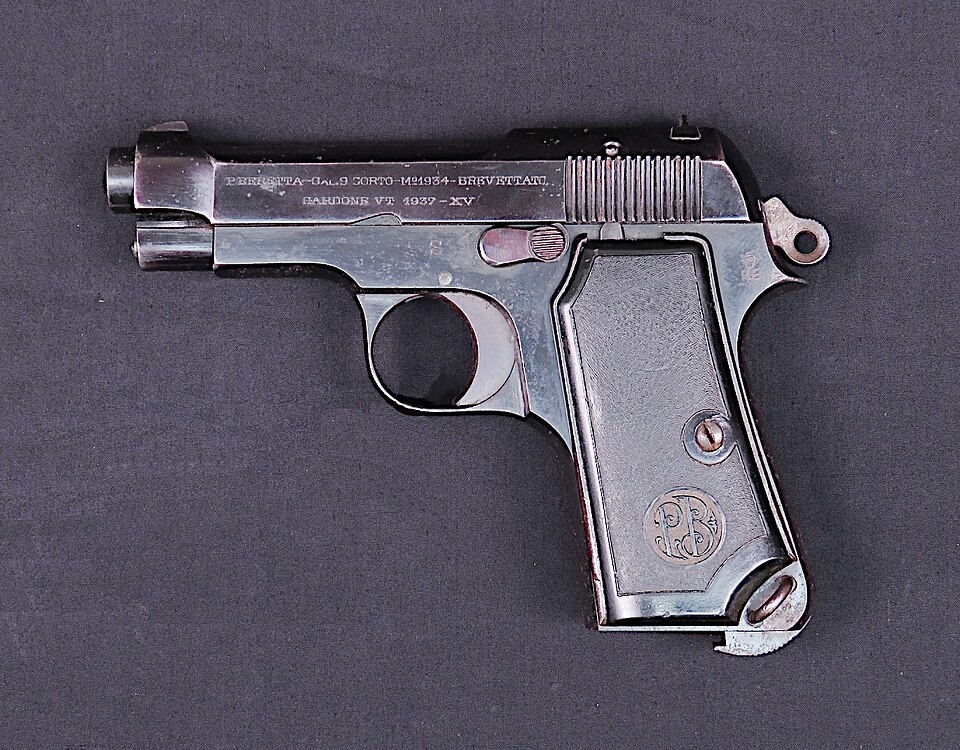
In the early 1930s the Italian army got a look at the Walther PP and liked it. Beretta, not wanting to hand a major contract to a German rival, took Marengoni’s existing design and chambered it for 9mm Corto, which Americans call .380 ACP. The result was the Model 1934.

It’s a simple blowback pistol, compact, with that open slide and a stubby curved grip that fits the hand better than it looks like it should. Nothing fancy. The barrel stays fixed when you fire. There are few parts, and it shrugs off neglect, with a service life people put at over a century if you take care of it.

The Italian army adopted it formally in 1936 and bought close to 400,000 by 1940. Total production ran past a million across its life. It went everywhere Italy went, which in those years meant Abyssinia, the Spanish Civil War, and then the whole sprawl of World War II. Germany issued captured and contract examples as the Pistole P671(i). Romania and Finland carried them too.

Now, it wasn’t a great combat pistol in the way a 1911 was. The .380 round is on the light side, the trigger is creepy, and the loose barrel-to-frame fit means accuracy tops out around four inches at 25 meters with service ammo. It also kicks harder than a gun that small has any right to, with a sharp slap to the web of the hand. Veteran reviewers were honest about all of this even decades ago.

But none of that stopped it from being the single most-issued Italian pistol of the war, and it stayed in Italian police and military service into the 1990s. For GIs and Tommies coming home, a captured 1934 was a prized souvenir, which is a big reason so many turned up in American gun cabinets after 1945. For a collector today, that combination of huge production and wartime history makes the 1934 an accessible entry point. They’re around, they’re affordable relative to a lot of WWII pistols, and the story attached to each one is real.

Model 38: the best submachine gun almost nobody talks about

While Marengoni was perfecting pocket pistols, he was also building what may be the finest pistol-caliber automatic weapon of the entire war. That’s a big claim. Forgotten Weapons puts the Model 38A in its top five WWII submachine guns, and it’s hard to argue.

The lineage traces back to the Villar Perosa, the odd twin-barreled gun from World War I that was arguably the world’s first submachine gun, then through Beretta’s own Model 1918. Marengoni started the Model 38 design around 1935 and the production version came in early 1938. It was first issued to Italian colonial police in Africa before the army took it on.

What made it good was the same thing that made all good Berettas good: build quality. The early 38A was milled from forged steel, weighed about nine and a half pounds empty, and was finished like a sporting gun. It chambered a proper 9mm Parabellum cartridge (most Italian arms used the weaker Glisenti), fired around 600 rounds per minute, and the combination of weight, that moderate rate, and a big muzzle compensator made it controllable in a way most subguns of the era weren’t. German troops who got their hands on them judged them heavy but reliable and beautifully made. Italian partisans who pried them loose preferred them over the British Sten by a wide margin.

The catch was cost. Italy’s industrial base was thin, and the 38A took too many machine-hours. So Marengoni simplified it. He dropped the cooling jacket and the bayonet mount, machined the firing pin into the bolt face, and switched to sheet-metal construction. That became the 38/42, produced from late 1942 to the end of the war, and it’s the version that finally got mass-produced once Italy’s wartime situation came apart in 1943.

The Model 38 family soldiered on long past the war. Variants stayed in production into the 1960s and served police and ceremonial roles for decades. The Italian Navy was still using them well into the 2000s. Total production across all versions came to roughly a million.

For collectors, the early machined 38A is the prize, though as a select-fire weapon it sits behind NSFA paperwork and a serious price in the US. The simplified later guns turn up more often. Either way, this is the Beretta that fighting men respected most in the field, and it deserves more recognition than it gets.

The little cats: 950, Bobcat, and Tomcat

Let’s lighten things up, because Beretta has a whole family of guns built around one clever trick.

By the early 1950s Beretta wanted a modern pocket pistol. The answer was the Model 950, and its signature feature was the tip-up barrel. Press a lever on the frame and the barrel pivots up at the muzzle, exposing the chamber so you can drop a round straight in without racking the slide. That’s a genuine help for anyone with weak hands or arthritis, and it’s just plain satisfying to use.

The 950 came in .22 Short (the Minx) and .25 ACP (the Jetfire). These were single-action, hammer-fired, and tiny, and the Jetfire in particular sold better than anything Beretta had made up to that point. The 950 design hung on in production all the way to 2003, which tells you something about how right they got it.

The story gets tangled by US gun law. The Gun Control Act of 1968 set import point requirements that the little 950 couldn’t meet, which pushed Beretta toward building in America. When Beretta USA set up in Accokeek, Maryland, the company developed updated, domestically-made versions. The Model 21A Bobcat arrived in 1984, a double-action evolution chambered in .22 LR or .25 ACP, and it’s still in the catalog today. The .32 ACP Tomcat (model 3032) followed in 1996, giving the line a bit more punch.

A couple of honest caveats on these. The Bobcat has no extractor; it relies on gas pressure to blow the spent case clear, which makes it picky about ammo. The double-action trigger pull on that first shot is heavy, around twelve pounds, and the tiny sights are nearly useless past close range. Early Tomcats had a reputation for cracking frames, since corrected with a beefier slide. None of that has dented their appeal. In 2020 Beretta added threaded-barrel Covert models, and the little cats found a second life as suppressor hosts. They’re not the most practical carry guns made, but few pocket pistols are this charming to own.

Model 92: the gun that became the M9

This is the big one, the model that put Beretta in the holster of every American serviceman for a generation.

The 92 didn’t come from nowhere. Trace its DNA back and you find the open slide of the old M1923 and, more importantly, the locking system of the post-war Model 1951 “Brigadier,” Beretta’s first locked-breech pistol, which borrowed a falling locking block from the Walther P38. Designers Carlo Beretta, Giuseppe Mazzetti, and Vittorio Valle did the work on what the company called the “92 Project,” and the Model 92 was presented in 1975. Italy’s combat divers and the Brazilian army were early adopters.

Then the US went shopping. The military had been carrying the M1911A1 since, well, 1911, and production of new ones had stopped in 1945. The search for a replacement kicked off in earnest through the Joint Services Small Arms Program, and Beretta entered an improved 92, the 92SB-F, against the SIG P226, Smith & Wesson, H&K, and others. The guns were tortured through hundreds of thousands of rounds.

Beretta won. In early 1985 the military adopted the pistol as the “Pistol, Semiautomatic, 9mm, M9.” The decision was bitter and contested. Losing manufacturers filed legal challenges, the General Accounting Office investigated, and Congress eventually stepped in, letting the first Beretta contract stand while ordering future competitions to stay open. Smith & Wesson in particular cried foul over the testing. Beretta’s edge in the second round of bidding came down partly to price; they underbid SIG.

The early service years brought a real scare. Several 92F slides cracked and separated during testing and Navy use, with the rear of the slide flying back toward the shooter’s face. There were fourteen failures in all, eleven in testing and three in service. The investigation got complicated, and a fair reading puts much of the blame on out-of-spec ammunition and test procedures rather than the gun itself, but Beretta still added an enlarged hammer pin that would catch a broken slide. That fix created the 92FS, which became the definitive version. The military made Beretta retrofit roughly 150,000 pistols already delivered.

To build for the contract, Beretta put up a plant in Accokeek, Maryland in 1986, then opened a second factory in Tennessee in 2016. The M9 went to war everywhere America did: Panama, the Gulf War, Somalia, the Balkans, Iraq, Afghanistan. It earned a mixed reputation. Plenty of troops trusted it for its accuracy, soft recoil, and durability. Others never forgave it for replacing the .45. One Marine first sergeant, Bradley Kasal, fought his way through the Second Battle of Fallujah with an M9 in hand and earned the Navy Cross.

The platform branched out. The Model 96 was the same gun in .40 S&W, built for police departments that adopted that cartridge, though demand faded as .40 did. The M9A1 added a rail and better magazines for the Marines in 2005. Later came the M9A3 and M9A4 with more modern features.

In 2017 the long run ended. After the Modular Handgun System trials, the Army picked the SIG Sauer P320 as the M17 and M18, and Beretta didn’t make the final round. The last US military contract M9 left the factory in 2021. M9s lingered in Marine Corps hands as late as 2023. Over more than three decades, the Army alone bought over 600,000 of them.

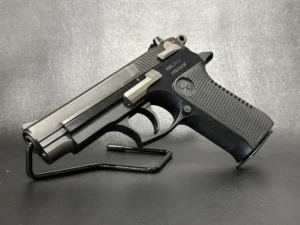
For buyers, the commercial 92FS is still made and still excellent, a full-size all-metal pistol with a feel that polymer guns can’t replicate. For collectors, early Italian-marked 92s and genuine military-issue examples carry a premium, and the historical weight here is obvious. Whatever you think of the 9mm-versus-.45 argument, the M9 is the sidearm that defined American service for a generation, and that’s not a small thing to own a piece of.

The shotguns: where Beretta quietly reigns

Here’s something that gets lost behind the military pistols. Sporting arms make up about three-quarters of Beretta’s sales. The company that built the M9 is, first and foremost, one of the great shotgun makers in the world, and it has been for nearly a hundred years.

The over/under story starts in 1933 with the S1, Beretta’s first modern stack-barrel gun and the first Italian over/under. That gun seeded the SO series, hand-built sidelock shotguns that became, by reputation, some of the finest competition and game guns ever made. The SO line evolved into today’s SO10 and the SO Sparviere, and “finest” is not marketing fluff here. These are custom-order guns with over 100 hours of hand engraving, no visible screws, walnut chosen to the customer’s specification, and prices that start around $100,000 and climb past $125,000. They’re heirlooms, bought to be handed down. If you ever get to handle one at a Beretta Gallery, do it.

But the shotgun most shooters actually own is the 686.

The 680 series launched in 1979 as a more attainable over/under built on a low, slim, strong action with a distinctive locking system: trapezoidal shoulders and dual conical lugs that keep the gun shooting loose-free for a very long time. Beretta says more than a million of these actions are in use, many of them past 30 years old and still tight. The 686 Silver Pigeon sits at the entry point of the line, which at street prices under $3,000 is a relative term these days, and it remains one of the best values in a quality field over/under. The family climbs through the 687 and various Silver, Gold, and Diamond Pigeon grades with progressively better wood and engraving.

I’ll add one small real-world note from the reviews, because it’s the kind of thing that catches new owners off guard. The tang safety on a fresh 680-series gun is stiff. Mine loosened with use, and a thirty-year-old 686 will flick off like silk. If you don’t want to wait, a gunsmith can sort it cheaply. It’s not a flaw worth walking away from a 686 over.

On the semi-auto side, Beretta’s modern guns run the BLINK gas system, a fast-cycling design shared with the A400 sporting shotguns. It migrated into the tactical world through the TX4 Storm and then the 1301 Tactical, which Beretta brought to the US around 2013 and put into production in 2014. The 1301 is a serious home-defense and duty shotgun: an 18.5-inch barreled, roughly 6.5-pound gun that cycles, by Beretta’s claim, 36 percent faster than the competition. Fast enough that testers have put four rounds on target inside a single second. It runs everything from light birdshot to slugs without choking, which is the whole point of a gas gun done right. It’s not as famous as the Benelli M4, but it’s earned a devoted following.

What to actually buy

If you want history you can afford, the Model 1934 is the play. Huge production, real WWII provenance, and prices that won’t scare you.

If you want a piece of American service history, a commercial 92FS or a genuine M9 puts the gun a generation of soldiers carried in your hands, and the all-steel build feels like nothing made today.

If you want a shotgun you’ll pass to your kids, the 686 Silver Pigeon is the sweet spot. The SO guns are the dream, but the 686 is the one most of us will buy and never regret.

And if you just want something fun and a little odd, flip up the barrel on a Bobcat and you’ll understand why Beretta has kept that trick alive for seventy years.

Five hundred years in, the family in Gardone Val Trompia is still making guns worth knowing. Not many companies of any kind can say they’ve been at it that long. None of the others can hand you a working firearm at the end of the sentence.


Frequently Asked Questions

How old is Beretta?

The company dates to 1526, when Bartolomeo Beretta sold 185 arquebus barrels to the Arsenal of Venice. That makes it the oldest active firearms maker and one of the oldest companies of any kind still running, owned by the same family across 15 generations.

What is the Beretta M9?

It’s the military version of the Model 92 pistol, adopted by the US military in 1985 to replace the M1911A1. It served as the standard sidearm for over three decades before SIG’s M17 and M18 replaced it after 2017.

Is the Beretta 92 still made?

es. The commercial 92FS is still in production, a full-size all-metal pistol that feels different from the polymer guns that dominate today.

What’s the best Beretta shotgun to buy?

For most shooters, the 686 Silver Pigeon hits the sweet spot, with a strong 680-series action and prices well below the custom guns. If money’s no object, the hand-built SO sidelocks are the dream, though they start around $100,000.

What was the Model 1934?

It was Beretta’s main WWII service pistol, chambered in .380 ACP, with over a million made. Its huge production and wartime history make it an affordable entry point for collectors.

Love this article? Why not share it...

Michael Graczyk

As a firearms enthusiast with a background in website design, SEO, and information technology, I bring a unique blend of technical expertise and passion for firearms to the articles I write. With experience in computer networking and online marketing, I focus on delivering insightful content that helps fellow enthusiasts and collectors navigate the world of firearms.

Leave a Reply

Your email address will not be published. Required fields are marked *

Related News

Beretta’s best, across five centuries

A receipt from 1526 is where this story starts: not a blueprint or a famous battle, just a payment record from the Arsenal of Venice for 185 arquebus barrels delivered by a barrel maker named Bartolomeo Beretta. Five hundred years and fifteen generations later, the same family is still making guns worth knowing, from the Model 1934 that armed Italy through two wars to the 92 that rode in every American serviceman’s holster for a generation.

Read More »

The guns that built a Czech legend: CZ’s best across nine decades

A friend of mine bought his first CZ almost by accident, picked it up off the shelf because the Glock he wanted was sold out, and has owned five more since.A friend of mine bought his first CZ almost by accident, picked it up off the shelf because the Glock he wanted was sold out, and has owned five more since. That story repeats in gun shops everywhere, because the company from a small Moravian town has spent ninety years making firearms that feel right and shoot straight for money that doesn’t make you wince.

Read More »

Springfield Armory: the guns that built a name, twice

There are really two Springfield Armories: a federal arms factory that ran for nearly two centuries in Massachusetts, and a private Illinois company founded in…There are really two Springfield Armories: a federal arms factory that ran for nearly two centuries in Massachusetts, and a private Illinois company founded in 1974 that bought the name. From the 1873 trapdoor and the M1 Garand to today’s Hellcat and Echelon, knowing which armory made what is most of what separates a smart purchase from a confused one.

Read More »

Availability Notification

Some pieces never make it to public listing. Join our private notification list to be the first to know when exceptional firearms become available.

Name