
Key Takeaways:
- “Cutaway” describes an exposed mechanism; it does not establish who performed the work or why.
- Documentary provenance is essential when attributing a cutaway to a factory or military program.
- A nonfunctional cutaway can remain federally regulated, particularly when it retains a qualifying frame or receiver.
A cutaway firearm exposes the machinery normally concealed inside its frame, receiver, slide, or stock. Carefully placed openings may reveal the trigger and sear, locking system, magazine, chamber, safety, or extraction mechanism. When movable parts remain intact, the operating cycle can be observed without disassembling the firearm.
That educational value explains why cutaways appear in museums, military classrooms, factory collections, and sales demonstrations. After an eight-month, $12 million renovation, the Cody Firearms Museum in Wyoming reopened in July 2019 with more than 10,000 artifacts in 40,000 square feet.[1] Its introductory exhibits let visitors operate representative actions and explore how different firearm types function before entering the main galleries.[2]
Cutaway Is a Description, Not a Provenance
Collectors commonly use “cutaway” for a firearm from which material has been deliberately removed to expose internal components. The term does not identify who performed the work.
A cutaway may have been made by the original manufacturer, a military organization, an instructional program, a gunsmith, or a private owner. These origins are not equivalent. Factory and military examples can be historically significant teaching or engineering artifacts. An ordinary firearm altered later without documentation may have little value beyond its usefulness as a demonstration piece.
The attribution must therefore rest on evidence rather than appearance alone. Relevant evidence can include factory records, military markings, period photographs, instructional manuals, correspondence, published collection records, and a documented chain of ownership.
Factory Demonstration Pieces
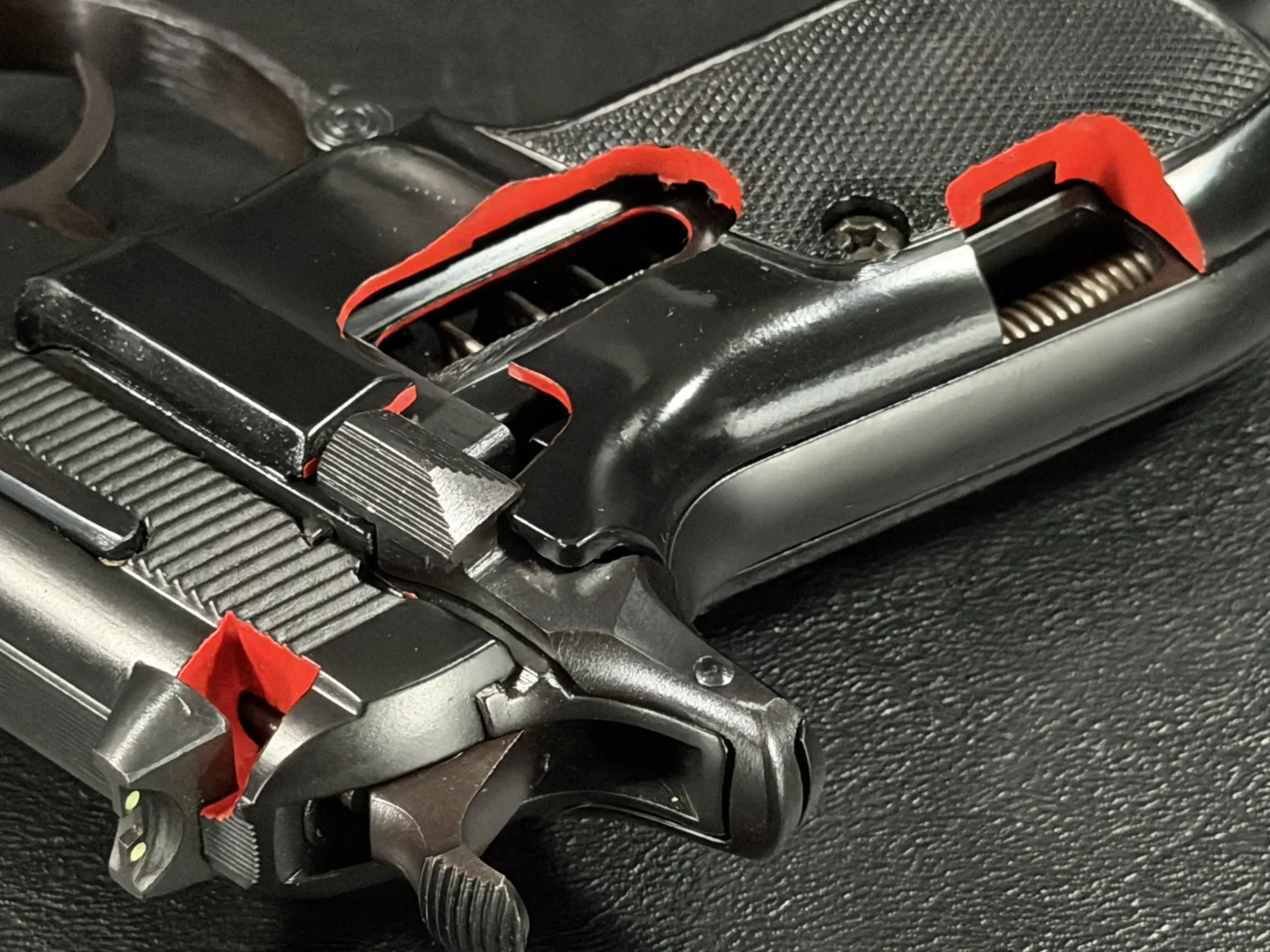
Factory cutaways were built to show how a design worked. Windows were positioned to reveal specific mechanical relationships, and the action could often still be operated manually.
A Savage Model 1907 pistol offered by Rock Island Auction Company in 2022 illustrates the form. The pistol had 17 separate viewing windows exposing much of its internal mechanism. The borders of those windows were painted red for visibility. Its reported factory provenance relied partly on a letter from Savage pistol authority Bailey Brower Jr., which connected the firearm to material acquired from the company’s research-and-development holdings.[3]
That documentation does not establish general production figures or prove how every Savage cutaway was constructed. It supports the history attributed to that particular pistol. This distinction is essential when evaluating any unusual firearm: physical features establish what the object is, while records help explain where it came from and why it was made.
Oversized Military Trainers
Some instructional cutaways were models rather than altered production firearms. During the Second World War, the United States used enlarged mechanical trainers that allowed an instructor to demonstrate an operating system to an entire classroom.
Surviving examples include trainers representing the Browning Automatic Rifle, M2 Carbine, M1919 machine gun, and M1 Garand. The Browning Automatic Rifle trainer was designated M23 and identified in training literature as Device 3-F-3. Examples described by Rock Island Auction Company measure approximately 95 inches long and use exposed, movable components to demonstrate loading, extraction, ejection, trigger operation, gas-piston movement, and other parts of the operating cycle. Wartime examples were manufactured by J.H. Keeney & Company of Chicago.[4]
These enlarged trainers should be evaluated as purpose-built instructional equipment. Identification plates, military nomenclature, working components, original stands, magazines, simulated ammunition, and documented institutional use can all contribute to their significance.
Cutaway and Deactivated Do Not Mean the Same Thing
A cutaway exposes a mechanism. Deactivation attempts to prevent a firearm from operating. An object can be both, but neither condition automatically proves the other.
The distinction is especially important with Deactivated War Trophies, or DEWATs. Federal court records describe the postwar program under which qualifying military firearms could be retained after prescribed deactivation. The regulatory treatment of these firearms changed with the 1968 revisions to federal firearms law.[5]
Current ATF guidance states that a DEWAT covered by the National Firearms Act remains an NFA firearm despite being unserviceable. It must be registered. An approved transfer of an unserviceable NFA firearm as a curio or ornament is conducted tax-exempt on ATF Form 5.[6]
A properly registered unserviceable NFA firearm may be reactivated only through the applicable federal approval and registration process. ATF states that reactivation by a person other than a qualified manufacturer requires an approved Form 1 and payment of the applicable making tax before the work is performed.[7]
Registration and transfer documents are consequently part of the collectible object. They should remain with the firearm and be examined before ownership changes.
Legal Status Turns on the Actual Object
Cutting openings into a firearm does not automatically remove it from federal regulation. Federal rules provide that a frame or receiver can remain regulated even when it is incomplete, disassembled, or nonfunctional.[8]
National Firearms Act classifications require particular care. Federal law defines a machine gun to include its frame or receiver.[9] A cutaway or deactivated machine-gun receiver therefore cannot be presumed unregulated merely because it is incapable of firing in its present condition.
Descriptions such as “dummy,” “display,” “non-firing,” or “DEWAT” are not substitutes for classification and registration records. Before a purchase or transfer, the object’s markings, construction, registration status, and applicable federal, state, and local requirements should be established.
Evaluating a Cutaway
Provenance is the first consideration. Factory correspondence, military records, instructional manuals, period photographs, museum documentation, and an unbroken ownership history carry more weight than a seller’s unsupported attribution.
Workmanship should be consistent with the stated purpose. A demonstration cutaway normally exposes components in a mechanically logical sequence. Cut edges may be finished, labeled, or color-coded. Military teaching equipment may be utilitarian, but its construction should still correspond with authenticated examples.
Completeness also matters. Cutaways and trainers often contain exposed springs, pins, removable panels, magazines, dummy cartridges, or simulated ammunition. Because these objects were handled repeatedly, small components are frequently missing. Replacements should be identified rather than represented as original.
Condition must be interpreted in context. Wear from documented classroom use can be part of an artifact’s history. Refinishing or undocumented reconstruction is more problematic when it conceals markings, changes exposed surfaces, or interferes with authentication.
Rarity claims demand restraint. An unusual configuration does not establish a production total, and the absence of another known example does not prove uniqueness. Claims such as “one of a kind” should be supported by surviving records and serious comparative research.
Mechanics on Display
A documented cutaway can preserve more than the architecture of a firearm. It can record how a manufacturer presented a design, how an institution taught it, or how military personnel learned to operate and maintain it.
The strongest examples combine an instructive mechanism, workmanship consistent with their stated origin, documentary provenance, and clear legal status. Without those elements, a cutaway may be merely an altered firearm. With them, it becomes evidence of how firearms were engineered, explained, and understood.
Frequently Asked Questions
A cutaway firearm has material deliberately removed to expose internal components such as its trigger, locking system, chamber, or safety.
No. Manufacturers, military organizations, instructional programs, gunsmiths, and private owners have all produced cutaways.
No. A cutaway exposes a mechanism, while deactivation is intended to prevent operation; an object may be both, but the terms are not interchangeable.
Documented origin, period workmanship, mechanical completeness, and evidence of factory, military, or institutional use support historical significance.
It can be. Under federal rules, a nonfunctional frame or receiver may remain regulated, and National Firearms Act classifications require particular care.
Sources
- Buffalo Bill Center of the West. “Cody Firearms Museum Announces Grand Opening.” June 5, 2019.
- Buffalo Bill Center of the West. “Cody Firearms Museum Exhibits.”
- Rock Island Auction Company. “Documented Factory Cutaway Savage Model 1907 Pistol.” Auction record, December 10, 2022.
- Rock Island Auction Company. “Big Guns for When the Going Gets Tough.”
- United States Court of Appeals for the Sixth Circuit. “United States v. One Historic Arms Model 12 Military Shotgun.” May 29, 2013.
- Bureau of Alcohol, Tobacco, Firearms and Explosives. “National Firearms Act Handbook, Chapter 10: Collectors.” Section 10.1.5.
- Bureau of Alcohol, Tobacco, Firearms and Explosives. “National Firearms Act Handbook, Chapter 6: Making NFA Firearms by Nonlicensees.” Section 6.6.
- Electronic Code of Federal Regulations. “27 C.F.R. § 478.12: Definition of Frame or Receiver.”
- U.S. Government Publishing Office. “26 U.S.C. § 5845: Definitions.”