
The appeal of prototype and pre-series firearms

Table of Contents

Key Takeaways:

  • A prototype shows a decision being made, not the finished result. The terms matter too, because toolroom one-offs, trials guns, pre-series runs like the zero-series P.38, and production studies like the 500 Singer 1911A1s are different things with different markets, and sellers constantly blur the lines.
  • Paperwork works differently for these guns. Factory letters confirm shipping records, and a toolroom gun never shipped, so real documentation comes from published references, museum pedigrees, old bills of sale, and physical evidence of period work. Vague listing language is the warning sign.
  • Story beats scarcity at auction. A documented Singer from a run of 500 brought $414,000, while a genuine one-off like the Bern P47 prototype sold for $23,500, because the depth of the collecting field and the quality of the paper set the price more than uniqueness alone.

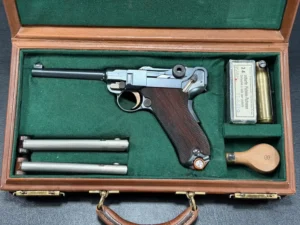
In the spring of 1907, the U.S. Army was shopping for a .45 caliber sidearm, and Georg Luger wanted the contract. He crossed the Atlantic with a Parabellum pistol rebuilt around the fat American cartridge, watched it run through tests at Springfield Armory, and wrote home from a New York hotel that things had gone to his satisfaction. Then DWM walked away from the whole affair, and the trial pistol itself dropped out of the record. Nobody can say today where it went. Wrecked in testing, scrapped, lost in a drawer somewhere. Pick your theory.

What survives is a second .45 Luger, marked internally with a small “2”. Springfield sold it around 1913 to a doctor in Akron, Ohio. In 1944, it changed hands for $150. In 1989, an Indonesian buyer reportedly paid a million dollars for it, which is how it picked up the nickname “the Million Dollar Luger” and a cameo in the 1987 movie Wall Street. When it crossed the auction block in March 2010, it brought $494,500, a record at the time for any Luger sold at auction.

Here’s the part I love. Serious Luger students still argue about whether number 2 was ever at the trials at all. Some hold it was a backup sample, retained for examination. Others insist Luger arrived with one pistol, that the real test gun is gone forever, and that number 2 came over later as a sales sample. Half a million dollars, a century of provenance, and the story still has a hole in the middle of it.

That, in one gun, is the whole appeal of prototypes and pre-series firearms. They sit at the exact spot where history hasn’t hardened yet.

Sorting out the terms

Collectors throw around “prototype” loosely, and dealers throw it around even more loosely, so it pays to be picky about words.

A true prototype is a gun built to test an idea. It might be a one-off from a designer’s own bench, as the rifles John Browning and his brothers built in their Ogden shop before Winchester bought the designs. It might be a toolroom gun, made inside a factory by its best machinists to prove out a drawing before anyone cuts production tooling. These guns often carry no serial number, or a meaningless one, and their surfaces tell on them: hand-stoned parts, soft unhardened components, pencil or electro-pencil notations, features that match no catalog.

A trials gun is a step further along. It was built for someone else’s judgment, usually a military test board. Savage’s Model 1907 in .45 ACP is a good example. It went head-to-head with Colt’s Browning-designed entry in the same trials the .45 Luger touched, earned an order for 200 field-trial pistols, and lost anyway. What’s left is a small population of guns that almost became the American service pistol, each one carrying the marks of a road not taken.

Then comes the pre-series gun, and this is where things get interesting for buyers, because these exist in numbers you can actually find. A pre-series or “zero series” run is an early production made before the design settles. Walther’s P.38 is the textbook case. Before full production started in mid-1940, Walther built roughly 12,000 to 13,000 test pistols in three series (published counts vary slightly), each serial number beginning with a zero. The first series appeared in mid-1939. The third, around 10,000 guns, carried most of the changes that defined the wartime pistol. Put a first-series and a third-series gun side by side, and you can watch the design being argued over. The extractor changes. The firing pin changes. The finish stays glossy commercial blue, because nobody had yet told the polishing room there was a war on.

One warning here. Names repeat. Walther also produced a second, completely different “zero series” at the very end of the war, when a couple of thousand pistols assembled in early 1945 from leftover commercial parts got a zero added to their serials. Same nickname, opposite end of the story, very different gun. If a seller says “zero series P.38,” make him say which one.

Finally, there are educational and pilot orders, which are production studies rather than design studies. The famous one is Singer. In April 1940, the Ordnance Department gave the sewing machine maker Educational Order W-ORD-396: build 500 M1911A1 pistols and, more to the point, work out how a company that had never made guns could tool up to make them fast. The whole order cost the government $278,875.67, about $538 per pistol, a startling figure for 1940. Singer delivered its 500 in December 1941, passed its tooling and documentation downstream to Remington Rand, and went off to build fire control instruments instead. Nothing about the design was experimental. The manufacturing was.

Why do the almost-guns get under your skin

Rarity explains part of it. Nothing is scarcer than a one-off. But rarity alone is a thin reason to want anything, and plenty of rare guns are rare because nobody liked them.

The better answer is that a prototype is the only kind of firearm that shows you a decision being made. A production gun tells you what a company concluded. A prototype tells you what it is considered. When you handle an experimental Winchester lever gun with a left-side ejection port that never reached a catalog, you’re looking at a morning in New Haven when somebody said “what if” and somebody else, eventually, said no. The gun is the minutes of that meeting.

There’s also the handwork. Prototypes come out of the toolroom, not off the line, and toolroom work has a look. Machining marks sit where production polishing would have erased them. Parts are fitted, not gauged. Odd stampings appear: an engineer’s initials, a date, the word “Experimental” scratched in with an electric pencil. A one-off .30-06 rifle built on Thompson submachine gun architecture, sold through Rock Island Auction, carries “Experimental” and “12/43” written right on the metal. On a production gun, that would be a defect. On a prototype, it’s the signature.

And these guns come with unfinished stories. Why did the .45 Luger die? Mostly because DWM had a huge German army contract in hand and little patience left for American procurement. Why did Winchester’s four-barrel “Liberator” shotgun of the Vietnam era, a crude pepperbox meant to arm resistance fighters in the spirit of the old OSS pistol, stall at the exploratory stage? The published record is thin. A production gun’s history is settled. A prototype’s history has loose threads you can pull for years, and for a certain kind of collector, the pulling is the hobby.

There’s one more thing, harder to put a number on. A prototype collapses the distance between you and the designer. Production guns pass through hundreds of anonymous hands. A toolroom gun passed through a few, and some of them belonged to the person who thought it up. That’s about as close as this hobby gets to owning a manuscript instead of a printed book.

Where do these guns come from

Prototypes were never supposed to leave the building, so everyone on the market escaped somehow. Knowing the escape routes matters because the route is the provenance.

The biggest single route is the dissolution or donation of factory collections. Winchester kept its own reference museum for a century: prototypes, cutaways, competitors’ guns, and the paperwork to go with them. In 1976 that collection went to what’s now the Buffalo Bill Center of the West in Cody, Wyoming, where the Cody Firearms Museum keeps more than 7,000 firearms and gives a whole section over to experimental pieces. Colt kept a factory museum too, and guns pedigreed to the Colt factory collection surface at auction from time to time, like a .40 caliber experimental Model 1851 Navy, serial number 1, built while Sam Colt’s shop felt its way toward the 1860 Army. Museum deaccessions happen more often than people realize. Experimental Winchesters that once sat in the New Haven factory museum, and later at Cody, have turned up in auction catalogs over the years.

The second route is the estates of the people who did the work. Engineers kept things. Designers kept things. So did plant managers and, less officially, machinists. Which brings up the “lunchbox gun,” the piece assembled by employees from parts that walked out the door a pocket at a time. Singer’s story has a version of this: alongside the 500 serialized contract pistols, a number of employee guns were reportedly built without serial numbers or inspection marks. Fascinating objects, genuine factory work in some sense, and a swamp for authentication, because an unmarked gun proves almost nothing about itself.

The third route is government disposal. Trials guns went back to arsenals when testing ended, and arsenals periodically cleaned house. That’s how .45 Luger number 2 left Springfield around 1913, sold to a private buyer while the receipt survived. Those old disposals were legal and documented. The trouble is that not everything that left government hands over the past century went out the front door, which is worth remembering when a piece has an arsenal connection and no paper trail. If the story amounts to “it was liberated from a lab,” keep your hands in your pockets.

The paperwork problem

Now the uncomfortable part. For documenting a prototype, the standard tools mostly don’t work.

For ordinary collectible guns, the anchor is the factory letter. Colt’s archive service will confirm how a gun shipped, when, and where. The Smith & Wesson Historical Foundation does the same from S&W’s records. The Cody Firearms Records Office letters Winchesters, Marlins, L.C. Smiths and several other makes from the original factory ledgers. All of these letters document shipping records. A toolroom gun never shipped. It has no ledger line, so it can’t “letter” in the normal sense, and a seller who waves that away is asking you to buy a story instead of a document.

Documentation for prototypes gets built differently, from a patchwork:

  • Publication history. Appearing in a standard reference matters enormously. That one-off Thompson-pattern rifle is photographed and described in Tracie Hill’s book on the Thompson, and the auction listing leans on that page hard. For P.38s, Warren Buxton’s volumes are the court of record. For Colts, an R.L. Wilson attribution carried weight for decades.
  • Institutional pedigree. “Formerly of the Colt factory collection” or “ex-Winchester museum, New Haven” can be checked against old inventories and deaccession records.
  • Chain of ownership. The .45 Luger’s file includes a Springfield receipt and bills of sale from the 1940s naming names and dollar figures. Boring, decades-old paper. That’s what real provenance looks like.
  • Physical evidence. Toolroom construction is hard to fake well. Correct period machining, correct soft parts, correct marking styles. This is where an experienced specialist earns the fee.

Be honest with yourself about the incentives here. The word “prototype” adds a zero to a price, so it gets applied to every odd gun with a missing roll mark. Some of those guns are lunchbox specials. Some are salesman’s samples. Some are Saturday-afternoon gunsmithing from 1962. And a few are outright fakes, aged and stamped for the occasion. Vague phrasing is the tell. A description built on “possibly,” “believed to be,” and “one of a kind,” without a single checkable fact underneath, is a description of a hope.

Even the greatest pieces carry disputes, and you should find that reassuring rather than scary. The open argument over whether the surviving .45 Luger actually attended the 1907 trials has run for years in collector forums and in print, with receipts and period letters quoted on both sides. Nobody involved thinks the gun is fake. They disagree about which true story it belongs to. That’s what scholarship looks like in this corner of the hobby, and a buyer at this level is buying into the argument as much as the object.

A word on the law

I’m not a lawyer and nothing here is legal advice, but a few flags are worth planting.

Many of the most interesting twentieth-century prototypes are select-fire. Machine gun testbeds, submachine gun developments, trials rifles from the T44 and T48 era, and most wartime German developmental long guns fall under the National Firearms Act in the United States. A properly registered, transferable example is a different animal from an unregistered one in every way that matters, and registration status isn’t a detail to sort out after the sale. It’s the first question.

Ownership can be murky too. Some trials and experimental guns were arguably never disposed of by the government at all, and items that went missing from arsenals and museums have been recovered from private hands decades later. Reputable auction houses screen for this, which is one real argument for buying through them. If you’re looking at a private sale of anything with an arsenal or factory-lab history, ask hard questions about how it entered private ownership, and get the answers in writing.

State law adds its own wrinkles, especially around unserialized guns, and the rules change. Verify the current law where you live before money moves. None of this should scare you off. It should just slow you down, which around five- and six-figure purchases is a feature.

What the market actually pays

The honest answer is: all over the map, and the story drives the number more than the scarcity does.

At the top, documented pieces with famous narratives bring serious money. The .45 Luger at $494,500 in 2010. A Singer 1911A1 with a documented aircrew recovery history at $414,000 in 2018, out of a run of 500 guns. Read that again. The Singer, with 499 siblings, out-earns most true one-offs, because the 1911 field is deep, the references are thorough, and the guns can be authenticated down to individual inspection stamps.

In the middle, and this surprises people, sit genuine one-of-a-kind experimental guns at prices ordinary collectors can reach. A Swiss Waffenfabrik Bern P47 experimental prototype pistol brought $23,500 at Rock Island in December 2022. A Springfield Armory experimental M1 Garand chambered for a .22-06 duplex cartridge, a Cold War salvo-project rifle with two bullets stacked in each case, sold for $31,625 in 2015. Civil War era trial carbines, actual submitted-and-rejected hardware, have sold in the mid to high teens. Strong prices for what they are, but that’s club-membership money, not castle money. Unique doesn’t automatically mean expensive. It means there’s exactly one buyer pool for that exact story.

Pre-series guns behave more like ordinary collectibles with a premium attached. Zero series P.38s trade steadily, with variation and condition setting the spread. Refinished Singers have sold in the mid five figures while untouched examples run several times that. It’s the usual collector math about originality, just with bigger numbers on both ends.

I’ll skip the investment talk, because guns bought as tickers tend to disappoint their owners and bore everyone else. Prices move and tastes shift. Buy the gun whose unfinished history you actually want to live with. If it appreciates someday, lovely.

If the bug has bitten you

Some practical advice, earned partly by watching other people’s mistakes and partly by making a couple of my own.

Buy the books before the guns. Whatever your lane is, the standard references cost less than one bad purchase. Buxton for the P.38. Clawson for U.S. .45 service pistols. Flayderman’s guide for American antiques generally. The auction archives at the major houses are free and searchable, and reading five years of prototype descriptions will teach you the difference between documentation and adjectives.

Pick a narrow lane. Prototype collecting rewards depth. The collector who knows everything about, say, Savage’s automatic pistols will spot a real experimental variation across a crowded show table. The generalist walks past it, or worse, buys a fake one.

Go stand in front of the real things. The Cody Firearms Museum will show you more factory experimental work in an afternoon than most collectors handle in a lifetime, and the study-collection format lets you compare a prototype directly against its production descendant. The records office there will research serial numbers for the makes it covers, a resource worth knowing even though true prototypes usually won’t letter.

Pay for expertise at the price points that matter. A specialist’s opinion, a records search, an extra week of due diligence. Cheap insurance.

And recalibrate your eye on the condition. On a production gun, tool marks and mismatched parts are damaged. On a prototype, they’re evidence. A toolroom gun that’s been “improved” with a polishing wheel has had its testimony sanded off. Original surfaces, however homely, are the point.

The hole in the story

Somewhere, maybe, the first .45 Luger still exists. The gun that actually fed those American cartridges at Springfield in 1907, the one Georg Luger wrote home about from his New York hotel. Most students assume it was wrecked in testing or scrapped afterward. Every so often, somebody claims a lead, the forums light up, and it comes to nothing.

I half hope it turns up in a shoebox one day, ugly and worn and nearly undocumentable, just to watch the experts go to work. Because that’s the real appeal of this corner of collecting. Production guns answer questions. Ask them about prototypes. And a hundred years on, the good ones are still asking.


Frequently Asked Questions

What counts as a prototype firearm?

A gun built to test an idea before production tooling exists, usually made in a factory toolroom or a designer’s own shop. Trials guns, pre-series runs, and pilot orders come later in the development process and are separate categories.

What does “pre-series” or “zero series” mean?

It refers to early production made before a design settles, like the roughly 13,000 Walther P.38 test pistols built with zero-prefix serial numbers before full production began in mid-1940. These guns record the changes that shaped the final model.

How do you authenticate a prototype if factory letters don’t apply?

Factory letters document shipping records, and toolroom guns never shipped, so authentication rests on published references, institutional pedigree, old ownership paper, and physical evidence of period toolroom construction. At these prices, a specialist’s examination is worth the fee.

Are prototype firearms legal to own?

Many are, but select-fire prototypes fall under the National Firearms Act in the U.S., and registration status is the first question to ask. Some pieces also carry ownership questions if they left the government or factory hands informally, so verify everything before money moves.

What do prototype and pre-series guns actually cost?

The spread runs wide: documented pieces with famous stories have brought $414,000 and more, while genuine one-off experimentals have sold in the low twenty thousands. Documentation and the depth of the collecting field drive the price more than rarity by itself.

Love this article? Why not share it...

Michael Graczyk

As a firearms enthusiast with a background in website design, SEO, and information technology, I bring a unique blend of technical expertise and passion for firearms to the articles I write. With experience in computer networking and online marketing, I focus on delivering insightful content that helps fellow enthusiasts and collectors navigate the world of firearms.

Leave a Reply

Your email address will not be published. Required fields are marked *

Related News

The appeal of prototype and pre-series firearms

In 1907 a .45 caliber Luger ran through U.S. Army trials at Springfield Armory, then vanished, while its surviving sibling later sold for $494,500 as collectors argued over whether it was ever at the tests. That unfinished quality is the whole draw of prototype and pre-series guns, and this guide sorts out the terms, the provenance problems, the legal flags, and the prices real examples have brought.

Read More »

Factory Engraving vs. Aftermarket Engraving: What collectors should know

A beautifully engraved gun isn’t always what the seller claims, and the difference between factory and aftermarket work can swing its value dramatically. Here’s how to tell what you’re really looking at, from Colt’s Custom Shop grades to the independent engravers whose names carry weight on their own.

Read More »

Availability Notification

Some pieces never make it to public listing. Join our private notification list to be the first to know when exceptional firearms become available.

Name