
Why Will Collectors Wait a Year For a Piece of Paper

Table of Contents

Key Takeaways:

  • A factory letter confirms how a specific gun left the factory (caliber, finish, barrel length, shipping destination), not what happened to it afterward. Refinishing, part swaps, and family ownership stories fall outside what the paper can prove.
  • Prices and wait times vary by manufacturer and change often, so check current fees and turnaround directly with the issuing archive (Colt Archive Properties, the Cody Firearms Records Office, the Smith & Wesson Historical Foundation) before you order.
  • Documentation moves the needle most on special-order or unusual configurations, where a letter can prove rarity that’s otherwise nearly impossible to establish. Forged letters exist too, so confirm anything you didn’t order yourself with the archive directly.

A few years back, at a table near the back of a gun show in Ohio, I watched a seller quote two prices for the same rifle. One was written on the tag. The other, higher by several thousand dollars, was what he’d take if the buyer would wait ninety days for a letter. The gun hadn’t changed. The price had, because somewhere in Cody, Wyoming, there’s a filing cabinet that might say where that rifle went in 1891.

That’s the strange economics of factory letters. A collector will spend real money and real patience on a document that adds nothing to the gun itself: no new finish, no missing part replaced, no improvement in mechanical condition. What it adds is certainty. And in a hobby built on serial numbers, faded stampings, and family stories that don’t always hold up, certainty is worth paying for.

What a factory letter actually is

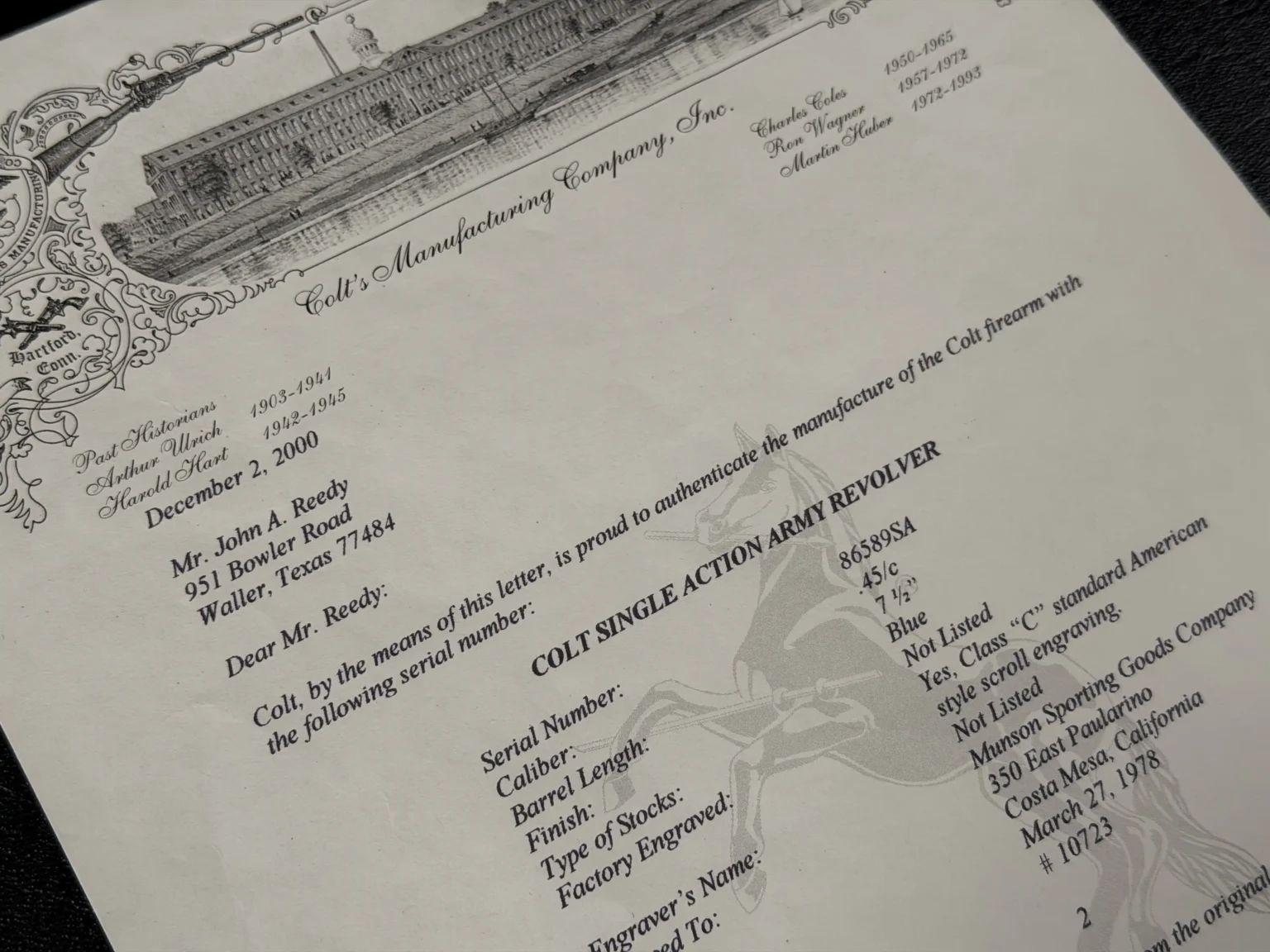
A factory letter, sometimes called an archive letter or a letter of authenticity, is a document issued by a manufacturer, a manufacturer’s historical archive, or a recognized third-party authority, confirming what a specific serial-numbered firearm looked like when it left the factory. Typically, that means caliber, barrel length, finish, stock or grip material, and the date and destination of the original shipment.

It is not an appraisal. It doesn’t establish a dollar value, and the organizations that issue letters are usually careful to say so. It’s also not proof of who owned the gun after it left the factory, unless the shipping record names an individual buyer rather than a hardware store or distributor, which was the more common arrangement well into the 20th century.

Content varies enormously by manufacturer and era. A Colt Single Action Army letter from the 1880s might list caliber, barrel length, finish, and the wholesale hardware company it shipped to. A Winchester letter on a lever gun with special-order features might spell out a nonstandard barrel length, a set trigger, a particular sight, or an upgraded stock, details that can separate a common rifle from a five-figure one. Later production, once manufacturers moved toward retail distribution networks and away from direct-to-dealer ledgers, sometimes yields thinner letters simply because the records got thinner too.

Where the paper trail starts, and where it burns

The practice traces back to something surprisingly mundane: 19th-century manufacturers kept shipping ledgers because that’s how any business tracks inventory leaving a warehouse. Nobody at Colt or Winchester in 1880 was thinking about collectors. They were thinking about accounts receivable. It’s only in hindsight, once those ledgers survived long enough to become historical documents, that they turned into something collectors would pay to consult.

They didn’t all survive. On February 4, 1864, a fire tore through Colt’s East Armory in Hartford, destroying the main building along with company records, and Samuel Colt himself had died two years earlier and wasn’t around to see it happen. Multiple firearms-history sources describe the loss as severe, taking with it much of the company’s paper trail from the earliest years. Oddly, Colt’s own archive service now advertises shipping records reaching back to 1861, three years before that fire, and it isn’t entirely clear from public sources how those particular volumes escaped the blaze or whether they represent a partial, reconstructed record. That gap is worth knowing about if you’re chasing documentation on anything from the percussion era.

Winchester’s records fared better in the sense that they survive at all, though gaps exist there too; collectors researching military-era production sometimes run into stretches with thin or missing paperwork. The point isn’t that any one company’s archive is unreliable. It’s that these are 19th and early 20th century business records that happened to survive fires, corporate sales, bankruptcies, and a few moves across state lines. Treat “the records go back to X” as a statement about what happened to survive, not a guarantee that your particular gun is in there.

The major archives and how they differ

Colt. Colt Archive Properties, LLC, handles letters for Colt firearms. It’s worth knowing this is a separate business from Colt’s Manufacturing Company itself, under different ownership, a detail that surprises some first-time buyers who assume the modern gunmaker is writing the letters. As of recent pricing information, a standard letter runs roughly $75 to $300 depending on model and rarity, with an additional fee for expedited service. Turnaround has been quoted at around 150 days for standard requests, sometimes longer during busy stretches. Prices and wait times change often enough that you should check current figures directly with Colt Archive Properties before ordering rather than relying on last year’s numbers.

Winchester and friends. The Cody Firearms Records Office, housed at the Buffalo Bill Center of the West in Cody, Wyoming, researches Winchester, Marlin, L.C. Smith, Ithaca (including Lefever and Western Arms Corporation), Savage, and A.H. Fox firearms from the manufacturers’ original factory ledgers. Letters are typically mailed within four to six weeks, and pricing depends on whether you’re a Center Firearms Member; members receive free or discounted letters and a quicker turnaround for basic serial-number searches. The museum itself was known as the Winchester Arms Museum until a 1991 reopening under its current name, and it remains a Smithsonian affiliate.

Smith & Wesson. The Smith & Wesson Historical Foundation, which now issues what it calls a Letter of Authenticity (the older “factory letter” terminology has largely given way to this newer name), draws on roughly 700,000 documents preserved at the Connecticut Valley Historical Museum. Because Smith & Wesson used overlapping serial number ranges across different models until the 1940s, and didn’t move to a fully unique numbering scheme until the 1980s, identifying a gun from its serial number alone can be genuinely difficult, and the Foundation is upfront that this sometimes means manual research rather than a quick database lookup. A basic letter has run around $100 in recent years, with member discounts, and there’s a second-tier “Historical Deep Dive” letter for collectors who want more, though the digitized records behind that deeper search only cover 1920 through 1966.

Smaller programs. Ruger, Ed Brown, and a handful of other current manufacturers offer their own letters of authenticity, generally at modest cost. Collector organizations fill in gaps the manufacturers themselves left behind: the L.C. Smith Collectors Association compiles research letters on Elsie shotguns, and the Parker Gun Collectors Association does similar work for Parker doubles. None of these programs are identical in scope, format, or reliability, so the right move before ordering is confirming what a given archive actually covers for your specific model and era.

The specialists who aren’t at the factory at all

Some of the most respected documentation in the hobby doesn’t come from a manufacturer’s archive at all. John Kopec spent decades as the leading independent authority on U.S. martial Colt Single Action Army revolvers, the Cavalry and Artillery models issued to the American military in the late 1800s. Starting in the early 1970s, he wrote more than 2,600 authentication letters, backed by his own survey database and his co-authored reference “A Study of the Colt Single Action Army Revolver,” a book collectors in that niche still treat as close to gospel. His letters came with a bronze, silver, or gold embossed seal, depending on what he found, right down to noting replaced parts or evidence of tampering. Kopec died in February 2025 at 97, having continued authenticating for Rock Island Auction Company well into his retirement, and more than one longtime collector has wondered aloud whether anyone can really replace that particular kind of institutional trust.

For U.S. military handguns more broadly, there’s the Springfield Research Service, a separate database built from government-issue records rather than factory shipping ledgers. It documents which unit a particular gun was issued to, which is a genuinely different question than where a factory shipped it, and a match in that database can mean real money for a Civil War or later martial firearm. It’s a reminder that “documentation” in this hobby isn’t one single thing. A factory letter tells you where a gun went when it left the maker. A researcher’s letter, like Kopec’s, evaluates whether the gun’s current physical condition matches what it should be. A service record tells you who used it. Serious collectors sometimes chase all three on the same gun.

What a letter can tell you, and what it can’t

A factory letter documents a moment: the day a specific serial-numbered firearm left a warehouse, in a specific configuration, headed to a specific destination. That’s genuinely useful, because it replaces guesswork with a documented fact for that one variable. It does not verify anything that happened afterward. A gun refinished, rebarreled, or modified since it left the factory will still letter to its original specifications, because the letter describes 1891, not today. It falls to the collector or an appraiser to compare the letter with the gun in hand and note any discrepancies.

Letters aren’t infallible even on their own terms. Rock Island Auction Company has sold a special-order Winchester Deluxe Model 1886 takedown rifle whose accompanying factory letter incorrectly listed the trigger type. Description errors happen even in official documentation, and it still brought $152,750 against a high estimate of $65,000. Clerical mistakes from 130 years ago, or from an archivist transcribing them today, are part of the deal.

And a letter can’t manufacture a story that isn’t there. If a family has always said a Colt belonged to a famous lawman, a shipping record listing a hardware distributor in Kansas City doesn’t confirm or deny that claim. As one Rock Island Auction piece on the subject puts it, a letter might show the gun went to a wholesaler, and that says nothing about whether the wholesaler’s customer really was who the family remembers.

Does it actually move the price?

Often, yes, though “often” is doing real work in that sentence. Rock Island Auction’s own writing on the topic points to a special-order Winchester Model 1876 that carried a letter documenting its shipment and configuration and sold for $88,125, more than $20,000 above its high estimate. The auction house has also noted that a large share of the lots in a typical premier sale, over a hundred in one recent catalog, include some kind of authenticating letter or research note, which tells you how normalized the practice has become at the high end of the market.

The value a letter adds tends to scale with how much the letter can actually confirm. A plain, late-production rifle with an unremarkable shipment record might letter for the fee and add little beyond peace of mind. A special-order gun, whose factory letter proves it left with an uncommon barrel length, an upgraded finish, or an unusual sight configuration that would otherwise be nearly impossible to prove, can see its value shift dramatically because those special-order features are exactly what separate a $2,000 gun from a $50,000 one in some model lines. The letter doesn’t create the rarity. It proves the rarity was real.

Paper is easier to forge than steel

Here’s the part that doesn’t get said enough at gun shows: a convincing forged document is, in some ways, an easier con than a convincing fake gun. Metal has to match period tooling, period markings, and period wear patterns. A letter just has to look right on the page. The National Firearms Museum’s own material on fakes and frauds specifically flags forged factory letters as a known risk, along with faked engraving and reproductions sold as period originals.

This isn’t a reason to distrust the practice generally. It’s a reason to verify. If you’re buying a gun with an included letter rather than ordering your own, it costs little to contact the issuing archive directly and confirm the letter is genuine and matches their file. Reputable auction houses generally do this vetting themselves, which is one argument for buying documented pieces through an established house rather than a private sale where nobody’s checked the paperwork against the source.

Actually ordering one

The process is more patience than skill. You’ll need the serial number, read carefully and recorded accurately, along with clear photographs of markings, proof marks, and any features that look unusual. Most archives now take orders online through a request form, though some still prefer mail-in requests with a check.

From there, it’s a waiting game. Turnaround has ranged from a few weeks for smaller archives with lighter request volumes to four or five months or more for busier programs during peak demand. Expedited service exists at several archives for an additional fee if you need an answer faster, though “faster” is relative when the baseline is measured in months rather than days.

One practical note worth building into the budget: request costs aren’t trivial once you start lettering a whole collection. Discounts for bulk requests are available at some archives, and collector-association membership frequently knocks a meaningful amount off the price at others, which is another reason serious collectors of a given brand tend to join the relevant collectors’ club sooner rather than later.

Why bother

None of this changes what the gun does. A lettered Winchester shoots exactly like an unlettered one. But collecting has never really been about function alone, and a hobby that’s existed in something like its modern form for well over a century runs on documented history the way a coin collection runs on mint marks or a book collection runs on first-edition points. The letter is what turns “I think this might be special” into “here is what the company itself recorded the day it left the building.”

That’s worth something to a lot of people, myself included. Not because the paper is rare, exactly, though on some models it effectively is. Because for a few dollars and a long wait, it lets a gun tell you its own story instead of asking you to take somebody’s word for it.


Frequently Asked Questions

What is a factory letter?

It’s a document from a manufacturer or a recognized archive confirming a specific firearm’s original configuration and shipping details, tied to its serial number. It describes the gun as it left the factory, not anything that’s happened to it since.

How much does a factory letter cost?

It depends on the manufacturer and model. Colt letters have run roughly $75 to $300 and Smith & Wesson letters around $100, with member discounts at several archives, and prices change often enough that you should confirm current fees directly.

How long does it take to get one?

Turnaround runs from a few weeks at smaller archives to four or five months or more during busy stretches at places like Colt Archive Properties. Some archives offer expedited service for an added fee if you need an answer sooner.

Does a factory letter prove who owned the gun?

Usually not. Before the mid-20th century, most firearms were shipped to a hardware store or distributor rather than a named individual, so a letter typically cannot confirm a specific personal owner.

Can a factory letter be wrong?

Yes. Clerical errors in the original ledger, or in a modern archivist’s transcription, occur occasionally, so a letter is strong evidence rather than an infallible record.

Love this article? Why not share it...

Michael Graczyk

As a firearms enthusiast with a background in website design, SEO, and information technology, I bring a unique blend of technical expertise and passion for firearms to the articles I write. With experience in computer networking and online marketing, I focus on delivering insightful content that helps fellow enthusiasts and collectors navigate the world of firearms.

Leave a Reply

Your email address will not be published. Required fields are marked *

Related News

Factory Engraving vs. Aftermarket Engraving: What collectors should know

A beautifully engraved gun isn’t always what the seller claims, and the difference between factory and aftermarket work can swing its value dramatically. Here’s how to tell what you’re really looking at, from Colt’s Custom Shop grades to the independent engravers whose names carry weight on their own.

Read More »

Collecting the high end: what actually makes a rifle worth six figures

In June 2026, a rifle with no engraving and no royal history sold at auction for $5.875 million, proof that paperwork often matters more than polish. From Winchester’s mysterious “One of One Thousand” program to the bespoke doubles built by Holland & Holland and Rigby, here’s what actually separates a valuable collectible rifle from a merely old one.

Read More »

Availability Notification

Some pieces never make it to public listing. Join our private notification list to be the first to know when exceptional firearms become available.

Name