
The top modern luxury and high-end firearm manufacturers

Table of Contents

Key Takeaways:

  • High-end firearms are not all high-end for the same reason. A Purdey, a Korth, a Perazzi, and an Accuracy International rifle each earn attention in a different way, through handwork, mechanical design, competition use, precision engineering, or collector history.
  • The best makers have a clear identity. Purdey and Holland & Holland are tied to bespoke sporting guns; Perazzi and Krieghoff to serious competition shotguns; Korth and Manurhin to premium revolvers; and Wilson Combat, Nighthawk, Ed Brown, Les Baer, Cabot, and Alchemy to the modern custom 1911 market.
  • Smart buyers should look past price and name recognition. Documentation, condition, configuration, originality, and maker records often matter more than decoration alone, especially with British best guns, limited-production pistols, competition shotguns, and precision rifles.

Luxury in firearms is a funny thing.

Sometimes it means a London shotgun that takes years to build and looks almost plain until you know what you’re looking at. Sometimes it means a German revolver with lockwork so smooth that people argue about it as watch collectors argue about movements. Sometimes it’s a hand-fit 1911, a competition shotgun, a precision rifle, or a Swiss-made tactical firearm built with the kind of clean machining that makes even simple parts feel expensive.

That’s why any serious list of the top modern luxury and high-end firearm manufacturers has to be a little messy. A Purdey side-by-side, a Korth revolver, a Perazzi MX8, and a Barrett MRAD do not belong to the same world. Not really. But they all sit near the top of their own lanes.

So this isn’t a simple “number one through number twenty” ranking. That would be neat, and mostly useless. The better question is this: which modern makers matter most if you care about history, fit, finish, mechanical design, scarcity, and buyer relevance?

Here are the names worth knowing.

What makes a firearm high-end?

Price alone doesn’t do it.

A firearm can be expensive because it is rare, discontinued, in short supply, heavily engraved, contract-specific, or difficult to import. That doesn’t automatically make it well made. The opposite is also true. Some plain-looking guns are built to a level that only shows up after years of shooting, service, and close inspection.

For this article, “high-end” means some mix of four things:

Build quality. Hand-fitting, machining, finishing, regulation, trigger work, barrel work, stock work, and final inspection.

Design importance. A gun that changed a category, solved a real problem, or became the pattern others followed.

Collector interest. Not hype. Real interest based on provenance, production history, configuration, condition, or maker reputation.

Modern relevance. The company is still active, or its late-production guns still shape the current collector and buyer market.

That leaves out plenty of good manufacturers. It also means a maker can be high-end without being “luxury” in the gold-inlay sense. Accuracy International, Sako, and Barrett are not luxury houses in the Purdey or Holland & Holland sense. But their top rifles belong in the same buyer conversation because of engineering, contracts, and long-range precision.

Purdey

If you’re talking about luxury sporting arms, Purdey is almost impossible to leave out.

James Purdey opened his own London shop in 1814 after working under Joseph Manton, one of the great names in British gunmaking. The company became closely associated with high-quality sporting guns and rifles, and Purdey has held royal warrants throughout its long history. Today, it remains one of the reference points for bespoke British shotgun and rifle work.

The collector’s appeal is not hard to understand. Purdey guns are not just about engraving or name value. The interest is in proportion, stocking, action work, barrel quality, and restraint. A best Purdey can be deeply decorated, but the classic look is often quieter than people expect. The finish is in the lines.

For buyers, Purdey sits at the intersection of sporting gun, luxury object, and family heirloom. That can make evaluation tricky. Condition matters. Originality matters. Barrel wall thickness, proof status, stock dimensions, case, accessories, and maker records all matter. With older guns, small details can change the entire conversation.

Modern Purdey is still active in the production of bespoke shotguns and rifles. The brand also sits inside the broader luxury business world through Richemont ownership, which matters because it gives the company a different kind of backing than many smaller gunmakers have. Recent reporting has noted Purdey’s reliance on markets such as the UK and the United States, as well as pressure from regulations, import rules, and changes in lead shot policy.

That’s useful context. Purdey is historic, but it’s not frozen in amber.

Holland & Holland

Holland & Holland is the other big London name many buyers think of first.

The company traces its history to Harris Holland and 1835, and its “Royal” name became associated with the firm’s best guns and rifles in the late 19th century. Holland & Holland built its identity around handmade sporting arms, especially shotguns and double rifles, and the name still carries major weight in the high-end gun world.

Where Purdey often feels like the polished conservative choice, Holland & Holland has a slightly different pull. It has deep association with dangerous-game rifles, big British cartridges, and the classic African safari era. That history can be over-romanticized, but it matters because many high-grade Holland rifles and guns were built for hard use by serious sportsmen.

Collector interest often centers on configuration. A best-quality Royal side-by-side, a double rifle in a desirable Nitro Express chambering, or a well-documented gun with original case and accessories is a different animal from a later or lower-grade example. That doesn’t mean one is “good” and the other “bad.” It means the buyer needs to know what tier of the maker’s work they are looking at.

Modern Holland & Holland remains one of the names people use to define the top end of British gunmaking. For the buyer, the lesson is simple: don’t buy only the name. Buy the gun.

Boss & Co.

Boss & Co. is smaller, rarer, and, to some collectors, even more interesting.

Boss describes itself as London’s oldest gunmaker, established in 1812, and the firm is closely associated with “best guns only.” The company’s history includes important action and trigger work, and its name is tied to some of the most admired British over-and-under shotguns.

The appeal of Boss is partly scarcity. You see fewer of them. The guns also have a distinct design reputation, especially the low-profile over-and-under associated with John Robertson’s work in the early 20th century. Collectors who know English shotguns often talk about Boss with a different tone. Less obvious, more inside baseball.

That can be a buying advantage or a trap. A Boss can be magnificent, but the same rules apply. Look at the barrels, proof, stock, repairs, alterations, and documentation. With the best British guns, the romance is real, but so are the inspection bills.

Boss belongs here because it proves that luxury isn’t always about scale. Sometimes the smallest shop has the sharpest identity.

Westley Richards

Westley Richards deserves special attention because it is not just a luxury name. It is a design name.

The firm is tied to the Anson & Deeley boxlock action, patented in 1875, one of the most important shotgun action designs ever made. Westley Richards is also known for its hand-detachable lock system, often called the droplock, patented in 1897 by Leslie B. Taylor.

That combination matters. Westley Richards sits at an interesting point between mechanical cleverness and high finish. A droplock is not just a feature you list in a catalog. It changes how the gun is serviced and understood. It gives the owner direct access to the locks in a way that feels both practical and elegant.

For collectors, Westley Richards can be especially rewarding because the firm’s identity is so mechanically clear. You’re not only buying engraving or wood. You’re buying a design lineage.

Modern Westley Richards still builds high-grade sporting guns and rifles, and its older guns remain active in the market. As with Purdey, Holland, and Boss, the smart buyer wants documentation and inspection. A beautiful gun with tired barrels is still a tired gun.

Beretta premium guns

Beretta differs from the London houses in that it operates on a much larger scale. That can make people forget how serious its upper-end guns are.

Beretta traces its origins to 1526 in Gardone Val Trompia, Italy, and is widely described as one of the oldest active firearm makers. The modern company covers everything from service pistols to field guns, competition shotguns, premium sidelocks, and limited editions.

For this article, we are not talking about the standard production side of Beretta. We’re talking about the SO series, the SL3, premium EELL grades, custom shop guns, and higher-grade competition and field models.

Beretta’s high-end appeal is different from that of a bespoke London gun. It blends industrial depth with hand finishing. The company has the resources of a major manufacturer, but its premium guns still carry the details of a real gunmaker: engraving, wood selection, handwork, and a long model lineage.

For buyers, Beretta is often easier to live with than a fragile older best gun. Parts, service knowledge, and model familiarity are better than with many tiny makers. The high-grade Beretta shotgun can be both collectible and usable, which is a nice place to be.

Perazzi

Perazzi is one of the great modern competition shotgun makers.

Daniele Perazzi founded Armi Perazzi in 1957 at age 25. From the start, the company built its reputation on high-grade competition and game guns, blending traditional Italian gunmaking with modern production methods and carefully selected materials.

The Perazzi name is closely tied to the clay-target world. The MX8, developed in the 1960s, became one of the defining competition over-and-unders. It is famous for its detachable trigger group, competition-focused balance, and adaptability. Perazzi’s whole buyer experience, from stock dimensions to rib choice, barrel setup, engraving, and wood, is built around fit.

This is why Perazzi is high-end in a very specific way. It’s not just expensive. It’s personal. A serious competition shooter can build a Perazzi around their body type, mounts, discipline, and preferences. That also means used Perazzis need to be evaluated carefully. Stock dimensions that are perfect for one shooter can be wrong for the next.

For collectors, early guns, special engravings, Olympic associations, and rare configurations are the main draw. For shooters, the draw is simpler. They work.

Krieghoff

Krieghoff holds a significant position in the premium competition shotgun market, especially with the K-80.

The K-80 launched in 1980 as the successor to the K-32 concept. Krieghoff’s own history notes the K-32’s role in the American clay target market during the 1960s, followed by the K-80’s arrival with technological updates and a broader American presence.

The K-80 is not delicate. That is part of its charm. It has the feel of a serious machine built for volume shooting. Adjustable ribs, multiple barrel sets, various stock setups, and a huge following in competition make it one of the most practical high-end shotguns on the market.

Krieghoff also has strong collector appeal in engraved and special-order guns. A highly engraved K-80 or K-20 can quickly shift from a competition tool to a luxury object. But even then, the core identity remains mechanical and modular.

For buyers, the K-80 is one of the safest high-end shotgun names to understand because the model family is well known. That does not remove the need for inspection, but it does make the market easier to read.

Fabbri

Fabbri is the Italian maker people mention when the conversation turns from expensive to almost unreal.

The company is associated with Ivo Fabbri, who worked with Daniele Perazzi before going his own way. Sources differ slightly on whether the company’s founding should be dated 1965 or 1968, so it is safest to say Fabbri emerged in the mid-to-late 1960s following that Perazzi connection.

Fabbri’s reputation rests on very small-scale production, advanced machining, exceptional finishing, and bespoke shotguns that often sit near the highest end of the modern market. These are not guns most buyers encounter often. When they do appear, condition, specification, and provenance matter a great deal.

The interesting thing about Fabbri is how modern it feels compared with old British gunmaking. It honors the best-gun tradition, but it does not feel like a museum exercise. The machining and material control are part of the story.

If Purdey and Holland are old-world luxury, Fabbri is modern Italian precision turned into a sporting gun.

Korth

Korth is the high-end revolver name that refuses to go away, and for good reason.

Willi Korth founded the company in Germany in 1954. The brand became associated with expensive, finely made revolvers, later expanding into pistols as well. Current Korth offerings include revolvers and PRS pistols, with the company still trading on its German precision identity.

Collectors like Korth because the guns feel different. The lockwork, finish, fit, and small mechanical details set them apart from normal production revolvers. Older Ratzeburg-era Korths have their own following, while later guns and modern Nighthawk-imported examples give buyers different options.

The thing to understand is that Korth is not “just a fancy revolver.” It’s a maker with a real mechanical language. The cylinder release, trigger feel, adjustable features, barrel systems, and finish all create a different experience from a Smith & Wesson, Colt, Ruger, or Manurhin.

That doesn’t mean every Korth is automatically better for every use. Some buyers want a service revolver. Some want a competition gun. Some want a collector’s piece. Korth lives more in the last two categories, though many are perfectly shootable.

Manurhin

The Manurhin MR73 has a different kind of high-end status.

It is not a luxury revolver in the decorative sense. It is a serious French service and match revolver, introduced in the 1970s and tied to police and special-unit use, including GIGN. The MR73 has been made in .357 Magnum and .38 Special variants, with Match and Sport models adding another collector lane.

Why include it among luxury and high-end makers? Because the MR73 sits in that rare category where service history, build quality, and shooter reputation meet. It was built to handle heavy use, but it also has the finish and trigger quality that make revolver collectors pay attention.

Modern U.S. interest rose after renewed imports made new-production MR73 revolvers more visible to American buyers. The current guns trace back to Chapuis-era production, dating to Chapuis’s acquisition of Manurhin’s revolver business in the late 1990s.

The MR73 is a good reminder that “high-end” does not always mean polished presentation. Sometimes it means a duty gun built beyond normal duty standards.

Wilson Combat

Wilson Combat is one of the most important American high-end 1911 makers.

Bill Wilson founded Wilson Combat in 1977, and the company built its reputation around custom 1911 pistols, parts, long guns, and accessories. Today, Wilson Combat covers classic 1911s, double-stack designs, defensive pistols, AR-pattern rifles, and more.

The reason Wilson matters is that it helped define the premium American fighting 1911 as a commercial category. A Wilson is usually not trying to be a museum-grade engraving project. It is trying to be reliable, accurate, well-finished, and durable, with enough refinement to justify its place above standard production guns.

Collector interest tends to follow model era, configuration, limited runs, caliber, condition, and association with important 1911 trends. Early guns, special builds, and discontinued models can be especially interesting.

For buyers who want a single high-end 1911 they can shoot without guilt, Wilson remains one of the easiest names to recommend.

Nighthawk Custom

Nighthawk Custom occupies a space similar to Wilson’s, but with its own shop identity.

Founded in 2004, Nighthawk grew from a small group of 1911 enthusiasts into a major name in precision firearms. Its best-known build philosophy is “one gun, one gunsmith,” meaning a single gunsmith is responsible for building the pistol rather than passing it down a long assembly line.

That philosophy matters to buyers because it gives the gun a traceable human element. It also fits the way many collectors think about high-end 1911s. They want to know who built it, what options were selected, and how the pistol differs from the catalog baseline.

Nighthawk has also been willing to experiment. The company has built traditional 1911s, double-stack pistols, compensated models, collaboration guns, and premium finishes. Its relationship with Korth imports also gives it a broader place in the high-end handgun market.

For buyers, Nighthawk is strongest when the build sheet is clear. Save the paperwork. Save the test target if present. Save the case and accessories. High-end modern handguns live and die by documentation later.

Ed Brown

Ed Brown belongs in this group because of both pistols and parts.

Ed Brown Products is known for custom 1911 handguns and 1911 parts, including major models such as the Kobra Carry, Special Forces, Classic Custom, and other modern lines. The Brown family’s role in 1911 components and custom pistol work gives the company a place in the American high-end pistol story.

Ed Brown guns tend to have a clean, functional feel. Less flash than some boutique makers, more emphasis on fit, reliability, parts quality, and established design. That’s not a knock. It’s the point.

For collectors, Ed Brown is interesting because the company’s parts have influenced far more 1911s than just its own pistols. Beavertail grip safeties, thumb safeties, barrels, slide stops, and other components helped shape the modern custom 1911 language.

A buyer looking at Ed Brown should pay attention to the configuration and era. Some guns are fairly straightforward working customs. Others are special editions, engraved pistols, or harder-to-find variants.

Les Baer

Les Baer Custom is another pillar of the American semi-custom 1911 market.

Les Baer began building his own line of 1911 pistols in the early 1990s, and Les Baer Custom became known for tight-fitting pistols, accuracy guarantees, and models such as the Premier II, Thunder Ranch Special, Monolith, Stinger, and others.

Baer pistols have a personality. Many are very tight when new. Some buyers love that. Some don’t. But the brand’s identity is clear: accuracy, hand-fitting, and a no-nonsense approach to the 1911.

For collectors, Baer’s Thunder Ranch-related guns, early production examples, special configurations, and presentation-grade pistols are worth watching. For shooters, the Premier II and other core models have long been part of the “serious 1911” conversation.

Les Baer may not have the same luxury finish image as Cabot or some Nighthawk builds, but it absolutely belongs among high-end American handgun makers.

Cabot Guns

Cabot Guns is modern American luxury with a taste for unusual materials.

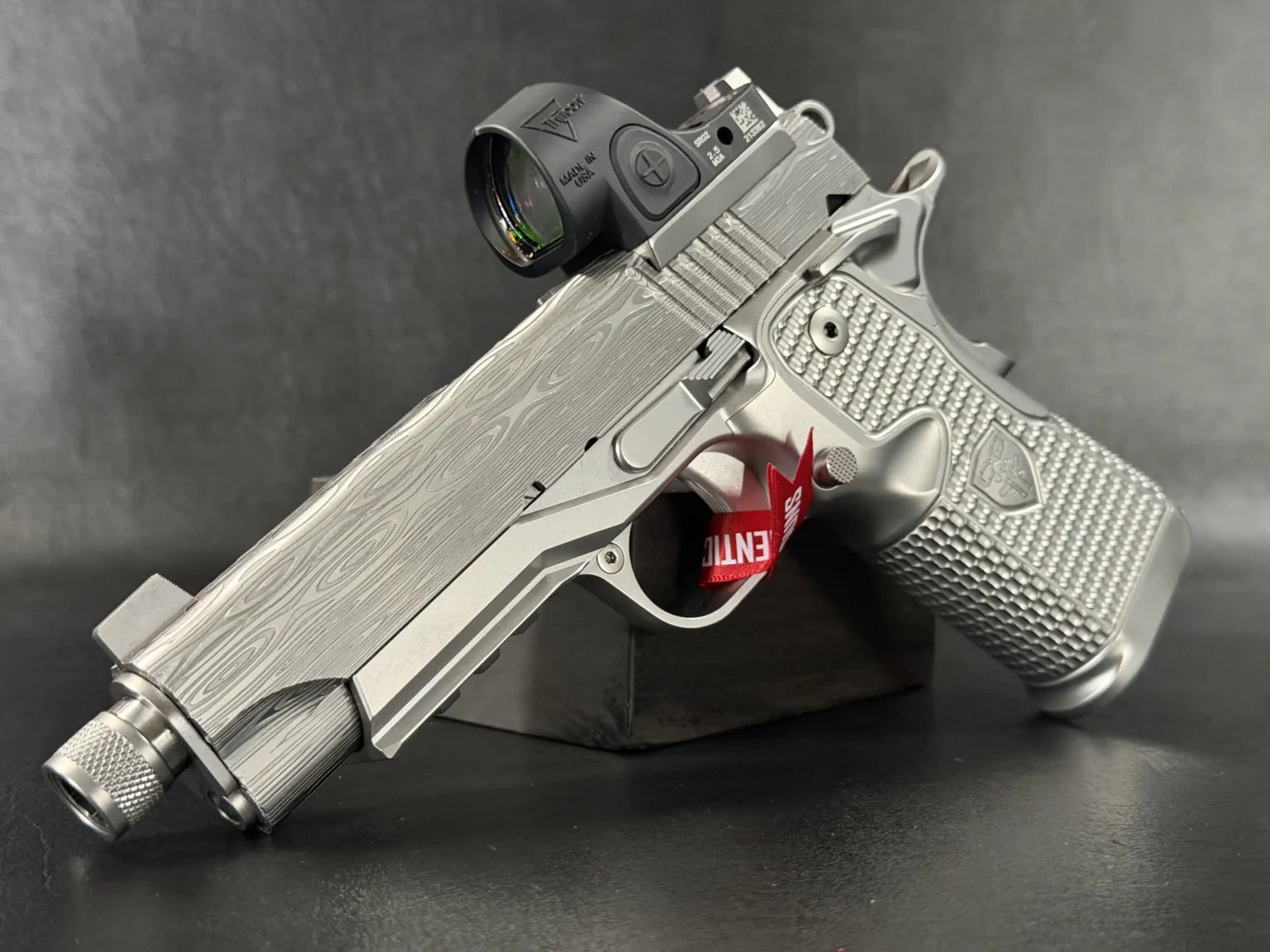
Cabot makes American 1911 pistols, including limited editions, one-of-a-kind guns, and Damascus steel builds. The company has leaned hard into aerospace-style machining, high-end materials, and collector presentation. Its Damascus pistols, including full Damascus examples, can reach extremely high price points.

Cabot is not for everyone. Some traditional 1911 buyers prefer the old pistolsmith feel of Wilson, Brown, Baer, Alchemy, or Nighthawk. Cabot’s appeal is different. It is about precision machining, art materials, paired pistols, limited runs, and conversation pieces that still function as firearms.

The collector’s question with Cabot is usually not “Is it rare?” Many Cabots are rare by design. The better question is whether the theme, material, execution, and documentation will still make sense years later. Some will. Some may feel more tied to a moment.

At its best, Cabot shows how modern luxury firearms can borrow from watches, knives, aerospace machining, and art metalwork without losing the 1911 as the base form.

Alchemy Custom Weaponry

Alchemy Custom Weaponry, now associated with Cabot, is worth separating from Cabot because the appeal is different.

Alchemy builds hand-fit 1911 pistols with a more classic American custom feel. The company presents itself as centered on traditional craftsmanship, forged parts, hand fitting, and old-school 1911 lines rather than futuristic materials or extreme presentation.

That makes Alchemy appealing to buyers who want a high-end 1911 that looks like a custom pistol from the golden age of pistolsmithing, but with modern execution. Less jewelry. More blue steel, clean flats, good checkering, tight slide-to-frame fit, and tasteful options.

For collectors, Alchemy is still young compared with Wilson, Brown, and Baer. That cuts both ways. It has a shorter long-term market history, but certain early guns, discontinued specs, and special builds may age well.

SIG Sauer Mastershop

The SIG Sauer Mastershop deserves mention even though it no longer functions in the same way that made collectors chase its pistols.

The German Mastershop became known for high-grade SIG pistols, especially X-Five, X-Six, P210-based, Skeleton, Black & White, Midnight, PPC, and other Prestige or Individual-line models. A 2019 report described the Mastershop lineup as divided into Sport, Prestige, and Individual lines, with P226 and P210-based models appearing at IWA that year.

These pistols matter because they combine modern SIG engineering with hand-fit, limited-production, and presentation-grade work. The best examples have the kind of machining and finish that make standard service pistols feel ordinary by comparison.

For buyers, Mastershop SIGs are a paperwork game. Box, test target, manual, certificates, import markings, model designation, finish, barrel length, trigger system, and configuration all matter. The difference between an X-Five, X-Six, PPC, Skeleton, or special commemorative is not cosmetic trivia. It defines the gun.

The market has become more collector-driven as availability has tightened. That does not mean every Mastershop pistol is automatically rare, but it does mean careful identification is important.

Sako

Sako sits in the premium rifle world with a different kind of authority.

The Finnish company’s TRG line is one of the key modern precision rifle families. The TRG-21 and TRG-41 appeared in the late 1980s, followed by the TRG-22 and TRG-42 in 1999, with chamberings including .308 Winchester, .300 Winchester Magnum, and .338 Lapua Magnum, depending on the model.

Sako’s appeal is not luxury in the engraved-stock sense. It is clean engineering, repeatability, and a long reputation for accurate bolt guns. The TRG family, in particular, has a strong following among precision shooters and collectors of military and police-oriented rifles.

For buyers, Sako is often a smart, high-end rifle choice because its guns are reliable. They don’t feel like fragile artifacts. A TRG-22 or TRG-42 can be bought, set up correctly, and shot seriously. That gives them a different value than a safe queen.

Collector interest centers on early TRGs, military or police provenance, where documented, rare configurations, accessories, and discontinued variants.

Accuracy International

Accuracy International changed how many shooters think about precision rifles.

Founded in Britain, Accuracy International became known for chassis-based sniper rifles, including the Arctic Warfare family. Reporting on the company has described its origins in the late 1970s and its use of engineering, soldier feedback, and intensive testing to build rifles for hard environments.

The Arctic Warfare identity matters. The rifle was designed around field use, cold-weather performance, and repeatable accuracy. Later, Accuracy International rifles and chassis systems shaped the broader precision rifle market. The AICS alone influenced countless Remington 700-based builds and helped make chassis rifles normal rather than strange.

There is also a current business context. In 2026, FN Browning Group announced an agreement to acquire Accuracy International, with reports noting that AI would retain its brand identity.

For collectors, Accuracy International rifles are still in the early stage of serious historical sorting. Military-contract examples, early AW variants, correct accessories, and documented service links will likely matter more than generic commercial rifles.

For buyers, AI remains one of the safest names in serious precision rifles. Not cheap. Not decorative. Very real.

Barrett

Barrett belongs here because it created one of the most recognizable modern American rifle identities, then proved it could do more than .50 BMG.

The MRAD is the key modern high-end Barrett for this discussion. It became the basis for U.S. military Mk 22 rifle programs, with chambering-conversion capability for cartridges such as 7.62x51mm NATO, .300 Norma Magnum, and .338 Norma Magnum, depending on the system.

The MRAD is not a luxury gun in the traditional sense. It is expensive because it is modular, contract-proven, precision-oriented, and built for demanding use. That places it in the same buyer space as Accuracy International, Sako TRG, and other top precision platforms.

Collector interest in Barrett is broader than the MRAD, of course. The Model 82 and M107 families are historically important. But for a modern, high-end manufacturer list, MRAD best shows Barrett’s current relevance.

For buyers, the key is configuration. Barrel kits, caliber setup, optic package, suppressor compatibility where lawful, military designation, and original accessories all affect desirability.

Blaser

Blaser is one of the strongest modern premium hunting rifle makers.

The R8 is the model that defines the brand for many current buyers. Blaser describes the R8 as around modularity, compact construction, a manual cocking system, and a broad portfolio of configurations.

The Blaser appeal is practical luxury. The rifle is beautifully made, but the real draw is the system. Switch barrels, switch calibers, travel with a single receiver system, and build a hunting rifle for a very specific use. It feels modern in a way that a classic Mauser sporting rifle does not.

Some American buyers need time to warm up to the straight-pull action and overall layout. European hunters tend to grasp the appeal more quickly. Once you see the R8 as a complete system rather than a single rifle, it makes more sense.

Collector interest is still forming around special editions, high-grade wood, engraving, rare calibers, and complete multi-barrel sets.

B&T

B&T, formerly Brügger & Thomet, is a Swiss maker that fits the modern high-end tactical category.

The company began in 1991 as a designer and manufacturer of suppressors and later expanded into complete weapon systems. Its history includes the BT96 in the 1990s, as well as later firearms such as the APC family, TP9, GHM9, SPC9, and other Swiss-made platforms.

B&T is not luxury in the walnut-and-engraving sense. It is premium because of machining, suppressed-weapon knowledge, compact system design, and Swiss manufacturing discipline. For many buyers, B&T is the high-end alternative to more common PCC and compact carbine platforms.

Collector interest often follows import status, early examples, contract-style configurations, limited runs, and factory accessories. With B&T, accessories matter more than usual. Magazines, stocks, suppressor mounts where lawful, cases, manuals, and original parts can change how complete the package feels.

Laugo Arms

Laugo Arms is the wild card.

The Alien pistol, made by Laugo Arms, Czechoslovakia, is one of the most unusual modern 9mm pistols. It uses a very low bore axis, a fixed barrel, a gas-delayed blowback system, and a non-reciprocating top rail. The modern Laugo Arms story dates to 2017, when the company relocated operations to Prague, with a larger facility in Blansko following in 2020.

The Alien is high-end because it is genuinely different. Many luxury guns are familiar designs with a better finish. The Alien changes the architecture. That makes it interesting to shooters, collectors, and design nerds.

Will it become a long-term collector’s classic? Too early to say. Some innovative pistols become landmarks. Others become footnotes. The Alien has enough mechanical originality to deserve a place in the conversation, but the market will need time to decide what early models, limited editions, and competition variants really mean.

For now, it is one of the few modern pistols that doesn’t feel like another version of something we already know.

Christensen Arms

Christensen Arms brings the premium lightweight hunting rifle into the discussion.

The company traces its story to carbon-fiber barrel work in the 1990s, with Christensen Arms founded in 1995 after Roland Christensen applied carbon fiber to rifle barrels. The company later expanded into complete rifles, AR-pattern firearms, and broader in-house production.

Christensen is not a bespoke maker in the Purdey sense, but it helped make carbon-wrapped barrels a mainstream premium rifle feature. For mountain hunters and buyers who care about weight, that matters.

The collector side is not as mature as with older names. Christensen is more of a modern buyer’s brand than a deep collector brand. Still, early rifles, unusual calibers, and high-end limited models may become more interesting over time.

The main buyer appeal is simple: light rifles with premium materials and strong out-of-the-box identity.

The makers that sit just outside the main list

A list like this can’t include everyone without turning into a directory. A few names deserve mention.

Heym remains important in the production of German sporting rifles and double rifles. Chapuis matters through both French sporting arms and the modern Manurhin connection. Dakota Arms, Cooper Firearms, and similar American rifle makers have their own collector lanes. Benelli and Browning both make premium guns, though their broad production profiles make them harder to fit into a luxury-focused article. FN, HK, SIG Sauer, and CZ all produce serious high-end or collector-grade firearms, but much of their identity comes from service arms rather than luxury manufacturing.

Then there are true boutique builders: full-custom rifle shops, elite pistolsmiths, one-man shotgun makers, engravers, stockmakers, and restoration specialists. Some produce work that exceeds famous factory guns. The problem is the consistency of market recognition. A known maker’s name travels more easily.

That may not be fair, but it is how the collector market works.

How to buy high-end firearms without fooling yourself

The first rule is boring: documentation matters.

Factory letters, invoices, build sheets, test targets, cases, tools, spare parts, barrel sets, certificates, and correspondence can all matter. On a high-end gun, the paper is not just paper. It helps preserve the story.

The second rule is a condition, but not in the lazy “98 percent” way. High-end guns need category-specific inspection. The best English shotgun needs barrel measurements and proof review. A Korth needs a mechanical inspection. A Perazzi or Krieghoff needs attention to locking surfaces, triggers, stock dimensions, and barrel setup. A precision rifle needs round count context, if available, barrel condition, accessory completeness, and a configuration check.

The third rule is to separate rarity from desirability. Rare can mean “few were made because nobody wanted it.” Desirable means buyers still care. The best guns often have both, but not always.

The fourth rule is to know what kind of high-end you actually want. A Purdey and an MRAD can both be expensive, but they answer completely different questions. A Cabot and an Alchemy are both 1911s, yet they appeal to different buyers. A Korth and an MR73 are both premium revolvers, but one leans toward luxury-mechanical, and the other leans toward service-match.

That distinction saves money and regret.

Final thoughts

The top modern high-end firearm manufacturers do not all speak the same language.

Purdey, Holland & Holland, Boss, and Westley Richards speak in the language of British best guns. Beretta, Perazzi, Krieghoff, and Fabbri speak in Italian and German about competition, sporting, and bespoke work. Korth and Manurhin speak to revolver people. Wilson Combat, Nighthawk, Ed Brown, Les Baer, Cabot, Alchemy, and SIG Sauer Mastershop speak to the high-end pistol buyer. Sako, Accuracy International, Barrett, Blaser, B&T, Laugo, and Christensen show how modern engineering created its own premium categories.

That’s what makes the subject interesting. There is no single definition of luxury here. Sometimes it is hand-cut engraving and perfectly laid-out walnut. Sometimes it is a detachable-trigger-group rifle, a cold-weather-chassis rifle, a Swiss PCC, or a revolver that feels like it was fitted by someone with a loupe and too much patience.

The good ones have a point of view. That’s what buyers should look for.

Not the loudest gun. Not the most expensive gun.

The one that knows exactly what it is.


Frequently Asked Questions

What makes a firearm manufacturer high-end?

A high-end maker usually has strong build quality, careful fitting, good materials, and a clear design identity. Price matters less than execution, condition, and long-term buyer interest.

Are luxury firearms always engraved or highly decorated?

No. Some of the best high-end firearms look plain at first glance, especially British sporting guns, precision rifles, and serious competition shotguns.

Who are the top modern luxury shotgun makers?

Purdey, Holland & Holland, Boss & Co., Westley Richards, Beretta, Perazzi, Krieghoff, and Fabbri are among the most important names. Each one appeals to a different type of buyer, from bespoke sporting-gun collectors to serious clay-target shooters.

What are the top high-end handgun makers?

Korth, Manurhin, Wilson Combat, Nighthawk Custom, Ed Brown, Les Baer, Cabot Guns, Alchemy Custom Weaponry, and SIG Sauer Mastershop all belong in the conversation. Their appeal ranges from revolver mechanics to hand-fit 1911s and limited-production European pistols.

Are precision rifle makers part of the luxury firearm market?

Yes, but for a different reason. Accuracy International, Sako, Barrett, Blaser, and Christensen Arms are high-end because of engineering, accuracy, materials, and real-world use rather than engraving or presentation.

Love this article? Why not share it...

Michael Graczyk

As a firearms enthusiast with a background in website design, SEO, and information technology, I bring a unique blend of technical expertise and passion for firearms to the articles I write. With experience in computer networking and online marketing, I focus on delivering insightful content that helps fellow enthusiasts and collectors navigate the world of firearms.

Leave a Reply

Your email address will not be published. Required fields are marked *

Related News

Collecting the high end: what actually makes a rifle worth six figures

In June 2026, a rifle with no engraving and no royal history sold at auction for $5.875 million, proof that paperwork often matters more than polish. From Winchester’s mysterious “One of One Thousand” program to the bespoke doubles built by Holland & Holland and Rigby, here’s what actually separates a valuable collectible rifle from a merely old one.

Read More »

The top modern luxury and high-end firearm manufacturers

Modern luxury firearms are not defined by price alone, but by build quality, design identity, maker history, and the details that serious buyers notice over time. From Purdey and Holland & Holland sporting guns to Korth revolvers, Perazzi competition shotguns, SIG Sauer Mastershop pistols, and Accuracy International precision rifles, the best makers each bring something different to the high-end market.

Read More »

Beretta’s best, across five centuries

A receipt from 1526 is where this story starts: not a blueprint or a famous battle, just a payment record from the Arsenal of Venice for 185 arquebus barrels delivered by a barrel maker named Bartolomeo Beretta. Five hundred years and fifteen generations later, the same family is still making guns worth knowing, from the Model 1934 that armed Italy through two wars to the 92 that rode in every American serviceman’s holster for a generation.

Read More »

Availability Notification

Some pieces never make it to public listing. Join our private notification list to be the first to know when exceptional firearms become available.

Name