
Key Takeaways:
- Nighthawk states that one gunsmith builds and hand-fits each pistol, with the builder’s initials stamped beneath the left grip panel.
- Specifications can vary within the same model, so collectors should verify the individual pistol’s caliber, frame, barrel, sights, finish and factory options.
- Original build sheets, invoices, cases and correspondence provide stronger evidence of identity and originality than rankings or unsupported investment claims.
Nighthawk Custom occupies a distinct place in the modern 1911 market. Founded in 2004 and based in Berryville, Arkansas, the company organizes its pistol production around its trademarked “One Gun, One Gunsmith” method: a single pistolsmith builds and fits each handgun from start to finish. Nighthawk states that its pistols use oversized, fully machined components that require individual fitting; its owner’s manual adds that the builder’s initials are stamped beneath the left grip panel.[1][2]
That manufacturing method is more consequential to collectors than the size of the company’s catalog. Model names, finishes and option packages have changed over time, but the identifying characteristics of an individual pistol, its serial number, caliber marking, configuration and gunsmith’s initials, provide a more reliable basis for evaluation than reputation or model hierarchy alone.
GRP: The Foundational Model
The GRP, or Global Response Pistol, is the most direct expression of Nighthawk’s traditional approach. Company literature identifies it as the firm’s base model and describes a Government-size pistol with a 5-inch match-grade barrel, fully machined components, and hand fitting by one gunsmith.[3]
The model also has an unusual origin. Writing for American Rifleman, Wiley Clapp reported that the GRP was initially developed for a small military contract before becoming a commercial catalog offering. Clapp’s examination further noted the absence of metal-injection-molded components in the pistol he reviewed.[4]
For collectors, the GRP’s appeal lies in its relative restraint. It generally lacks the elaborate machining, specialized coatings and decorative treatments found on more expensive Nighthawk models. That simplicity makes it a useful reference point when comparing the company’s later technical and stylistic variations.
President and Chairman: The Boardroom Series
The President and its long-slide counterpart, the Chairman, represent the more formal side of Nighthawk’s catalog. Both belong to the Boardroom Series, which emphasizes extensive surface preparation, distinctive slide machining, and premium cosmetic details.
The President is a full-size 1911, although specifications vary by caliber and individual order. A .30 Super Carry example evaluated by Outdoor Life used a forged Government-size frame, a 5-inch bull barrel, a black diamond-like-carbon finish and a gold-bead front sight. The tested pistol weighed 41.85 ounces and was equipped with Nighthawk’s interchangeable optics system and a Trijicon RMR.[5] Those measurements document that particular specimen, not every President produced.
The Chairman extends the same general design language to a 6-inch long-slide format. The additional length changes the pistol’s balance and increases its sight radius when iron sights are used. Collectors should distinguish standard catalog examples from individually commissioned pistols, which may differ substantially in caliber, finish, sights, and controls.
Agent 2: A Modern Collaboration
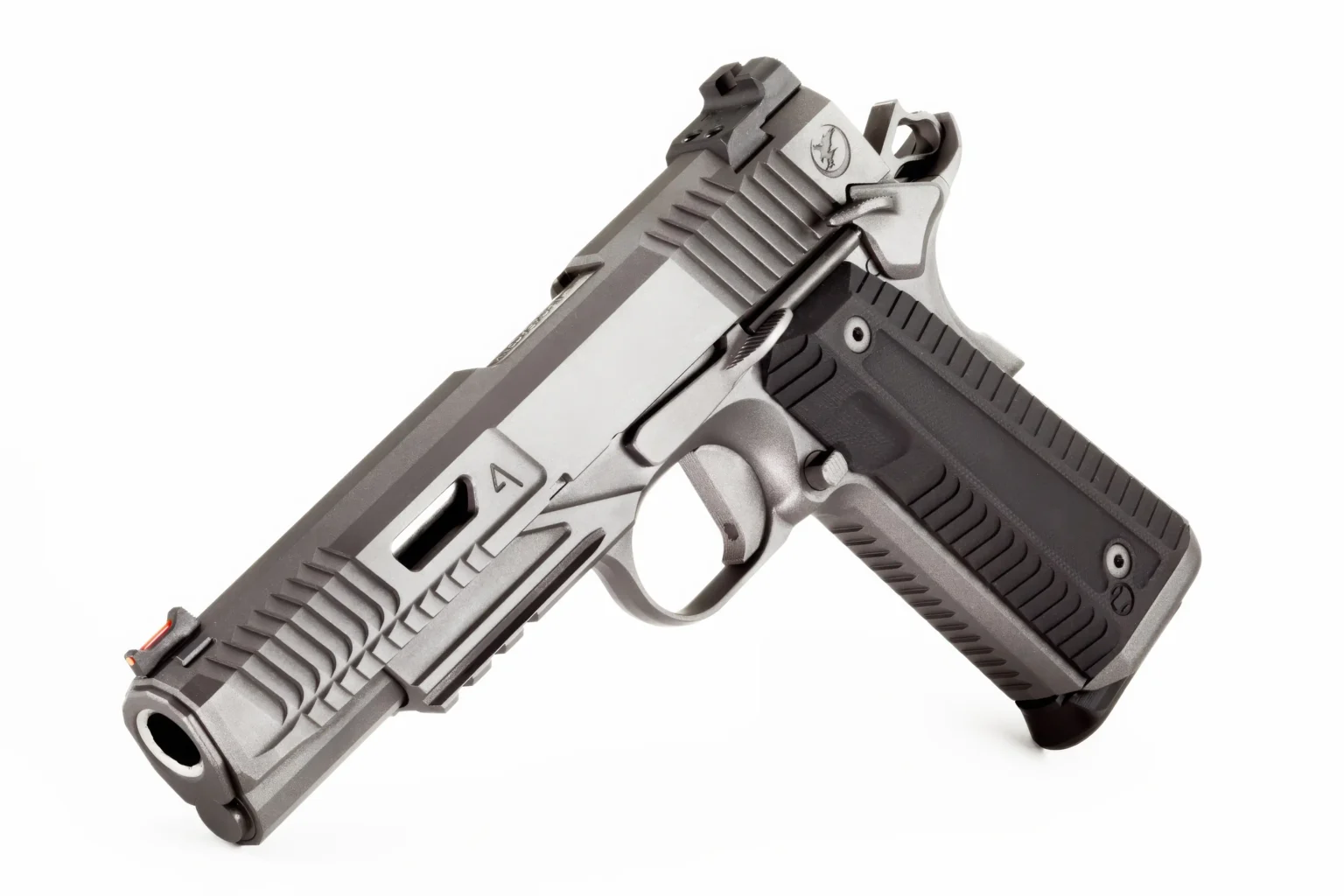
The Agent 2 departed sharply from conventional 1911 styling. It was developed through a collaboration involving Nighthawk Custom, Agency Arms, Railscales and Hillbilly 223. Its defining features include aggressively machined slide surfaces, a faceted profile and proprietary grip treatment.[6]
The collaboration is important because it gives the model an identifiable design lineage beyond its cosmetic novelty. Different Agent 2 configurations have been offered, however, so caliber, barrel length, finish and factory-installed options must be verified on the individual firearm. An unusual appearance by itself does not establish a scarce or limited-production variant.
TRS Comp and Sand Hawk: Compensated Double-Stacks
The TRS Comp represents Nighthawk’s move into high-capacity, compensated 9mm pistols. A published evaluation documented a 5-inch match-grade barrel, integral single-port compensator, double-stack frame, 17-round magazine, and black diamond-like-carbon finish. The tested pistol measured 8.47 inches overall and weighed 39.6 ounces with an empty magazine.[7]
In that test, the best five-shot group measured 0.70 inch at 25 yards with SIG Sauer 124-grain V-Crown ammunition.[7] This is a documented result from one pistol with one load, not a universal accuracy guarantee.
The Sand Hawk applies a tan-and-black finish treatment and related styling to the compensated platform. Both single- and double-stack Sand Hawk configurations have appeared, making the precise frame and magazine arrangement an essential part of any description. Collectors should not assume that every Sand Hawk has the same capacity or mechanical specification.
Counselor and T4: Compact Formats
The Counselor is one of Nighthawk’s smallest purpose-built carry pistols. American Rifleman documented a 9mm example with a 3.5-inch barrel, shortened forged-aluminum Officer-size frame, flush-fit magazine well, eight-round magazines, and an unloaded weight of 27.9 ounces.[8] The pistol tested by the magazine averaged 0.76 inch for 75 shots fired in five-shot groups at seven yards, without a malfunction during the reported evaluation.[8]
The T4 occupies a slightly larger compact format. A 2017 Gun Digest evaluation documented a .45 ACP example with a 3.8-inch barrel, forged Officer-size frame, seven-round magazine and an unloaded weight of 34.3 ounces.[9] Because the T4 has also been offered in other chamberings and configurations, the published specifications should be applied only to comparable examples.
Neither model’s size proves reliability or suitability for defensive use. Those judgments require inspection and testing of the individual pistol with its intended magazines and ammunition.
War Hawk and the Bob Marvel Connection
Nighthawk’s work with pistolsmith and designer Bob Marvel produced a separate family of 1911s incorporating his specifications. A contemporary American Rifleman review reported that Marvel developed the specifications for a Nighthawk model and trained a company pistolsmith to build it. The reviewed pistol used a bushingless bull barrel, full-length guide rod, and Marvel-designed recoil-spring system.[10]
Later Nighthawk models, including the War Hawk, adopted recognizable elements associated with this design family. A collector should nevertheless avoid describing every War Hawk as a Bob Marvel Custom. The model marking, production period, and original paperwork must support that attribution.
Turnbull VIP 2: A Documented Collector Model
The Turnbull VIP 2 is one of the clearest collector-oriented Nighthawk variants. Nighthawk records the model as having been offered from 2016 through 2021 in collaboration with firearm finisher Doug Turnbull. Documented features include a color-case-hardened frame, charcoal-blued slide, niter-blued controls, mammoth-ivory grips, a 14-karat-gold front-sight bead, and a presentation case.[11]
Nighthawk describes production as extremely limited but does not publish a production total on the model’s official page.[11] Without factory records, a precise quantity should not be claimed. Original grips, case, paperwork, and finish condition are particularly important when evaluating an example.
Beyond Nighthawk-Built 1911s
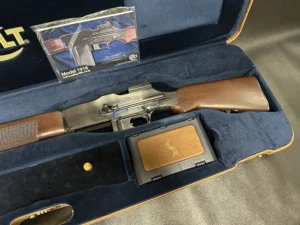
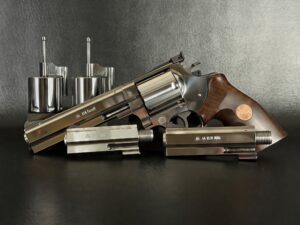
Nighthawk’s broader catalog now includes Cooper rifles, while the company serves as the exclusive United States importer of Korth revolvers and Cosmi shotguns.[1] These firearms may be sold and supported through Nighthawk, but they should not be represented as Nighthawk-manufactured 1911s. Manufacturer, importer, and custom finisher are separate roles, and accurate cataloging requires that distinction.
Evaluating a Nighthawk for a Collection
A Nighthawk’s model name is only the beginning of a proper assessment. Prospective buyers should document the serial number, frame size, caliber, barrel length, sight system, finish, grip material, and gunsmith’s initials. The company’s manual states that the model is generally engraved on the right side and the caliber is marked on the barrel.[2]
Original invoices, build sheets, test targets, presentation cases and correspondence can establish how a pistol left the factory. They are especially valuable for discontinued models, collaborations, and heavily optioned builds.
Claims that a particular Nighthawk is an “investment,” that limited editions inevitably appreciate, or that used examples routinely sell above their original prices are not supported by a stable public record. Condition, configuration, provenance and buyer demand all affect value. The strongest collector examples are therefore not simply the most ornate. They are the pistols whose identity, originality and history can be documented.
Frequently Asked Questions
Nighthawk uses a “One Gun, One Gunsmith” process in which one pistolsmith builds and hand-fits the pistol. The builder’s initials are stamped beneath the left grip panel.
The GRP is identified in company literature as Nighthawk’s base model and represents its relatively restrained, traditional approach. Whether it is the right purchase depends on the buyer’s intended use, preferred configuration, and budget.
The Turnbull VIP 2 is a documented collector-oriented collaboration produced from 2016 through 2021. Its features included a color-case-hardened frame, charcoal-blued slide, and niter-blued controls.
No. Both single- and double-stack Sand Hawk configurations have appeared, so the frame type and magazine capacity must be verified on the individual pistol.
No stable public record supports a blanket claim that Nighthawk pistols inevitably appreciate. Value depends on originality, condition, configuration, provenance, and current buyer demand.
Sources
- Nighthawk Custom, “About Nighthawk Custom.”
- Nighthawk Custom, “Safety Reference Owner’s Manual.”
- Nighthawk Custom, “Express Gunsmithing Initiative.”
- Wiley Clapp, “Nighthawk Custom Global Response Pistol: The Wiley Clapp Review,” American Rifleman.
- Tyler Freel, “Nighthawk Custom President: A Top-Shelf 1911,” Outdoor Life.
- Tom Beckstrand, “Nighthawk Custom Agent 2 Review,” Guns & Ammo, January 13, 2020.
- Chris Mudgett, “Nighthawk Custom TRS Comp Double-Stack,” On Target Magazine.
- Aaron Carter, “Review: Nighthawk Custom Counselor,” American Rifleman.
- Bob Campbell, “Gun Review: Nighthawk Custom T4 1911,” Gun Digest.
- Wiley Clapp, “Review: Nighthawk Custom .45 Pistols,” American Rifleman.
- Nighthawk Custom, “Turnbull VIP 2.”