
Key Takeaways:
- Uberti’s Reproductions Are the Real Deal. A. Uberti S.p.A. doesn’t just copy historic firearms — they refine them. With superior fit, finish, and modern steel alloys, Uberti reproductions often outperform the originals in consistency and shootability, making them a smart choice for collectors and competitors alike.
There’s a Uberti for Every Corner of History. From Civil War percussion revolvers like the 1860 Army and 1851 Navy to frontier cartridge guns like the 1873 Cattleman and Yellowboy, Uberti’s catalog spans over a century of American firearms history. Building a themed collection around these pieces is one of the most rewarding paths in the hobby.
Quality and Value Go Hand in Hand. Original Colt SAAs and Winchester 1873s can cost thousands at auction. Uberti gives collectors the visual experience, the historical connection, and the shootability of those iconic designs without the financial anxiety. Honestly, for most enthusiasts, that’s the best of both worlds.
There’s something almost poetic about holding a firearm that looks and feels like it just rolled off the assembly line of a 19th-century American gunsmith. That’s exactly the magic Aldo Uberti bottled back in 1959 when he founded A. Uberti S.p.A. in Gardone Val Trompia, Italy. A small town with a massive legacy in metalworking, Gardone became the birthplace of some of the most faithful, beautifully crafted reproduction firearms the world has ever seen.
Here’s the thing: Uberti didn’t just copy guns. He studied them, obsessed over them, and arguably improved the manufacturing tolerances on designs that were already considered legendary. Over the decades, the company became the go-to source for Hollywood prop masters, Cowboy Action Shooting competitors, serious collectors, and first-time buyers who simply wanted a piece of the Old West without paying museum prices for an original.
So what makes a Uberti firearm worth your attention? Let’s walk through the models that truly defined the brand, the ones collectors argue about at gun shows and historians quietly admire from behind glass cases.
The 1873 Cattleman: Uberti’s Crown Jewel
If you ask any Uberti enthusiast to name the company’s defining piece, nine times out of ten, they’ll say the 1873 Cattleman. And honestly, it’s hard to argue with them.
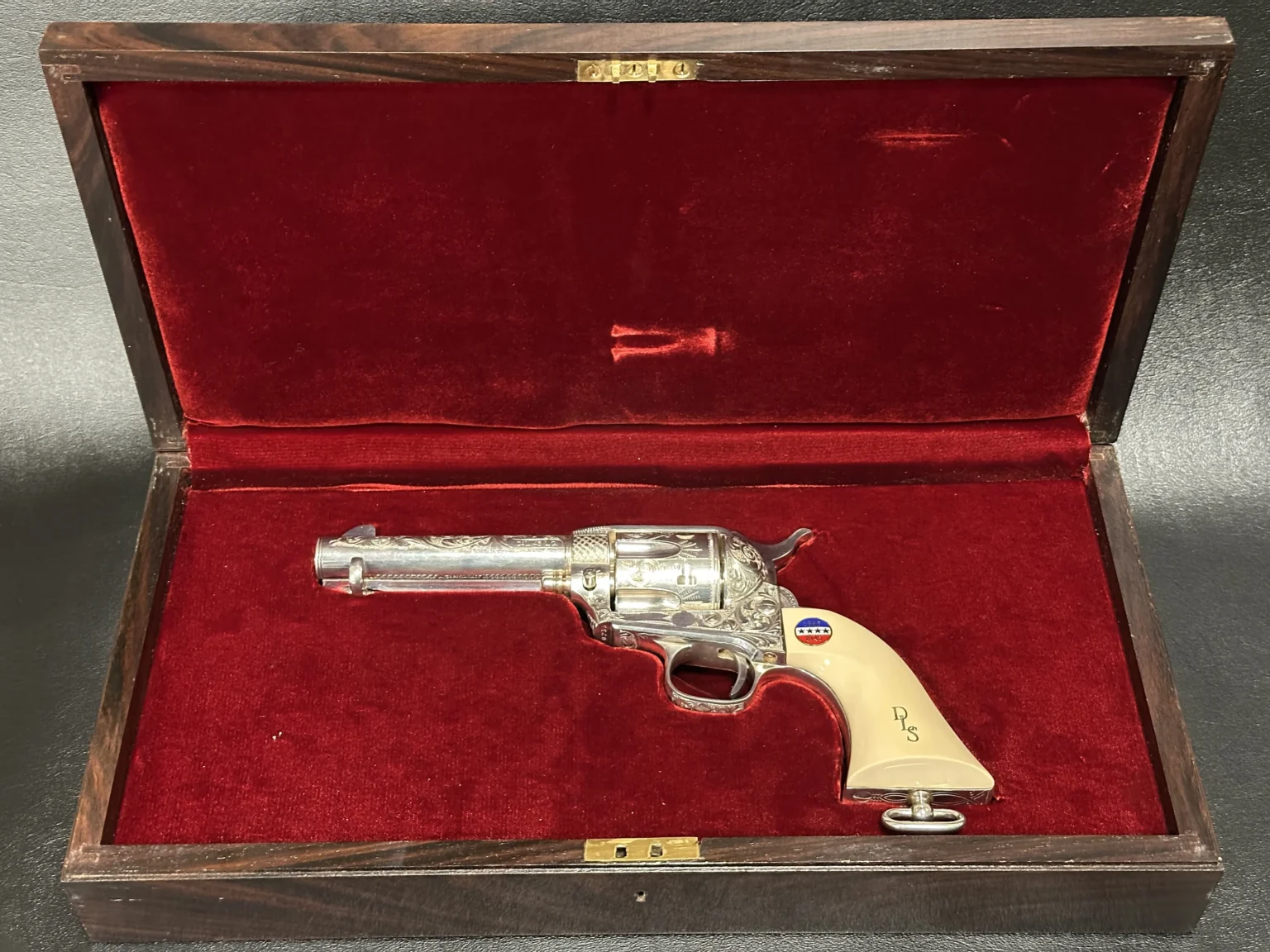
The Cattleman is Uberti’s reproduction of the Colt Single Action Army, the gun that practically wrote the mythology of the American West. Originally chambered in .45 Colt for the U.S. Army in 1873, the Colt SAA became the sidearm of lawmen, outlaws, cowboys, and cavalry alike. When Uberti began producing their version, they faced an almost impossible standard. The original Colts are revered; some fetch tens of thousands at auction. Matching that heritage in a modern production firearm? That takes nerve.
What Uberti managed was remarkable. The Cattleman features case-hardened frame colors that genuinely rival vintage originals in visual appeal. The action timing is crisp. The single-action trigger breaks cleanly. Collectors who’ve held both an original SAA and a Uberti Cattleman often note that, mechanically, the Uberti can outperform the original in terms of fit and finish consistency.
Available in calibers ranging from .357 Magnum and .44-40 Winchester to .45 Colt, with barrel lengths from 3.5 inches to 7.5 inches, the Cattleman isn’t a one-size-fits-all proposition. That versatility is part of why it endures. Whether you’re competing in SASS (Single Action Shooting Society) matches or displaying it in a rosewood cabinet, there’s a Cattleman configuration built for your purpose.
The blued-finish variants have their devotees, but the color-case-hardened versions are the ones that stop people mid-stride at gun shows. That swirling blue-and-orange pattern on the receiver is like a fingerprint; no two look exactly alike.
The 1866 Yellowboy: Golden History, Literally
Some firearms earn their nicknames. The Winchester Model 1866, affectionately called the “Yellowboy” because of its brass receiver, is one of them. Uberti’s reproduction captures every curve, every line, and every warm gleam of that iconic receiver, making you feel the weight of history when you shoulder it.
The original 1866 was a refinement of the Henry rifle, addressing some of its practical shortcomings. B. Tyler Henry’s lever-action design was revolutionary, but its magazine was awkward to load. The 1866 introduced a loading gate on the receiver’s right side, a feature that persisted in lever-action designs for over a century.
Uberti’s Yellowboy comes in several configurations: rifle, carbine, and short rifle. The rifle with its 24-inch octagonal barrel is the one that photographers and filmmakers fall for. The carbine, with its 19-inch barrel and saddle ring, is arguably the more historically significant configuration for actual use on horseback.
You know what separates serious collectors from casual buyers when it comes to the Yellowboy? The brass. Cheap reproductions have brass that looks thin, almost toy-like. The Uberti version has substantial brass receiver walls, properly fitted to the walnut stock, with a polished finish that deepens to a richer tone over years of handling. It patinas beautifully.
Chambered in .44-40, .45 Colt, and .38 Special / .357 Magnum, the Yellowboy is a functional history. You can shoot it, compete with it, or simply own it as a tangible link to an era when a repeating rifle was the most powerful personal protection technology available.
The 1873 Winchester Lever-Action: Where Versatility Met Legacy
The Winchester 1873 followed the 1866 and became arguably the most successful lever-action design of the 19th century. Winchester’s marketing team didn’t shy away from the claim either; they called it “The Gun That Won the West.” Marketing hyperbole? Maybe. But the 1873 was chambered for pistol cartridges that could also be used in revolvers of the same era, which meant a frontier family only needed to stock one type of ammunition for both long guns and handguns. That’s practical genius.
Uberti’s reproduction of the 1873 Winchester is one of their most refined offerings. The action on a well-fitted Uberti 1873 is smooth in a way that surprises first-time handlers. There’s a satisfying mechanical precision to the way the lever cycles; it’s tight where it needs to be, smooth where smoothness matters.
The full-octagon barrels are gorgeous. Run your hand along one, and you feel why gunsmiths of the 1870s chose that profile; the flat surfaces radiate heat more efficiently than a round barrel, and visually, the geometry is deeply satisfying.
For Cowboy Action Shooting competitors, the Uberti 1873 is practically standard equipment. The rifle’s reliability under competition conditions is well-documented, and the aftermarket support, springs, hammers, and action jobs are robust because so many competitors rely on these guns. Gunsmiths who specialize in SASS-legal modifications have tuned thousands of these rifles into competition-grade tools.
One small note for prospective buyers: Uberti’s 1873 Winchester in .357 Magnum is particularly popular because it handles both .38 Special and .357 Magnum cartridges, giving shooters cost-effective practice options while still allowing full-power loads when needed.
The 1860 Army: Civil War Thunder in Your Hand
Percussion revolvers occupy a strange, almost mystical space in the firearms world. They require more effort, black powder, percussion caps, lead balls or conical bullets, and a ramrod, but the reward is a shooting experience unlike anything a cartridge revolver offers. The smell of black powder, the white smoke rolling out from the cylinder, the physical ritual of loading. It’s immersive in a way that modern shooting simply isn’t.
The Colt Model 1860 Army was the primary sidearm of Union soldiers during the Civil War. More than 200,000 were manufactured between 1860 and 1873, making it one of the most produced revolvers of the percussion era. Uberti’s reproduction honors that legacy with a level of detail that even purists appreciate.
The 1860 Army’s rebated cylinder, slightly smaller in diameter at the rear than at the front, is one of its distinctive visual features. Uberti renders it accurately, along with the creeping-style rammer mounted under the barrel and the characteristic round-backed trigger guard. In .44 caliber with an 8-inch barrel, the Uberti 1860 Army has excellent balance; it’s heavier than modern revolvers but sits naturally in the hand.
For black powder enthusiasts, this is often a first serious purchase and frequently not the last. Well-maintained Uberti percussion revolvers hold their value remarkably well, and the shooting experience keeps people coming back. There’s a competitive discipline called Mounted Shooting that sometimes involves percussion revolvers, and you’ll find Uberti 1860 Armys at those events; they work reliably, even under competitive pressure.
The 1851 Navy: The Gentleman’s Revolver
If the 1860 Army was the military workhorse, the Colt 1851 Navy was the refined, elegant sibling. Lighter, with a smaller .36 caliber cylinder and a slimmer profile, the Navy was favored by civilians, gamblers, and, famously, Wild Bill Hickok, who carried a pair of them in a crossdraw configuration for much of his life.
Hickok’s attachment to the 1851 Navy is well documented. He supposedly had them custom-engraved and ivory-gripped. Whether you find that kind of gunfighter mythology compelling or a bit dramatic probably says something about your relationship with history. Personally, the historical associations of these firearms add a dimension that no modern gun can replicate.
Uberti’s 1851 Navy is delicate by the standards of percussion revolvers. The 7.5-inch octagon barrel, the rectangular brass trigger guard, and the two-piece walnut grips are all proportioned with care. It’s genuinely beautiful as a display piece. As a shooter, it’s surprisingly accurate at typical handgun distances.
The case-hardened frame on Uberti’s 1851 Navy has that same characteristic swirling color pattern as the Cattleman. It’s a detail that separates this reproduction from cheaper alternatives. Some makers cut corners on case hardening because it requires careful chemistry and timing. Uberti doesn’t.
The Schofield: A Revolver With a Story Worth Telling
Major George W. Schofield modified Smith & Wesson’s Model 3 revolver in the early 1870s to make reloading faster on horseback. The result was the Schofield Model, a top-break revolver that ejects all spent cases simultaneously when you break the action open. Faster than a Colt’s loading gate? Significantly. Jesse James reportedly preferred Schofields for exactly this reason.
Uberti’s Schofield reproduction is a masterclass in manufacturing a mechanically complex firearm. The top-break mechanism requires precise fitting; too loose and the action wobbles, too tight and it won’t open smoothly. The Uberti version handles this well, with a hinge-and-latch system that feels secure yet opens with authority.
Available in .45 Colt and .38 Special, the Uberti Schofield is a different kind of collector’s piece. It’s not as immediately famous as the Cattleman, but among people who know their history, it prompts immediate recognition and genuine appreciation. The bird’s-head grip option Uberti offers on some variants adds a cavalry aesthetic that photographs extraordinarily well.
The Schofield is also simply fun to shoot. The simultaneous ejection of spent cases, the satisfying clack of the action opening and closing, the top-break silhouette against a blue sky at the range, there’s a theatrical quality to this revolver that appeals to people who appreciate firearms as mechanical art.
The 1875 and 1890 Remington Outlaw and Police: The Other Side of the Argument
Not everyone was a Colt partisan. Remington made strong arguments for their own revolvers during the frontier era, and the 1875 Remington Army, and its follow-up, the 1890 Remington Police, had their own loyal user base. Jesse James again, outlaws generally, and people who appreciated the 1875’s solid web under the barrel, which gave it a sturdier appearance and, arguably, a more balanced feel than the Colt SAA.
Uberti’s reproductions of both models are excellent. The 1875 Outlaw, with its distinctive barrel web, is visually striking in a way that the SAA isn’t; it looks almost aggressive by comparison, which is probably fitting given who tended to carry them historically. The 1890 Police version dropped the web, creating a cleaner, lighter profile.
Both models are available in .357 Magnum and .45 Colt. The grips are two-piece walnut on standard models, and the case-hardened frames again showcase Uberti’s commitment to period-correct aesthetics. These aren’t as commonly seen at gun shows as the Cattleman, which makes them genuinely interesting collector targets. The Remington reproductions are underappreciated in a market that tilts heavily toward Colt.
The 1874 Sharps: Long-Range Authority
Shifting from handguns to rifles for a moment, the 1874 Sharps represents a completely different chapter in Uberti’s catalog and in American firearms history. The Sharps was the dominant buffalo rifle of the 1870s, a single-shot, falling-block design capable of devastating accuracy at ranges that would challenge modern bolt-action precision rifles.
Buffalo hunters using .45-70 and .45-110 Sharps cartridges regularly made kills at 500 yards and beyond. The rifle’s falling-block action is mechanically elegant in its simplicity: pull the trigger guard/lever downward; the breech drops; insert a cartridge; close the breech; and you’re ready. No complex lock mechanisms, no extraction issues. Just a solid, reliable action that professional hunters trusted their livelihood to.
Uberti’s Sharps reproduction comes with double-set triggers as standard, a feature that allows you to set a very light trigger pull by pushing the rear trigger forward before shooting. For precision work at a distance, this is invaluable. The heavy octagonal barrels on the rifle variants are genuine; they’re not decorative but functional. Mass helps absorb recoil from large buffalo cartridges, and the octagon profile was standard practice for heavy-barreled sporting rifles of the period.
For hunters today who pursue large game at distance with traditional equipment, the Uberti Sharps in .45-70 Government remains a viable hunting tool. The nostalgia is real, but so is the performance.
The Springfield Trapdoor: Underdog Elegance
Less glamorous than the Sharps in collector circles but historically significant in its own right, the Springfield Trapdoor rifle was the U.S. Army’s standard infantry rifle from the late 1860s through the 1890s. It’s most associated with the Battle of the Little Bighorn in 1876, where Seventh Cavalry troopers armed with Trapdoor carbines faced disaster, a fact that has made the rifle both fascinating and somewhat haunting to military history enthusiasts.
The “trapdoor” refers to the hinged breechblock that lifts to allow cartridge insertion, converting the single-shot muzzleloader into a cartridge-firing breechloader. It was the Army’s economical solution to modernizing vast stockpiles of Civil War muskets, and while the design was never ideal, the extractors had issues in dirty field conditions, it served for decades.
Uberti’s reproduction captures the look and feel of the original with admirable fidelity. The case-hardened lock, the walnut stock with its three barrel bands, the distinctive trapdoor breechblock mechanism, it’s a handsome piece of military history. Chambered in .45-70 Government, it’s also shootable, and for history enthusiasts who want to understand what a cavalryman carried at the Little Bighorn, this is as close as most people will ever get without visiting a museum.
The 1851 Navy Conversion and the Richards-Mason: Bridging Two Eras
Here’s a fascinating transitional moment in firearms history that Uberti addresses with a specific model line. After the Civil War, there were enormous numbers of percussion revolvers in circulation. When metallic cartridges became dominant in the late 1860s, a practical question arose: what do you do with all those percussion guns?
Colt’s answer, developed by engineers Richards and Mason, was a conversion cylinder. You could replace the percussion cylinder with a new cylinder that accepted metallic cartridges, add an ejector rod, and convert a cap-and-ball revolver into a cartridge revolver relatively cheaply.
Uberti makes conversion revolvers in this tradition, percussion-frame guns fitted with cartridge cylinders that accept .38 Special and similar calibers. They’re historically accurate representations of a specific moment in technological transition, and they have a unique visual identity. The combination of old-style percussion revolver lines with a cartridge cylinder and an ejector rod creates a firearm that looks exactly like what it is: a bridge between eras.
Collectors who specialize in this period find conversion revolvers endlessly interesting. They tell a story about economic realities, practical engineering, and the rapid pace of firearms development in the post-Civil War decades.
What Sets Uberti Apart From the Competition?
You’ve probably noticed that several other companies make Western reproduction firearms. Pietta, based in the same Gardone Valley region, is the most direct competitor for percussion revolvers and some cartridge guns. Taylor’s & Co. is a major importer and sometimes carries Uberti and Pietta under its own branding. EMF (Early & Modern Firearms) has imported both as well.
So why do serious collectors and competitors often gravitate toward Uberti specifically?
Fit and finish, primarily. The wood-to-metal fit on Uberti firearms is consistently better than the budget competition. The case hardening is deeper and more visually interesting. The internal parts fit more precisely, resulting in better trigger pull and smoother action right out of the box.
Steel quality matters too. Uberti uses modern steel alloys that are often stronger than the originals, which means these guns can typically be fired with modern pressure-rated ammunition without concern. The Cattleman in .45 Colt, for instance, can handle Cowboy loads, standard loads, and some manufacturers even make “+P” loads designed specifically for strong-frame revolvers. Always verify manufacturer specifications before loading, but the metallurgy on Uberti firearms is generally reassuring.
The Beretta connection is worth mentioning. Beretta acquired Uberti in 1996, and the deep manufacturing resources and quality control standards of one of the world’s oldest firearms companies have arguably strengthened Uberti’s production consistency. When you buy a Uberti today, you’re buying a product backed by centuries of Italian gunsmithing tradition through its parent company, even if the product itself is thoroughly American in spirit.
Caring for Your Uberti: A Few Thoughts
Reproduction firearms, particularly percussion models, require more attentive maintenance than modern cartridge guns. Black powder residue is hygroscopic; it attracts moisture and will cause rust on unprotected metal surfaces within hours if left unaddressed after shooting.
The cartridge guns are far more forgiving but still deserve proper care. Bore solvent, a quality brush, patches, and a light coat of oil are all you need. For case-hardened surfaces, avoid over-oiling; a thin protective coat is sufficient, and heavy oil can actually attract dust and grit, which accelerate wear.
Walnut stocks respond well to periodic application of linseed oil or a quality stock wax. The original 19th-century gunsmiths finished their walnut in oil, and maintaining that tradition keeps the wood protected and looking its age-appropriate best.
Storage matters too. Humidity is the enemy. Silica gel packets in a gun safe, a dehumidifier rod if you’re storing for extended periods, and periodic inspections to catch any early signs of corrosion will keep a Uberti in excellent condition for generations. These firearms were built to last; they just need a little respect.
The Collector’s Perspective: Building a Uberti Collection
Collecting Uberti firearms can be an approachable entry into the larger world of antique and reproduction gun collecting. Original Colt SAAs in good condition now regularly sell for $3,000 to $15,000 or more, depending on configuration and era. Original Winchester 1873s in shootable condition start around $1,500 and go considerably higher for desirable variants.
Uberti reproductions give collectors the visual and historical experience of owning these designs at a fraction of the cost, while allowing them to actually shoot the firearms without the existential anxiety that comes with firing a $10,000 original.
Many collectors build themed sets. A Civil War percussion set might include the 1860 Army, the 1851 Navy, and a reproduction Springfield or Enfield rifle musket. A frontier lawman set might pair the Cattleman with a Yellowboy carbine. A buffalo hunter theme calls for the Sharps, maybe paired with a period-correct holster and accouterments. The possibilities are genuinely enjoyable to plan.
Commemorative and special edition Ubertis are worth watching for as well. Limited-production engravings, unique finishes, and special-caliber offerings appear periodically and tend to hold their value or increase in value relative to standard production models.
Final Thoughts: Why Uberti Still Matters
Sixty-plus years after Aldo Uberti started his company in a gunsmithing tradition that Gardone Val Trompia had cultivated for centuries, A. Uberti S.p.A. remains the gold standard for Western reproduction firearms. The models covered here represent the high points, but the catalog is broad, and nearly every serious firearms collection that touches on American history includes at least one Uberti.
There’s something genuinely moving about holding a Cattleman or cycling the lever on a Yellowboy. It’s not nostalgia exactly; it’s more like a direct physical connection to a period of history that shaped so much of American culture and mythology. These weren’t just tools; they were technologies that defined an era.
Uberti understood that. The company’s commitment to accuracy, quality, and shootability has never wavered, and for collectors, competitors, hunters, and history enthusiasts alike, that commitment makes all the difference. Whether you’re buying your first reproduction or adding the fifteenth piece to a curated collection, Uberti firearms reward attention and appreciation in equal measure.
That’s a legacy worth holding onto.
Frequently Asked Questions
Uberti consistently delivers superior wood-to-metal fit, deeper case hardening, and more precisely fitted internal parts than budget competitors. That attention to detail translates directly into better trigger pull and action smoothness right out of the box.
Uberti firearms are built to shoot, not just sit behind glass. Modern steel alloys and tight manufacturing tolerances mean most models handle standard and competition loads without issue.
The 1873 Cattleman is the natural first choice; it’s historically significant, visually stunning, and available in versatile calibers like .45 Colt and .357 Magnum. It’s the model that defines the brand for a reason.
Black powder residue attracts moisture fast, so cleaning after every shooting session is non-negotiable. Beyond that, basic bore care and a light coat of oil are all these revolvers really need.
Standard production models hold value well, but limited-edition and engraved variants tend to appreciate more noticeably over time. Keeping them in excellent condition through proper storage and maintenance is the simplest way to protect that investment.