
Key Takeaways:
- The Mauser 98 Action Is the blueprint that the Whole Industry Borrowed. If you’ve ever wondered why so many bolt-action rifles feel vaguely familiar, this is why. Winchester, Springfield, Remington. They all drew from the same well. The Mauser 98’s controlled-round-feed system, dual locking lugs, and claw extractor weren’t just good ideas for 1898. They were good enough that engineers kept copying them for a century afterward. That’s not influence. That’s dominance.
- Condition and Provenance Separate a Good Collection from a Great One: Matching numbers, original finish, documented history. These details might seem like collector obsessions, but they’re actually what separates a firearm that holds its value from one that quietly loses it. A mismatched, refinished 98k and a correct, all-original example might look similar at a glance. Their stories, and their prices, are a world apart. Buy with your eyes open.
- Mauser Isn’t Just History. It’s Still Happening. There’s a temptation to treat Mauser as a purely historical brand, something you study rather than use. The modern M03 pushes back hard against that idea. Current production rifles carry the same engineering philosophy forward: tight tolerances, modular design, and field reliability. The name on the receiver still means something. It just means something slightly different depending on which century the rifle was made in.
let’s get started…
There’s a moment every serious collector knows. You’re holding a Mauser bolt-action, feeling the weight of it settle into your hands, and something almost inexplicable happens. The cold steel, the precision of the action, the history embedded in every machined surface. It’s not just a firearm. It’s a conversation with 150 years of engineering genius.
Mauser. The name alone carries weight. Paul Mauser and his brother Wilhelm started their story in Oberndorf am Neckar, Germany, back in 1867, and what followed was nothing short of a revolution in how the world thought about firearms. Their designs didn’t just influence military history. They defined it. Rifles bearing the Mauser name were carried by soldiers in World War I, World War II, and dozens of conflicts in between and beyond. Hunters stalked African plains with Mauser actions. Olympic shooters refined their craft with Mauser-derived mechanisms.
So, where do you even start when ranking the greatest Mauser firearms? You start at the beginning, and you follow the thread.
The One That Started Everything: The Mauser Model 1871
Let’s be honest, the Model 1871 doesn’t get enough credit. It’s the grandfather of everything Mauser became, and collectors who overlook it are missing a fascinating piece of the puzzle.
The German Imperial Army adopted this single-shot, bolt-action rifle in 1871, making it one of the earliest purpose-built military bolt actions in the world. The design introduced a rotating bolt that locked directly at the receiver, a concept that would define Mauser’s trajectory for the next century. The action was robust, the trigger pull clean, and, for its era, genuinely advanced engineering.
Here’s the thing: the Model 1871 wasn’t glamorous by modern standards. It fired a single round at a time, chambered in the black-powder 11x60mmR cartridge, and required manual loading after each shot. But that misses the point. What mattered was the philosophy behind it. Paul Mauser was building a system, not just a gun. The rotating bolt head, the controlled extraction, and the overall reliability in field conditions. These weren’t accidents. They were deliberate choices that laid the groundwork for everything that came after.
Finding a clean Model 1871 today requires patience, but they’re out there. Some specimens show extraordinary craftsmanship on the wooden stocks, particularly those made for Prussian cavalry units. If you’re a collector who values historical depth over raw performance metrics, the 1871 belongs on your shelf.
When Smokeless Powder Changed Everything: The Gewehr 98
Now we’re talking. If you had to pick a single Mauser that defined the brand, the Gewehr 98 would win that argument most days of the week.
Adopted by the German military in 1898, the Gewehr 98 introduced what became the definitive controlled-round-feed bolt action. The 98 action features a dual opposed locking lug system at the bolt head, a claw extractor that grips cartridges from the moment they leave the magazine, and a three-position safety that remains one of the most intuitive ever designed. Seventy-plus years later, custom rifle makers worldwide were still copying it directly, and many still do.
The cartridge it was chambered for, the 7.92x57mm Mauser, deserves its own moment of appreciation. This round, often called the 8mm Mauser by American shooters, hit harder than most of its contemporaries, offered excellent ballistic performance, and remained in military service well into the Cold War era. Bolt-action rifles chambered in 7.92x57mm can still punch steel at 600 yards with factory ammo today.
From a collector’s perspective, Gewehr 98s vary enormously. Early production rifles from factories such as DWM (Deutsche Waffen- und Munitionsfabriken) are highly prized, particularly those with matching numbers on all components. Mismatched parts tell a story, too, though. Many Gewehr 98s were rebuilt, repaired, or reassigned throughout two world wars, and rifles with documented provenance or unit markings can command high prices at auction.
One thing worth noting: the Gewehr 98’s rear sight is graduated to distances that seem almost absurd by today’s standards. Some models show markings out to 2,000 meters. Were soldiers actually shooting at targets a mile and a quarter away with open iron sights? Mostly, no. But the ambition embedded in that design speaks to how Germany viewed its military potential in 1898.
The Everyman’s Mauser: The Karabiner 98k
If the Gewehr 98 was the refined expression of Mauser’s bolt-action philosophy, the Karabiner 98k was its working-class evolution. Shorter, lighter, faster to handle in tight quarters. The 98k became arguably the most-produced Mauser variant ever, with estimates suggesting between 10 and 15 million were manufactured between 1935 and 1945.
Every major theater of World War II saw the 98k. North African desert sand, the forests of the Eastern Front, the hedgerows of Normandy. German infantry carried this rifle through conditions that would destroy lesser firearms, and it held up. That’s the foundational promise of any Mauser action: reliability when it matters most.
Collectors face a unique challenge with 98k rifles. Supply is, relatively speaking, abundant. But condition and provenance scatter wildly. A never-issued, matching-numbers 98k from a late-war factory run is a very different animal from a post-war import with refinished wood and arsenal rebuild markings. Neither is without value, but they tell different stories and command very different prices.
Some of the most collectible 98k variants include the “Laminated stock” rifles produced after 1940 (Germany was running low on quality walnut by mid-war, so laminated birch stocks became standard), rifles bearing the markings of specific manufacturers like Mauser-Werke, Oberspree, or Gustloff-Werke, and late-war “last ditch” rifles that show simplified production methods driven by wartime resource shortages. These crude, semi-finished late examples actually fetch premium prices from collectors precisely because they document the collapse of German manufacturing capacity in 1944 and 1945.
There’s also the matter of caliber. While the vast majority of 98k rifles were chambered in 7.92x57mm, some post-war variants produced in Yugoslavia (as the M48) were rechambered to 7.62x51mm NATO or other calibers. These Yugoslav rifles, sometimes called “Zastava” actions in the American market, are functionally excellent but historically distinct from wartime German production.
The Hunting Rifle That Changed Safari Culture: The Mauser Model 98 Magnum Actions
Here’s where the story gets interesting for hunters and sporting collectors specifically. After World War II, Mauser’s legacy didn’t fade. It migrated into the commercial sporting world, and the result was a generation of premium bolt-action hunting rifles that defined what a “dangerous game” rifle meant.
The Mauser 98 action proved adaptable to large-caliber cartridges in ways that genuinely surprised the market. Rechambered in .375 H&H Magnum, .416 Rigby, .458 Winchester Magnum, and similar big-bore offerings, Mauser-actioned rifles became the standard choice for professional hunters across Africa and Asia. Companies like Rigby, Heym, and Dakota Arms built their reputations on Mauser-derived actions, each adding its own refinements while keeping the essential DNA intact.
The reason wasn’t nostalgia, either. It was engineering. The controlled-round-feed system, in which the extractor claw grips the cartridge base the instant it leaves the magazine, is functionally superior for dangerous-game work compared to push-feed designs. When you’re working a bolt on a charging Cape buffalo at 15 yards, you cannot afford a feeding malfunction. The Mauser 98 action essentially eliminates that risk category.
Original Mauser Magnum-length commercial actions from the Oberndorf factory, particularly pre-war production, are genuine treasures. Post-war commercial Mauser actions made at Oberndorf between the 1950s and 1990s are also excellent, and rifles built on these actions by quality British and German gunmakers can be extraordinary pieces of craftsmanship. If you’re shopping in this space, expect to spend serious money. A properly made dangerous game rifle on an original Mauser Magnum action from a reputable maker doesn’t have much ceiling on its value.
The Pistol That Outlived Its Era: The C96 “Broomhandle”
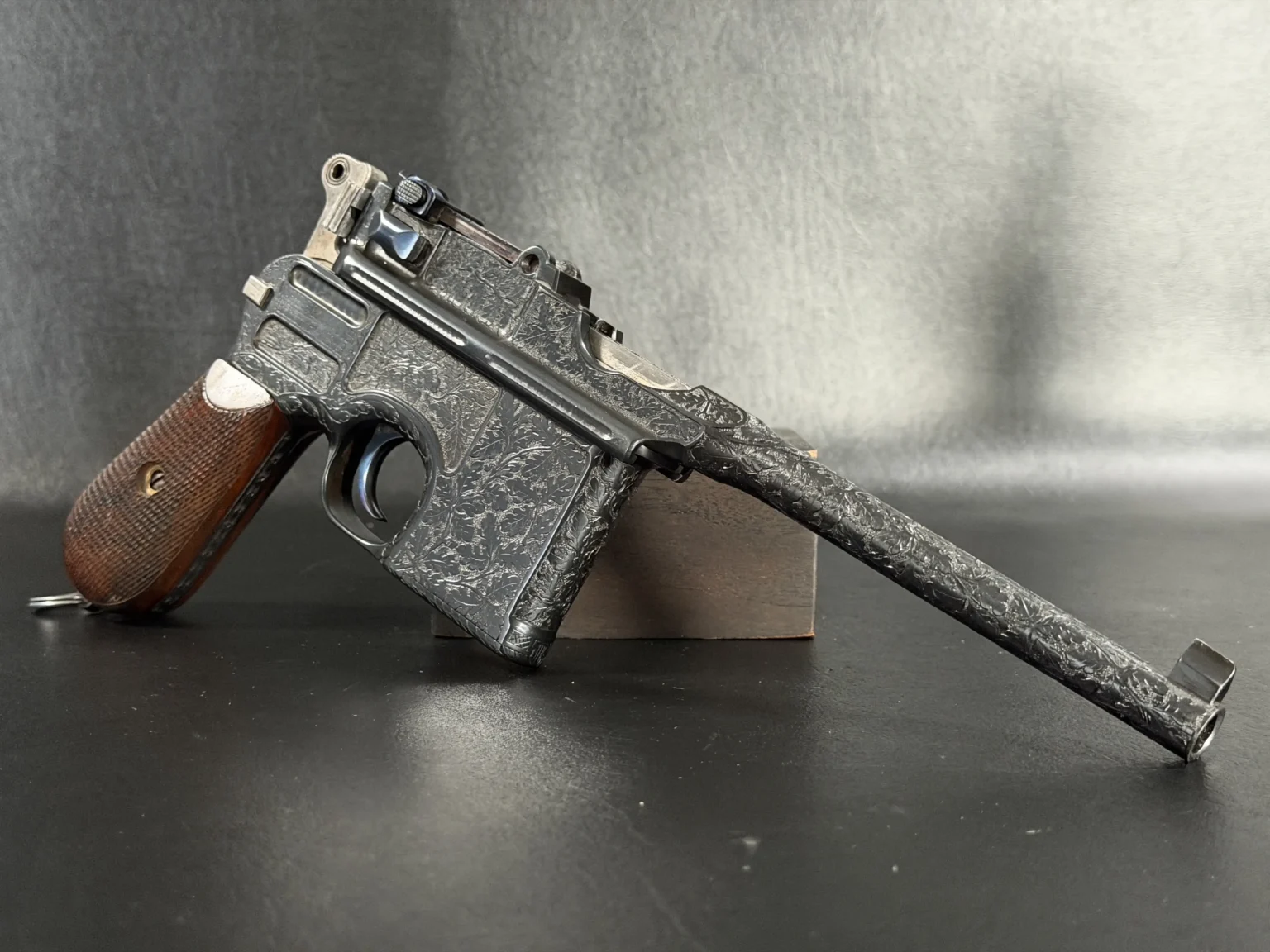
You simply cannot write about Mauser’s greatest firearms without discussing the C96. This pistol, introduced in 1896, looks like nothing else. The distinctive box magazine ahead of the trigger guard, the long barrel, the wooden holster that converts to a shoulder stock. It earned its “Broomhandle” nickname from that unmistakable grip shape, and it earned its reputation the hard way.
Winston Churchill carried a C96 at the Battle of Omdurman in 1898. Lawrence of Arabia reportedly used one during the Arab Revolt. The Chinese Nationalist Army bought hundreds of thousands of them, and Chinese copies continued production into the 1950s. Simplified versions were made with detachable box magazines and selective-fire capability, producing what would become an early submachine-gun concept decades before the term existed.
From a purely mechanical standpoint, the C96 is a fascinating study in late Victorian engineering. The internal mechanism is complex in a way that modern pistols have long since abandoned, but it functions reliably with proper maintenance. Chambering varied over the production run, with 7.63x25mm Mauser and 9mm Parabellum being the most common. Some were chambered in .45 ACP for the American export market.
Collector grades on C96 pistols vary enormously. Standard commercial models are accessible; matching-numbers specimens with original holster stocks and accessories get expensive quickly. The “Red 9” variant, chambered in 9mm and bearing a large red “9” carved into the grips to prevent accidental ammunition mixups, is particularly desirable. These were made for the German military during World War I when 7.63mm Mauser ammunition supplies were constrained, and surviving examples in good condition are genuinely rare.
The Post-War Phoenix: The Mauser M03 and Modern Production
Mauser didn’t die with the Third Reich. That’s a misconception worth clearing up. The company underwent several ownership changes in the post-war decades, eventually coming under the umbrella of SIG Sauer’s parent company before re-establishing itself as a standalone brand within German Sport Guns’ ownership structure. The modern Mauser company, headquartered in Isny im Allgäu, makes precision hunting rifles that would make Paul Mauser proud.
The Mauser M03 represents the company’s contemporary bolt-action philosophy. It features a modular stock system that allows shooters to adjust length of pull and cheekpiece height without tools, a quick-change barrel system that lets users swap between calibers in minutes, and a detachable magazine design that feeds reliably across a range of cartridges from .243 Winchester to .375 H&H Magnum. The action is refined and smooth, the trigger pull is crisp and adjustable, and the accuracy expectations are tight.
Honestly, the M03 doesn’t have the historical romance of a Gewehr 98. It’s a modern tool designed to compete with Sako, Blaser, Heym, and other premium European hunting-rifle brands. But what it does have is that the Mauser name is backed by genuine engineering competence. The fit and finish of current-production M03 rifles is excellent. German gunmakers don’t cut corners on quality, and Mauser’s current production reflects that tradition.
For collectors who want something to actually use in the field rather than preserve under glass, the M03 is worth serious consideration. It’s not cheap. European precision hunting rifles rarely are. But it earns its price honestly.
The Sniper’s Tool: The Mauser SP66 and SR93
Here’s a corner of Mauser history that doesn’t always get the attention it deserves: precision long-range shooting. The Mauser SP66, introduced in the 1970s, was a precision sniper rifle designed specifically for law enforcement and military special operations. It used a shortened Mauser 98-type action in a thumbhole stock designed to provide maximum shooting stability, chambered primarily in .308 Winchester.
The SP66 wasn’t a perfect rifle by any means. It’s a single-shot bolt-action in an era when semi-automatic precision rifles were increasingly in demand. But for agencies that prioritized absolute accuracy over rate of fire, the SP66 delivered. German police units used it for years, and its reputation for reliability in difficult conditions was solid.
The SR93, introduced in the early 1990s, was a more competitive design. It featured a short bolt throw for faster cycling, a chassis-style stock system for improved ergonomics, and better overall practical accuracy. Neither the SP66 nor the SR93 is commonly available to civilian collectors in the United States, which makes documented examples genuinely interesting acquisitions when they do surface.
The Small Caliber Big Deal: The Model 1914 and 1910 Pocket Pistols
We should spend a moment on the Mauser pocket pistols, because they represent a different side of the company’s engineering talent. The Model 1910 and its larger companion, the Model 1914, were small semi-automatic pistols chambered in .25 ACP and .32 ACP, respectively. These weren’t fighting guns in the traditional sense. They were civilian concealed-carry pistols for an era when personal protection was considered a gentleman’s practical concern.
The design is a straightforward straight-blowback semi-automatic, mechanically simpler than the C96 by several orders of magnitude. What distinguished these pistols was quality. Mauser built them to the same standards as their military products: tight tolerances, excellent finish, and reliable function. Pre-war examples in original condition show wood grips that fit perfectly, slides that move with fluid precision, and overall dimensions that feel purposeful rather than compromised.
European collectors, particularly German and Austrian specialists, prize these pocket pistols significantly. American collectors tend to overlook them in favor of the more dramatic military designs, but that’s their loss. A matched pair of Mauser 1910 pistols in original condition represents genuine craftsmanship, full stop.
Why Mauser Still Matters: The Bigger Picture
You know what separates Mauser from most firearms brands? Longevity with integrity. There are plenty of companies that dominated an era and faded. Mauser dominated an era, then another, then another, and it’s still making rifles today that people buy because they’re good, not just because of the name.
The Mauser bolt action in its Model 98 configuration remains the most widely copied firearm design in history. Winchester Model 70 actions owe their controlled-round-feed mechanism to the Mauser. Springfield Model 1903 rifles were so heavily influenced by Mauser that the U.S. government paid Mauser a licensing fee until World War I made that arrangement politically untenable. Remington’s 700 action and countless others adapted Mauser concepts even as they modified the details.
When you look at a Mauser, you’re not just looking at a firearm. You’re looking at a blueprint for a century of bolt-action development. That’s not hyperbole. That’s history.
For collectors, the practical question is always where to focus. The answer depends entirely on what you’re after. Historical significance points toward Gewehr 98 and Karabiner 98k specimens with verified provenance. Mechanical fascination draws many collectors toward the C96 and its variants. Sporting utility sends buyers toward commercial Mauser Magnum actions and quality rifles built upon them. Modern precision attracts those who appreciate the M03’s engineering without needing the patina of age.
There’s no wrong answer. That’s the luxury of collecting in a category this rich. Mauser gave us enough variety across enough decades that you could spend an entire collecting lifetime exploring it without running out of territory.
The Collector’s Practical Guide: What to Watch For
Before we wrap up, let’s talk practicalities for a moment, because loving a brand and buying wisely are two different skills.
Matching numbers matter enormously on military Mauser rifles, particularly Karabiner 98k specimens. The receiver, bolt, barrel, and stock should all show the same serial number (or at a minimum the last two digits, which was standard German military practice). Mismatched rifles aren’t worthless, but they’re significantly less valuable than matching examples, and some dealers aren’t always forthcoming about which you’re getting.
Import marks are a reality on many surplus Mausers. U.S. law requires importers to mark imported firearms with their name and location, which is understandably frustrating to purists who’d prefer their 1944 Mauser to look exactly as it left the factory. Deep import marks reduce value. Shallow marks are less damaging. If you’re buying something that originated in the U.S. market as a surplus import, expect marks.
Refinishing is perhaps the most common value killer in the military Mauser category. Re-blued rifles, re-stocked guns, and sanded receivers that removed original inspector marks and proofmarks lose substantial collector premium. Learning to identify original finish versus refinished metal takes time, but it’s worth developing that eye before spending serious money.
Finally, the chamber condition on older Mausers deserves attention. Many 98k rifles and other surplus specimens have been shot extensively. Throat erosion and worn rifling can turn an otherwise handsome rifle into a poor shooter. If you plan to actually fire your Mausers rather than just display them, have a qualified gunsmith assess the chamber and bore condition before running ammunition through it.
The Last Word on Mauser
Paul Mauser died in 1914, just as the war that would define his rifle’s global legacy was beginning. He never saw the Karabiner 98k, nor did he live to witness how many conflicts his designs would shape over the next century. He simply built things well—deliberately, to exacting standards, and with a conviction that rigorous engineering could achieve outcomes nothing else could.
That philosophy is what collectors are really acquiring when they bring a Mauser home. Not just metal and wood. Not just a historical artifact or a mechanical curiosity. Something more like a continuous argument that quality matters, that craft has value, that a thing worth making is worth making right.
The greatest Mauser firearms aren’t great because they’re rare or expensive or battle-proven. They’re great because they represented the best their makers could do with the knowledge and materials available to them. In a way, each one is a snapshot of genuine ambition meeting genuine execution.
That’s worth preserving. That’s worth collecting. That, in the end, is why Mauser endures.
Whether you’re hunting your first C96 at a gun show or considering a modern M03 for the next hunting season, the Mauser world rewards the curious and patient collector. Take your time, learn the markings, handle as many examples as you can, and when the right one finds you, you’ll know.
Frequently Asked Questions
The controlled-round-feed system grips the cartridge from the moment it leaves the magazine, making feeding failures nearly impossible under pressure. That single design choice is why dangerous game hunters still trust Mauser-derived actions over almost anything else.
Honestly, yes. Supply is relatively accessible compared to earlier Mauser variants, but condition and provenance vary wildly, so learning to spot matching numbers and original finish before you buy is non-negotiable.
The M03 earns its price through genuine engineering quality, not nostalgia. Tight tolerances, a modular design, and field-proven reliability put it in honest competition with other premium European hunting rifles like Sako and Blaser.
Few firearms carry the kind of biographical weight the C96 does. Churchill carried one; Lawrence of Arabia reportedly used one; and Chinese copies remained in production for over 50 years. That’s a story no other pistol from 1896 can match.
Import marks, refinished metal, and mismatched serial numbers are the three things that quietly kill collector value. Take your time, handle as many examples as possible, and when in doubt, walk away.