
Key Takeaways:
- One Man, an Entire Industry’s Blueprint: John Moses Browning didn’t just design great guns; he rewired the industry’s thinking about firearms. His work spans bolt actions, semi-autos, pump shotguns, and heavy machine guns. That kind of range across a single career? It’s nearly impossible to find a parallel anywhere in engineering history.
- “Old” Doesn’t Mean Obsolete: The M2 is still in active military production. The 1911 still wins competition shoots. The Auto-5’s operating principle echoed through shotgun design for generations. Browning’s firearms age differently from most because they were built around mechanical logic that endures, not trends that fade.
- Collecting Browning Is Really Collecting Context: A Belgian FN-proofed Hi-Power and a Miroku-built Citori are both Browning firearms, but they tell completely different stories. Condition matters, provenance matters, and understanding the manufacturing history behind each piece separates a knowledgeable collector from someone who’s just buying names. The deeper you go, the richer the story gets.
Let’s get started…
There’s a name in the firearms world that carries a kind of quiet reverence. You say “Browning” around serious collectors, and you’ll see something shift in their expression, a recognition that goes beyond brand loyalty. John Moses Browning wasn’t just a gunsmith. He was, arguably, the single most consequential firearms designer who ever lived, and that’s not hyperbole. It’s a statement backed by nearly 130 patents, by wars fought and won with his designs, by decades of hunters, soldiers, and sport shooters trusting his work with their lives.
So, where do you even begin with a legacy this wide?
Let’s walk through the firearms that defined Browning’s genius, from his earliest masterpieces to the modern-day icons still rolling off production lines. Some of these changed the course of military history. Others quietly became the gold standard of hunting and competitive shooting. All of them are worth knowing.
The Winchester Model 1886: Where It All Started to Click
Before the lever-action rifle was refined into something elegant and reliable, it was a mechanical mess. Early designs had real limitations, weak actions that couldn’t handle the heavier centerfire cartridges hunters were starting to demand. Winchester knew they had a problem. So they went looking for someone who could fix it.
Browning was 31 years old when he redesigned the Winchester lever-action. The result, introduced in 1886, was a revelation. The Model 1886 used a vertically sliding locking bolt that gave it the structural strength to handle big-bore cartridges like the .45-70 Government and the .50-110 Winchester. For hunters who wanted to take down elk, bison, or bear without flinching, this was exactly what they’d been waiting for.
Here’s the thing about the 1886: it wasn’t just functional, it was elegant. The action cycles smoothly, the lines are clean, and there’s a craftsmanship to it that you feel every time you work the lever. Collectors today pay serious money for original Winchester Model 1886s in good condition, and reproductions from Browning’s current catalog still sell briskly. It’s a testament to a design that’s stood the test of time for well over a century.
The Colt Single Action Army? No, But Here’s Why That Matters
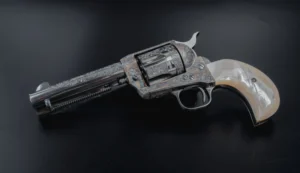
Browning didn’t design the Single Action Army to be clear. But his relationship with Colt, starting in the late 1880s, gave us some of the most important handguns ever made. Understanding that context matters, as Browning’s genius flourished partly through his collaborations with manufacturers such as Colt, Winchester, and FN Herstal. He was the idea machine; they built the infrastructure.
That partnership paid off spectacularly with what came next.
The Colt Model 1911: The Legend That Won’t Retire
If you had to pick one firearm that most shaped modern handgun design, most serious historians would point to the 1911. It’s almost unfair. The pistol Browning finalized in 1910 and delivered to the U.S. Army in 1911 served as the standard American military sidearm until 1986, a 75-year run that no other pistol has come close to matching. And even today, in 2025, custom 1911s are among the most sought-after competition and carry pistols on the market.
What made it so good? A few things working together: the short-recoil operated, locked-breech action; the grip angle that felt natural in the hand; the single-action trigger that gave shooters a clean, consistent break. When you strip it down, every component makes sense. There’s no wasted motion, no unnecessary complexity. It’s the mechanical equivalent of a perfectly written sentence.
The .45 ACP cartridge, which Browning also designed specifically for this pistol, added to its reputation as a hard-hitting defensive round. Some shooters swear by it to this day, though the debate over stopping power versus magazine capacity has never really quieted down. Honestly, that debate may never end.
For collectors, original pre-WWII Colts built on Browning’s design are highly valuable, particularly those with documented military provenance. But even modern 1911s from makers like Kimber, Springfield Armory, and Wilson Combat carry Browning’s DNA in every component.
The Browning Auto-5: Shotguns Would Never Be the Same
Winchester passed on it. So Browning took it to FN Herstal in Belgium, and the result was the Auto-5, the world’s first mass-produced semi-automatic shotgun. Introduced in 1902, it remained in production for nearly a century, with the last ones rolling off the production line at Miroku’s factory in Japan in 1998. That’s a 96-year production run, which in the firearms world is almost mythological.
The Auto-5’s long-recoil operating system was unusual. When you fire it, the barrel and bolt recoil together, giving the gun that distinctive, sharp rearward kick, followed by a snappy return to battery. Old-timers called it the “Humpback” because of its distinctive receiver shape, and waterfowl hunters loved it because it just kept working, regardless of conditions.
Remington licensed the design and produced it as the Model 11. Savage made their version too. But there’s something about the original Browning-marked Auto-5 that collectors gravitate toward. Finding one in good mechanical condition, with the original finish intact, is a genuine score. They’re not rare exactly, but a really clean example with original wood? You’re looking at a hunting shotgun that’s also a piece of American industrial history.
The M1919 and M2: When Browning Changed Warfare
Here’s where the conversation shifts from sport and hunting to something weightier. Browning’s contributions to military firearms weren’t incidental; they were foundational.
The M1917 water-cooled heavy machine gun came first, followed by the M1919 air-cooled variant. Both were used extensively during World War II, the Korean War, and beyond. Reliable, accurate, and chambered in .30-06 Springfield, the M1919 became a fixture of American infantry tactics. You’ve seen it on Jeeps, on aircraft, on the spines of countless historical photographs. It’s a Browning.
But the real heavyweight is the M2. Chambered in .50 BMG, another cartridge Browning developed, the M2 heavy machine gun entered service in 1933 and is still being manufactured today. Let that sink in. A firearm designed nearly a century ago is still in active military production and service with armed forces around the world. It’s been mounted on aircraft, tanks, ships, helicopters, and ground vehicles. It’s served in every major conflict since WWII.
The .50 BMG cartridge itself spawned an entire ecosystem of long-range precision rifles, with companies like Barrett building the Model 82 around Browning’s original cartridge specification. When competitive long-range shooters push past 1,000 yards, they’re often doing it with a cartridge that traces back to John Browning’s drafting table in the early 20th century.
The Browning Hi-Power: The Final Masterpiece He Didn’t Quite Finish
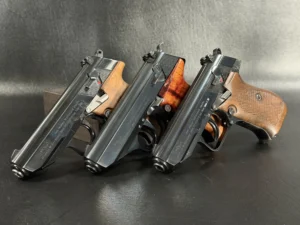
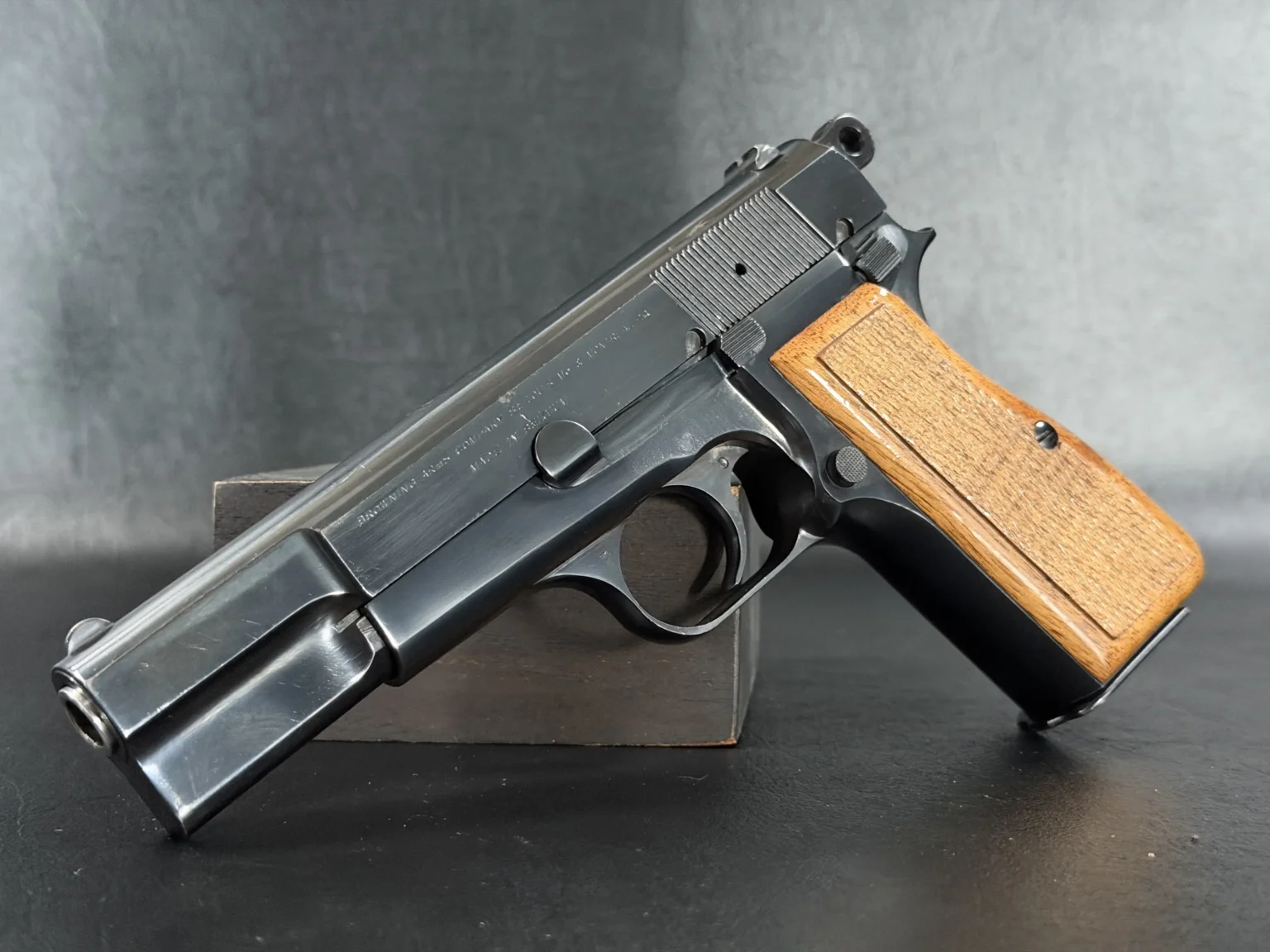
There’s a melancholy footnote to Browning’s career. He died in 1926, at his workbench at FN Herstal in Belgium, before he could complete the pistol he’d been developing. Dieudonné Saive finished the work, and the result, the Browning Hi-Power, entered production in 1935.
What made the Hi-Power significant was its magazine capacity. Where the 1911 held 7+1 rounds of .45 ACP, the Hi-Power held 13+1 rounds of 9mm. For the era, that was enormous. Military planners took notice, and over the following decades, the Hi-Power was adopted by over 50 nations. It served in WWII on both sides, with Nazi Germany manufacturing captured FN plants’ Hi-Powers for Wehrmacht use while Allied forces were simultaneously carrying the same pistol.
That’s a strange and fascinating piece of history. The same gun was worn by enemies who were trying to kill each other.
The Hi-Power influenced nearly every high-capacity double-stack semi-automatic pistol that followed it. When Glock, SIG Sauer, and others developed their modern service pistols, the conceptual lineage ran through the Hi-Power and back to Browning. FN Herstal reintroduced a modernized Hi-Power variant in recent years, with updated sights, an improved trigger, and an accessory rail, and it sold out rapidly. Some designs just can’t be improved upon fundamentally.
The Browning BAR Hunting Rifle: A Name With Two Very Different Lives
You might hear “BAR” and immediately think of the Browning Automatic Rifle, the light machine gun that saw heavy use in WWI and WWII. And yes, that’s a Browning design, a remarkable one that gave infantry squads portable automatic fire support. But for modern hunters and collectors, the BAR most often refers to the semi-automatic hunting rifle Browning introduced in 1967.
The hunting BAR is a long-stroke gas-operated semi-automatic in calibers ranging from .243 Winchester up to .338 Winchester Magnum and beyond. For hunters who wanted the quick follow-up shots of a semi-auto without sacrificing the power for big game, this was a genuinely useful rifle. The action is smooth, the recoil is well managed by the operating system, and modern versions of the BAR MK 3, with their detachable magazines and updated stock designs, remain serious hunting tools.
Collectors who focus on early-production BARs, particularly those from the late 1960s and early 1970s, find a quality of fit and finish that reflects a different manufacturing era. The wood-to-metal fit on those early guns is something to see.
The Browning Citori: Over-Under Perfection in Clay Shooting
Shift gears entirely and talk to competitive trap or skeet shooters, and sooner or later, the Citori comes up. Introduced in 1973 and manufactured by Miroku in Japan under Browning’s specs, the Citori over-under shotgun became, and remains, one of the most respected competition and hunting shotguns in the world.
Why does the Citori matter? Consistent balance, reliable triggers, and a build quality that holds up under tens of thousands of rounds without needing serious gunsmithing. Serious clay shooters put absurd volume through their guns, and the Citori handles it. There are competitive shooters who have run over 200,000 rounds through a Citori with nothing more than routine maintenance.
The current lineup spans everything from the basic Grade I to the beautifully engraved Citori 725 Sporting models. The 725 in particular, with its lower receiver profile and Vector Pro lengthened forcing cones, represents a genuine step forward in clay target performance. If you’ve ever watched high-level trap shooting and wondered what that elegant O/U was, there’s a good chance it was a Citori or one of its close relatives.
What Makes Browning Collectible Today
Collecting Browning firearms is different from, say, collecting Smith & Wesson revolvers or Winchester lever-actions, not better or worse, just different in character. Because Browning’s designs were often manufactured by various partners (Winchester, Colt, FN, Miroku), condition and provenance matter enormously.
A few guidelines worth knowing:
- Original Belgian FN-manufactured firearms generally command a premium over later Japanese Miroku production, though Miroku’s quality is genuinely excellent.
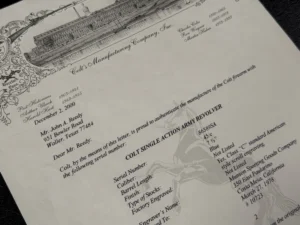
- Pre-WWII commercial pistols and shotguns with documented ownership history are particularly sought after.
- Military-contract firearms with proof marks and acceptance stamps carry their own collector premium.
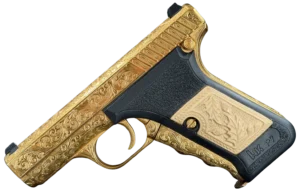
- Engraved presentation-grade pieces, when authentic, are among the most beautiful American firearms ever made.
The bluing on early FN-produced Browning shotguns and pistols was extraordinary, a deep, rich finish that modern hot-salt bluing rarely matches. If you find a 1920s or 1930s FN commercial pistol with 90% or better original blue, take it seriously. That’s becoming genuinely scarce.
The BPS and the Maxus: Browning’s Shotgun Legacy Continues
Not everything worth mentioning is a museum piece. The Browning BPS (Browning Pump Shotgun), introduced in 1977, addressed something that left-handed shotgunners had complained about forever: most pump-action shotguns eject spent hulls toward the right, which means they fly across a left-handed shooter’s face. The BPS ejects downward, making it completely ambidextrous.
It’s a small design detail that matters a lot in practice, and it’s exactly the kind of thoughtful engineering Browning has always excelled at.
The Maxus semi-automatic shotgun, and its successor the Maxus II, represent Browning’s current high-performance waterfowl and upland platform. The gas-operated system cycles everything from light 2-3/4″ target loads to heavy 3″ magnum shells without adjustment, which is the kind of versatility that duck hunters living in mixed-ammunition environments genuinely appreciate.
Why Browning’s Legacy Feels Different From Other Brands
Most firearms companies are proud of their history. Browning’s history is something else, because it’s not the history of a single company. It’s the history of one man’s ideas spreading across manufacturers, continents, and centuries.
The 1911 is still produced by dozens of companies worldwide. The .50 BMG is still snapping through steel at competition ranges and on battlefields. The Auto-5’s operating principle influenced shotgun design for generations. The Hi-Power concept shaped the entire category of high-capacity semi-automatic pistols.
You know what’s remarkable? Browning filed his first patent in 1879. More than 140 years later, military units and weekend hunters are still working with firearms built on his principles. That’s not brand loyalty. That’s something closer to engineering truth. When something works that well, for that long, in that many contexts, it stops being a preference and starts being a standard.
Collectors who focus on Browning firearms are, in a very real sense, collecting chapters of history. The Auto-5 your grandfather hunted pheasants with, and the Hi-Power a paratrooper carried into Normandy share a designer’s fingerprints. That connection across time and circumstance is part of what makes this pursuit so compelling.
A Note for New Collectors: Where to Start
If you’re new to Browning collecting, it’s natural to want to hunt down the rarest pieces right away. Don’t. Begin by getting hands-on experience with as many Browning firearms as possible, at gun shows, with reputable dealers, and at ranges that offer rentals. Train your eye to distinguish original finishes from reblued metal. Pay attention to how a properly functioning Auto‑5 cycles compared to one that needs attention. Study the differences between Belgian and Japanese proof marks so you can identify them at a glance.
Join the Browning Collectors Association. Their publications are a genuine resource, and the community of serious collectors is generally welcoming to newcomers who show up with honest curiosity rather than a checkbook looking for a quick flip.
The Blue Book of Gun Values is useful, but don’t treat any price guide as gospel. Regional markets vary significantly, and conditions drive price more than most guides fully capture. A Citori with original, uncracked wood and matching serial numbers on all parts is worth more than the book says. One with a refinished stock and a replaced recoil pad is worth less.
Final Thought: The Standard Bearer
John Browning’s genius wasn’t just technical; it was intuitive. He seemed to understand what shooters needed before they could fully articulate it themselves. Ergonomics that fit the human hand naturally. Actions that cycled reliably under stress. Cartridges calibrated to real-world terminal performance rather than theoretical ideals. He was solving problems that other designers hadn’t fully defined yet.
The firearms that carry his name, and the far larger number that carry his DNA without the branding, represent something rare in any field of human endeavor: ideas so good that they became invisible. When a design becomes the standard, people stop thinking of it as a design and start thinking of it as the way things are.
That’s the Browning legacy. Not just a collection of excellent guns, but a reshaping of what firearms could be. For collectors, enthusiasts, and historians, that story is still very much worth following.
Frequently Asked Questions
Browning didn’t just refine existing ideas; he consistently invented new operating systems, cartridges, and mechanisms that became industry standards. No other designer in history holds patents across so many firearm categories that are still in active use today.
Honestly, it depends on what draws you in, but early Belgian FN-manufactured pieces with original finish tend to command the strongest collector interest. Pre-WWII Hi-Powers and original Auto-5s in clean condition are consistently among the most sought-after finds.
It’s genuinely both, and there’s nothing wrong with that. Custom 1911s still dominate certain competition shooting categories, and plenty of experienced shooters carry them daily without apology.
Current production is split between FN Herstal in Belgium and Miroku in Japan, depending on the model. Miroku’s quality is excellent, though Belgian-manufactured pieces typically carry a premium in the collector market.
Start by handling as many examples as you can before spending serious money, because condition is everything and it takes time to train your eye. Joining the Browning Collectors Association early will save you from costly mistakes that most beginners make on their own.