
Key Takeaways:
- The Heckler & Koch USP Match wasn’t simply built as another competition handgun. It represented a very specific moment in firearms history when German engineering, practical shooting culture, and military-grade durability all collided into one unapologetically overbuilt pistol. Honestly, that blend is a huge part of why collectors still obsess over it today.
- While modern handguns often chase lighter weight and minimalist design, the USP Match came from an era when manufacturers were still willing to experiment boldly. The oversized barrel weight, unique recoil characteristics, and mechanical feel give it a personality that many newer pistols just don’t have anymore, and collectors notice that immediately.
- The historical importance of the USP Match goes far beyond performance on the range. Between its connection to late-1990s shooting culture, its rise through movies and gaming, and its reputation for tank-like reliability, the pistol became a cultural artifact as much as a firearm. That’s rare. And you know what? Guns that carry both mechanical credibility and emotional nostalgia almost always become collectible in the long run.
There’s something almost magnetic about German firearms design. Even people who aren’t deep into collecting can usually spot it. The lines feel deliberate. The controls click with confidence. The machining looks less like mass production and more like someone who’s obsessed with every contour, long after the accountants told them to stop.
And few pistols capture that feeling quite like the Heckler & Koch USP Match.
For collectors, the USP Match occupies a strange and fascinating niche in firearms history. It wasn’t created solely as a service pistol, nor was it purely a competition gun. Instead, it emerged in the space between, where 1990s military engineering met the growing culture of performance shooting. That very tension is what makes it so significant today.
You can feel it the moment you pick one up. The oversized barrel weight. The exaggerated proportions. The unmistakable silhouette made famous by movies, video games, and competitive shooting circles. It’s dramatic without being flashy, technical without feeling sterile. Honestly, the pistol almost feels like a physical manifestation of German engineering culture itself. Precise, overbuilt, a little stubborn, and deeply committed to doing things its own way.
But the story of the USP Match is bigger than one handgun. To understand why collectors chase them now, sometimes paying serious money for pristine examples, you have to go back to postwar Germany, the rise of Heckler & Koch, and a period when handgun design changed faster than almost anyone expected.
Before the Match Came the Mindset
German engineering didn’t become legendary overnight. By the time the USP Match arrived in the late 1990s, the foundation had already been laid through decades of firearms development shaped by war, rebuilding, and industrial discipline.
After World War II, German arms manufacturing existed under enormous scrutiny. Companies that survived had to reinvent themselves carefully. Heckler & Koch emerged from that environment with a very specific identity. The company focused heavily on engineering solutions rather than tradition for tradition’s sake.
That distinction matters.
Some firearms manufacturers lean hard into nostalgia. H&K rarely did. Their pistols and rifles often looked futuristic because the company prioritized function first. If a shape seemed unusual but improved performance, durability, or recoil control, they pursued it anyway. That philosophy sometimes frustrated traditionalists, but it also created some of the most technically respected firearms of the modern era.
By the late 1980s and early 1990s, handgun development was entering a new phase. Law enforcement agencies were moving away from revolvers. Polymer-framed pistols were proving themselves. Competitive shooting sports were growing rapidly. The old assumptions about combat handguns were starting to crack.
Then came the USP.
The Original USP Was Already Ahead of the Curve
When the Heckler & Koch USP launched in 1993, it arrived during one of the most competitive eras in handgun history. Glock had already disrupted the market with polymer-framed simplicity. SIG Sauer was dominating military and law enforcement contracts. The Beretta M9 was firmly embedded in American military service.
H&K’s response wasn’t to imitate anyone.
Instead, they built a pistol around durability testing that bordered on obsessive. The USP was designed to handle high-pressure ammunition, particularly the then-new .40 S&W cartridge. Engineers used a recoil-reduction system that reduced stress on the slide and frame. The controls were modular. The safety system allowed multiple carry configurations. It was modern, but it still appealed to shooters who preferred traditional double-action operation.
And maybe most importantly, it felt engineered rather than merely manufactured.
That sounds abstract until you handle one beside its competitors. The slide-to-frame fit feels purposeful. The recoil impulse has a unique character. Even the chunky grip, which some shooters criticize, contributes to the pistol’s remarkable control under recoil.
The USP wasn’t trying to be elegant. It was trying to survive anything.
That reputation became central to H&K’s identity.
Then Things Got Weird in the Best Possible Way
Here’s where the story gets fun.
During the 1990s, practical shooting competitions exploded in popularity. IPSC and USPSA shooters pushed pistols harder than most military or police environments ever would. Speed mattered. Split times mattered. Recoil control mattered. Shooters were aggressively modifying guns, adding compensators, optic mounts, extended controls, and tuned triggers.
Manufacturers noticed.
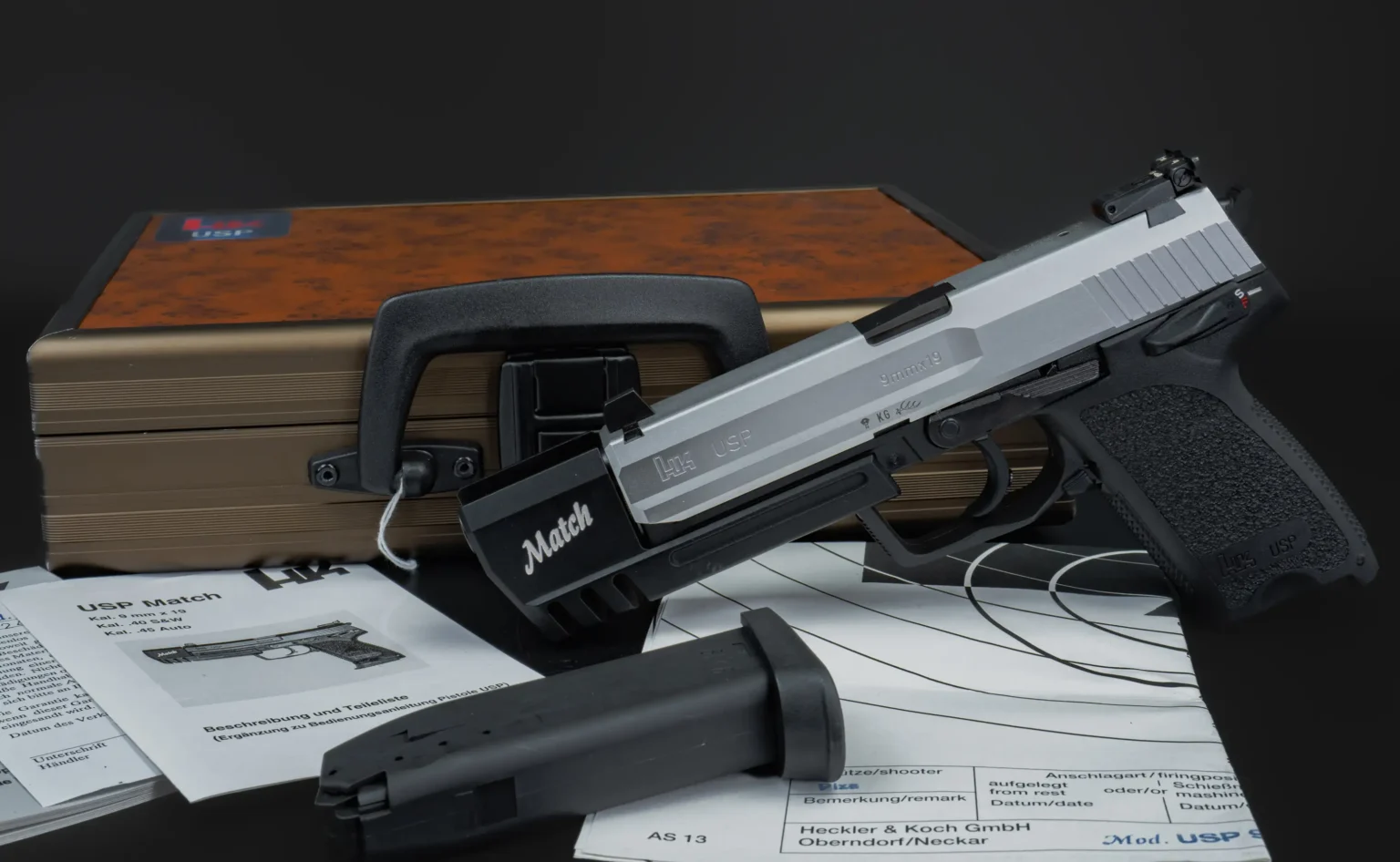
The USP platform already had the strength needed for high-performance shooting. So H&K began experimenting with competition-oriented variants. One of the most ambitious outcomes was the USP Match.
And the thing looked wild.
The extended slide assembly and barrel weight gave the pistol an unmistakable front-heavy profile. Some people loved it immediately. Others thought it looked like something from science fiction. Truthfully, both reactions were fair.
But the added weight served a purpose. It reduced muzzle rise dramatically and helped shooters maintain faster follow-up shots. Combined with the USP’s recoil system, the Match became surprisingly soft-shooting for such a large handgun.
The pistol also featured an enhanced trigger system and an extended sight radius. Everything about it emphasized control and consistency.
It wasn’t subtle. German engineers rarely are when they think they’ve found the right answer.
Hollywood Accidentally Turned It Into a Legend
Collectors sometimes hate admitting how much pop culture matters. But it matters. A lot.
The USP Match probably would’ve remained a respected niche competition pistol without Hollywood and gaming culture pushing it into legend territory. Then came 1998.
Lara Croft: Tomb Raider helped popularize oversized H&K pistols visually, but the real turning point for the USP Match came through gaming culture, particularly the original Counter-Strike era.
Suddenly, a whole generation recognized the silhouette instantly.
That sounds superficial until you watch what happens in the collector market twenty years later. Firearms tied to cultural memory often develop an emotional value beyond pure mechanical merit. The same thing happened with the Desert Eagle, the Colt Python, and countless Cold War military rifles.
The USP Match benefited from timing. It arrived during the rise of internet gaming culture, action cinema, and a broader fascination with “tactical” aesthetics. Yet unlike some movie-famous firearms, the USP Match actually delivered real performance.
That combination is rare.
Sometimes guns become collectible because they were everywhere. Other times they become collectible because they were unusual enough that people never forgot them. The USP Match belongs firmly in the second category.
German Precision Isn’t Just Marketing
People throw around the phrase “German engineering” constantly now. Cars, watches, kitchen appliances, espresso machines. At some point, the term became almost cliché.
But with H&K pistols, there’s usually substance behind it.
The USP Match reflected a broader German manufacturing philosophy that prioritized consistency and longevity over trend chasing. H&K engineers approached firearm design almost like industrial machinery design. Components were expected to repeatedly endure harsh conditions, not merely meet acceptable testing standards.
You see that mindset throughout the USP platform:
- Oversized locking surfaces
- Reinforced polymer construction
- Aggressive corrosion resistance
- Durable recoil assemblies
- Extremely long service life expectations
To some shooters, that makes the pistol feel overbuilt. Honestly, it is overbuilt. That’s partly why collectors appreciate it.
There’s an old saying among enthusiasts that German firearms feel like they were designed by engineers first and marketers second. The USP Match may be one of the clearest examples of that philosophy ever sold commercially.
And yet, despite all the engineering seriousness, there’s still personality in the design. The Match isn’t cold or clinical. It has presence. It feels unapologetically mechanical in a world increasingly dominated by minimalist polymer pistols that all blur together.
That matters more than people realize.
The Trigger Debate Never Really Ended
No discussion about the USP Match is complete without mentioning the trigger.
H&K triggers have always sparked arguments among enthusiasts. Some shooters defend them fiercely. Others compare them unfavorably to tuned 1911s or competition-oriented striker-fired pistols. The truth sits somewhere in the middle.
The USP Match trigger was improved over standard USP models, but it still retained that distinctly H&K character. A bit deliberate. Slightly mechanical. Not sloppy, just different.
Here’s the thing, though. The pistol was never trying to imitate a hand-fit race gun. H&K prioritized reliability and durability alongside performance. That balance shaped every design choice.
And collectors today often appreciate the pistol precisely because it honestly reflects that compromise.
Modern handgun culture sometimes treats every firearm as if it should excel equally in every category. Realistically, that’s impossible. The USP Match excelled at controllability, durability, and precision under hard use. The trigger, while good, remained part of a broader engineering package rather than a standalone showpiece.
Oddly enough, that restraint gives the pistol authenticity.
Oversized, Heavy, and Completely Unapologetic
By modern standards, the USP Match is enormous.
Seriously. Put it beside many current polymer pistols, and it almost looks exaggerated. The proportions are aggressive. The barrel weight extends dramatically forward. Concealed carry practicality is basically irrelevant here.
But that size tells an important story about the era.
The 1990s were full of experimentation in handgun development. Manufacturers weren’t yet obsessed with minimalism or micro-compacts. Competition influence pushed designs toward specialization instead. Bigger controls, heavier frames, compensators, optic mounts. Companies explored what shooters actually wanted when concealment wasn’t the priority.
The USP Match emerged directly from that environment.
And honestly, there’s something refreshing about it today. Modern firearms increasingly chase the same formulas. Slimmer. Lighter. Smaller. More modular. The USP Match ignores all of that. It’s built around shooting performance first.
Collectors recognize that immediately.
Handling one feels like stepping into a different period of firearms culture, when manufacturers were still willing to produce handguns with strong personalities instead of universal appeal.
The Match and the Mark 23 Often Get Compared… But They’re Not Twins
People constantly confuse the USP Match with the Heckler & Koch Mark 23. The visual similarities make that understandable.
Both pistols have oversized dimensions and distinctive front-end assemblies. Developed in the same engineering era, they each went on to gain renown through military lore and pop culture.
But their purposes were very different.
The Mark 23 emerged from the USSOCOM Offensive Handgun Weapon System program. It was built as a military tool first and foremost, emphasizing suppressed operation, durability, and offensive combat capability.
The USP Match leaned far more toward competition shooting and civilian performance markets.
Still, the overlap between the two pistols strengthened the mystique surrounding the USP platform overall. During the late 1990s and early 2000s, H&K pistols developed an almost mythical reputation among enthusiasts. They felt exclusive, highly engineered, and slightly intimidating.
You didn’t casually buy an H&K. At least that’s how many shooters viewed it at the time.
And that perception still lingers today.
Collectors Aren’t Just Buying a Pistol
They’re buying a snapshot of an era.
That’s really what makes the USP Match historically important.
It represents a moment when firearms design balanced old-school mechanical engineering with emerging modern shooting culture. It sits right between the Cold War era and the fully modular tactical age that followed.
The pistol also reflects broader changes happening in enthusiast culture:
- Competitive shooting became mainstream
- Gaming culture influenced firearm popularity
- Tactical aesthetics entered civilian markets
- Polymer handguns have matured beyond novelty status
- Manufacturers began catering directly to enthusiast subcultures
The USP Match absorbed all of that at once.
And unlike many “trend guns” from the same period, it aged remarkably well.
Some firearms become dated quickly. Others become iconic because they captured their moment perfectly. The USP Match did exactly that.
Why Prices Keep Climbing
Collectors already know the answer, but it’s worth spelling out anyway.
The USP Match has become increasingly difficult to find in excellent condition. Many examples were heavily used, modified, or simply shot hard. Competition-oriented pistols rarely spend their lives sitting untouched in safes.
At the same time, nostalgia has matured into serious collector demand.
Shooters who grew up seeing the pistol in movies, magazines, and games now have disposable income. That generational shift changes markets dramatically. We’ve seen it happen repeatedly with military surplus rifles, classic revolvers, and even early polymer pistols.
Condition matters enormously with the USP Match, too. Original accessories, factory weights, matching boxes, manuals, and unmodified configurations command attention from collectors.
And because H&K enthusiasts tend to be deeply detail-oriented, provenance matters as well.
You’ll hear collectors discussing production variants, import markings, proof marks, and date codes with almost watchmaker-level precision. Honestly, that level of obsession feels appropriate for German firearms.
Shooting One Today Feels Surprisingly Modern
This may sound strange considering the pistol’s age, but the USP Match still shoots exceptionally well.
A lot of older “performance pistols” feel dated once modern ergonomics and recoil systems surpass them. The USP Match avoids much of that problem because its engineering priorities were fundamentally solid from the start.
The recoil impulse remains smooth. Accuracy remains excellent. Reliability remains impressive.
Sure, modern striker-fired pistols may offer lighter triggers or better compatibility with optics. But the USP Match delivers a shooting experience that feels distinctly mechanical and confidence-inspiring in a way many newer pistols don’t.
There’s heft to it. Stability. Rhythm.
The pistol rewards deliberate shooting rather than frantic manipulation. That’s becoming increasingly rare.
And maybe that’s part of why enthusiasts keep coming back to it. In an age of disposable consumer products and endless product refresh cycles, the USP Match feels permanent.
It was built expecting to outlast trends.
The Collector Community Keeps the Story Alive
One of the more interesting aspects of H&K collecting culture is how passionate and archival-minded the community tends to be.
Forums, collector groups, auction catalogs, and enthusiast sites document production details obsessively. People track variant differences that casual shooters would never notice. Box labels matter. Import marks matter. Factory test targets matter.
To outsiders, that level of detail might seem excessive.
Collectors understand it differently.
Firearms like the USP Match occupy a narrow but meaningful lane in modern firearms history. They weren’t mass-market commodities in the same sense as standard duty pistols. They represented ambition. Engineering experimentation. A willingness to build something specialized because the company believed in the concept.
That’s worth preserving.
And frankly, the collector market often preserves firearms history more effectively than museums do. Enthusiasts maintain the stories, documentation, and mechanical understanding that would otherwise disappear over time.
German Engineering Was Never About Perfection
This is the funny part.
People talk about German engineering as if it were synonymous with flawlessness. But historically, German industrial design has often been defined more by relentless refinement than perfection itself.
The USP Match reflects that beautifully.
It isn’t a perfect pistol. It’s large. Expensive. Some shooters dislike the ergonomics. Others never warm up to the trigger system. The accessory compatibility feels dated now. Spare parts can sometimes become a headache.
Yet those imperfections almost make the pistol more interesting.
Because underneath all of it, you can feel the intent. The engineers behind the USP Match genuinely believed they were building something exceptional. Not trendy. Not disposable. Exceptional.
That conviction gives the pistol character.
And character matters in collecting. Probably more than raw specifications ever will.
Why the USP Match Still Matters
A lot of firearms fade quietly into obscurity. They become footnotes in old catalogs and forgotten auction listings.
The USP Match never quite disappeared.
Part of that comes from performance. Part comes from cultural visibility. But deeper than that, the pistol represents a philosophy that resonates strongly with enthusiasts who appreciate mechanical craftsmanship.
It reminds collectors of a period when manufacturers were willing to take risks on bold designs. When performance pistols could look unconventional. When engineering teams chased durability and precision with almost stubborn intensity.
You know what? There’s something comforting about that now.
Modern firearms excel by nearly every measurable standard, but many of them feel engineered by committee. By contrast, the USP Match feels personal: it has quirks, attitude, and an unmistakable identity.
And maybe that’s why collectors continue hunting for them decades later.
Not simply because it’s an H&K.
Not simply because it’s rare.
But because the USP Match captured something larger than itself. A moment when German engineering, competition shooting culture, and enthusiast obsession collided to produce one of the most memorable pistols of its generation.
That kind of firearm doesn’t come around very often.
Frequently Asked Questions
The USP Match captured a unique moment in firearms history when competition shooting, military-grade engineering, and late-1990s tactical culture all influenced handgun design simultaneously. It also helped cement H&K’s reputation for building pistols that felt overbuilt in the best possible way.
Not directly. While it shared engineering DNA with the Heckler & Koch Mark 23, the USP Match leaned much more toward competition shooting and enthusiast performance markets.
Collectors appreciate the pistol’s limited availability, distinct design, and strong connection to 1990s firearms culture. Honestly, its appearance in movies and games only added to the mystique over time.
Yes, surprisingly so. The recoil system, added front-end weight, and overall balance still make it a smooth and accurate pistol on the range.
The pistol came from an era when manufacturers experimented more openly with specialized performance designs instead of chasing slim, minimalist carry guns. Its oversized profile was intentional and built around recoil control rather than concealment.