
Key Takeaways:
- Engineering ambition, not market pressure, built HK’s reputation. Every firearm HK produced that truly mattered solved a real problem in a way nobody else had bothered to try. The P7’s squeeze cocker, the MP5’s closed-bolt accuracy, the HK416’s piston system. These weren’t cosmetic upgrades or spec-sheet chasing. They were answers to genuine questions. That’s a rarer quality in any industry than it sounds.
- History lives in the metal. Collecting HK isn’t just about owning well-made firearms. It’s about holding objects that were present at defining moments in modern military and law enforcement history. The Iranian Embassy Siege. Post-9/11 special operations. Abbottabad. When provenance is this tangible, a collection becomes something closer to a historical archive than a hobby.
- The premium is real, and so is the reason for it. You will always pay more for HK than a comparable alternative. That’s just true. But once you understand the manufacturing tolerances, the engineering decisions, and the operational track record of each platform, the price starts to make a different kind of sense. Quality isn’t always visible until you look for it, and with HK, looking closely is often a rewarding exercise.
Let’s get started…
There’s a moment every serious collector knows. You pick up a firearm, feel the weight settle into your hands, and something just clicks. Not literally, though that’s part of it, too. It’s more like an understanding passes between you and the thing. The craftsmanship speaks. And when that gun happens to have “HK” stamped somewhere on its frame, that conversation tends to be a rich one.
Since 1949, Heckler & Koch has been building firearms with an almost obsessive focus on engineering precision, rising from the rubble of postwar Germany to become synonymous with reliability. Over the decades, they didn’t just create a product line; they developed a philosophy: guns that work in the rain, in the dirt, and when lives are on the line. That reputation wasn’t built by marketing campaigns, but by decades of soldiers, police officers, and competitors pushing their guns through conditions that would make lesser manufacturers wince.
So let’s take a walk through the most significant HK firearms over the decades. Not just a list, but a real look at what made each one matter, who used them, and why they still resonate today.
Where It All Started: The G3 and HK’s First Big Statement
You can’t talk about Heckler & Koch without starting here. The G3 is, in many ways, the gun that put HK on the map.
Developed in the late 1950s in collaboration with the Spanish CETME design, the G3 was West Germany’s answer to a serious question: what do you arm a reborn military with? The answer was a roller-delayed blowback rifle chambered in 7.62x51mm NATO, and it turned out to be an exceptionally good answer. Over 40 countries adopted it in one form or another. Portugal carried it through African colonial conflicts. Pakistan issued it for decades. Germany relied on it until the late 1990s.
What made the G3 special wasn’t just its reliability, though that was considerable. It was the system’s modularity before modularity was even a buzzword in the firearms world. The same basic operating mechanism gave birth to an entire family of weapons: the HK33 in 5.56mm, the HK21 general-purpose machine gun, and the MP5 (but we’ll get there). The roller-delayed system was genuinely clever engineering, spreading recoil forces and slowing bolt movement in a way that made the whole platform feel more controllable than competing designs of the era.
For collectors today, original G3S pieces are fascinating. The fluted chambers, which leave distinctive marks on brass, the paddle magazine release unfamiliar to American hands raised on AR-pattern rifles, and the somewhat aggressive recoil that reminds you this isn’t a mild cartridge. It’s a rifle that asks something of the shooter and rewards those who learn it.
The MP5: Possibly the Most Recognized Submachine Gun on Earth
Here’s the thing about the MP5. You’ve seen it everywhere, and you might not even know it.
It’s been in more action movies than arguably any other firearm. The SAS used it during the Iranian Embassy Siege in 1980, an event broadcast live on British television that essentially made the world aware that special operations units existed and that they carried this particular gun. After that, the MP5 became shorthand for “elite.” SWAT teams wanted it. Counterterrorism units bought it by the crate. Hollywood put it in every thriller for the next two decades.
But the reputation wasn’t just aesthetic. The MP5 genuinely earned its status.
Derived from the G3’s roller-delayed mechanism scaled down for 9mm Parabellum, the MP5 was extraordinarily accurate for a submachine gun. It fires from a closed bolt, unlike most SMGs of its era, which dramatically improves first-shot accuracy. The slow cyclic rate and excellent ergonomics made it controllable in full-auto. Variants multiplied over the years: the compact MP5K for close protection work, the suppressed MP5SD with its integral suppressor that bled gas through the barrel, and the semi-auto civilian variants that are still highly sought on the secondary market.
The MP5 family’s longevity is remarkable. Developed in the 1960s, refined through the 1970s and 1980s, it remained the dominant force in its category well into the 2000s. Police departments were still issuing fresh MP5s in the early 2010s. That’s a product lifecycle that most manufacturers dream about.
For collectors, genuine pre-ban full-auto MP5s are serious investments. Semi-auto clones from HK and licensed manufacturers offer a taste of the experience without the tax stamp complexity, but there’s nothing quite like handling an original.
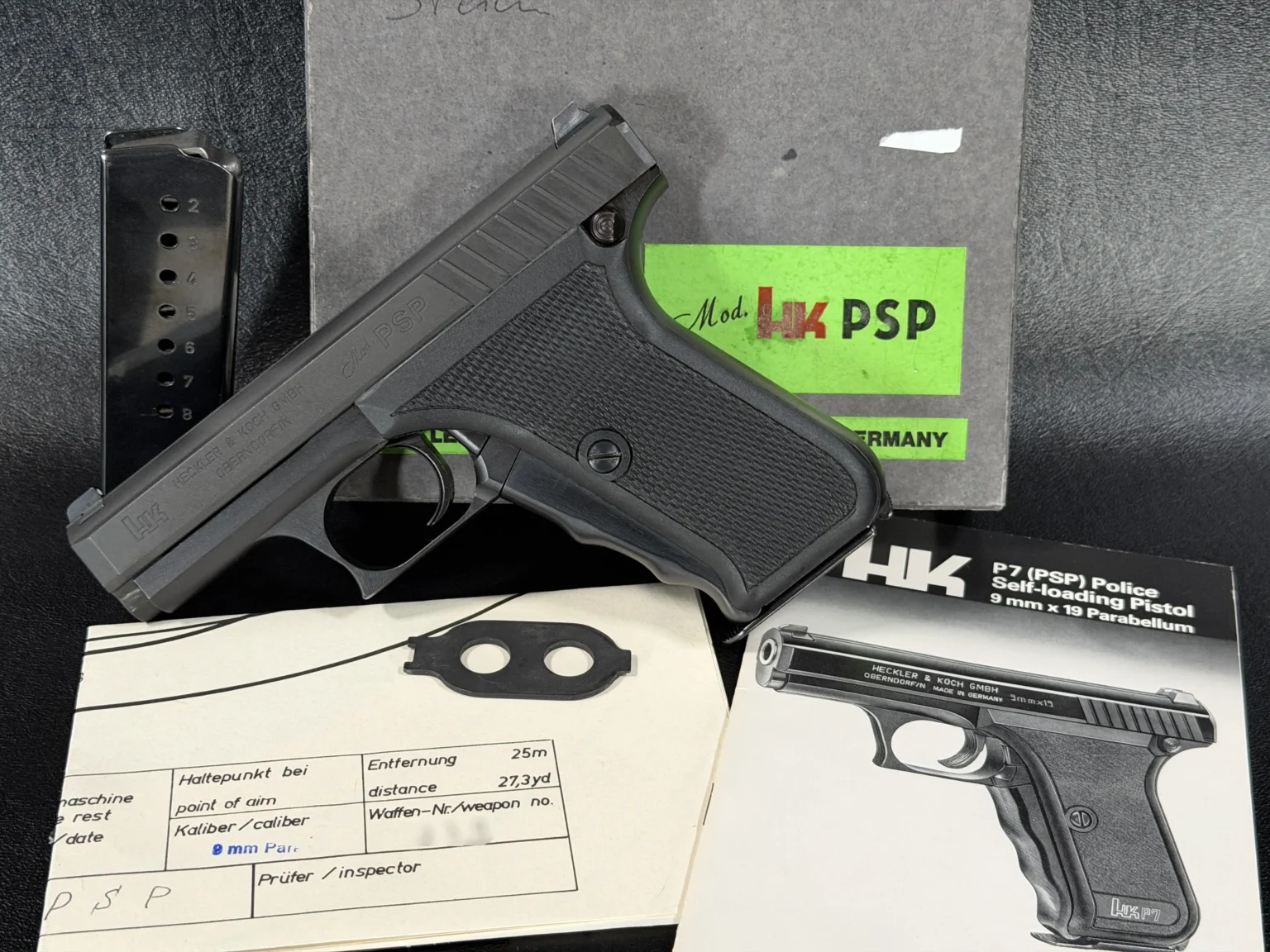
The PSP / P7: Engineering Genius in a Compact Package
Not everyone knows the P7, and that’s honestly a shame.
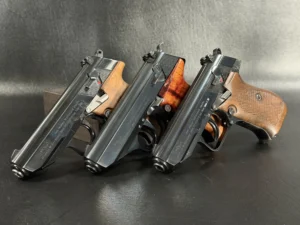
Introduced in 1976 in response to a German police requirement following the 1972 Munich Olympics, the P7 represented genuinely unconventional thinking. HK’s engineers looked at what police needed, which was a pistol that was safe to carry with a round in the chamber, fast into action, accurate, and reliable, and they solved that problem in a way nobody else had considered.
The squeeze cocker.
The front strap of the P7’s grip incorporates a lever. Grip the pistol naturally, and the lever compresses; release it, and the pistol is safe. No external safety to fumble with under stress. No decocking lever to remember. Just grip and shoot. The mechanism also contributes to an exceptionally consistent trigger pull, since the firing pin is always at the same state of tension when you draw.
The P7 also used a gas-delayed blowback system, bleeding propellant gases into a cylinder beneath the barrel to slow bolt rearward travel. The result was a pistol with very mild felt recoil despite its compact dimensions.
German police agencies carried P7S for decades. The GSG-9 issued them. Border protection units trusted them. American shooters who discovered the P7 through importation often became evangelical about it. There are entire online communities devoted to P7 devotees. The pistol’s accuracy out of the box routinely surprised shooters accustomed to service pistols requiring break-in periods and trigger jobs.
Production ended in 2008, which means the P7 is now a collector’s piece by necessity. Values have risen considerably. A good condition P7M8 or P7M13 commands serious money, and rightfully so. It’s one of those designs that rewards close examination; the more you understand how it works, the more impressive it becomes.
The USP: When HK Got Serious About the American Market
By the early 1990s, HK recognized something. The American civilian and law enforcement markets were enormous, and they weren’t capturing nearly enough of them. The solution was the Universal Self-loading Pistol, introduced in 1993.
The USP was a deliberate departure from HK’s previous pistol philosophy. Where the P7 was idiosyncratic genius, the USP was practical excellence. Polymer frame, conventional Browning-type locking, double-action/single-action trigger with a manual safety and decocking lever. It spoke a language American shooters already understood from decades of DA/SA pistols, but with HK’s characteristic build quality.
What set the USP apart from competitors was its recoil-reduction system built into the frame. A modified buffer in the recoil assembly absorbed and managed energy, reducing felt recoil and, crucially, reducing stress on the frame over tens of thousands of rounds. HK designed it specifically to handle .40 S&W, which was punishing many other polymer pistols of the era, and then chambered it in 9mm and .45 ACP as well.
The .45 ACP variant in particular found devoted fans. The USP45 Tactical, with its threaded barrel and higher capacity magazine, became a standard against which other suppressor-host pistols were measured.
Law enforcement adoption was solid. Federal agencies, state police, and various specialized units carried USPs throughout the late 1990s and 2000s. The pistol also had a compelling military track record: SOCOM adopted a variant, the Mk23, as an offensive handgun system, putting it through some of the most demanding testing any pistol has undergone. The Mk23 passed. Predictably, given the manufacturer.
The G36: Controversy, Capability, and a Complicated Legacy
The G36 story is genuinely interesting and a little complicated, which makes it worth spending some time on.
Germany’s Bundeswehr needed to replace the aging G3, and HK delivered the G36 in the mid-1990s. Chambered in 5.56mm NATO, featuring a polymer receiver, proprietary magazine system, and integrated optics, it was a thoroughly modern service rifle for its era. It looked the part. It functioned well under most conditions.
Then came Afghanistan. And reports started filtering back about accuracy degradation when the rifle ran hot after sustained fire.
HK and the German government spent years arguing over the extent of the problem. Independent testing confirmed that the G36’s polymer receiver exhibited thermal expansion, affecting accuracy when the rifle was fired repeatedly in rapid succession. HK disputed the characterization of the extent to which this affected combat effectiveness. The Bundeswehr eventually decided to replace the G36 entirely, a move that was a public embarrassment for both parties.
Here’s the nuance, though: for typical law-enforcement or sport-shooting use, the G36’s thermal issues are essentially irrelevant. You’re not going to sustain the rate of fire that causes problems in any ordinary context. Many police forces across Europe still carry G36S without complaint. The civilian semi-auto versions that were importable before the regulations changed were popular with sport shooters.
The controversy is now part of the G36’s story. Collectors who own examples often know the full history and find it adds to the narrative. This is a rifle that served in numerous conflicts, generated a geopolitical procurement dispute, and still looks genuinely purposeful sitting in a rack. That’s nothing.
The HK45: Refining What Already Worked
The HK45 arrived in 2007, and if you want to understand why it exists, you need to know that the US Joint Combat Pistol program was running at the time, seeking to replace the M9 Beretta in military service.
HK designed the HK45 specifically to compete, taking the USP platform and significantly improving it. The ergonomics were redesigned, most notably with a lower bore axis that better aligns the barrel with the shooter’s hand. The grip texture changed. The control layout became more intuitive. The trigger was refined.
The JCP program collapsed without selecting a replacement, but the HK45 survived as both a commercial and law-enforcement offering. And it’s good. Genuinely good. The .45 ACP variant carries ten rounds in the standard magazine plus one in the chamber, handles well, and benefits from the same recoil reduction system that made the USP notable.
The Compact variant, the HK45C, found particular favor with concealed carry-oriented shooters willing to accept a slightly larger package for the advantages of HK’s engineering. Suppressor-ready variants with threaded barrels extended their appeal to the growing community of suppressed handgun users.
For the collector, the HK45 represents something interesting: a gun designed at a specific historical moment for a competition that never concluded, refined over time, and now occupying a permanent place in HK’s lineup. It’s history in the making, which is always compelling.
The VP9: HK Joins the Striker-Fired Revolution (On Their Own Terms)
It took HK longer than some manufacturers to enter the striker-fired pistol market. That’s not a criticism; it’s actually consistent with how the company operates. They watched, they evaluated, and when they finally released the VP9 in 2014, they produced something refined rather than rushed.
The VP9 uses a striker-fired mechanism, but with a trigger that HK spent considerable time engineering. The result is a break that feels genuinely different from most striker pistols on the market, with a pronounced wall before the break and a reset that’s both short and tactually distinct. Shooters who try it often comment that it doesn’t feel like a Glock, and they mean that as a compliment.
The ergonomics are outstanding. Interchangeable backstraps and side panels in multiple sizes let shooters genuinely customize fit rather than choosing between two options. The grip texture is aggressive without being abrasive. The balance point feels natural for both one-handed and two-handed shooting.
Law enforcement adoption picked up relatively quickly. Several German police agencies transitioned from aging P7S or USPs to VP9s. American departments began appearing on adoption lists within a few years of introduction. The pistol competed successfully in law enforcement trials against established competitors.
The VP9 represents HK at their most commercially savvy: a striker pistol for a market that had clearly decided striker pistols were the future, but designed with enough genuine innovation to justify the price premium over competitors. For collectors interested in contemporary HK, the VP9’s early variants may eventually represent the beginning of a new era.
The HK416: When Special Operations Wanted Better
The HK416 has one of the more interesting origin stories in recent firearms history.
Around 2002, elements of US special operations were quietly working with HK on a problem. The M4 carbine, while capable, had reliability issues under certain conditions. The direct-impingement gas system that Stoner designed vented hot, dirty gas directly into the receiver, fouling the bolt and causing malfunctions in the sustained, high-tempo operations that characterized early post-9/11 deployments.
The HK416 replaced the direct-impingement system with a short-stroke piston operating system borrowed from the G36. Same external profile as an M4, same magazine compatibility, familiar manual of arms. But internally, the operating system ran cooler and cleaner. Field reports from units carrying early HK416s were positive.
Norway adopted the HK416 as its standard service rifle. France replaced the FAMAS with it, a significant procurement for HK. By various accounts, Delta Force made it their standard carbine. The HK416 also achieved a specific kind of notoriety in May 2011: it was reportedly the weapon used during the Abbottabad raid that resulted in Osama bin Laden’s death, which generated the kind of real-world attention no advertising budget can buy.
Civilian semi-auto variants, where importation laws permitted, became prized by HK enthusiasts. The quality of materials and manufacturing is evident in handling. This is not a budget AR alternative; it’s a precision instrument that happens to share external dimensions with a common pattern rifle.
For collectors interested in military history that’s still unfolding, the HK416 is a fascinating piece of contemporary arms development.
The SP5: Giving Civilian Collectors a Taste of History
Here’s where HK did something that made many collectors very happy.
The SP5, introduced in 2019 for the American civilian market, is the closest thing to a factory-original semi-auto MP5 that civilian buyers have ever been able to purchase directly from HK. Previous semi-auto MP5 variants from HK had certain compromises; the SP5 corrected most of them.
The SP5 uses the same roller-delayed operating mechanism as its submachine gun ancestor. The build quality is what you’d expect from the factory: excellent. The paddle magazine release, the familiar cocking lever, the distinctive profile. Shoot one alongside an MP5 and the lineage is unmistakable.
The reception from the collector community was enthusiastic. Waiting lists developed. Secondary market prices temporarily exceeded MSRP. People who had spent years shooting clones from other manufacturers and wondering what the real thing felt like finally had an accessible answer.
The SP5K variant followed, offering the compact K configuration in semi-auto. Both have become benchmark pieces for HK collections focused on the modern era.
There’s something satisfying about HK choosing to offer this. The company has a reputation for occasionally dismissing civilian market concerns, which makes genuine efforts to serve collector interests meaningful when they happen.
What Makes HK Different, and Why It Matters
Let’s step back for a moment, because there’s a bigger picture worth examining.
HK firearms are not the most affordable option in any category they compete in. A VP9 costs more than a comparable Glock or Smith and Wesson M&P. An HK416 is substantially more expensive than a quality AR-pattern rifle from domestic manufacturers. The SP5 commands a premium that many shooters consider eyebrow-raising.
So why do collectors and enthusiasts continue to seek them out?
Part of the answer is quality. When you examine HK manufacturing tolerances, material specifications, and quality control standards, the price differential becomes more understandable. These guns are built to a specification that most manufacturers don’t attempt.
Part of the answer is history. HK firearms have appeared at genuinely significant moments in modern history. The weapons carried by units defined what special operations could be. The pistol trusted by a generation of European police officers. The rifle that replaced service arms in multiple NATO nations. That history is tangible when you hold the physical object.
And part of the answer, honestly, is that HK has always cared about engineering problems that other manufacturers were happy to work around. The squeeze cocker of the P7. The recoil reduction system of the USP. The piston conversion of the HK416. These weren’t solutions in search of problems. They were answers to specific questions that the company’s engineers found worth pursuing.
That’s what separates enduring brands from temporary ones. Not just quality of execution, but quality of intention.
Building a Meaningful HK Collection
If you’re approaching HK collecting seriously, it’s worth thinking about what story you want to tell through your collection.
Some collectors focus on chronology, tracing the development of HK’s engineering philosophy from the roller-delayed G3 era through the polymer revolution and into the contemporary striker-fired and piston-operated era. That approach rewards understanding the connections between platforms.
Others focus by category: military service weapons, law enforcement pistols, and competition-oriented variants. That gives you depth within specific use contexts and often surfaces interesting comparisons of variants.
And then there are collectors who simply pursue the pieces that spoke to them, which is honestly as valid as any systematic approach. The P7 enthusiast who owns seven variants. The MP5 completionist is working through every configuration. The person who specifically wants every HK pistol that saw service with US law enforcement.
A few practical observations for anyone building a collection:
Condition matters significantly for value, but shoot-condition examples often have their own appeal. An HK that spent twenty years in a German police holster has a story. Documentation and matching accessories are worth preserving when they exist. And the HK collector community, spread across various forums and clubs, is genuinely knowledgeable and often generous with information about provenance and authenticity.
The Ones That Got Away (And the Ones Still Coming)
No survey of HK would be complete without acknowledging the pieces that are difficult or impossible for American collectors to obtain.
The G36 in its service configuration remains unavailable for civilian import. The original full-auto MP5 is a transferable item that requires a pre-1986 registry entry and currently sells for well above $30,000. The P11 underwater pistol, designed for combat swimmers, is strictly military and essentially invisible in civilian channels.
And looking forward, HK continues to develop. The HK433, their newest assault rifle designed to replace the G36 in German service, represents where the company’s engineering thinking currently sits. Whether future variants make their way to civilian markets in accessible forms remains to be seen.
What’s certain is that the brand isn’t standing still. After seven decades, HK retains the engineering culture that produced its best work. That’s the real legacy, more than any individual firearm: a consistent commitment to solving problems correctly rather than cheaply. For collectors who appreciate that approach, the HK catalog will continue to generate interesting pieces worth pursuing for as long as the company operates.
And if the first seven decades are any indication, that’s going to be a while.
Whether you’re hunting for a pristine P7 at an auction house, shooting a VP9 at the range to decide if it earns a place in your collection, or simply reading about the HK416’s operational history with the kind of appreciation that only comes from understanding what it replaced and why, HK firearms reward attention. The more you know about them, the more interesting they become. That’s the best thing you can say about any piece of machinery.
Frequently Asked Questions
HK built its name on engineering precision and battlefield reliability, producing firearms trusted by military and law enforcement units across the globe. The MP5 and HK416 are probably their most recognized platforms, though collectors will argue the P7 deserves equal billing.
Honestly, that depends on what you value. If tighter tolerances, proven operational history, and genuine engineering innovation matter to you, the premium makes sense.
The VP9 is an approachable starting point since it’s currently in production, widely available, and represents HK’s modern design philosophy well. That said, if the budget allows, a used USP tells a richer story.
The Bundeswehr cited degradation in accuracy during sustained rapid fire due to thermal expansion in the polymer receiver. HK disputed how operationally significant the issue actually was, and that disagreement was never fully resolved.
It’s the closest civilian buyers will realistically get to the real thing, sharing the same roller-delayed mechanism and factory-level build quality. It’s semi-auto only, but the DNA is unmistakably there.