
Key Takeaways:
- Walther Didn’t Just Make Guns, It Made History. The double-action trigger, the decocker, the locking block system: these weren’t small tweaks. Walther sat at the critical junctures of pistol evolution, and the modern service pistol you’re holding today owes more to a German factory in Zella-Mehlis than most people realize.
- Pre-War Examples Are in a Different League. Honestly, if you’re serious about collecting, the pre-war PP and PPK are where the real craftsmanship lives. The machining tolerances, the deep bluing, the fit. It’s the kind of quality that makes modern production guns look like they’re still figuring things out.
- The Family Resemblance Never Left. Here’s the thing about Walther: nearly a century separates the PP from the PDP, yet the design DNA runs straight through both. That consistency of identity, elegant, mechanically thoughtful, purposeful in the hand, is what separates a truly great manufacturer from one that just keeps the lights on.
Let’s get started…
There’s something almost unfair about the way Walther firearms carry themselves. Pick up a PP from 1931 or a brand-new PDP, and you’ll notice it immediately: that particular combination of engineering confidence and visual elegance that makes you feel like the designers genuinely cared. Not just about function, but about the whole experience of holding the thing. That’s rarer than it sounds.
Carl Walther Waffenfabrik has been building firearms since 1886, starting in Zella-Mehlis, Germany, and the company’s influence on the pistol world is almost impossible to overstate. The double-action trigger mechanism we now take for granted? Walther gave us that. The double-stack magazine in a slim-framed pistol? Walther pushed hard on that, too. And the iconic silhouette of the PPK? That’s been embedded in popular culture since Sean Connery first chambered a round on film in the 1960s.
So let’s talk about the guns that made Walther what it is. Not just a list, but a real conversation about what made each one special, why collectors still hunt for certain variants, and what each pistol says about the era that produced it.
The Gun That Started a Revolution: The PP and PPK
If you want to understand Walther’s DNA, you start here. The Polizei Pistole, introduced in 1929, was a genuine watershed moment in firearms design. Before the PP, if you wanted a self-loading pistol, you were pulling back that hammer manually every time. Walther changed that by introducing the world’s first commercially successful double-action semi-automatic pistol.
Let me explain why that matters. A double-action trigger means the first pull both cocks and fires the gun. You could carry it with a round chambered and the hammer down, which was significantly safer for everyday carry. Police departments across Europe recognized this immediately, and the PP became a standard-issue sidearm for German law enforcement. The name wasn’t accidental.
Two years later, in 1931, the PPK arrived. Shorter, lighter, more concealable. The “K” stands for Kriminalmodell, literally “detective model.” This was the plainclothes version, sized for a shoulder holster or a coat pocket without printing through the fabric.
Here’s the thing about these guns that collectors know intimately: the pre-war examples are in a different league. Not just historically, but mechanically. The machining tolerances and finish quality on a genuine Zella-Mehlis PP from the 1930s will make modern production guns look slightly embarrassed. The bluing is deeper, the fit is tighter, and there’s a kind of intentional pride in the craftsmanship that’s hard to fake.
The variants alone could fill a book. You’ve got the standard commercial models, the Heer (army) markings, the Luftwaffe eagles, the wartime alloy-frame versions produced when aluminum became a priority material, the post-war French manufacture from Manurhin, and the eventual American production. Each variant tells a story about the world that made it. Finding a mint pre-war PPK in 7.65mm Browning (.32 ACP) with matching box and documentation is the kind of thing that makes collectors go very quiet and reach for their wallets.
The PPK’s cultural footprint is absurd, honestly. James Bond adopted it in the novels starting in 1956, and when the films came along, that silhouette became one of the most recognizable objects in cinema. But here’s what most casual observers miss: the gun actually earned that reputation. It’s not just movie-famous. It was genuinely revolutionary for its time and remains, nearly a century later, a well-functioning, historically significant firearm.
The Army Pistol: Walther P38
By the late 1930s, the German military was looking for something bigger. The Luger P08 was iconic but expensive and complex to manufacture. The Walther P38, adopted in 1938, was the answer.
This is a fascinating gun from a collector’s standpoint, partly because of its history and partly because it introduced another first: the locked-breech double-action pistol. The PP and PPK were blowback-operated, which limited the cartridge power they could handle. The P38 used a tilting locking block system that allowed it to chamber the more powerful 9x19mm Parabellum cartridge while still giving you that double-action first shot.
The result was a service pistol that was genuinely ahead of its time mechanically. The safety/decocker allowed you to carry chambered with the hammer down and the safety off, and to drop the hammer safely with a lever press. Modern pistols still use variations of this concept. The P38 essentially wrote the rulebook for the military service pistol, and it’s remarkable how many designs that followed were essentially refinements of what Walther figured out in the 1930s.
Wartime P38s are complex from a collector’s perspective. Production was distributed across multiple factories during the war, each using a different code: “ac” for Walther itself, “byf” for Mauser-Borsigwalde, and “cyq” for Spreewerk. Serial number blocks, year markings, proof marks, and factory codes all intersect to create a genuinely deep collector matrix. A properly matched set with original holster, spare magazine, and documented unit markings? That’s a serious find.
Post-war, the P38 came back. West Germany rearmed in the late 1950s, and Walther reintroduced the P38 (eventually renamed the P1) for the Bundeswehr. These later examples used alloy frames instead of steel, which affects both weight and collector value. The all-steel wartime examples are generally considered the more desirable pieces, particularly the early production guns with better finish quality before wartime production pressures took their toll.
The Quiet Excellence: P5, P88, and the Modern Transition
The 1970s and 1980s saw Walther navigating a different world. Police forces were modernizing, Germany had specific requirements for decocker-equipped service pistols, and the company had to keep pace with Smith & Wesson, SIG Sauer, and Beretta, all vying for lucrative contracts.
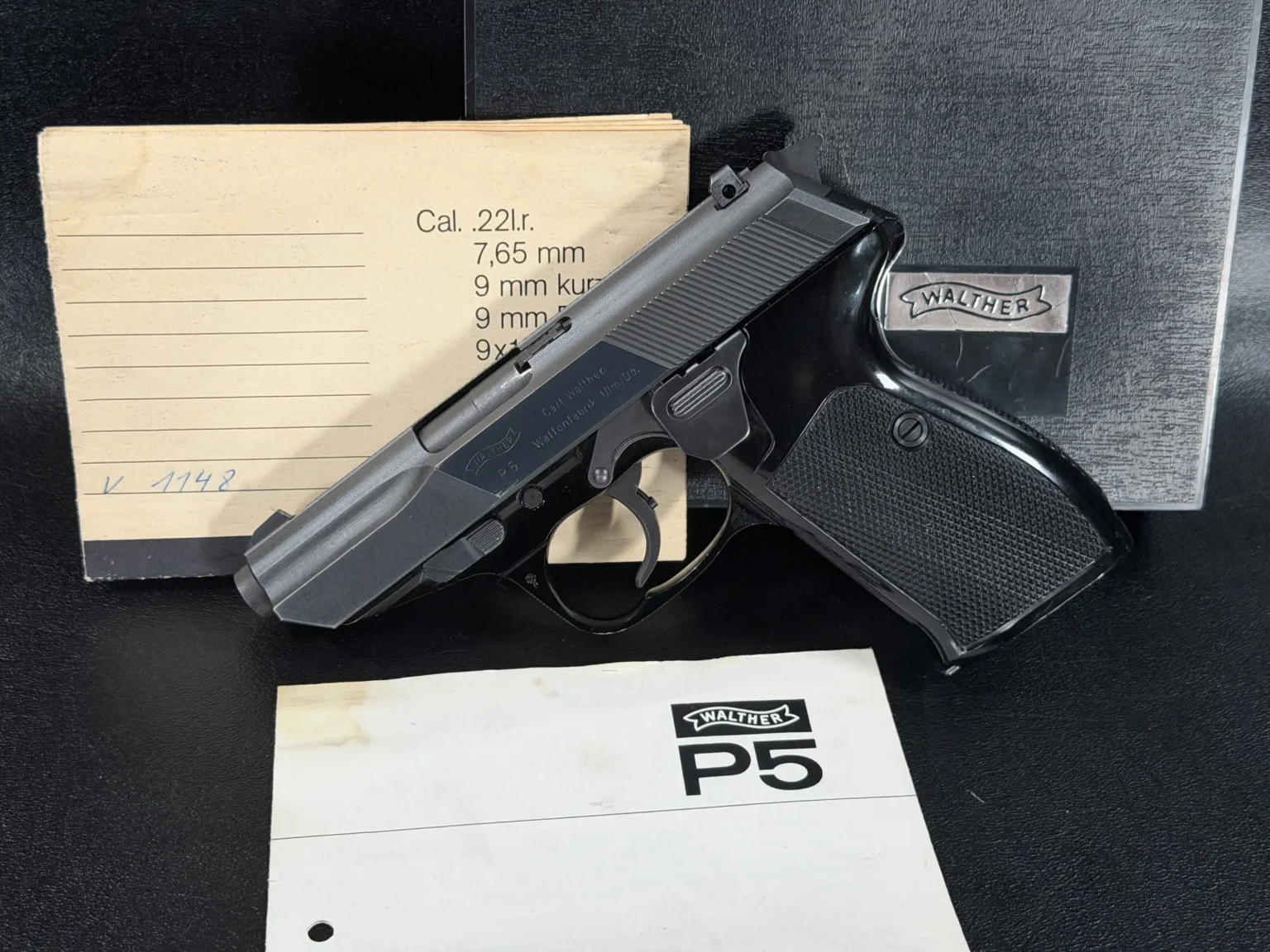
The P5, introduced in 1977, deserves more attention than it gets. This was Walther’s response to West German police requirements that emphasized safety features and double-action operation. The P5 used an updated, more compact version of the P38’s locking system, wrapped in a cleaner, more modern package. Dutch and Portuguese police services adopted it. The German federal border police carried it.
What makes the P5 interesting from a collector’s view is its relative obscurity in North America. European police surplus examples occasionally appear at auction, and the build quality is consistently excellent. The P5 Compact, which has a slightly shorter barrel and grip, is genuinely rare and commands serious collector interest. It’s one of those guns that specialists know, and casual observers walk past at gun shows, which means the prices haven’t fully caught up to the quality and scarcity. That won’t last forever.
The P88, introduced in 1988, was Walther’s attempt to enter the international military and law enforcement market. It was a departure in some ways: a double-action pistol with a conventional push-button magazine release (rather than the European heel-magazine release), staggered-column magazine, and modern ergonomics. The P88 competed directly against the Beretta 92 and the SIG P226 for the U.S. military contract and came up short.
Commercially, the P88 was never a massive success. That limited production actually makes surviving examples interesting collector pieces today, particularly the P88 Compact variant. The gun is mechanically sound and well-made; it just arrived at a crowded moment and didn’t find enough room to breathe.
The Bond Gun Grows Up: The P99
1997 was a good year for Walther. The P99 hit the market, and it hit hard. This was a genuine reinvention: a striker-fired (with a cocked-striker system they called “Anti-Stress”), polymer-framed, high-capacity service pistol that could compete directly with the Glock and the SIG P226 in any serious evaluation.
The P99 had a few genuinely clever features. The trigger system offered something close to a true double-action feel on the first shot after decocking, becoming lighter and crisper as the striker pre-cocked during cycling. Some shooters loved this; others found it confusing. But it was at least a thoughtful attempt to give operators a consistent trigger experience rather than forcing them to choose between a heavy first shot and manual safety management.
It also found its way back into the Bond franchise. GoldenEye was 1995, and Pierce Brosnan was still carrying the PPK. But for The World Is Not Enough in 1999, Bond made the upgrade to the P99, and the gun got another generation of cultural cachet. Daniel Craig eventually went back to the PPK, because of course he did.
From a collector’s standpoint, the P99 variants are worth tracking. The first-generation examples with the original anti-stress trigger system, the law enforcement versions with full-size frames, and particularly the P99 QA (Quick Action, essentially a consistent lighter-pull striker trigger) represent meaningfully different guns despite sharing the same name. The compact P99c AS added another branch to the family tree.
Walther also licensed the P99 platform to Smith & Wesson, which produced it as the SW99 for the American market during the early 2000s. These are mechanically nearly identical to the P99, sometimes easier to find than original Walther production, and often overlooked by collectors who focus exclusively on German-marked examples.
Trigger Happy: The PPQ and the Striker Revolution
By the mid-2000s, striker-fired pistols had taken over the law enforcement and civilian markets. Glock had won the war of normalization. Walther needed to compete on trigger quality, and when the PPQ arrived in 2011, it made a serious argument that it had.
The PPQ trigger is the gun’s whole identity. Short pre-travel, a crisp break, a short reset. Reviewers at the time fell over themselves trying to describe how good it was for a striker-fired pistol, and the enthusiasm wasn’t exaggerated. In back-to-back comparisons, the PPQ trigger genuinely felt different from Glock’s standard offering and more immediate than many of its competitors.
The PPQ came in M1 (paddle magazine release, European style) and M2 (push-button release, American preference) configurations, which was a smart acknowledgment that Walther was selling into two distinct market cultures. The M2 is considerably more common in North American collections.
Walther followed the standard formula: compact, subcompact, and long-slide variants, different barrel lengths for competition and defensive purposes, and various caliber options, including .45 ACP, to satisfy American market preferences. The PPQ SC (Subcompact) brought the trigger quality down to a more concealable package.
Here’s a practical note for collectors looking at the PPQ: early production examples are already developing a following among enthusiasts who want to capture the pre-revision trigger characteristics before manufacturing adjustments crept in. First-year production guns, in particular, are worth noting. This kind of variation is exactly what makes a model interesting to follow over time.
Where Walther Stands Now: The PDP
The Performance Duty Pistol launched in 2021, and Walther clearly designed it with some ambitions. This was their attempt to compete directly in the red-dot-ready service pistol market that had exploded following military and law enforcement adoption of miniaturized optics.
The PDP introduced a few notable features. The grip texture is aggressive without being punishing, designed for consistent hand positioning under stress. The trigger got another refinement, maintaining the PPQ’s short reset character but tuned slightly differently. Most importantly, the optics-ready slide came standard, with a flush mounting system Walther called “Performance Duty Optic” cut that accommodates most popular miniature red dots without adapter plates.
The PDP compact is genuinely competitive against the SIG P365XL and Glock 48 in the single-stack-equivalent market, though it uses a different design philosophy. The full-size and fiber-optic-equipped variants have found homes in competitive shooting, particularly in USPSA Production and Carry Optics divisions.
For collectors, the PDP is obviously too new to have accumulated genuine scarcity value. But it represents where Walther’s engineering DNA currently lives. You can feel the design lineage from the PP through the P99 and PPQ in how the PDP handles, and that continuity is itself part of the story.
What Makes Walther Worth Collecting?
Good question. There are plenty of German firearms manufacturers with long histories. Why does Walther occupy a particular place in the collector’s affection?
Part of it is the design milestone argument. If you want to understand the evolution of the self-loading pistol from the early 20th century to today, Walther sits at several critical junctures. The double-action trigger, the decocker, the locking block system, the early adoption of polymer frames in a European context: these aren’t small contributions.
Part of it is the cultural footprint, honestly. The PPK’s association with Ian Fleming’s spy series gives Walther a pop-culture presence that most firearms manufacturers can only dream of. That matters to a certain type of collector who cares about the intersection of history, culture, and mechanical achievement.
And part of it is just quality. Pre-war Walther production, in particular, represents a standard of fit and finish that was exceptional even by the standards of an era when German precision manufacturing was the global benchmark. Finding a pristine pre-war example feels different from most firearms collecting because you’re holding something made by craftsmen who had no idea they were making a historical artifact. They were just doing their jobs to a very high standard.
A few things worth knowing if you’re starting to build a Walther collection:
- Pre-war PP and PPK examples in 7.65mm (.32 ACP) generally command higher premiums than 9mm Kurz (.380 ACP) versions among German collectors, though American collectors sometimes reverse this preference.
- Matching numbers matter enormously. A P38 with mismatched grips or a replacement barrel is a different (and significantly less valuable) object than an all-matching example.
- Documentation adds value but requires verification. War-era provenance can be fabricated; work with established auction houses or specialist dealers who can authenticate paperwork.
- Manurhin-produced PP and PPK pistols from the post-war French production period are often undervalued relative to their quality and historical interest.
The Through Line
What’s remarkable, when you step back and look at Walther’s production across 130-plus years, is how consistent the underlying values have been. There’s always been attention to how a Walther feels in the hand. There’s always been a willingness to solve problems through mechanisms rather than brute simplicity. And there’s always been a kind of elegance in the external design, even on production guns that were never intended to be beautiful.
The PP from 1929 and the PDP from 2021 exist nearly a century apart. They operate differently, are made from different materials, and are designed for different threats and users. But put them next to each other, and there’s a family resemblance that’s hard to articulate but immediately recognizable.
That continuity is what separates a truly great firearms manufacturer from a merely competent one. Walther has had lean periods, competitive defeats, and product lines that didn’t find their market. But the core identity has held. For collectors and enthusiasts who care about where the modern pistol came from, and who built it, and why it works the way it does, that heritage is exactly why a Walther collection is worth starting, or deepening, or never stopping.
You know what? Some things earn their reputation. This is one of them.
Frequently Asked Questions
Walther didn’t just build pistols; it rewrote how they work, giving the world its first commercially successful double-action semi-automatic with the PP in 1929. The design milestones kept coming after that, and the modern service pistol still carries Walther’s fingerprints all over it.
Honestly, a post-war PPK in good condition is a smart, accessible entry point: historically rich, culturally iconic, and available at a range of price points. From there, the rabbit hole goes as deep as your budget allows.
The fit, finish, and machining tolerances on a genuine Zella-Mehlis PP or PPK from the 1930s reflect a standard of craftsmanship that wartime production pressures and later manufacturing economies simply couldn’t maintain. You’re not just buying a gun, you’re buying a piece of industrial artistry.
It drives broader name recognition more than it inflates specific prices, but there’s no question the PPK’s cultural footprint keeps demand steady across generations of new collectors. That kind of sustained interest is never a bad thing for long-term value.
Too new for scarcity value, but the PDP is where Walther’s engineering DNA currently lives and it competes seriously against the best striker-fired pistols on the market today. If you care about the lineage, it belongs in the conversation.