
Key Takeaways:
- The P5 uses a short-recoil, locked-breech mechanism in which the barrel and slide initially move rearward together.
- The standard model combines an eight-round magazine with left-side ejection and a frame-mounted slide-release and decocking lever.
- Dutch police began using the P5 in 1979, while police in Rhineland-Palatinate used it for approximately three decades before announcing its replacement in 2008.
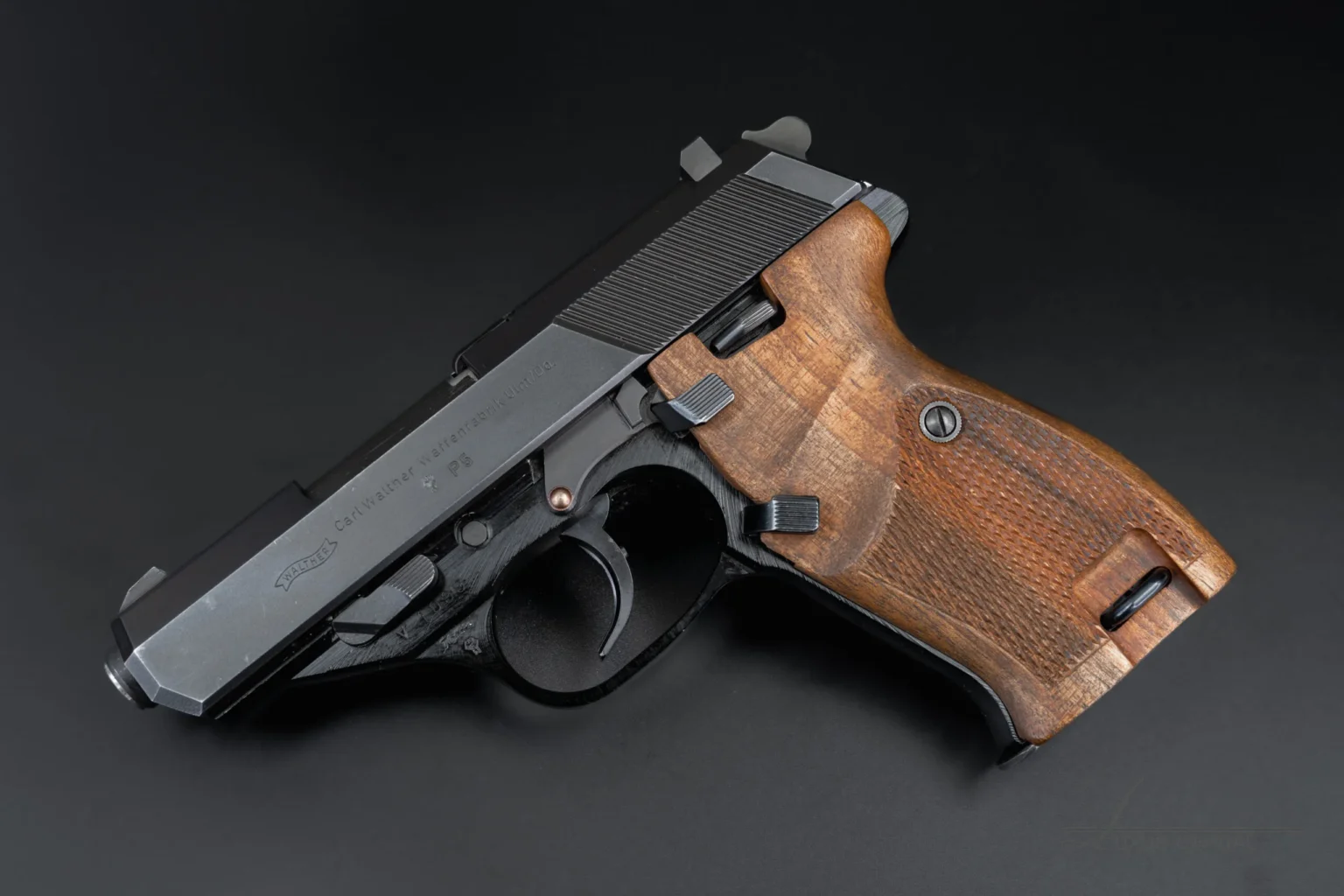
The Walther P5 adapted the P38 family’s operating system to a smaller service pistol. Designed to meet West German police specifications, it combined 9×19mm Parabellum chambering, an aluminum frame, and double-action/single-action operation with revised controls and internal safeties. [1][2]
The P5 uses a short-recoil, locked-breech mechanism. When fired, the barrel and slide initially move rearward together. A locking block beneath the barrel then drops out of engagement with the slide, allowing the slide to continue rearward. Two recoil springs return the slide forward. [1][2]
Its appearance differs from the P38’s open-top slide arrangement: the P5 has a more enclosed slide with an ejection port on the left. Left-side ejection itself was inherited from the earlier design. The standard P5 also has a magazine catch at the heel of the grip and a rear sight adjustable for windage. [1]
A frame-mounted lever combines slide-release and decocking functions. Internally, the firing pin remains outside the hammer’s striking path until the trigger is pulled, while a disconnector prevents firing when the breech is not fully locked. Double-action operation cocks and releases the hammer through the trigger pull; single-action operation releases an already cocked hammer. [1][2]
Walther’s factory specifications give the standard P5 a 90 mm barrel, an overall length of 180 mm, an empty weight of approximately 795 grams, and an eight-round magazine. These correspond to a 3.54-inch barrel, 7.09-inch overall length, and approximately 28 ounces. [2]
The P5 Compact offered another configuration, including a push-button magazine release beside the trigger guard. That control clearly distinguished it from the standard model’s heel catch. [1][3]
The pistol’s service history extended over several decades. In Germany, Rhineland-Palatinate police used the P5 for approximately 30 years before the state announced its replacement by the Walther P99 Q in September 2008. [4] Dutch police began using the P5 in 1979. In October 2012, the Netherlands announced the selection of the P99Q as its replacement. [5]
Military use included the U.S. Army’s Special Forces unit in West Berlin, which replaced its P38 pistols with P5s. The unit’s history places the model in a specific Cold War military setting alongside its better-known police service. [6]
For collectors examining accompanying equipment, Walther’s manual lists a plastic case, spare magazine, cleaning rod, test target, and instruction booklet. These establish the factory-described package for that edition of the manual. [2]
The P5 also appeared in two James Bond films released in 1983: Roger Moore carried it in Octopussy, and Sean Connery used it in Never Say Never Again. [7] design, the P5 is one of those pistols that deserves a permanent place in your collection—and your story.
Frequently Asked Questions
The Walther P5 is a 9×19mm Parabellum semiautomatic pistol developed from the P38 family’s design to meet West German police specifications. It has an aluminum frame and double-action/single-action operation.
No. The barrel and slide recoil together initially, then a locking block disengages to allow the slide to continue rearward.
The standard Walther P5 magazine holds eight rounds of 9×19mm Parabellum ammunition.
Walther offered the P5 Compact with a push-button magazine release beside the trigger guard. The standard P5 uses a magazine catch at the heel of the grip.
Documented users include Dutch police and police in the German state of Rhineland-Palatinate. Both subsequently announced plans to replace their P5 pistols with versions of the Walther P99Q.
Sources
[1] Simmons, Donald M. “The Walther P5: ‘A Super Pocket Auto’.” American Handgunner, March/April 1983, pp. 38–39, 84.
[2] Carl Walther GmbH. Walther P5: Bedienungsanleitung. September 1990, pp. 6–7, 10, 17, 19, 41.
[3] Carl Walther GmbH. P5 Compact 9×19: Parts Drawing and Parts List. Document 248 95 20, revision c, n.d., pp. 1–2.
[4] Ministerium des Innern und für Sport des Landes Rheinland-Pfalz. “10.000 neue Dienstpistolen für die rheinland-pfälzische Polizei.” Official press release, September 22, 2008.
[5] RTL Nieuws. “Politie krijgt nieuw dienstwapen.” RTL Nieuws, October 26, 2012; updated September 10, 2017.
[6] Stejskal, James. “Cold War Warriors: The Men and Guns of Special Forces Berlin.” American Rifleman, November 27, 2017.
[7] Maccar, David. “The Walther P5: James Bond’s Other Pistol.” Hook & Barrel, September 30, 2024; updated April 23, 2026.