
Key Takeaways:
- Smith & Wesson’s staying power isn’t an accident. For over 170 years, the company has consistently delivered firearms that meet real-world demands, from the Model 10 arming law enforcement for decades to the M&P challenging Glock’s grip on the modern market. That kind of track record doesn’t happen by luck.
- The most iconic models earned their status through performance, not just reputation. The Model 29 was a serious hunting handgun long before Dirty Harry made it famous, and the Model 686 became a competition staple because it genuinely outworked its rivals, not because of clever marketing.
- For collectors, context is everything. A worn Model 10 with documented police provenance can tell a richer story than a pristine example sitting unfired in a box. The firearms themselves are fascinating, but the history attached to them is what makes a collection truly worth building.
Let’s get started…
There’s something about holding a classic Smith & Wesson that almost defies explanation. The weight, the balance, the way the cylinder clicks into place with that satisfying, mechanical certainty. It’s not just a firearm; it’s over 170 years of American engineering philosophy made tangible. And for collectors, that feeling is kind of the whole point.
Smith & Wesson has been at this since 1852. Think about what the world looked like then. The Civil War hadn’t happened yet. Wyatt Earp was a toddler. And yet, the company that Horace Smith and Daniel Wesson built in Springfield, Massachusetts, would go on to arm lawmen, soldiers, hunters, and competitors across every era that followed. That’s a legacy that doesn’t just persist, it compounds.
This isn’t meant to be an exhaustive catalog. Think of it more like a conversation between enthusiasts, the kind you’d have at a gun show, flipping through blued steel and worn grips, debating which model really deserves the top spot. Some of these choices will be obvious. A few might surprise you.
The Model 10: The Revolver That Refused to Be Forgotten
If you had to pick the single most historically significant Smith & Wesson ever made, the Model 10 makes an almost unanswerable case. It started life in 1899 as the .38 Military & Police, a name that tells you exactly what Smith & Wesson had in mind. For the better part of the 20th century, this was the standard-issue sidearm for police departments from New York to Los Angeles, and for military forces around the world.
Here’s what’s remarkable: the Model 10 survived not because it was the flashiest option, but because it was relentlessly, stubbornly reliable. Six rounds of .38 Special, a four-inch barrel in the most common configuration, and double-action trigger operation that felt intuitive to almost anyone who picked it up. Law enforcement agencies didn’t require elaborate training programs just to get officers proficient with it.
The numbers are staggering when you look them up. Smith & Wesson produced something in the neighborhood of six million Model 10s over its production run. Six million. That figure alone makes it one of the most-produced revolvers in history. For collectors, that abundance is both a blessing and a challenge. Common variants are relatively accessible, but pre-war examples, rare barrel lengths, and transition models between designations are not. Those are the ones worth hunting.
One thing collectors often overlook is how much the Model 10 evolved while somehow remaining essentially itself. The pinned barrel, the recessed chambers, the changes in grip design over decades, learning to read those details is half the fun. An early-1950s example and a 1970s version are nominally the same firearm, but they tell completely different stories about the eras they came from.
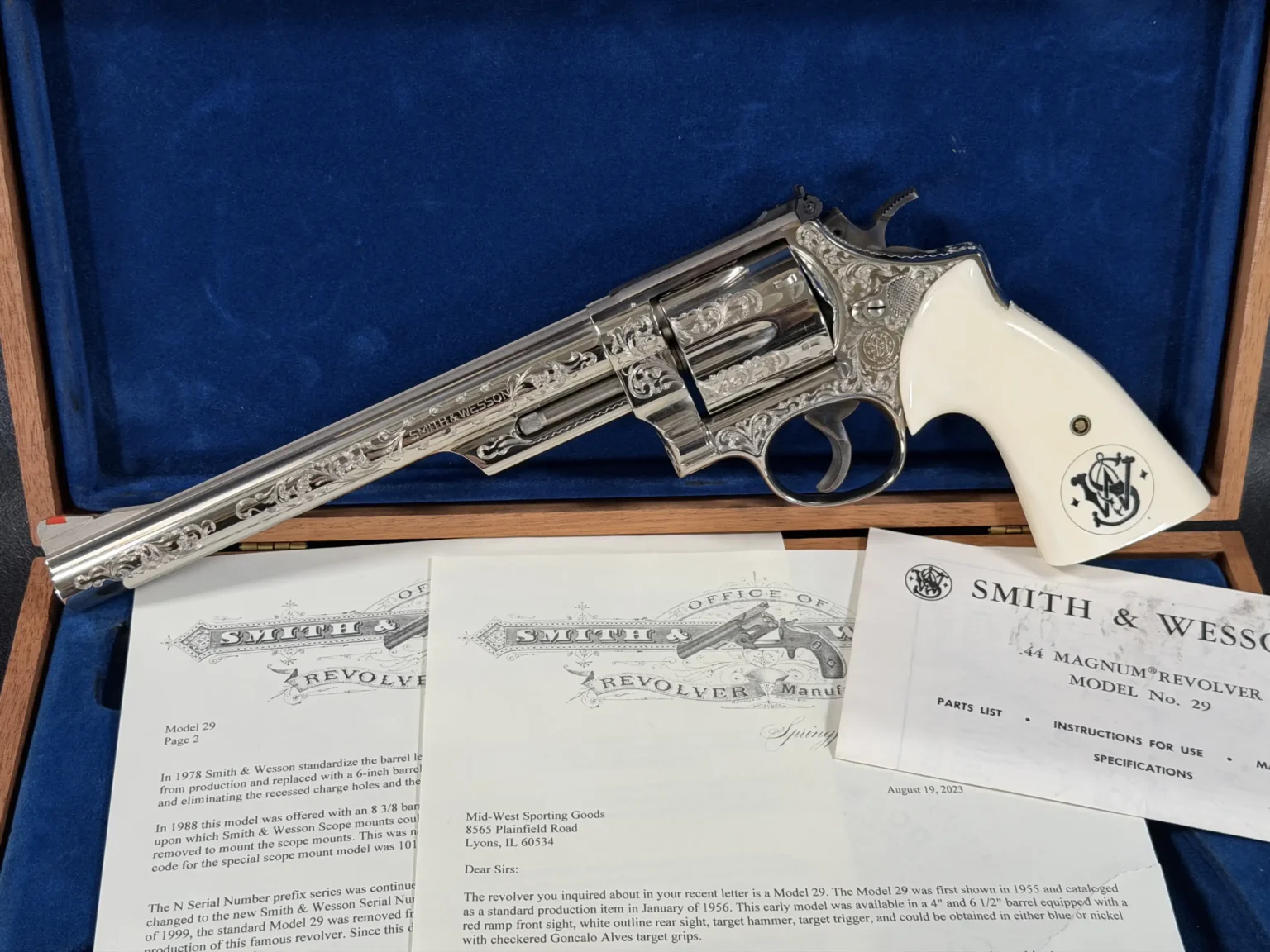
The Model 29: Dirty Harry Made It Famous, But It Was Always More Than a Movie Gun
Let’s be honest about something. The Model 29’s cultural footprint is enormous, and Clint Eastwood’s Dirty Harry is responsible for a significant chunk of it. “The most powerful handgun in the world”, that line burned itself into the public consciousness in 1971, and demand for .44 Magnums went berserk almost overnight. Smith & Wesson had to put customers on waiting lists.
But reduce the Model 29 to its Hollywood association, and you’re selling it short.
The .44 Magnum cartridge itself has a fascinating backstory. Elmer Keith, a legendary gun writer and outdoorsman, spent years advocating for a more powerful revolver cartridge before Remington and Smith & Wesson finally collaborated to make it happen in 1955. Keith understood that hunters pursuing large game needed a handgun with genuine stopping power, not just something that looked impressive. The Model 29, chambered in this new cartridge, delivered exactly that.
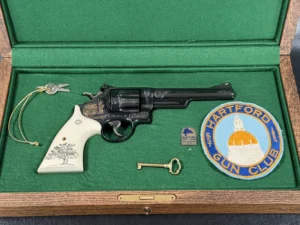
The original Model 29s from the late 1950s and early 1960s are genuine collector gold at this point. The pinned barrels, the recessed cylinder chambers, these construction details mark them as pre-cost-cutting production, and their prices at auction reflect that. A pristine example in the original presentation box is the kind of find that makes a gun collector’s hands tremble.
Later variants offered barrel lengths ranging from 3 inches to 10.625 inches, allowing shooters to tune the balance between portability and muzzle velocity. The 6.5-inch barrel became the most popular for hunting applications, giving shooters a meaningful velocity advantage without tipping into unwieldy territory. You know what? That thoughtful approach to configuration options is part of why the Model 29 has endured so well as a serious hunting handgun, not just a collector’s piece.
The Model 686: Stainless, Versatile, and Basically Bulletproof
The Model 29 is prestigious, and the Model 10 is historic. But if you asked a working revolver shooter, whether in competition, hunting, or daily carry back when revolvers ruled the market, which Smith & Wesson they’d truly want in their hands, a surprising number would say the 686.
Introduced in 1980, the Model 686 was S&W’s stainless steel L-frame chambered in .357 Magnum. The L-frame itself was something of a compromise in the best possible sense: heavier and sturdier than the K-frame that had served for decades, but smaller and more manageable than the N-frame used for the Model 29. The goal was a platform that could handle sustained .357 Magnum use without the accelerated wear that K-frame revolvers showed when fed a steady diet of magnum loads.
It worked. Famously.
The 686 became a go-to choice for IPSC and IDPA competition shooters throughout the 1980s and into the 1990s. Its stainless steel construction shrugged off holster wear that would scratch and stain blued carbon steel. The adjustable rear sight made it straightforward to zero for different loads. And the .357 Magnum chambering, which also accepts .38 Special, gave shooters flexibility that single-cartridge revolvers couldn’t match.
Today, the 686 Plus variant adds a seventh round to the cylinder, a meaningful advantage in competition shooting. The “Distinguished Combat Magnum” label that Smith & Wesson applied to some configurations wasn’t just marketing; it reflected genuine acknowledgment that this was a serious tool for serious shooters. For collectors, the early production models with the full underlug barrel and the period-correct grips hold particular appeal. The 686 feels like a gun built to outlast any of us.
The Model 1911: A Legend Wearing Different Clothes
Here’s the thing about Smith & Wesson producing a 1911: it’s a little bit like a great Italian restaurant adding sushi to the menu. The concept feels odd until you taste it, and then you realize the kitchen just understands good food regardless of the style.
S&W entered the 1911 market seriously in 2003, which put them relatively late to a party that had been running since 1911. The platform John Browning designed for Colt had been produced by dozens of manufacturers over the preceding century, and devotees had very strong opinions about who did it right. Entering that conversation required genuine commitment to quality.
What Smith & Wesson brought to the format was their own manufacturing precision and a willingness to develop variations that addressed specific use cases. The Performance Center 1911s, built in S&W’s custom shop, earned respect from competitive shooters who knew exactly what they were evaluating. Match-grade barrels, hand-fitted components, flat-faced triggers tuned to specific pull weights, these weren’t cosmetic upgrades.
The SW1911 Pro Series attracted attention, particularly among IDPA shooters seeking a competition-legal 1911 without the cost of true custom work. The stainless construction on several variants also addressed one of the 1911 platform’s traditional vulnerabilities: susceptibility to rust in humid environments. For shooters in the American South, that matters more than it might seem.
Collectors who focus on Smith & Wesson specifically sometimes overlook the 1911 offerings, viewing them as outside S&W’s core identity. That’s understandable, but it also means these guns often represent relative value compared to their quality level. The Performance Center examples especially deserve more attention than they typically get in dedicated S&W collections.
The M&P Series: When Smith & Wesson Decided to Fight Back
The late 1990s and early 2000s were uncomfortable years for Smith & Wesson. Glock had reshaped the law enforcement market with polymer-framed, striker-fired pistols, and S&W’s early attempts to compete, the Sigma series, ended up generating a lawsuit from Glock over alleged patent infringement. It was not a proud chapter.
The Military & Police series, launched in 2005, was Smith & Wesson’s serious answer to that challenge. And honestly, it was long overdue.
The M&P borrowed the ergonomic philosophy that had made Glock successful, a polymer frame, striker-fired action, internal safeties rather than external manual controls, and then improved on several points that Glock devotees had complained about for years. The grip angle on the M&P felt more natural to shooters trained on traditional pistols. The interchangeable backstraps let users tune the grip to their hand size, a practical feature that competitors didn’t initially offer. The trigger, while not exceptional in standard form, responded well to aftermarket work.
Law enforcement adoption came quickly. The M&P became standard issue for a significant number of police departments, including large agencies that had previously been Glock strongholds. That adoption reflected genuine confidence in the platform’s reliability.
The M&P line has since expanded considerably, with the M&P Shield for concealed carry, the M&P 2.0 with a revised trigger and grip texture, and the M&P 5.7 chambered in the 5.7x28mm cartridge that had previously been nearly exclusive to FN. The Performance Center M&P variants feature factory-ported barrels and tuned triggers for competition use. It’s a mature ecosystem at this point, built around a platform that earned its position through performance rather than marketing.
For collectors focused on contemporary production, the early M&P variants and limited-production runs are attracting growing interest. As the series ages, the first-generation examples will develop the historical significance that collectors assign to any firearm that influenced its era.
The Model 500: Because Sometimes “Enough” Isn’t
Let’s talk about the Model 500 for a moment, because it represents something different from everything else on this list. This isn’t a service pistol, a competition revolver, or a law-enforcement standard. The Model 500 is, in the most straightforward possible terms, an exercise in maximum feasibility.
Introduced in 2003 and chambered in .500 S&W Magnum, the Model 500 claimed the “most powerful production handgun” designation that the .44 Magnum had held for decades. The .500 S&W Magnum produces roughly 2,600 foot-pounds of muzzle energy in standard commercial loads. For context, many rifle cartridges don’t reach that figure. The five-shot cylinder on the X-frame platform that Smith & Wesson developed specifically for this cartridge weighs over four and a half pounds empty, before you load it.
The practical applications are more serious than the “hand cannon” reputation suggests. Hunters pursuing dangerous game in Alaska and Africa have adopted the Model 500 precisely because its power levels provide genuine insurance against a charging bear or cape buffalo. At those moments, the word “overkill” kind of loses its meaning.
For collectors, the Model 500 occupies a curious position. It’s contemporary enough that examples are still in production and widely available, but distinctive enough that a complete collection spanning S&W’s major platforms feels incomplete without one. The limited-production variants, the Performance Center versions with compensators, and the shorter-barreled “hunting” configurations add variation that collectors find interesting.
There’s also something philosophically satisfying about the Model 500 as the logical endpoint of a company that started producing revolvers in the 1850s. The engineering distance between those earliest models and the Model 500 is almost impossible to overstate, and yet the fundamental operating mechanism, a rotating cylinder advancing to align each chamber with the barrel, would be recognizable to those original designers.
What About the Classics That Don’t Get Enough Credit?
Any serious conversation about Smith & Wesson has to acknowledge a few models that often get crowded out by the famous names.
The Model 19 Combat Magnum, introduced in 1957, was Bill Jordan’s dream realized, a K-frame revolver with the same.357 Magnum chambering that previously required the larger N-frame. Jordan, a Border Patrol officer and renowned gunwriter, convinced Smith & Wesson that law enforcement needed a .357 in a package that didn’t feel like carrying a cannon. The Model 19 was the answer, and it dominated law enforcement holsters for two decades.
The Model 36 Chief’s Special is another one. Introduced at the International Association of Chiefs of Police convention in 1950, hence the “Chief’s Special” name, this J-frame five-shot revolver essentially created the compact revolver category as modern shooters understand it. Everything that followed in the small carry revolver space, from S&W’s own Airweight variants to competitors across the industry, owes a debt to the Chief’s Special’s concept.
And the Model 41, Smith & Wesson’s competition-grade .22 LR target pistol, deserves acknowledgment for what it represents. Competition shooters in bullseye disciplines have relied on the Model 41 for decades. It’s a specialized tool rather than a mainstream product, but within its intended context, it has few peers. The precision engineering involved in a target pistol that shooters stake their competitive records on is genuinely impressive.
Collecting Smith & Wesson: Where Do You Even Start?
For someone drawn to S&W collecting but unsure how to approach it, the practical question isn’t “which gun is best?” but “what story do I want to tell with my collection?”
Some collectors focus on a single model across its entire production history, accumulating examples that document every engineering change, every grip variation, every refinement over decades. The Model 10, with its century-plus production run, supports this approach better than almost any other American firearm.
Others build collections around a specific era, pre-war production, or the postwar boom years, or the transition period between the old letter-prefix serial number system and the modern hyphenated model numbers. Learning the dating system for Smith & Wesson revolvers is genuinely absorbing, particularly for the pre-model-number guns, where the serial range and factory records become your primary tools.
A third approach follows function, assembling a collection that represents how S&W firearms were actually used: military and law enforcement service, competition shooting, hunting, and personal protection. This approach requires greater breadth across models but yields a collection that tells a complete story of how firearms integrate into American life across different contexts.
Regardless of approach, condition matters enormously to value, but perhaps not in the way beginners assume. A well-worn gun with documented provenance, a police service weapon with records tracing it to a specific department and officer, for instance, can be more compelling and sometimes more valuable than an unfired example without context. History leaves marks, and those marks aren’t always a liability.
The grading standards established by the NRA remain the accepted language for condition in the collector community. Learning to apply them honestly to both purchases and your own holdings is foundational. The difference between “very good” and “excellent” represents real money, and the difference between “good” and “fair” represents even more.
Why Smith & Wesson Keeps Mattering
Over 170 years is a long time for any company to stay relevant. In the firearms industry, where consumer loyalty runs deep and skepticism about change runs even deeper, longevity requires more than competent manufacturing. It requires a genuine understanding of what shooters actually need and, occasionally, the willingness to build something that goes beyond what they thought they needed.
Smith & Wesson has navigated corporate ownership changes, legal challenges, market shifts from revolvers to semi-automatics and back to revolvers, the rise of polymer-framed pistols, the explosion of the concealed carry market, and the emergence of a new generation of firearms enthusiasts who came to the hobby through very different paths than their predecessors. Through it all, the core of the company, manufacturing quality firearms that perform when it matters, has remained consistent.
For collectors, that continuity is actually the most valuable thing Smith & Wesson produces. Each model in a collection isn’t just a firearm; it’s evidence of how American manufacturing and design responded to the specific demands of a specific era. The Model 10 tells you about mid-20th-century law enforcement. The M&P tells you about the post-Glock competitive landscape. The Model 500 tells you that American engineering culture still believes in taking an idea as far as it can go, regardless of whether anyone strictly asked.
That’s a collection worth building. It just takes patience, knowledge, and a clear appreciation for what makes each piece significant within the larger story. Smith & Wesson has given collectors a lot to work with.
And somehow, after 170-plus years, they’re still adding to it.
Frequently Asked Questions
With roughly six million units produced, the Model 10 served as the standard-issue sidearm for police departments and military forces across the world for most of the 20th century. That kind of adoption doesn’t happen unless a firearm is genuinely, consistently reliable.
Honestly, yes, the early pinned-barrel examples from the late 1950s and early 1960s are legitimate collector gold, and pristine examples in their original presentation boxes command serious money at auction. The Hollywood association is just a bonus.
The M&P improved on several points that Glock shooters had complained about for years, including a more natural grip angle and interchangeable backstraps for different hand sizes. It earned its adoption by law enforcement through performance, not just brand loyalty.
The best starting point is deciding what story you want your collection to tell, whether that’s a single model across its entire production history or firearms tied to a specific era. From there, learning S&W’s serial number dating system is the single most useful skill you can develop.
It’s genuinely both; hunters pursuing dangerous game in places like Alaska rely on its power levels as serious insurance against a charging bear. But there’s no denying that building a handgun with more muzzle energy than many rifle cartridges is also a statement about what’s possible.