
Key Takeaways:
- SIG Sauer’s consistency is the real legacy. Across seven decades and wildly different product generations, one thing hasn’t changed: you always know you’re holding a SIG. That’s not an accident. It’s the result of a company that established a design philosophy early and refused to abandon it, even as materials, manufacturing methods, and market demands shifted dramatically around them.
- History and value go hand in hand. The guns that carried soldiers, protected heads of state, and won landmark military contracts don’t stay ordinary used firearms for long. Whether it’s a West German P226, a SEAL-heritage MK25, or an early M17, the historical context around a SIG almost always catches up to its price tag eventually. Collectors who understand that early tend to build better collections.
- The story is still being written. SIG isn’t coasting on reputation. The MCX Spear just won the biggest U.S. military rifle contract in a generation. The P365 reshaped the concealed carry market. Honestly, that’s what sets SIG apart from most legacy manufacturers: the guns worth owning tomorrow are still rolling off the line today.
Let’s get started…
There’s something about holding a SIG Sauer that just feels different. Maybe it’s the weight distribution, or the way the trigger breaks so cleanly. Or maybe it’s knowing you’re holding a piece of engineering history. Whatever it is, collectors and shooters have been chasing that feeling for decades, and honestly, it’s not hard to understand why.
SIG Sauer’s story technically starts in Switzerland. The Swiss Industrial Company, Schweizerische Industrie-Gesellschaft, merged its arms division with J.P. Sauer & Sohn of Germany, and from that union came one of the most respected firearms manufacturers on the planet. Two countries, two proud traditions, one relentless obsession with precision. That combination has produced pistols, rifles, and everything in between that have graced military holsters, law enforcement belts, and collectors’ safes across the globe.
So let’s walk through the standouts. The guns that defined eras, broke new ground, and in some cases, fundamentally changed how the firearms industry operates.
The P210: Where It All Started (and Still Hasn’t Been Topped)
If you want to talk SIG, you start here. Full stop.
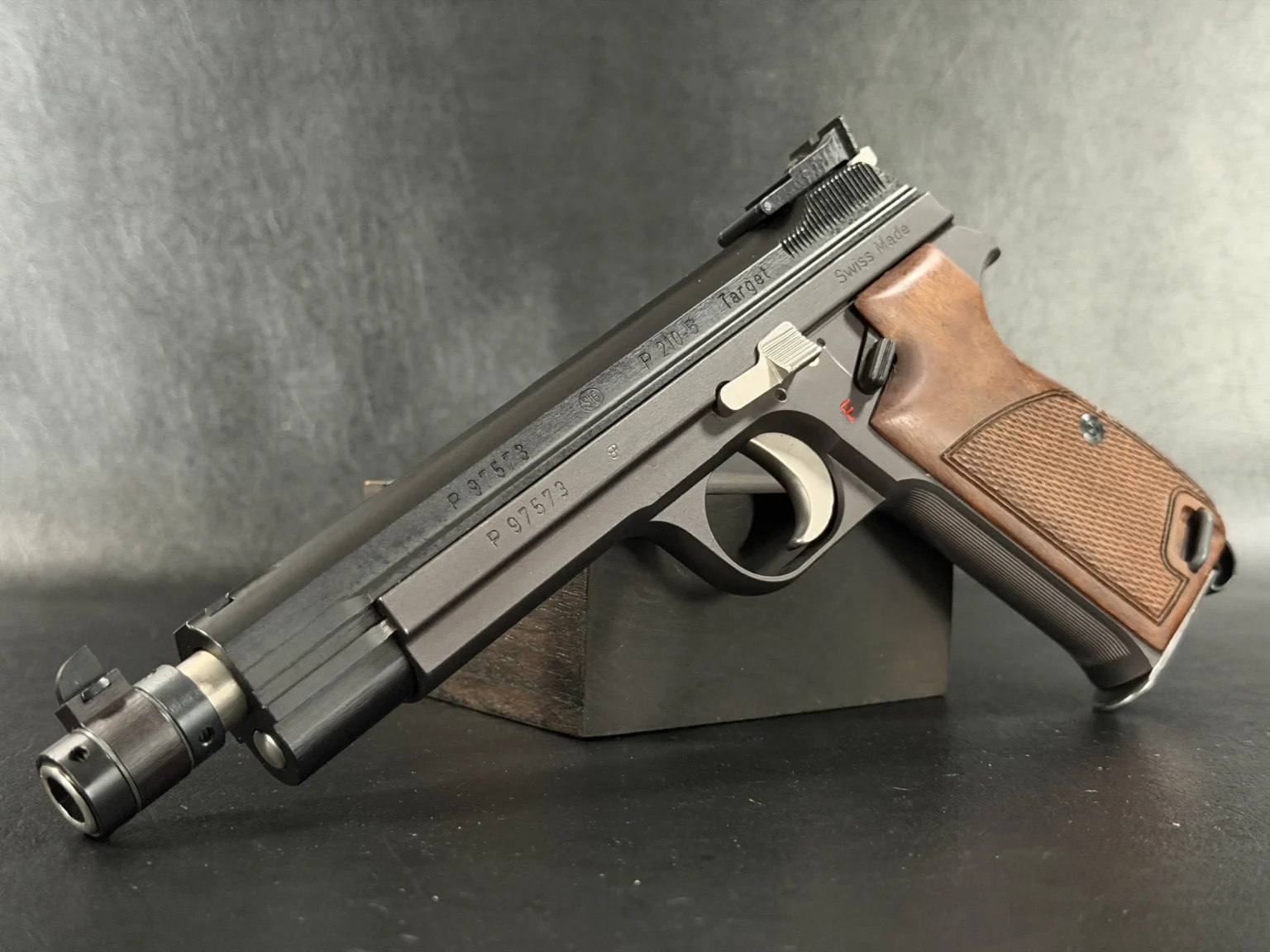
The P210 entered production in 1947, adopted by the Swiss Army as the Pistole 49. And here’s the thing about the P210 that people outside the collecting world often miss: this gun was never really meant for mass consumption. It was built the way fine watches are built. Fitted, finished, and assembled to tolerances that most manufacturers still haven’t matched at scale.
The single-action trigger on a well-tuned P210 is, without exaggeration, one of the finest factory triggers ever installed in a semi-automatic pistol. Competitors from the 1970s and 80s would send their P210S to gunsmiths to have the triggers adjusted, only to be told there wasn’t much left to improve. The rail-in-frame design, where the slide rides inside the frame rather than outside it, gives the gun an almost eerie lockup that contributes directly to its legendary accuracy.
Original Swiss military surplus P210S, especially early-production specimens with walnut grips and a high-polish finish, command serious attention at auction. A collector who picks up a pristine P210-1 or P210-2 today is sitting on an appreciating asset, not just a firearm. SIG reintroduced the P210 as a modern legend series in recent years, and while those are genuinely fine pistols in their own right, there’s a different feel to holding the original. Something that reminds you, seventy-plus years of trigger pulls have validated this design over and over again.
The P220: When SIG Went Global
Jump forward to 1975. The Swiss Army wanted a new service pistol, and SIG delivered the P220. What they might not have anticipated was how that design would ripple outward into virtually every corner of the firearms market.
The P220 introduced what would become SIG’s signature DA/SA (double-action/single-action) trigger system combined with their decocking lever arrangement. No manual safety. No external hammer to catch on a holster. Just a deliberate, heavier first pull that transitions into a crisp single-action once the hammer is cocked. For military and law enforcement applications, that design philosophy was genuinely revolutionary.
Japan adopted the P220 as their service pistol, chambered in .45 ACP no less, which immediately signaled to American shooters that this wasn’t just a European curiosity. The gun was built to handle serious cartridges seriously. When imports started flowing into the U.S. market in the late 1970s, demand was almost immediately outpaced by supply.
What makes P220S interesting from a collector’s perspective is the sheer variety of configurations they came in. West German-produced specimens with the heel magazine release command premiums over later American-assembled guns. The early Nitron-finish variants tell one story; the polished stainless steel tells another. Building a complete P220 collection across eras and configurations is a legitimate pursuit, and enthusiasts do exactly that.
The P226: Born From Competition, Adopted by Warriors
You know what’s fascinating about the P226? It almost won the U.S. military trials in 1984. Almost.
The Army was looking to replace the venerable 1911 with something that could handle the NATO-standard 9mm cartridge and carry more rounds. SIG entered the P226. Beretta entered the 92F. Both passed the technical trials with flying colors. The Beretta won on price. That’s it. The P226 was quite literally too expensive for the U.S. Army’s budget at the time.
But here’s where the story gets interesting: the Navy SEALs were watching. When they adopted their own pistol, they chose the P226 over the Beretta that the broader military was using. That decision carried enormous weight. The SEALs’ adoption wasn’t a footnote; it became a central part of the P226’s identity and marketing for decades.
The P226 itself is a thoroughly evolved platform. Compared to the P220, it gained a double-stack magazine for increased capacity, a slightly revised trigger geometry, and over the years of production, a parade of configurations: the P226 LEGION with its enhanced grip and reduced reset trigger, the P226 Elite with its beavertail and shortening of the trigger reach, and the MK25 variant that carries the anchor marking denoting its SEAL heritage.
Collectors who focus on military contracts and law enforcement configurations have nearly endless variants to pursue. The German Federal Police’s GSG9 has carried the P226. So has the French GIGN. British Special Forces. The gun has been on more high-stakes operations than most people want to think about, and that history is tangible when you handle one.
The P228 and P229: Compact Matters
Not everyone needs a full-size service pistol, and SIG knew that. The P228 arrived in 1989 as a compact version of the P226 platform, retaining the 9mm chambering in a package that was genuinely concealable for plainclothes carry. The U.S. military adopted it under the designation M11, another notable adoption that gave the P228 real credibility.
The P229 followed in 1992, making a subtle but important change: a machined stainless-steel slide rather than a stamped-steel version. This allowed the platform to handle the higher-pressure .40 S&W cartridge that law enforcement agencies were gravitating toward at the time. Later, .357 SIG (a cartridge SIG literally created) and 9mm versions followed.
The P229 became perhaps the single most common SIG in American law enforcement holsters through the 1990s and 2000s. Department of Homeland Security, Secret Service, DEA, FBI field agents, and local police departments coast to coast. If you were studying American law enforcement carry preferences in that era, the P229 was simply unavoidable.
From a collector’s standpoint, P229S are fascinating because the production timeline captures a particular era of American law enforcement philosophy. The caliber wars. The push toward higher-capacity service pistols. The eventual migration back toward 9mm. An early West German-assembled P229 in .40 S&W sits differently in a collection than a modern P229 Legion in 9mm, and both deserve their place.
The P239: The Overlooked Gem
Let’s be direct: the P239 never got the attention it deserved, and the firearms community still hasn’t fully made peace with its discontinuation.
Introduced in 1996, the P239 was a single-stack compact designed for concealed carry in a market increasingly aware that not every shooter has large hands or wants a bulging grip. It chambered 9mm, .40 S&W, or .357 SIG. The action was the familiar DA/SA, the build quality was unmistakably SIG, and the size was genuinely comfortable for all-day carry in a strong-side or appendix position.
SIG discontinued the P239 in 2018, a decision that frustrated a vocal segment of the collector community. Pre-discontinuation, P239S were available at fairly ordinary prices. Post-discontinuation, the secondary market responded the way it always does: prices climbed, and certain configurations became actively sought. The SAS (SIG Anti-Snag) variant, with its melted corners and bobbed hammer, has become genuinely collectible.
If you’re building a SIG collection and haven’t considered a P239 SAS in good condition, give it some thought. That ship has been sailing, and the tide isn’t coming back.
The P320: The Future Arrived With a Lawsuit and a Military Contract
No SIG Sauer article would be honest without talking about the P320, and no P320 discussion is complete without acknowledging its complicated early history.
The P320 is a modular, striker-fired pistol built around a serialized chassis that can be configured for different grip sizes and calibers. When SIG designed this system, they were thinking about the future of the military service pistol market. Their bet paid off in 2017 when the P320 beat out Glock, Beretta, and others to become the U.S. Army’s M17/M18 service pistol. That’s a contract worth billions. That’s the kind of win that validates a platform entirely.
The early years, though, were rocky. Reports of drop-induced discharges led to a voluntary upgrade program that SIG handled aggressively. The updated P320 mechanism addressed the concerns, and independent testing by the Army and multiple agencies confirmed the reliability and safety of the resolved design. It was a real moment of turbulence, and how SIG responded mattered.
Fast-forward to today: the P320 platform has expanded into one of the most versatile in the modern market. The P320-M17, the civilian version of the military pistol, sits comfortably in collector territory already simply because of its role in U.S. military history. Future generations will look at M17S the way current collectors look at M9 Berettas or 1911s: as service pistols that carried a nation’s soldiers through specific chapters of history.
The platform’s modularity has also spawned a genuine aftermarket ecosystem. Agencies, competition shooters, and everyday carriers have all found versions of the P320 that work for their specific needs. The XCarry, the AXG Legion, the P320-XTEN in 10mm, the SPECTRE COMP variant, these aren’t just product lines; they’re an ongoing conversation about what a modern pistol should be.
The MPX: SIG’s Take on the PCC Market
Here’s a slight digression that’s worth the detour, because the MPX tells you something important about how SIG evolved.
When the pistol-caliber carbine market started genuinely heating up, SIG entered with the MPX, a blowback 9mm platform that deliberately borrowed aesthetics and controls from the AR-15/M4 world. Folding stocks, ambidextrous controls, and a familiar manual of arms for anyone already trained on military rifles. The MPX found immediate favor with competition shooters, certain law enforcement agencies for vehicle carry, and collectors who wanted a high-quality PCC.
The MPX K, the compact variant with a shorter barrel, pushed the platform toward home defense and SBR territory. SIG made several versions across production runs, and early models and later production runs differ enough to matter to serious collectors. It’s the kind of gun that slides easily into both a working collection and an investment portfolio, which is a combination that doesn’t come along every day.
The MCX and Rattler: Rifles That Think Differently
SIG’s entry into the rifle market didn’t follow convention, which is exactly why it’s worth discussing.
The MCX began as a military development program, specifically SOCOM’s attempt to find a suppressor-optimized, short-barreled rifle that could reliably cycle with both subsonic and supersonic ammunition. The design SIG produced used a short-stroke piston system rather than direct impingement, which meant less heat and carbon fouling dumped into the action. The MCX also pioneered a folding-stock mechanism that worked reliably with the bufferless design, something previous AR-derived platforms hadn’t managed to do convincingly.
The MCX Spear, chambered in 6.8x51mm Common Cartridge, won the Next Generation Squad Weapon competition in 2022. That’s the biggest U.S. military rifle contract in recent memory. For collectors, MCX Spear rifles and the Spear LT civilian variants represent the beginning of a new chapter in American military small arms. These are guns that will be historically significant. Full stop.
The Rattler, the ultra-compact variant of the MCX, has developed its own following among both law enforcement and serious collectors. The thing is barely larger than a pistol when folded, yet it functions as a credible rifle. Early-production Rattlers with specific barrel and suppressor configurations have already become items that serious SIG collectors track closely.
The P365: Small Package, Enormous Impact
Back to pistols, because the P365 deserves its own moment.
When SIG announced a micro-compact 9mm that could carry 10+1 rounds in a frame smaller than most competing 6-round pistols, the industry was skeptical. It sounded like marketing copy, the kind of claim that sounds great until you hold the actual gun and realize someone cut corners somewhere to make the numbers work.
Then people actually shot the P365.
The 10-round flush-fit magazine was real. The trigger, while obviously not a P226 LEGION, was genuinely usable for a pistol this size. The sights were better than the competitors’ standard offerings. And the carry ergonomics were, frankly, outstanding for a gun designed to disappear into a waistband. SIG had figured something out.
The P365 family has since expanded considerably: the P365X with a longer grip; the P365XL with a longer slide and an optics-ready configuration; the P365-XMACRO, which pushed capacity to 17 rounds while retaining a compact footprint; and the P365 Specter Comp with an integrated compensator. Each variant tells you where the market was heading when SIG designed it. Collectively, they represent one of the most successful product launches in recent handgun history.
What Connects All of These?
You could look at the P210 and the P365 and see nothing but contrast. One is a machined-steel heirloom with a single-stack magazine and a finish that takes a craftsman’s real time to achieve. The other is a polymer-framed carry gun with interchangeable components and an optics footprint cut directly into the slide. Different eras, different manufacturing philosophies, different purposes.
And yet. Pick up either one, and you’ll feel a consistent difference. The tolerances are tight. The controls have a deliberate feel. Nothing rattles, nothing feels provisional. SIG has managed, across seventy-plus years and multiple product generations, to maintain a character across their lineup that’s honestly difficult to articulate but immediately recognizable to anyone who’s handled a few.
That consistency is probably what keeps collectors coming back. You buy one SIG, and you understand why the others exist. There’s an internal logic to the lineup, a through-line connecting the P210 to the P320 to the MCX Spear that isn’t accidental. It’s the product of a company that genuinely knows what it is and builds accordingly.
Building a SIG Collection: Where to Start
If you’re relatively new to SIG collecting specifically, here’s a reasonable framework.
Start with a representative DA/SA pistol from the classic series, probably a P220 or P226, depending on what speaks to you. Understanding that trigger system and that design philosophy gives you the foundation for everything else. An early West German production P226 in good condition teaches you more about what SIG is than any amount of reading.
From there, let your interests guide you. If law-enforcement history is your focus, look for P229 variants issued by notable agencies. If you’re more captivated by military service pistols, concentrate on the M17/M18 P320 variants and, in time, MCX Spear specimens, the future of that category. If your main priority is experiencing SIG at its finest, a pristine P210 is likely the pinnacle, though you should be prepared to pay a premium.
The discontinued P239, mentioned earlier, sits on an interesting price curve right now. Not yet at peak collector premium, but clearly moving. Same for certain early P365 variants before SIG revised production details. The early-production guns in any major platform tend to become the collectible specimens, and the P365 is young enough that the market hasn’t fully recognized which variants will matter most.
A Final Word on Why This All Matters
Firearms collecting, like any serious collecting pursuit, is ultimately about preserving history. Each P226 MK25 with its anchor engraving represents a piece of SEAL Team heritage. Each P210, with its fitted barrel and glass-smooth action, captures Swiss precision manufacturing at its absolute height. And every M17 marks the beginning of a story still being written by the soldiers who carry it in active service.
SIG Sauer has given collectors a genuine depth of material to work with. The variation across eras, calibers, contract configurations, and production countries means that even a focused collection can take years to develop seriously. And unlike some manufacturers whose historical significance is largely nostalgic, SIG remains at the cutting edge of military and law enforcement contracts, meaning new collectible specimens are still entering the world.
That’s a rare thing. A brand with deep historical roots that’s simultaneously defining what comes next. For collectors and enthusiasts alike, the SIG Sauer story isn’t over. Not even close.
Frequently Asked Questions
A P220 or P226 is the natural starting point, since both capture the core of SIG’s design philosophy. Get comfortable with the DA/SA trigger system, and everything else in the lineup will start to make a lot more sense.
Early West German production guns were assembled to tighter hand-fitting standards and carry a manufacturing heritage that later, higher-volume production simply can’t replicate. For serious collectors, the country of origin isn’t just a detail; it’s a meaningful part of the gun’s story.
Early production P365S are quietly moving in that direction, particularly variants with specific configurations that SIG has since revised or discontinued. The market hasn’t fully caught up yet, which is exactly the kind of window collectors look for.
The P210’s rail-in-frame design and hand-fitted tolerances give it an accuracy and trigger quality that most modern factory pistols genuinely can’t match. It’s less a service pistol and more a mechanical argument for what firearms craftsmanship can achieve.
Buying early in a military adoption cycle has historically rewarded patient collectors, and the M17 represents the beginning of a new chapter in U.S. service pistol history. First-production runs with correct markings tend to be the specimens that matter most down the line.