
Key Takeaways:
- Sam Colt didn’t just make guns; he made history. Every major Colt firearm, from the fragile Paterson to the legendary Single Action Army, arrived at a pivotal moment and changed what was possible. These weren’t passive tools sitting on a shelf. They were active participants in westward expansion, military conflict, and the formation of American identity. That’s a rare thing for any manufactured object to claim, and it’s exactly why the passion for collecting them runs so deep.
- Rarity and Condition Tell Very Different Stories. Here’s the thing most newcomers miss: a gun’s historical significance and its collector value don’t always move together. A Walker is historically significant, but so few survive in shootable condition that most are kept behind museum glass. A Detective Special? Far more attainable, still genuinely significant. Understanding where each model sits on both scales, historical weight and market reality, is what separates serious collectors from casual buyers.
- The Colt Collecting Community Is the Real Resource. Books, price guides, and auction records will only take you so far. The knowledge that lives inside the Colt Collectors Association, at regional shows, and in the hands of experienced collectors who’ve spent decades handling documented examples, that’s the education no catalog can fully replicate. Honestly, the community isn’t just a support network. It’s the backbone of the whole pursuit.
Let’s get started…
There’s a reason the saying goes “God created men, but Sam Colt made them equal.” Whether you think that’s poetic justice or just a clever piece of 19th-century marketing, you can’t argue with the impact. Colt’s Manufacturing Company didn’t just build guns. It built an American institution. From frontier lawmen to battlefield soldiers, from Hollywood westerns to glass display cases in private collections, Colt firearms have occupied a uniquely powerful place in the cultural and mechanical history of this country.
And honestly? The legacy is still alive. Collectors obsess over Colts with a fervor that borders on religious devotion. You’ll find people who’ve spent decades hunting for a specific serial number range, a particular finish variation, or some rare factory engraving that only appeared on a handful of guns shipped in 1882. That kind of passion doesn’t happen by accident. It’s earned, one exceptional firearm at a time.
So let’s walk through the firearms that made Colt what it is. Not just a ranked list, but a real look at what made each one matter, mechanically and historically.
The Gun That Started Everything: Colt Paterson (1836)
You want to talk about a paradigm shift? The Paterson was it. Before Samuel Colt’s first revolver hit the market, repeating fire meant either carrying multiple single-shot pistols or working a complicated mechanism that most shooters found maddening. The Paterson changed that conversation entirely.
Named after Paterson, New Jersey, where it was manufactured at Colt’s Patent Arms Manufacturing Company, this slender, elegant revolver featured a folding trigger that popped out when the hammer was cocked. No trigger guard. Five shots in a cylinder. In 1836, that was almost science fiction.
Here’s the thing, though: the Paterson had problems. The loading process was slow and required a separate loading tool. The folding trigger was fragile. Early models had no loading lever, meaning you had to partially disassemble the gun to reload it. The Texas Rangers used Patersons during the early days of conflict with Comanche warriors, and the stories from that period are harrowing precisely because reloading in the middle of a fight was essentially impossible.
But none of that diminishes what it was: the first commercially successful repeating handgun in American history. For collectors today, a genuine Paterson in any condition is a serious acquisition. In excellent condition? We’re talking six figures, easily. They’re rare, fragile, and historically irreplaceable.
Enter the Walker: Colt Walker (1847)
If the Paterson was the proof of concept, the Walker was the proof that Sam Colt could listen. After the Paterson’s commercial struggles, Colt’s company had actually gone bankrupt. But the Mexican-American War changed his fortunes dramatically.
Captain Samuel Walker of the Texas Rangers approached Colt with a proposition and a long list of improvements. The result was the Walker, and it was nothing short of massive. Literally. At 4.5 pounds unloaded and 15.5 inches long, the Walker was a hand cannon in every practical sense. Six shots of .44 caliber black powder. A charging lever is integrated directly into the frame for fast reloading. Enough power, as the legend goes, to take down a horse.
Only 1,100 Walkers were made. The production run ended before the design’s mechanical flaws, particularly cylinder failures from heavy powder charges, could be fully corrected. But those 1,100 guns had an outsized influence on everything that followed. The Walker established Colt as the go-to supplier for the U.S. military and put the company back on a solid commercial footing.
Finding an original Walker today is genuinely rare. Most examples live in museum collections. When one does appear at auction, expect prices that approach what you’d pay for a modest house in some parts of the country. The Colt Walker isn’t just a collectible; it’s a piece of American military and industrial history locked in steel.
The Dragoons and the Transition to Refinement
Between the Walker and the Navy, Colt produced three iterations of the Dragoon revolver between 1848 and 1860, each addressing the Walker’s shortcomings while retaining the massive .44-caliber power the military demanded.
The First Model Dragoon tightened up the cylinder locking mechanism. The Second Model refined the cylinder stop cuts. The Third Model, perhaps the most elegant of the trio, added a round trigger guard and an improved loading lever latch. About 10,500 Third Model Dragoons were produced, making them somewhat more accessible to collectors than the Walker, though “accessible” is relative when we’re talking about premium historical revolvers.
What makes the Dragoon series particularly interesting from a collector’s standpoint is the sheer variety of configurations. Shoulder stock attachments, canteen-equipped stocks, different barrel lengths, military inspectors’ marks, presentation cased sets with accessories. The permutations are extensive, and serious collectors can spend years cataloging the differences. Richard Satterlee and Arcadi Gluckman’s work on identifying Dragoon variants has become essentially required reading for anyone serious about pre-Civil War Colts.
The One They All Wanted: Colt Model 1851 Navy
You know what’s funny about the 1851 Navy? It was neither designed for naval use nor exclusively used at sea. The name came from a scene engraved on the cylinder depicting a naval battle, but soldiers, lawmen, civilians, and outlaws alike carried this revolver throughout the 1850s and 1860s. It became the defining handgun of its era.
The Navy was chambered in .36 caliber, which made it lighter and more manageable than the Dragoons. At around 2.6 pounds loaded, it sat comfortably in a holster without dragging down your belt, and it pointed naturally, with a balance that shooters immediately recognized as exceptional. Over 215,000 were produced between 1850 and 1873, which explains why they’re significantly more available to collectors than earlier models, though quality condition examples still command high prices.
The historical roster of 1851 Navy users reads like a who’s who of American frontier mythology. Wild Bill Hickok carried a pair of them, worn butt-forward in a cross-draw configuration. Robert E. Lee owned one. Ulysses S. Grant carried one during the Mexican-American War. The gun appeared at virtually every significant moment in mid-19th-century American history.
For collectors, condition grading and cylinder scene sharpness are the key factors. Early production guns with sharp, well-defined cylinder engravings are especially prized. Period accessories, original cases with all their accouterments intact, and documented provenance to a known historical figure can push values into genuinely rarefied territory.
The Army’s Answer: Colt Model 1860 Army
As the 1851 Navy was capturing civilian hearts, the U.S. Army wanted something with more punch. The Model 1860 Army delivered it. Chambered in .44 caliber with an elegant, streamlined profile that represented a significant aesthetic evolution over the boxy Dragoons, the 1860 Army became the most widely used revolver of the Civil War.
More than 200,000 were produced between 1860 and 1873, with the majority going directly to the Union Army under government contracts. The streamlined “creeping” loading lever, the round barrel, and the rebated cylinder, which allowed the larger caliber to fit into a frame sized for the Navy revolver, all represented genuine engineering advances. This was Colt’s percussion revolver technology at its most refined.
What’s particularly compelling about Civil War-era 1860 Armies is the trail of documentation. Military inspector marks, cartouche stamps, unit markings, and period modifications create a forensic record that careful researchers can trace back to specific regiments or individual soldiers. A well-documented 1860 Army with a verifiable provenance to a specific Civil War engagement is a completely different artifact than an unmarked commercial example, and the market reflects that distinction sharply.
The 1860 Army also holds an interesting transitional position in firearms history. It was manufactured and issued during the exact period when metallic cartridges were making black powder percussion arms obsolete. Some surviving examples were converted to fire cartridges after the war, creating a subgenre of “conversion” Colts that occupy their own collecting niche.
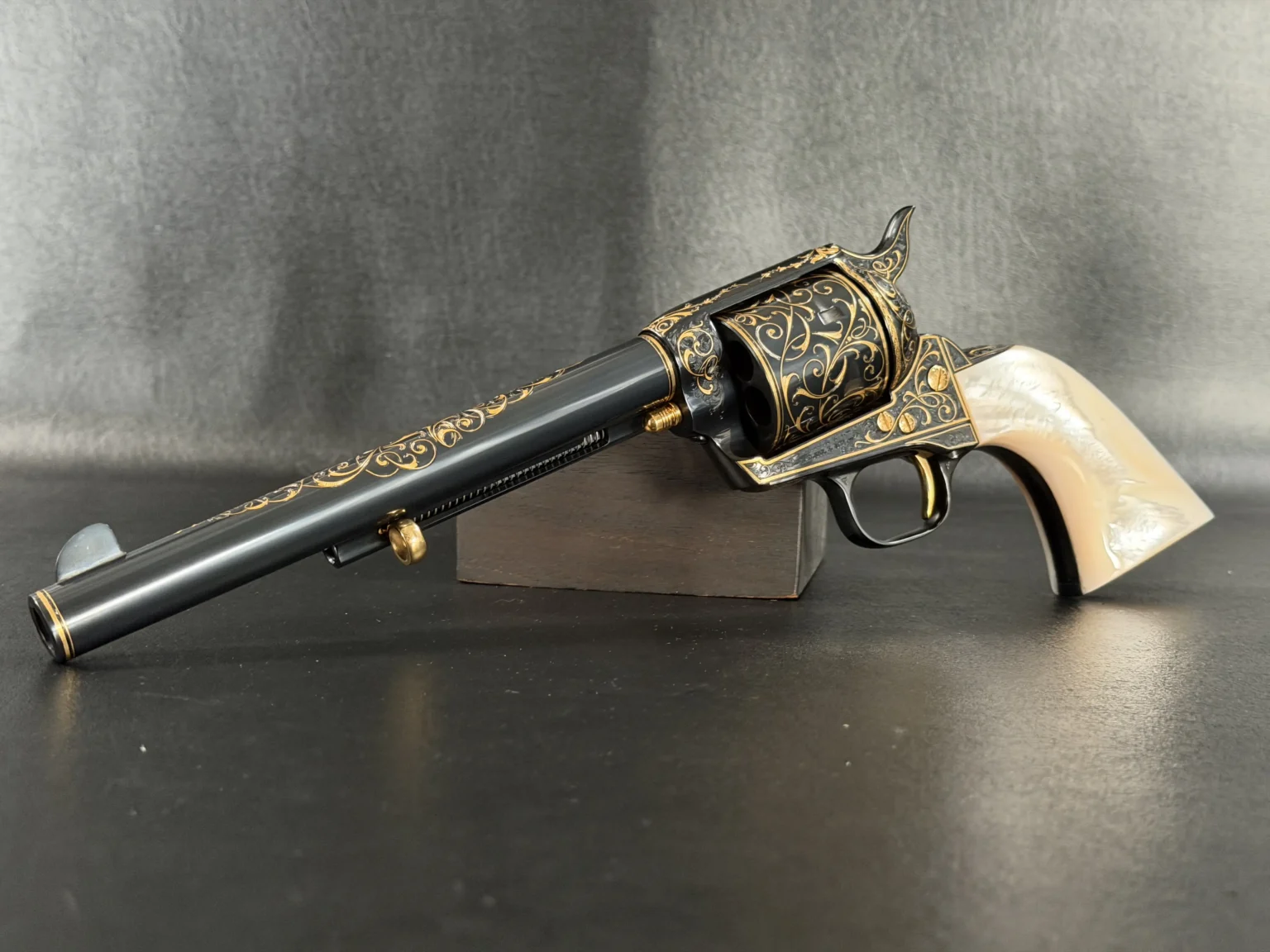
The Gun That Won the West: Colt Single Action Army (1873)
Here it is. The Peacemaker. The Equalizer. The gun that, perhaps more than any other, shaped how the world imagines the American West.
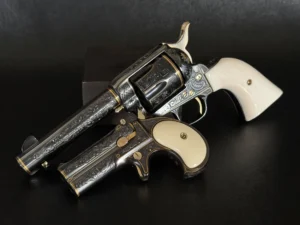
The Colt Single Action Army was adopted by the U.S. military in 1873, replacing the older percussion revolvers that had served since the Civil War. In .45 Colt caliber (though eventually chambered in dozens of others), with a 7.5-inch cavalry barrel as the standard configuration, the SAA became the sidearm of the frontier era. Shorter-barreled “Artillery” and “Civilian” (also called “Sheriff’s”) models followed, each finding its own constituencies.
The technical pedigree is worth understanding. The SAA used solid-frame construction with an ejector rod to remove spent cartridges, loaded through a gate on the right side of the frame. Single-action only means you must manually cock the hammer for each shot. By the standards of 1873, this was state-of-the-art. By modern standards, it’s a deliberate, ceremonial act of engagement with the mechanism, which is precisely why shooters still love it.
Production history matters enormously with the SAA. The “First Generation” runs from 1873 to 1941, when wartime priorities halted civilian production. “Second Generation” production resumed in 1956 and continued to 1975. “Third Generation” began in 1976 and continues today. Each generation has its own serial number range, finish characteristics, and collector following. First-generation guns, particularly those with documented law enforcement or military use, represent the pinnacle of SAA collecting.
The caliber variations alone could occupy an entire collecting career. The .44-40 Winchester chambering made the SAA compatible with the Winchester Model 1873 rifle, creating an appealing logistical convenience for frontier users and a compelling collecting pairing today. Rare chamberings like .476 Eley or .450 Boxer, chambered for the British market, command significant premiums.
And then there are the documented guns of outlaws and lawmen. Wyatt Earp, Doc Holliday, Pat Garrett, Billy the Kid, Jesse James. The SAA was the shared hardware of both sides of the law during the frontier period. When a gun with documented provenance to one of those figures surfaces, the prices are essentially whatever the market will bear.
The Lightning Strikes Twice: Colt Model 1877
Not every Colt was a single-action affair. The Model 1877, marketed in its .38 Long Colt chambering as the “Lightning” and in its .41 Long Colt version as the “Thunderer,” was Colt’s first double-action revolver. Pull the trigger, and the hammer cocks and falls in one continuous motion. Faster, more intuitive for some users, and mechanically more complex.
That mechanical complexity is part of the gun’s story. The 1877’s lockwork was famously finicky by the standards of the era. Pat Garrett reportedly called it “the worst gun I ever had.” Billy the Kid, on the other hand, reportedly favored his Thunderer. Whether that contradiction says something about the gun’s quality or simply about the preferences of individual shooters is a question collectors still debate.
For modern collectors, the 1877 occupies an interesting position. It’s historically significant, genuinely of the frontier era, chambered in obsolete cartridges that require some hunting to find, and mechanically delicate enough that many surviving examples don’t function reliably. That last point actually increases their appeal as display pieces and decreases their competition from shooters who want something they can actually take to the range.
About 166,000 Lightning and Thunderer revolvers were produced between 1877 and 1909. Condition, caliber, barrel length, and any documented provenance drive collector values considerably.
The Civilian Classic Reborn: Colt 1878 Frontier
While the 1877 Lightning was Colt’s entry into double-action territory for lighter calibers, the company needed a double-action option for the heavier .44 and .45 calibers demanded by the frontier market. The Model 1878, sometimes called the “Frontier Double Action,” answered that call.
Physically larger and heavier than the Lightning, the 1878 shared the same basic lockwork principles in a more robust package. It was chambered in .44-40, .45 Colt, and several other calibers. The U.S. Army purchased a significant number for the Alaskan market, creating a documented variant with specific inspector marks that collectors now pursue specifically.
About 51,000 were produced between 1878 and 1905, making them considerably rarer than the Lightning. The 1878 never achieved the SAA’s iconic status or the Lightning’s name recognition, which means it sometimes offers collectors a chance to acquire genuine frontier-era Colt iron at prices somewhat lower than comparable SAA examples. Relatively speaking, of course.
When Colt Met Browning: The Model 1911
Let’s jump forward to 1911, because this gun deserves its own conversation. Actually, it deserves a library, and plenty of writers have given it one. But in the context of Colt’s legacy, the Model 1911 represents something profound: the moment when Samuel Colt’s revolver-dominated company embraced the semi-automatic future, and did so with a firearm so successful that it’s still in production and still in service more than a century later.
John Moses Browning’s design, manufactured by Colt under a licensing agreement, won the U.S. military trials in 1911 after extensive competitive testing that included firing 6,000 rounds in a single session with the pistol cooled occasionally in water. The .45 ACP cartridge, which it chambers, became its own legend, inspiring decades of debate about stopping power, ballistics, and the eternal 9 mm versus.45 argument that still occupies internet forums today.
For collectors, the 1911 universe is both vast and highly organized. Military production variants from World War I, World War II, Korea, and Vietnam each have their own characteristics, inspector marks, finish variations, and documented serial number ranges. Commercial production runs parallel to military production throughout, creating additional variants. The “pre-Series 70,” “Series 70,” and “Series 80” distinctions matter to collectors and shooters alike.
Then there are the special editions, factory engravings, presentation pieces, and the cottage industry of custom 1911s that grew up around the platform. Companies like Wilson Combat, Les Baer, and Nighthawk Custom have built entire businesses on making the 1911 platform perform at levels Browning likely never imagined. The platform’s modularity, reliability, and elegantly simple single-action mechanism have made it a perpetual subject of both practical shooting and collector interest.
The Python: Colt’s Crown Jewel of Revolvers
Ask any serious revolver collector to name the finest production double-action revolver ever made, and a substantial percentage of them will say the Python without hesitation. Introduced in 1955 and produced continuously (with interruptions) to the present day, the Python represented Colt’s absolute commitment to quality in a six-shot .357 Magnum revolver.
The Python’s action was famously smooth. The barrel’s full-length underlug gave it a distinctive profile. The Royal Blue finish, when properly executed, had a depth and quality that competitors simply didn’t match. Police departments, competitive shooters, and discriminating collectors all found reasons to pursue the Python.
What happened to Colt’s revolver production in the late 1980s and 1990s is something of a cautionary tale. Economic pressures, military and law enforcement contracts drying up as semi-automatics dominated, and manufacturing changes that compromised the meticulous hand-fitting that made Pythons exceptional all contributed to a decline. Python was discontinued in 1999, which immediately transformed used examples into collectibles.
Then Colt relaunched the Python in 2020 with modern manufacturing. The new Pythons are genuinely excellent firearms, but collectors maintain clear distinctions between pre-discontinuation examples and the modern production guns. A pre-1999 Python in near-mint condition, particularly a nickel-finished example or one with original box and paperwork, commands prices that reflect its collectible status. A “Bright Stainless” Python from the mid-1980s in an original box? You’re looking at meaningful collector money.
The Detective Special and Its Siblings
While we’re talking about Colt revolvers, let’s give proper credit to the compact, snubnose segment of the lineup. The Detective Special, introduced in 1927, established the template for the modern snubnose revolver. A two-inch barrel, .38 Special chambering, six-shot cylinder, and a weight that made it genuinely pocketable for plainclothes officers.
The Cobra, introduced in 1950, was essentially an aluminum-framed Detective Special. The Agent, the Diamondback, the Viper: each of these offered variations on the compact revolver theme. For collectors who focus on the history of law enforcement equipment, the evolution of the Detective Special through its various model designations from 1927 to 1986 offers a rich field of study.
These guns also exist at a price point that allows newer collectors to acquire genuine, historically significant Colt revolvers without spending SAA or Python money. A solid Detective Special in honest used condition remains both shootable and historically meaningful.
What Makes a Colt Collection?
Here’s the honest truth about collecting Colts: there’s no single right approach. Some collectors pursue a single model across its entire production history, cataloging every variation. Others focus on a specific era, maybe pre-Civil War percussion revolvers or the immediate post-war period of the metallic-cartridge transition. Still others pursue law enforcement or military documented examples regardless of model.
What they share is a recognition that Colt made firearms that participated in history. Not just observed it, not just recorded it. Participated. The guns were there, in the hands of the people who shaped the country.
Condition grading, documented provenance, original finish percentage, mechanical function, matching components, factory options, and period accessories all affect value. The Standard Catalog of Colt Firearms, publications from the Colt Collectors Association, and resources such as John Kopec’s work on the Single Action Army provide frameworks for understanding variations and establishing values.
Perhaps most importantly, the Colt collecting community itself is a resource. The Colt Collectors Association annual show brings together people who know these guns in a way no publication can fully capture. Conversations with experienced collectors, the ability to handle documented examples, and the shared knowledge that accumulates over decades of focused attention: that’s where the real education happens.
The Legacy Continues
Colt has had its share of corporate turbulence over the decades. Bankruptcy, ownership changes, production interruptions, and quality controversies have all marked the company’s modern history. But the name persists, the craftsmanship in key products persists, and the historical legacy is immovable.
The firearms that Colt produced from 1836 through the 20th century represent a continuous thread in American industrial and cultural history. To hold a Walker, to examine the cylinder of a 1860 Army, to work the action of an original Python, is to hold something that shaped how people lived and died and how the country became what it is.
That’s not romance talking. That’s just an honest accounting of what these guns were and what they did.
And that’s why collectors keep hunting them down, one careful acquisition at a time.
Whether you’re just starting your Colt journey or you’ve been at it for thirty years, the depth of this legacy keeps revealing new layers. There’s always another variant to track down, another piece of documentation to uncover, another story to understand. That’s the thing about collecting Colts, really. You’re never quite finished.
Frequently Asked Questions
The Colt Walker takes that crown, with only 1,100 ever produced and most surviving examples already locked away in museums or major private collections. Finding one at auction is a genuine event, and the price tag reflects exactly that.
Honestly, the Detective Special or a Third Generation Single Action Army offers a far more accessible entry point than chasing Walkers or Patersons right out of the gate. Get familiar with condition grading, handle as many examples as you can, and let your focus sharpen naturally from there.
It absolutely does. First Generation guns, particularly those with documented military or law enforcement history, sit in a completely different value tier than Second or Third Generation examples.
The original Pythons were hand-fitted to a standard of precision that the manufacturing economics of the 1990s couldn’t sustain, which is part of what makes pre-discontinuation examples so desirable. The modern Python is a genuinely excellent revolver, but collectors treat the two as distinct categories.
The original Colt military production runs, particularly World War I and World War II examples with documented inspector marks, carry historical weight that no modern manufacturer can replicate. The platform’s ubiquity actually makes the authentic originals stand out more sharply, not less.