
Key Takeaways
- The U.S. Army received 1,000 DWM Model 1900 pistols at Springfield Armory late in 1901 for troop evaluation. Officers’ reports praised the eight-round capacity and accuracy but criticized the small caliber and the pistol’s complexity.
- The American eagle crest does not by itself identify a U.S. trial pistol. The trial Model 1900 has no German proofs and no “GERMANY” marking, while a documented commercial Model 1906 American Eagle carries a “GERMANY” export mark and crown/N proofs.
- Swiss trial pistol No. 19, made at DWM in late autumn 1899, was described as missing in publications from 1998 to 2016. Stiftung HAM staff identified it in the Swiss federal collection in spring 2020, with its barrel and extractor replaced at some earlier point.
A DWM Luger can be documented in three different ways. A military record shows what an army ordered, issued, and tested. A commercial catalog or advertisement shows what was offered to the public, and when. An institutional collection preserves the physical object, its later alterations, and its chain of custody. Each answers a different question. Two bounded examples show how the type of evidence changes what can be said about a pistol: the U.S. Army’s trial of the Model 1900, which began in 1901, and Swiss trial pistol No. 19 from 1899.
Example One: The U.S. Army Trial Model 1900
Late in 1901, 1,000 Model 1900 Luger pistols were delivered to Springfield Armory for evaluation by U.S. troops. The pistols, together with 200,000 rounds of 7.65x21mm ammunition, were ordered from Deutsche Waffen- und Munitionsfabriken (DWM) through Hans Tauscher, the company’s American representative. Most were issued to cavalry units, and the officers’ reports were divided. Favorable comments cited the eight-round capacity, faster reloading, accuracy, and natural pointing. Unfavorable comments cited the small caliber, the need for two hands to cock the pistol, its complexity for the average enlisted trooper, and its sensitivity to dirt and dust. On May 6, 1903, the Board of Ordnance ordered 50 more pistols in 9mm. They were fitted with the Powell indicating device, which showed how many cartridges remained in the magazine. [1]
These facts concern the Army’s decisions and the users’ judgments, and they come from the military side of the record. The pistols themselves add physical evidence. The trial Model 1900 carries the American eagle crest over the chamber and DWM’s monogram on the toggle. It has no German proof marks and no “GERMANY” marking. [1]
The eagle crest alone does not identify a trial pistol. DWM continued to apply it to later commercial pistols, including the Model 1906 in 7.65mm and 9mm. [1] One documented Model 1906 American Eagle commercial pistol, serial number 68336, shows how the commercial pattern differs. It has the eagle crest over the chamber, a “GERMANY” export mark on the front of the frame, and crown/N proofs on the barrel extension, front toggle link, and breech block. [2]
Commercial records answer a separate question: how the Luger was presented to American buyers outside the Army. The McCracken Research Library at the Buffalo Bill Center of the West holds a folder of Luger advertisements dated 1902 to 1912 in its Roy Marcot Firearms Advertisement Collection. The folder includes items from American Field (May 10, 1902), National Sportsman (1910 and 1911), Forest & Stream (January 7, 1911), and Illustrated Outdoor World and Recreation (October 1912). One 1910 item is headed “Luger Pistols Victorious in Long Fight.” [3] Advertisements of this kind establish when and how the pistol was marketed to the public. They do not show which pistols went to cavalry troops or how they performed in service. Those questions belong to the military record.
Example Two: Swiss Trial Pistol No. 19
The second example shows what an institutional collection adds that neither an order record nor a sales record can.
After earlier rounds of testing, DWM manufactured 20 pistols for a Swiss troop trial, following improved samples that Georg Luger presented in May 1899. The pistols were tested in military courses and shooting clubs during the winter of 1899 to 1900, and the Swiss Technical Department gave them final testing in spring 1900. On April 3, 1900, the rifle commission recommended the Borchardt-Luger pistol for adoption with minor changes to the trigger and grips. On May 4, 1900, the Federal Council selected it as the pistol for officers, replacing the Revolver 1882. It was declared the ordnance pistol on February 19, 1904. [4]
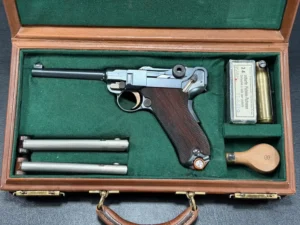
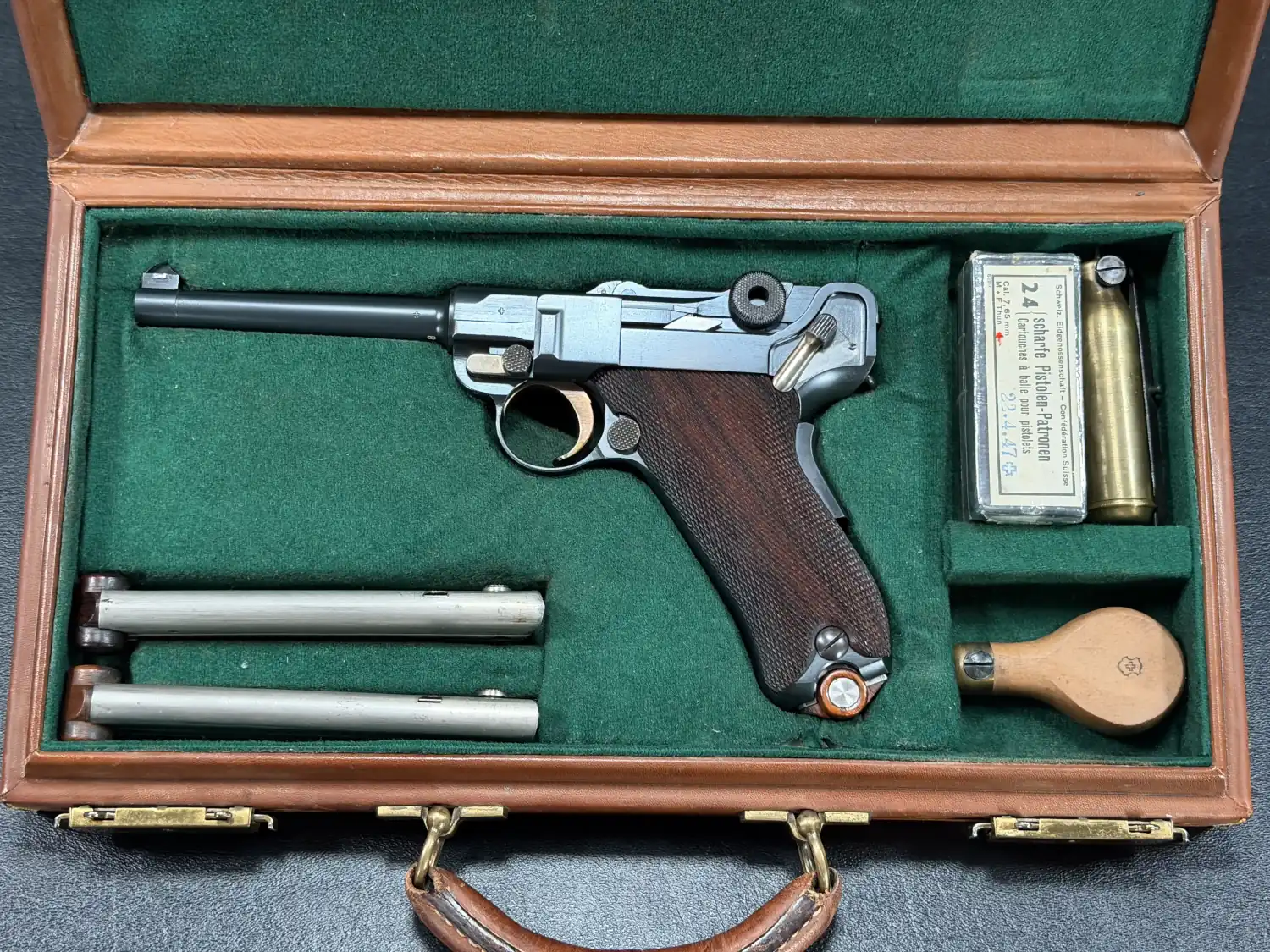
Pistol No. 19 was made at DWM in late autumn 1899 with the other trial pistols and took part in the winter trials. Its publication history traces how visible it was in the documentary record. It was first illustrated in 1974. A 1988 edition of the same work still listed the Technical Subdivision 6 at Thun as its owner. A third edition in 1998 described it as missing, and publications in 2005, 2011, and 2016 continued to describe it that way. In spring 2020, staff of the Stiftung HAM, the foundation responsible for the historic materiel of the Swiss Army, identified the pistol during the regular registration of the small-arms collection. It now carries HAM inventory number 135133. [4]
The object itself supplies evidence the literature did not. At some earlier point, No. 19’s barrel and extractor were replaced. It retains the narrow trigger typical of the 1899 trial pistols; pistols prepared for the British trials of 1900 already had an improved trigger. Only one other pistol from the 1899 trial, No. 21, is known in essentially unaltered original condition. It reappeared at a Kessler auction on August 22, 2009. [4]
A table in the foundation’s report, drawn from the work of Joachim Görtz and Geoffrey Sturgess, associates several numbers in the Swiss sequence with both the 1899 Swiss trials and the 1900 British trials. It lists Nos. 18 and 26 in the Pattern Room collection. [4] In this series, a number assigned during the Swiss trials does not by itself establish that a pistol served only in Switzerland.
What Each Record Can Establish
The two examples divide the evidence along clear lines. The U.S. Army record establishes quantity, issue, and user reports. The trial pistols’ own markings, compared with those of later commercial American Eagles, show how the two groups differ physically. Commercial advertisements establish public availability and how the pistol was marketed. An institutional collection establishes the present state of a specific object, its later modifications, and its custody. Pistol No. 19 remained in the Swiss federal collection while published references listed it as missing.
Frequently Asked Questions
Late in 1901, 1,000 Model 1900 pistols were delivered to Springfield Armory for evaluation by U.S. troops. They were ordered from DWM through its American representative, Hans Tauscher, together with 200,000 rounds of 7.65x21mm ammunition.
The trial Model 1900 carries the American eagle crest and DWM toggle monogram but has no German proof marks and no “GERMANY” marking. A documented commercial Model 1906 American Eagle, serial number 68336, has a “GERMANY” export mark on the frame and crown/N proofs on several major parts.
They show when and how the pistol was marketed to American buyers, as in the McCracken Research Library’s folder of Luger advertisements dated 1902 to 1912. They do not show which pistols went to cavalry troops or how the pistols performed in service.
On May 4, 1900, the Swiss Federal Council selected the pistol for officers, replacing the Revolver 1882. It was declared the ordnance pistol on February 19, 1904.
It is in the collection of Stiftung HAM, the foundation responsible for the historic materiel of the Swiss Army, under inventory number 135133. Staff identified it in spring 2020 during the regular registration of the small-arms collection.
Sources
[1] Thompson, Leroy. “The American Eagle Luger and Its Tests by the U.S. Army.” Firearms News, September 6, 2022.
[2] Rock Island Auction Company. “Lot 394: Scarce DWM Model 1906 ‘American Eagle’ Commercial Luger Semi-Automatic Pistol, Serial No. 68336.” Auction 4092 catalog, Book 1, p. 375, n.d. Cited for the description and markings of this lot only; no price cited.
[3] McCracken Research Library. “Luger Automatic Pistols, 1902 – 1912.” MS 111, Roy Marcot Firearms Advertisement Collection, Folder M111.118.1, McCracken Research Library, Buffalo Bill Center of the West, 1902 to 1912.
[4] Käser, Markus. “Fundobjekt in der Sammlung Stiftung HAM.” Stiftung HAM, Thun, January 2021, pp. 1 to 6.