
Key Takeaways:
- A serial number provides a starting point, but it does not establish an exact production or shipping date.
- A Colt archive letter may confirm the original configuration and shipment, but it rarely establishes later ownership.
- Condition, originality, and provenance are separate factors and should be evaluated independently before bidding.
Colt introduced the Single Action Army in 1873. The company received a U.S. government contract designating the revolver as the standard military sidearm and delivered more than 30,000 examples between 1873 and 1891. The names “Peacemaker,” “Colt .45,” and “Model P” subsequently became associated with the design.[1]
Design and Historical Context
The Single Action Army emerged from Colt’s transition from percussion revolvers to firearms using self-contained metallic cartridges. Charles B. Richards patented a system in 1871 that adapted Colt-pattern revolvers for rear-loaded cartridges and incorporated a loading gate and ejector.[2] William Mason’s 1872 patent described further improvements to cylinder rotation and the barrel-mounted ejector assembly.[3]
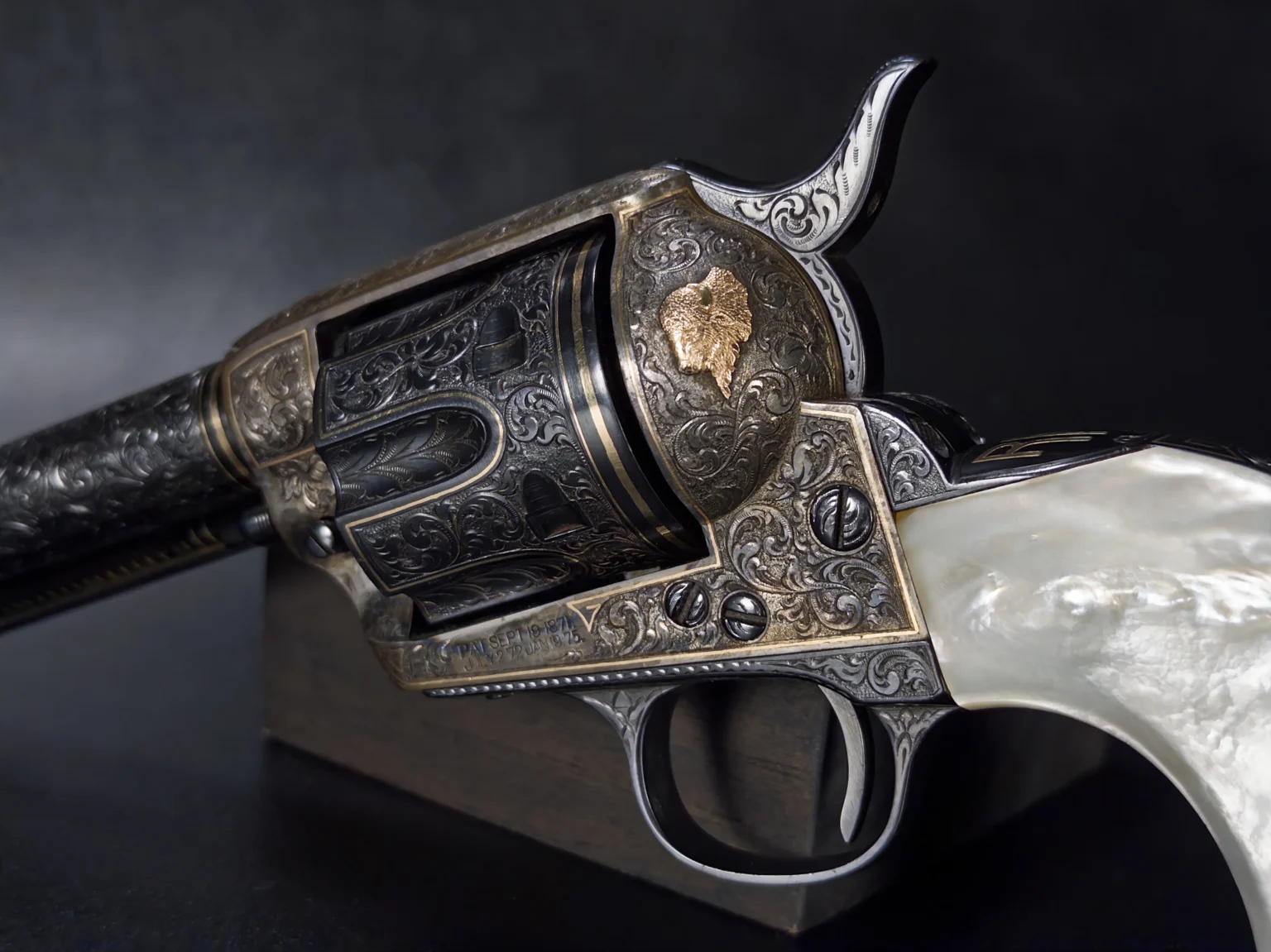
The resulting Single Action Army used a solid frame, a six-chambered cylinder, and a single-action lock. The hammer must be cocked before each shot. Cartridges are inserted individually through a loading gate, and fired cases are removed one at a time with the ejector rod.[4]
The revolver was initially associated with the .45 Colt cartridge, but Colt produced it in numerous chamberings. The .44-40 Winchester version appeared in 1878 and allowed owners of compatible Winchester rifles and Colt revolvers to use the same cartridge. Colt added .38-40 and .32-20 chamberings in 1884. The principal standard barrel lengths became 7½, 5½, and 4¾ inches, although factory special orders and later variations produced other configurations.[5]
These distinctions matter at auction. Two superficially similar revolvers can differ substantially in production period, chambering, finish, barrel length, military markings, engraving, and later alteration.
Generations and Variants
Collectors generally divide Single Action Army production into three generations. First Generation revolvers were manufactured from 1873 until production stopped in 1941. Colt revived the model in 1955, beginning the Second Generation, which continued through 1975. Production resumed after retooling in 1976, establishing the Third Generation.[5]
Generation cannot always be determined reliably from one feature. Some early Second Generation revolvers incorporated leftover prewar parts, while a limited number of early Third Generation guns were assembled on remaining Second Generation frames. Serial-number style, component markings, construction details, and factory documentation should therefore be considered together.[5]
First Generation examples include standard military and commercial revolvers, factory-engraved guns, target models, Bisley variants, and revolvers produced in numerous finishes and chamberings. The terms “Cavalry Model,” “Artillery Model,” and “Civilian Model” are collector classifications associated respectively with 7½, 5½, and 4¾-inch barrels. They should not, by themselves, be treated as proof of military issue or a particular service history.[5]
Reading an Auction Description
A useful catalog entry should identify the serial number, chambering, barrel length, finish, grips, visible markings, mechanical condition, and any included documentation. It should also state whether the auction house has examined the revolver in person and whether statements about originality or provenance are qualified.
Photographs should show both sides of the firearm, the serial-number locations, barrel address, caliber marking, patent markings, grip surfaces, cylinder, loading gate, ejector assembly, muzzle, and areas of finish loss or corrosion. Claims involving engraving, military inspection, special-order features, or ownership by a named person require closer documentation than an ordinary model identification.
The catalog’s condition report and the terms of sale must be read together. Buyer’s premiums, taxes, shipping charges, payment fees, and transfer expenses can materially increase the amount due. A maximum bid should be calculated from the total cost, not merely the hammer price.
Serial Numbers and Factory Records
A serial number is a starting point, not complete authentication. Colt states that online serial-number lookups provide approximate dates because firearms were not necessarily assembled or shipped in consecutive serial order. The patent dates stamped on a revolver refer to protected design features and do not establish when that particular firearm was manufactured.[6]
A Colt archive letter can provide the original shipping date and destination and may record the revolver’s caliber, barrel length, finish, stocks, engraving, and other special features. Comparing that information with the firearm’s present configuration can disclose a changed barrel, altered caliber, refinishing, replacement grips, or later engraving.[6]
An archive letter does not establish a complete chain of ownership. Colt’s records generally concern original configuration and shipment, and individual owners were only rarely identified in the shipping ledgers.[6] A letter showing shipment to a distributor or retailer therefore does not prove that a named historical figure subsequently purchased or carried the revolver.
Evaluating Originality
Originality must be assessed component by component. The frame, trigger guard, backstrap, barrel, cylinder, grips, ejector assembly, screws, and internal parts may not all date from the same period. Serial or assembly numbers should be checked wherever they are expected for the model and production range.
Finish requires similar care. Honest wear, corrosion, polishing, refinishing, and artificial aging can produce very different surfaces. Rounded markings, softened edges, dished screw holes, and an unusually uniform finish may indicate polishing or restoration. Conversely, finish loss alone does not prove extensive use or establish a historical association.
Replacement parts and restoration do not make a revolver inauthentic, but they must be described accurately. A genuine Colt frame fitted with a later barrel, cylinder, grips, or engraving is not equivalent to a firearm retaining its documented factory configuration. Mechanical condition is a separate question from historical originality and should be evaluated by a qualified specialist.
Provenance and Documentation
Provenance is a documented chain connecting a firearm to previous owners or events. Strong provenance may include dated correspondence, estate inventories, period photographs, military or institutional records, invoices, prior auction records, and signed transfer documents. The serial number or a sufficiently specific description must connect the documents to the firearm.
A family account without supporting records is not established provenance. Nor does an engraved name prove that the named person owned the revolver. Each link in the ownership chain should be examined for date, authorship, internal consistency, and an identifiable connection to the firearm.
Original documents should be inspected when possible. Photocopies and digital scans can be useful, but the location and ownership of the originals should be established. A bidder should also determine whether the documentation accompanies the revolver and whether the auction house will identify it in the invoice or bill of sale.
Inspection Before Bidding
An in-person preview is preferable for a significant purchase. Inspection should confirm that the firearm is unloaded before any further examination. Handling, cocking, disassembly, or removal of grips should occur only with the auction house’s permission.
The inspection should address bore condition, cylinder chambers, timing, lockup, endshake, hammer and trigger operation, loading-gate fit, ejector function, screw condition, and evidence of repair or welding. Findings should be compared with the catalog description and factory documentation. Any unresolved question involving originality, engraving, military markings, or named provenance warrants examination by a specialist familiar with the relevant production period.
A disciplined auction decision rests on three separate findings: what the firearm is, how much of its original configuration remains, and what its documentation actually proves. Treating those questions separately is the most reliable way to assess a Colt Single Action Army offered at auction.
Frequently Asked Questions
The Colt Single Action Army is a six-chambered, single-action revolver introduced in 1873. Cartridges are loaded individually through a loading gate.
First Generation production ran from 1873 to 1941, and Second Generation production ran from 1955 to 1975. Third Generation production began in 1976.
No. Serial-number databases provide approximate dates and should be considered alongside physical features and factory documentation.
An archive letter may record the original shipping date, destination, caliber, barrel length, finish, stocks, and special features. It generally does not document the firearm’s complete ownership history.
Buyers should examine the revolver’s markings, components, finish, mechanical condition, and supporting documents. They should also account for the buyer’s premium, taxes, shipping, transfer expenses, and other applicable charges.
Sources
[1] Colt’s Manufacturing Company LLC. “Timeline.” Colt’s Manufacturing Company LLC, n.d.
[2] Richards, Charles B. “Improvement in Revolving Fire-Arms.” U.S. Patent No. 117,461, issued July 25, 1871.
[3] Mason, William. “Improvement in Revolving Fire-Arms.” U.S. Patent No. 128,644, issued July 2, 1872.
[4] National Park Service. “1873 Colt Revolver.” Fort Smith National Historic Site, April 10, 2015.
[5] Hacker, Rick. “150 Years of the Colt Single Action Army.” American Rifleman, January 3, 2023.
[6] Colt Archive Properties, LLC. “About the Archive Letter.” Colt Archive Properties, LLC, 2023.