
Key Takeaways:
- Harris learned hand engraving from Weldon Bledsoe and has worked as a full-time engraver since 1985.
- His cattle-brand designs are cut by hand with a hammer and chisels rather than powered cutting equipment.
- Harris is a documented representative of the Agee-Bledsoe tradition, but available evidence does not establish him as its only or final practitioner.
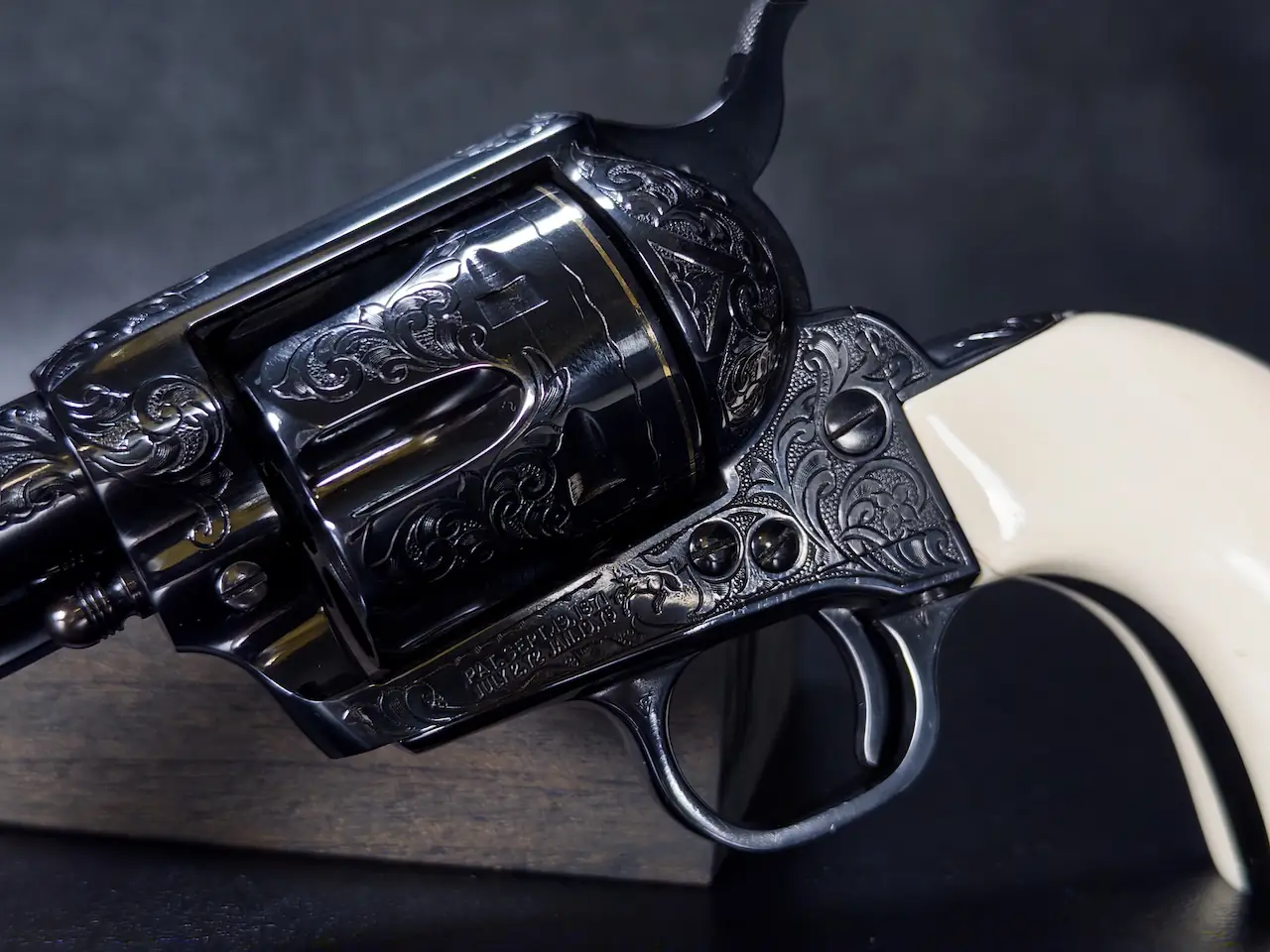
Cattle-brand engraving is a distinctive American style most closely associated with Colt Single Action Army revolvers. The typical composition covers much of the firearm with cattle-brand symbols set against a punch-dot background. The style has also appeared on rifles, shotguns, double-action revolvers, and semi-automatic pistols.[1]
David Wade Harris practices this tradition in Jacksonville, Texas. According to his professional biography, Harris has worked full time as an engraver since 1985 and learned hand engraving from Fort Worth engraver Weldon Bledsoe. Bledsoe, in turn, acquired techniques and toolmaking knowledge from Cole Agee, the Texas craftsman credited with establishing or popularizing the cattle-brand style.[1][2]
Cole Agee and Weldon Bledsoe
Cecil Coe “Cole” Agee lived from 1901 to 1955. Although he also produced conventional scroll engraving, his reputation rests largely on firearms covered with West Texas cattle brands. The number he completed remains uncertain because he rarely signed his work. Published estimates range from approximately 15 to 50 cattle-brand Colts.[1]
The designs have been associated with A Century of Texas Cattle Brands, a collection published by the Fair Publishing Company in 1936. The book compiled representative brands, drawing much of its material from information supplied by Texas county clerks. The Texas State Library and Archives Commission holds a copy in its collection.[3]
Around 1950, Bledsoe began learning from Agee. The Texas Ranger Hall of Fame and Museum reports that Agee showed him engraving techniques and the use of handcrafted tools. Bledsoe continued producing cattle-brand firearms after Agee’s death.[4]
Estimates attribute approximately 300 to 400 Colt single-actions to Bledsoe, although no comprehensive production register has been identified.[1] His work is particularly associated with the “2 Lazy 2 P” brand and a monogram combining his initials. A Bledsoe-engraved Colt Buntline in the Texas Ranger Hall of Fame and Museum bears both identifying devices.[4]
Bledsoe subsequently taught Harris, creating a documented connection between three generations of Texas engravers. This lineage is significant, but it does not make Harris the only contemporary practitioner of cattle-brand engraving. Other engravers have produced work in the style Agee made famous.[1]
Harris’s Method
Harris continues to engrave with a hammer and chisel rather than powered cutting equipment. His published account describes a four-stage preparation process. He first applies beeswax to the metal and then dusts it with talc or baby powder, creating a light-colored surface on which to draw. After laying out the design, he cuts it into the metal by hand.[5]
The composition is developed for the individual object. Harris describes studying the available area until he can visualize a suitable pattern, which he then follows while cutting. Although he uses chisels of different shapes and sizes, he states that most of his engraving is performed with a chisel he learned to make from Bledsoe. Harris identifies that tool as a continuation of the design Bledsoe learned through Agee.[5]
Harris’s work is not confined to cattle brands. His portfolio includes traditional scroll engraving and decoration applied to revolvers, pistols, rifles, shotguns, knives, and watches.[2] Nevertheless, cattle-brand firearms provide his clearest connection to the Agee-Bledsoe tradition.
Harris identifies his daughter, Tiffany Harris, as his apprentice.[5] Her training means the tradition may continue into another generation. Claims that Harris is definitively the last practitioner, however, are not supported by the available evidence.
For collectors, attribution requires more than recognizing a cattle-brand pattern. Signatures, monograms, documented provenance, and comparison with institutionally recorded examples are more persuasive than style alone. Bledsoe’s “2 Lazy 2 P” device and combined monogram are useful reference points, but even characteristic features should be considered alongside the firearm’s complete documentary history.[4]
Harris’s importance rests on verifiable elements: his training under Bledsoe, his continued use of handmade tools and traditional cutting methods, and his body of signed work. Those facts establish him as a notable living representative of a regional Texas engraving tradition without relying on unsupported claims of exclusivity, rarity, or future financial appreciation.
Frequently Asked Questions
Cattle-brand engraving decorates firearms with arrangements of ranch-brand symbols, frequently placed over a punch-dot background. It is most closely associated with single-action revolvers but also appears on other firearms.
Harris learned hand engraving from Fort Worth engraver Weldon Bledsoe. Bledsoe had acquired techniques and toolmaking knowledge from Cole Agee.
Harris cuts his designs by hand using a hammer and chisels. He prepares the metal with beeswax and powder to create a surface on which he can draw the design before cutting.
Agee is generally credited with establishing or popularizing the full-coverage Texas cattle-brand style. The surviving documentation does not conclusively establish every detail of its origin.
No reliable evidence establishes Harris as the last or only practitioner. His documented importance comes from his training under Bledsoe and his continued use of traditional hand-engraving methods.
Sources
- Rick Hacker, “Rifleman Q&A: Cattle Brand Colts,” American Rifleman, December 4, 2018.
- David Wade Harris, “Texas Engraver David Wade Harris,” professional website, accessed August 4, 2026.
- Texas State Library and Archives Commission, “Texas America250 Exhibit: Cattle Ranching and Rodeo,” accessed August 4, 2026.
- Texas Ranger Hall of Fame and Museum, “Colt Buntline Engraved by Weldon Bledsoe,” Firearms Collections, object no. 2004.038.001.
- David Wade Harris, “David Harris,” professional biography and description of engraving technique, accessed August 4, 2026.