
Key Takeaways:
- The Walther P5 uses a falling locking block, not a rotating barrel, and is distinguished by its left-side ejection.
- The HK P7 combines gas-delayed blowback operation with a frontstrap cocking lever that also serves several control functions.
- Original configuration, condition, factory documentation, and provenance are more meaningful than unsupported rarity or investment claims.
Age alone does not make a firearm collectible. The strongest modern candidates combine distinctive engineering, a clearly documented place in firearms development, recognizable factory variations, and enough surviving records to distinguish original examples from altered ones.
The Walther P5, Heckler & Koch P7, Walther P99, and German-made SIG Sauer P226 X-Five illustrate four different paths to modern-classic status. None should be treated as a guaranteed investment. Their significance rests on documented design and manufacturing history, not predictions about future prices.
Walther P5: A Refined Locking-Block Design
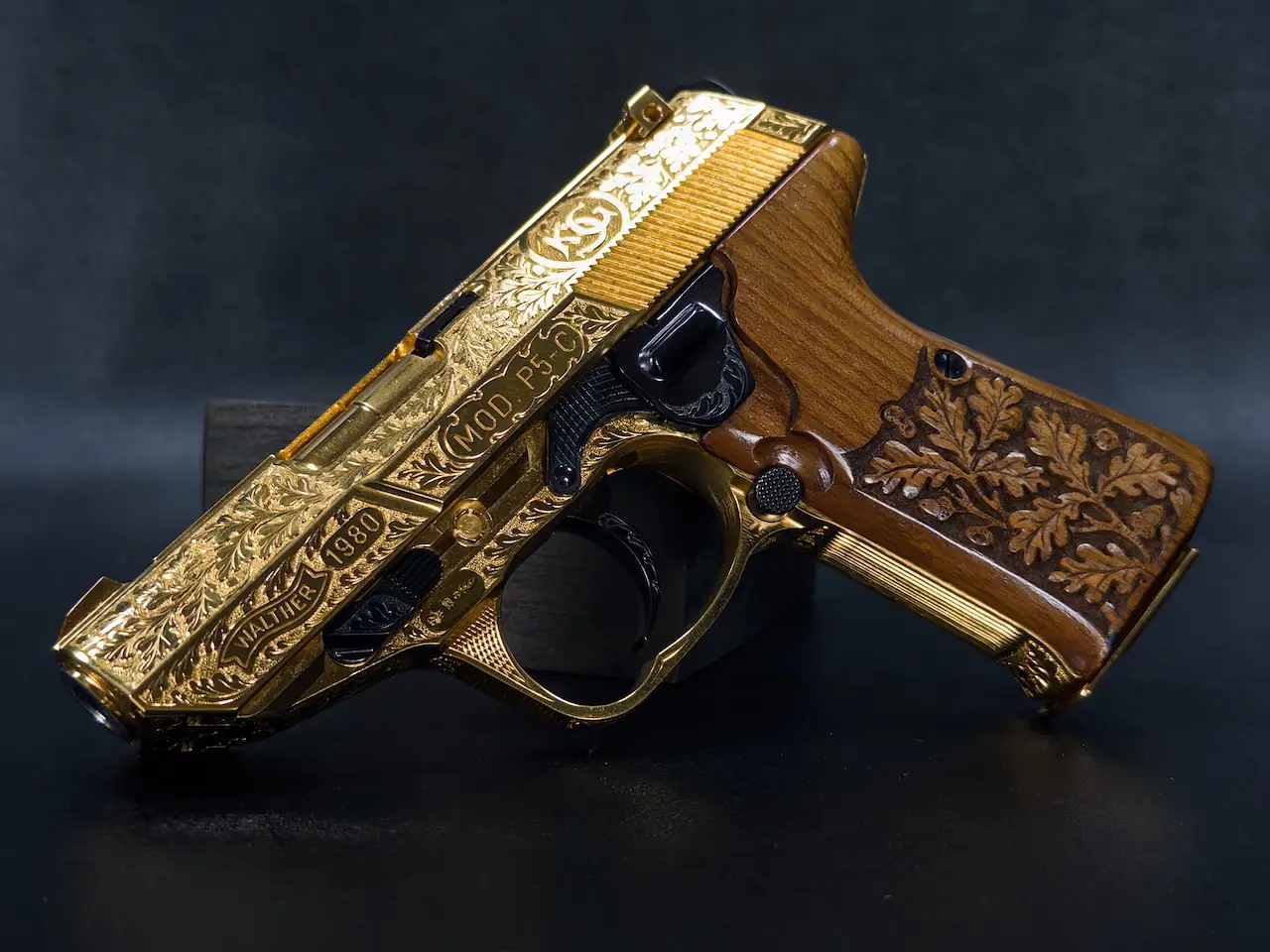
Developed for the West German police market during the 1970s, the Walther P5 was an extensive modernization of the P.38 concept. It retained the older pistol’s double-action/single-action trigger and falling locking-block system, but enclosed the barrel within a conventional slide and incorporated revised safety features. During cycling, the barrel moves almost directly rearward before the locking block drops and releases the slide.[1]
That mechanism is important because it corrects one of the most conspicuous errors commonly repeated about the P5: it does not use a rotating barrel. Its operation belongs to the same broad mechanical lineage as the Walther P.38 and later locking-block pistols such as the Beretta 92.
The P5 also ejects fired cases to the left. Its frame-mounted control lever performs two functions, releasing the slide when it is locked open and safely lowering the hammer when the slide is forward. The lever is mounted on the left side of the frame; describing it as fully ambidextrous would therefore be inaccurate.[1]
For collectors, the P5’s appeal lies in its identifiable Cold War police history, unusual left-side ejection, and recognizable relationship to the P.38. Standard pistols, P5 Compacts, and scarcer configurations should be evaluated separately. Police markings, import marks, proof marks, matching serial-numbered components, and the originality of magazines and grips can materially affect how an example should be classified.
Heckler & Koch P7: Engineering Outside the Mainstream
Heckler & Koch developed the pistol initially known as the PSP in response to West German police requirements for a compact 9×19 mm service arm. It was adopted under the P7 designation in 1978.[2]
The P7 does not use the locked-breech, short-recoil system found in most modern service pistols. Instead, it employs gas-delayed blowback. A port in the barrel directs propellant gas into a cylinder beneath the barrel, where pressure acts against a piston attached to the slide. This resistance delays the slide’s rearward movement until chamber pressure has fallen.[2]
Its other defining feature is the frontstrap cocking lever. Squeezing the lever cocks the firing mechanism and readies the pistol; releasing it decocks the pistol. The lever also functions as a grip safety and can release the slide under the prescribed conditions.[2] These features give the P7 a mechanical identity that is difficult to confuse with any conventional service pistol.
The family eventually included the original P7, the American-market P7M8, the higher-capacity P7M13, the .40 S&W P7M10, and the caliber-convertible P7K3.[2] Those names are not interchangeable. Magazine capacity, caliber, magazine-release location, heat shield, slide profile, and factory markings must match the correct variant.
The P7’s importance is not that its operating system proved universally superior. Gas-delayed operation brings its own maintenance and heat-management considerations. Its significance comes from the unusual, production-proven solution that Heckler & Koch applied to the compact service-pistol problem.
Walther P99: A Bridge to the Contemporary Service Pistol
Walther presented the P99 at the 1996 IWA trade fair. Developed by Horst Wesp and his team, it was Walther’s first polymer-frame pistol and used a striker-fired mechanism, interchangeable backstraps, and a bilateral paddle-style magazine release incorporated into the trigger guard.[3]
The P99 is especially notable for combining polymer-frame construction with trigger systems that preserved elements of traditional service-pistol handling. Walther offered double-action/single-action, partly pre-cocked, and double-action-only configurations.[3] Factory manuals identify the principal trigger designations as AS, QA, and DAO; they also document full-size and compact versions in multiple calibers.[4]
The AS, or Anti-Stress, model uses a slide-mounted decocking button and can provide a long double-action first pull followed by shorter single-action operation. The QA, or Quick Action, version uses a partly pre-cocked striker and a consistent trigger system. DAO denotes the double-action-only configuration.[4] “RAD,” sometimes listed as a P99 variant online, is not among the factory model designations documented in Walther’s manual and should not be presented as an established production variant.
Walther announced the P99 AS Final Edition for 2023, closing a production history that began in the 1990s. The Final Edition retained the locked-breech, short-recoil action, 4-inch barrel, 15-round 9 mm magazine, decocker, and interchangeable backstraps associated with the P99 AS.[5]
Early Interarms-marked pistols, later Walther imports, compact models, different trigger systems, and the Final Edition represent distinct collecting categories. Buyers should verify the trigger configuration mechanically and against the model markings rather than relying on a seller’s description.
SIG Sauer P226 X-Five: Factory Competition Development
The German P226 X-Five was not simply a decorative P226. SIG Sauer’s 2009 sports catalog presented it as a competition-oriented model with a 127 mm, or 5-inch, barrel, extended frame and slide, adjustable trigger, bilateral manual safety, adjustable target sights, flared magazine well, and specialized grips. The catalog listed both steel- and aluminum-frame versions.[6]
SIG Sauer also placed a separate group of elaborately configured P226 pistols under its “No Limits (Mastershop)” heading. Documented offerings included the X-Five Open, X-Five Golden Dragon, X-Five Blue Pearl, and X-Five Short, alongside several X-Six and decorated P226 variants.[6] The catalog demonstrates that “X-Five” described a broader model family, while “Mastershop” encompassed particular premium, competition, and decorative configurations.
That distinction matters. Not every German X-Five should automatically be described as a limited-production Mastershop pistol, and the existence of an ornate finish does not establish rarity. A defensible identification requires the exact model designation, proof date, frame material, trigger system, barrel length, cataloged finish, grips, sights, and accompanying factory documentation.
Original cases, test targets, manuals, tools, spare magazines, and order records are particularly valuable with highly optioned SIG Sauer pistols. They can establish how a specific example left the factory when visual features alone cannot.
Collecting the Evidence, Not the Story
Modern firearms demand the same documentary discipline as older collectibles. Before assigning significance to an example, establish exactly what it is. Record the serial number, proof and inspection marks, importer, model designation, caliber, mechanical configuration, finish, and accessories. Compare those details with contemporary manuals and catalogs.
Condition must also be described precisely. Mechanical wear, refinishing, replacement sights, altered triggers, aftermarket grips, and mismatched magazines should not be hidden behind broad terms such as “excellent” or “original.” Police service marks may strengthen an example’s historical identity, but they do not by themselves prove the firearm’s use by a particular officer or unit.
The P5, P7, P99, and German P226 X-Five deserve attention because each represents a documented design or manufacturing direction: the refinement of a locking-block service pistol, an unconventional gas-delayed police arm, an early adaptable polymer-frame Walther, and a factory-developed competition family. Their long-term collector standing will depend less on hype than on originality, condition, provenance, and the quality of the surviving record.
Frequently Asked Questions
Distinctive engineering, historical context, documented factory variations, originality, and provenance can all contribute to collector interest.
No. It uses a falling locking-block system in which the barrel moves almost directly rearward before unlocking.
The P7 uses gas-delayed blowback to resist the slide’s initial rearward movement. Its frontstrap lever cocks and decocks the firing mechanism.
Walther documented the principal configurations as AS, QA, and DAO. “RAD” is not identified as a factory P99 variant in Walther’s manual.
No. X-Five identifies a broader model family, while Mastershop covered particular premium, competition, and decorative configurations.
Sources
- Tim Harmsen, “The Walther P5 Cold War Warrior: A Great Collectible,” Firearms News, May 28, 2020.
- NRA Staff, “Heckler & Koch P7 Pistol,” American Rifleman, May 19, 2009.
- Carl Walther GmbH, “The Second Century,” company history.
- Carl Walther GmbH, “P99 AS, P99 QA and P99 DAO Operating Manual,” factory instruction manual.
- Mark A. Keefe IV, “Walther’s P99 AS Final Edition: The Last of the First,” American Rifleman, December 12, 2023.
- SIG Sauer, “Sports Catalog,” 2009 factory catalog.