
Key Takeaways
- The VP70, P7, MP5, G11, and Mark 23 demonstrate five different areas of Heckler & Koch firearms development.
- Exact configuration, original condition, correct markings, and traceable provenance are central to evaluating a collectible firearm.
- Commercial firearms, military variants, prototypes, and later accessories should not be treated as equivalent without supporting documentation.
Heckler & Koch was established in 1949 in Oberndorf am Neckar, Germany. The company initially produced precision components before entering the firearms industry. Its early success with the G3 rifle established the roller-delayed operating system that would characterize several of its most recognizable designs.[1]
For collectors, however, the manufacturer’s name is only a starting point. Historical importance, configuration, originality, condition, and documented provenance determine the significance of an individual firearm. The VP70, P7, MP5, G11, and Mark 23 illustrate five distinct chapters in Heckler & Koch’s development.
VP70: An Early Structural-Polymer Handgun
The VP70 was an unusually forward-looking handgun for its period. A patent application filed in 1969 by Alex Seidel, Tilo Möller, and Helmut Weldle describes a self-loading pistol with a grip member made entirely from synthetic resin. Metal components embedded in the grip supported and guided the moving breech assembly. The patent was assigned to Heckler & Koch.[2]
This construction distinguished the VP70 from conventional service pistols built around steel or aluminum frames. It also demonstrates that Heckler & Koch was working with structural polymers well before polymer-framed handguns became commonplace.
Collectors must distinguish between the semiautomatic commercial pistol and the select-fire configuration designed to work with a detachable shoulder stock containing the burst mechanism. A pistol, stock, magazine, or other accessory should be authenticated separately. Their presence in one package does not establish that they were originally sold together.
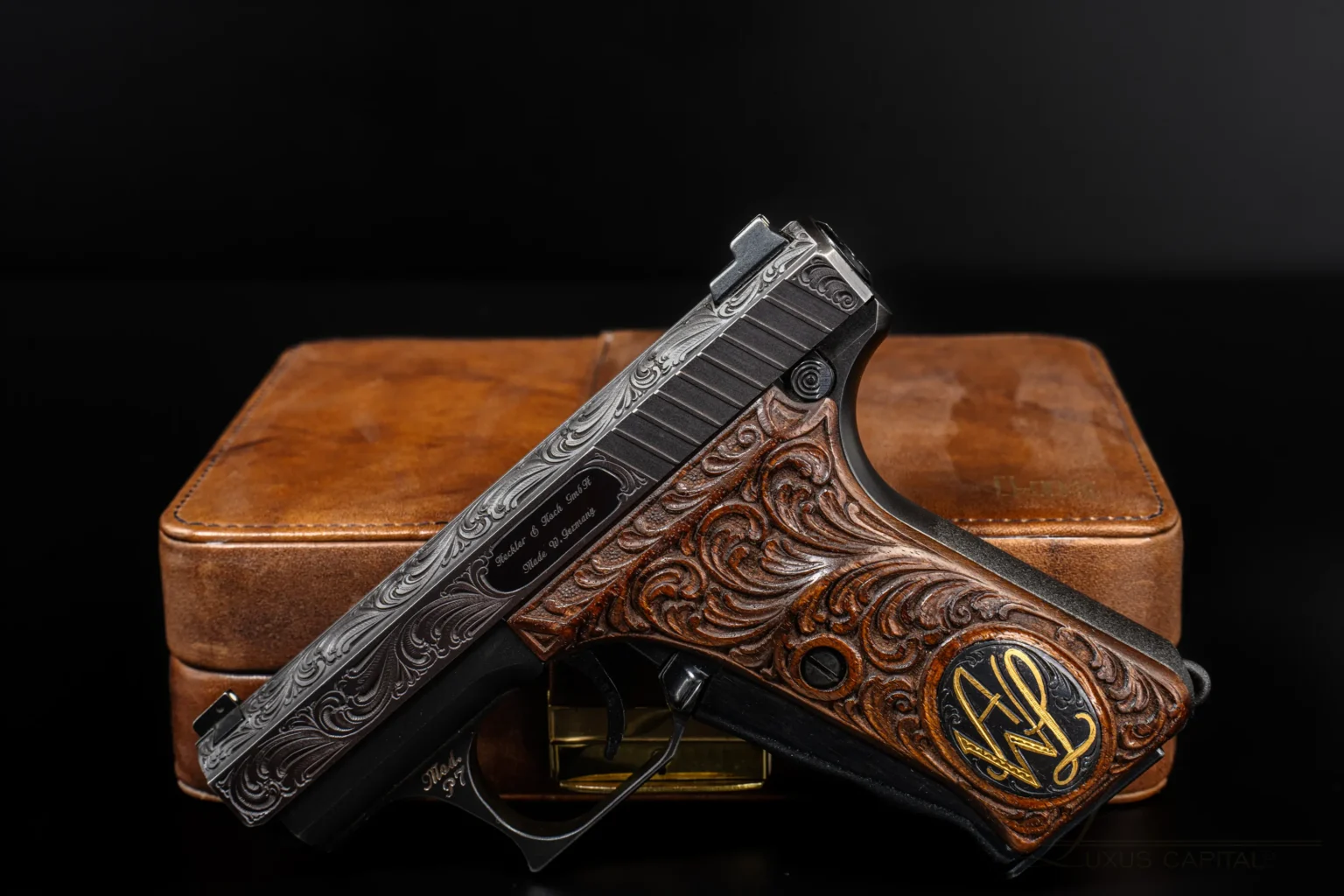
P7: Gas-Delayed Operation and Squeeze Cocking
The P7 originated in response to a West German requirement for a compact 9×19 mm police pistol. Initially known as the PSP, it used a gas-retarded blowback action. Gas diverted through a port near the chamber acted against a piston attached to the slide, delaying rearward movement until chamber pressure had fallen.[3]
The P7’s other defining feature was its frontstrap cocking lever. Squeezing the lever cocked the firing mechanism, while releasing it decocked the pistol. The PSP was adopted for German federal police service in 1978 and redesignated the P7.[3]
The family eventually included several mechanically and dimensionally distinct versions. These included the original eight-round pistol, the wider P7M13, the .40 S&W P7M10, and the P7K3, which was offered in multiple calibers using a different operating arrangement.[3]
Those distinctions matter. Model markings, caliber, magazine type, proof marks, import marks, finish, and small components should agree with the claimed variant. Refinishing or assembling a pistol from parts belonging to different versions may reduce its historical integrity even when the resulting firearm remains functional.
MP5: The Roller-Delayed System in 9×19 mm
Development of the MP5 began in 1964. The design adapted Heckler & Koch’s roller-delayed operating system to a 9×19 mm submachine gun, and West German authorities adopted it in 1966.[4]
Unlike many contemporary submachine guns that fired from an open bolt, the MP5 fired from a closed bolt. Heckler & Koch’s current specifications describe it as recoil-operated with a roller-delayed blowback bolt system. The principal family includes the standard MP5, the integrally suppressed MP5SD, and the shortened MP5K.[4][5]
The MP5 name encompasses numerous military, police, export, licensed-production, and commercial configurations. A credible collector description should therefore identify the exact manufacturer, receiver, model, trigger housing, stock, barrel arrangement, proof or date markings, and applicable import history.
Semiautomatic commercial firearms derived from the MP5 should not be represented as original select-fire service weapons. Mechanical resemblance does not establish common production history, government use, or provenance.
G11: The Caseless-Ammunition Program
In the mid-1970s, the West German Ministry of Defense commissioned Heckler & Koch to develop a weapon system using caseless ammunition. Heckler & Koch developed the firearm while Dynamit Nobel worked on the ammunition.[1]
The G11 program continued through extensive development and testing during the 1980s and early 1990s. It was not adopted, with Heckler & Koch attributing that outcome to the changed political and military circumstances at the end of the Cold War.[1]
The G11 never became a conventional production firearm. Surviving examples are developmental artifacts, and individual prototypes may reflect different stages of the program. Identification requires more than recognizing the familiar external shape. Configuration, internal mechanism, markings, associated ammunition, documentation, and traceable institutional history are essential to determining what a particular example represents.
Unsupported production totals or claims about a prototype’s place in the development sequence should not be repeated without factory or government documentation.
Mark 23: A Commercial Pistol with Military Lineage
The Mark 23 originated in the U.S. Special Operations Forces Offensive Handgun Weapon System program. Heckler & Koch received a development contract in 1991 for a system comprising a .45 ACP pistol, detachable sound-and-flash suppressor, and laser aiming module. The first military MK 23 pistols were delivered to U.S. Special Operations Command on May 1, 1996.[6]
The commercial Mark 23 is closely related to the government-issue MK 23 Mod 0, but the two are not identical. Heckler & Koch identifies differences in their slide markings and barrel headspace specifications.[6]
The Mark 23 uses a modified, linkless Browning short-recoil action. Factory specifications list a 5.87-inch barrel, an overall length of 9.65 inches, an unloaded weight of 2.66 pounds with an empty 12-round magazine, and a capacity of either 10 or 12 cartridges, depending on the magazine.[6]
A commercial Mark 23 should not be described as an issued MK 23 merely because it has a threaded barrel, suppressor, or aiming module. A claim of military issue requires correct government markings and documented provenance tied to the specific pistol.
Evaluating an HK Collectible
The historical importance of a model does not automatically establish the value or authenticity of an individual example. A sound examination should consider:
- Exact model and variant markings
- Serial number, proof marks, date codes, and import marks
- Correct major components and period-appropriate accessories
- Original finish and evidence of refinishing or alteration
- Mechanical condition and documented repairs
- Factory packaging, manuals, test targets, and sales records
- Provenance supported by original, traceable documentation
Factory literature can establish how a firearm was designed, specified, or marketed. It cannot prove that every surviving example remains in factory-original condition. Likewise, an accessory placed beside a firearm does not establish that the two were originally issued or sold together.
The most significant Heckler & Koch collections are built around verifiable examples rather than broad claims. The VP70’s polymer construction, the P7’s gas-delayed action, the MP5’s roller-delayed mechanism, the G11’s caseless-ammunition program, and the Mark 23’s special-operations development each document a different aspect of the company’s engineering history.
Frequently Asked Questions
The article covers the VP70, P7, MP5, G11, and Mark 23. Each represents a distinct engineering or historical development.
Collectibility depends on factors such as historical significance, originality, condition, configuration, and documented provenance. A desirable model name alone does not establish authenticity or value.
A patent application filed in 1969 documents its structural synthetic-resin grip with embedded metal components. This places the VP70 among the important early polymer-framed handgun designs.
The P7 uses gas pressure acting against a piston to delay the slide’s rearward movement. Its frontstrap lever cocks and decocks the firing mechanism.
No. Heckler & Koch identifies differences in slide markings and barrel headspace specifications, and military-issue status requires firearm-specific documentation.
Sources
- Heckler & Koch Defense, Corporate History.
- U.S. Patent No. 3,696,706, Alex Seidel, Tilo Möller, and Helmut Weldle, “Self-Loading Pistol Having Forwardly Extending Breech Slide”, filed September 17, 1969.
- American Rifleman, “Heckler & Koch P7 Pistol”, May 19, 2009.
- Dave Campbell, American Rifleman, “A Look Back at the Heckler & Koch MP5”, August 12, 2019.
- Heckler & Koch, MP5 Technical Description and Specifications.
- Heckler & Koch USA, Mark 23 Operator’s Manual, May 2026.