
Key Takeaways
- A well-known model name does not establish value; authenticity, rarity, condition, and demand must be evaluated for each firearm.
- Production periods, configurations, markings, and available serial-number records are essential to accurate identification.
- Military history, frontier associations, and film appearances can create collector interest, but they do not prove that a particular firearm is rare or valuable.
No firearm model is inherently “the most valuable.” The National Park Service identifies authenticity, rarity, condition, and market demand as important determinants of collector value.[1] This guide therefore focuses on seven firearms with well-documented historical, mechanical, or cultural significance rather than presenting an unsupported price ranking.
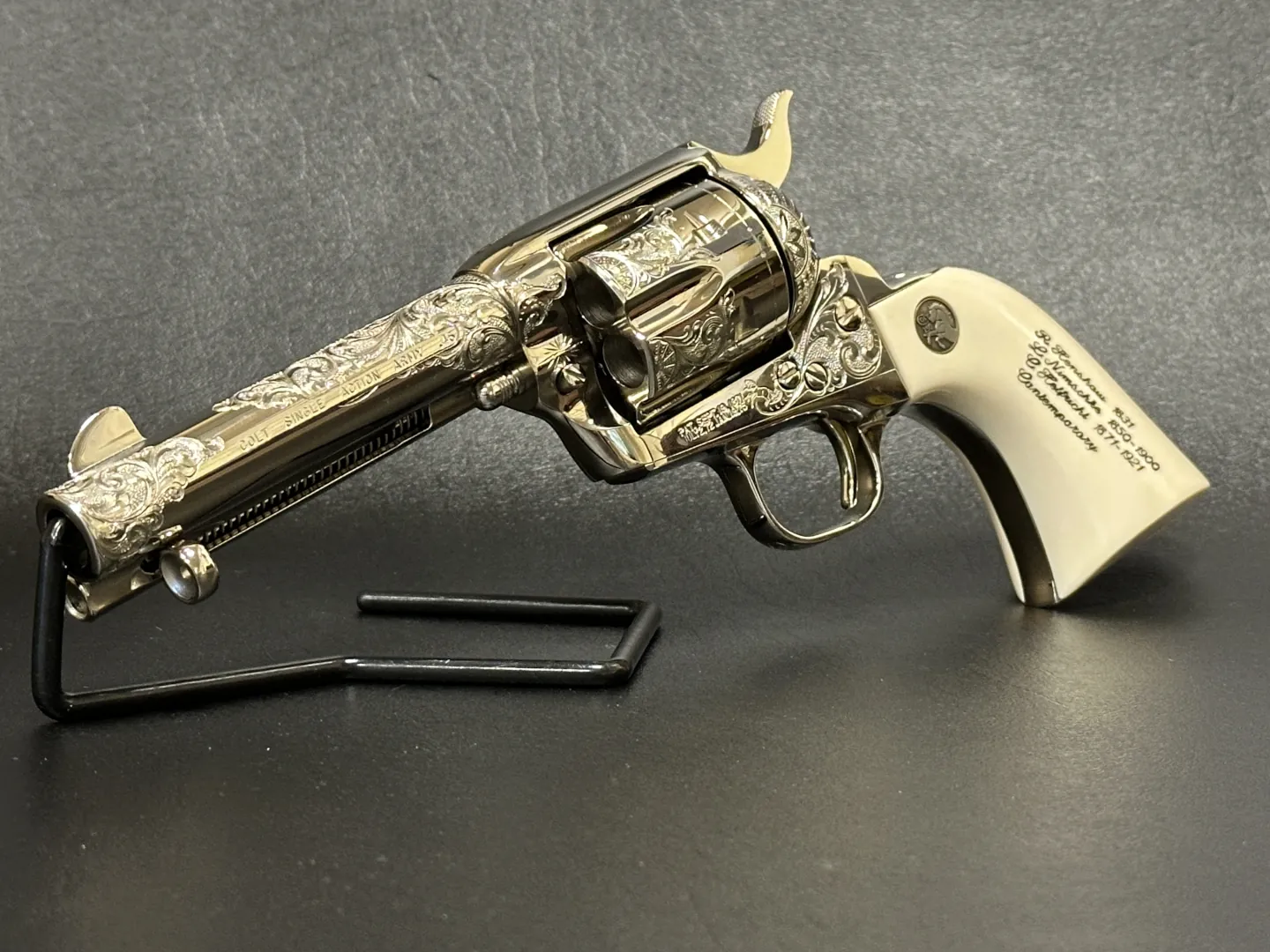
1. Colt Single Action Army
Colt introduced the Single Action Army in 1873. Commonly known as the Peacemaker, it secured a U.S. government contract as the standard military service revolver. Colt records deliveries of more than 30,000 revolvers under government contracts between 1873 and 1891.[2]
For collectors, the model name is only a starting point. Authenticity, rarity, condition, and demand must be assessed for the individual firearm.[1] Claims connecting a revolver to a notable owner or historical event should not be accepted without reliable documentation.
2. Winchester Model 1873
The Winchester Model 1873 is a lever-action rifle with a tubular magazine. Operating the lever ejects the fired cartridge case and chambers another round. Winchester states that the original rifle was favored by hunters, ranchers, and lawmen and could be chambered for cartridges also used in contemporary sidearms.[3]
“The Gun That Won the West” is a famous Winchester description, but it should be understood as a promotional title rather than a literal historical judgment. Original rifles must also be distinguished from modern Model 1873 reproductions, which Winchester describes as closely following the historic action.[3]
3. Colt Python
Colt introduced the .357 Magnum Python in 1955. The original production series ended in 2005, and Colt introduced a redesigned version in 2020. Although the modern revolver preserves the recognizable Python appearance, its internal construction was revised.[4]
That production break is important to collectors. An original Python and a modern-production Python are not interchangeable categories. Production period, configuration, finish, condition, and originality should be established before rarity or value is considered.
4. Smith & Wesson Model 29
Smith & Wesson completed its .44 Magnum revolver in 1955, initially offering 4-inch and 6½-inch barrels. An 8⅜-inch version followed several years later. According to the manufacturer, demand declined during the 1960s but increased sharply after the release of Dirty Harry in 1971.[5]
The Model 29 demonstrates how popular culture can influence collector demand. Nevertheless, cinematic recognition does not make every example rare. Condition and authenticity remain fundamental parts of evaluating an individual revolver.[1]
5. Browning Hi-Power
Development of the Hi-Power began with John M. Browning during the 1920s. After Browning died in 1926, engineers at Fabrique Nationale continued refining the pistol, including its double-column magazine. Belgium formally adopted the completed 9 mm pistol in 1935.[6]
Its production history requires careful research. Browning states that serial-number ranges for Hi-Power pistols sold in the United States from 1954 through 1957 are estimates. The company considers its records more accurate beginning in 1958.[7] Serial-number conclusions from the earlier period should therefore be presented with appropriate caution.
6. Remington Model 870
Remington introduced the pump-action Model 870 in 1950. The initial range comprised 15 versions in 12, 16, and 20 gauges. The design used dual action bars and a bolt that locked into a hardened barrel extension, allowing Remington to produce numerous field, target, law-enforcement, and military configurations.[8]
High production alone does not make the Model 870 uncollectible, but it does mean that age is not proof of rarity. Collector interest is more plausibly concentrated in identifiable configurations such as early-production guns, higher grades, documented commemoratives, and military models. One clearly defined example is the 1969 U.S. Marine Corps contract for 3,231 Model 870 Mk-1 shotguns.[8]
7. Walther PPK
The Walther PPK has one of the strongest cinematic associations of any handgun. The official James Bond archive records that Sean Connery’s Bond was issued a Walther PPK in the 1962 film Dr. No.[9]
That connection explains the model’s lasting recognition in popular culture. It does not, by itself, establish the rarity, authenticity, production history, or market value of a particular PPK. Those conclusions require additional evidence specific to the individual firearm.
A Disciplined Approach to Collecting
A recognizable name is not an appraisal. Before buying a collectible firearm, establish exactly what it is and examine its authenticity, rarity, condition, and demand.[1]
Condition should be described using an established grading system. The National Firearms Museum cautions that refinishing, modification, customization, and excessive cleaning ordinarily reduce the value of a collectible firearm.[10] An old firearm should not be cleaned or restored merely to improve its appearance without first consulting someone qualified to assess its historical and collector significance.
Frequently Asked Questions
No. They were selected for their documented historical, mechanical, or cultural significance, not as a price ranking.
Important factors include authenticity, rarity, condition, and market demand. The characteristics of the individual firearm matter more than the model name alone.
Manufacturers sometimes changed designs, configurations, and serial-number systems during production. Identifying the correct period helps distinguish materially different versions of the same model.
No. Cultural or historical associations can increase interest, but rarity must be established through production records and evidence specific to the firearm.
Not without qualified guidance. Refinishing, modification, excessive cleaning, or replacing original parts can reduce collector value.
Sources
- National Park Service, “Arms Collecting,” Springfield Armory National Historic Site.
- Colt’s Manufacturing Company, “Timeline”.
- Winchester Repeating Arms, Model 1873 Owner’s Manual.
- American Rifleman, “Colt’s Pythons: Then & Now,” January 25, 2023.
- Smith & Wesson, “The History of Smith & Wesson”.
- Browning, “The Hi-Power: Classic Autoloader,” April 19, 2016.
- Browning, “Hi-Power Pistol: Serial Number and Production Information”.
- American Rifleman, “The Remington 870: Greatest Pump Shotgun Ever Made?,” October 30, 2020.
- James Bond 007, “Q Lab’s Gadgets”.
- National Firearms Museum, Jim Supica, “Evaluating Firearms Condition”.