
Key Takeaways:
- The HK4 accommodates .22 LR, .25 ACP, .32 ACP, and .380 ACP through caliber-specific components.
- Converting the pistol requires changing the barrel, recoil spring, and magazine; switching to .22 LR also requires repositioning the breechface plate.
- Completeness, original accessories, markings, condition, and documented provenance are central when evaluating an HK4.
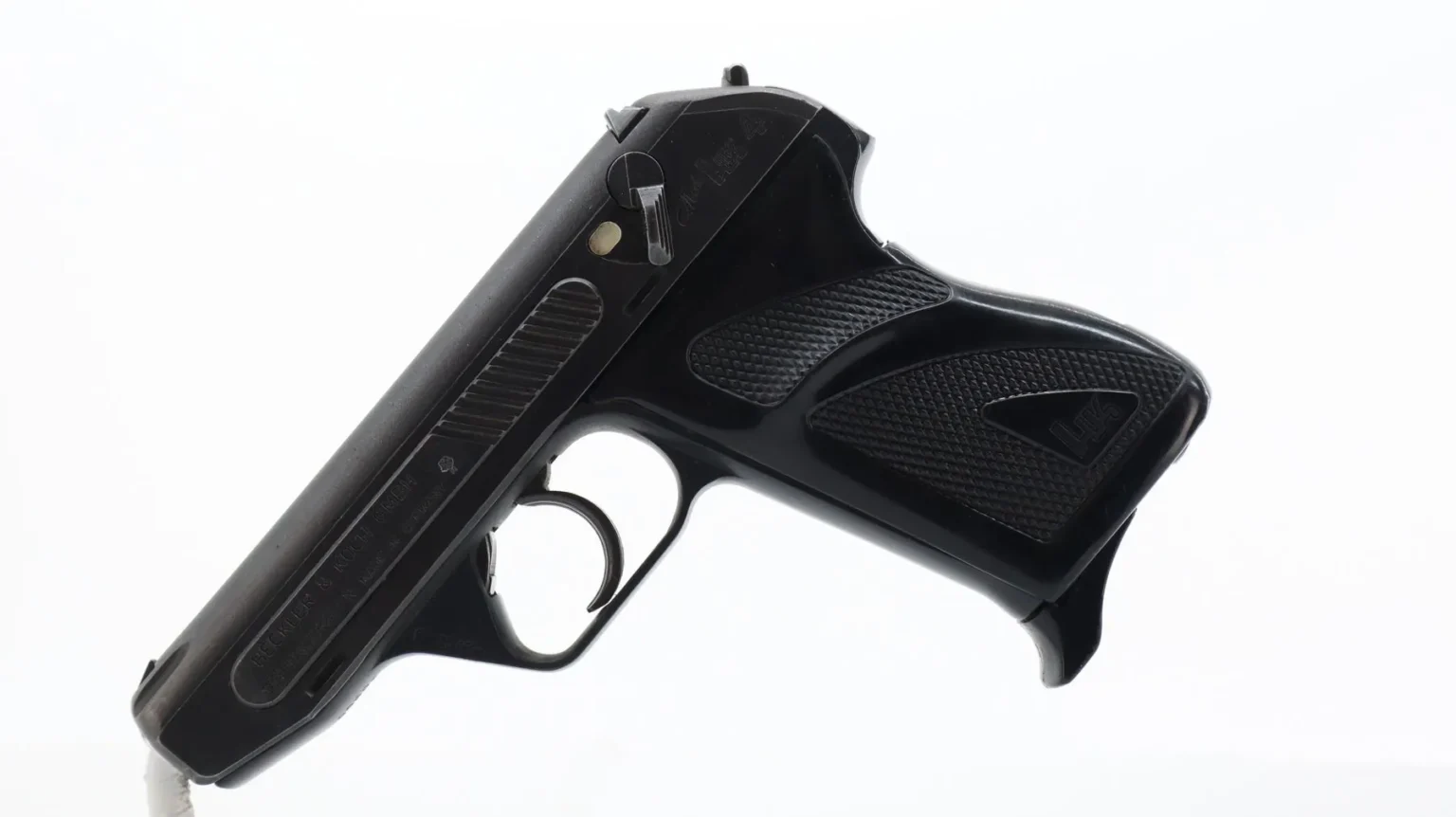
Heckler & Koch’s first production semiautomatic pistol was an unconventional one. The HK4 combined a compact, double-action design with a conversion system that allowed one pistol to use four cartridges: .22 Long Rifle, .25 ACP, .32 ACP, and .380 ACP. Commercial examples were reaching American dealers by early 1968, and production continued until 1984.[1][2]
The pistol’s development is documented in a patent filed by Alexander W. Seidel and Tilo T. Moller and assigned to Heckler & Koch. The application claimed German priority from February 18, 1964, was filed in the United States on February 5, 1965, and was granted as U.S. Patent 3,287,843 on November 29, 1966.[3] Seidel’s previous work on the Mauser HSc helps explain the HK4’s family resemblance to that earlier German pocket pistol, although the HK incorporated a substantially different conversion mechanism.[1]
A Practical Multicaliber System
The HK4 is a straight-blowback, hammer-fired pistol with double- and single-action operation. Changing calibers requires the appropriate barrel, recoil spring, and magazine. Conversion among the three centerfire cartridges is comparatively straightforward. Changing between centerfire ammunition and rimfire .22 Long Rifle also requires repositioning the breechface plate so that the firing pin strikes the correct portion of the cartridge.[1][2]
This arrangement was more sophisticated than a simple barrel swap. Seidel and Moller’s patent describes a breech assembly with central and offset firing-pin apertures, permitting the same firing pin and breech mechanism to accommodate both centerfire and rimfire cartridges. The design avoided replacing the complete breech bolt during conversion.[3]
Contemporary American coverage emphasized the novelty of the system. In March 1968, GUNS Magazine reported that the HK4 could be changed among all four chamberings by exchanging the magazine, barrel, and recoil spring and repositioning the firing mechanism for rimfire or centerfire ammunition. The review also recorded an aluminum-alloy frame and a fabricated steel slide incorporating a machined breechblock.[4]
The HK4 was offered both as a pistol in a single chambering and with conversion components for additional calibers. Some American-market packages combined .380 ACP and .22 Long Rifle, while complete four-caliber sets provided the pistol’s full range of configurations.[1]
Controls and Mechanical Safeguards
The HK4 has an external hammer and a slide-mounted manual safety. Its patented safety mechanism moves the rear of the firing pin out of the hammer’s path; the design also restrains the firing pin against forward movement when the safety is engaged.[3][5]
A magazine disconnect prevents firing when the magazine is withdrawn beyond its seated position. The pistol also uses an internal slide stop: after the last cartridge is fired, the slide remains open, and inserting another magazine releases it. With a loaded magazine, this action chambers the top cartridge automatically.[1][5]
These controls are distinctive, but they are not necessarily intuitive by modern standards. The automatic closing of the slide during magazine insertion and the HK4’s unusual procedures for unloading, decocking, and disassembly make original operating instructions particularly important for anyone handling a surviving example.
The American Market
Harrington & Richardson was the HK4’s first major American distributor. Period accounts show H&R-marked pistols arriving in the United States by early 1968, and American Rifleman records the H&R-branded version as being sold from 1968 through 1973.[2][4] Surviving examples may bear both Heckler & Koch and Harrington & Richardson markings. At least some H&R pistols also carry a lion emblem between the dates 1871 and 1971, identifying their connection to H&R’s centennial.[2]
Contemporary testing was generally favorable toward the pistol’s construction, accuracy, and versatility, although reviewers criticized its heavy or uneven trigger and some of its control arrangements. A 1977 American Handgunner evaluation likewise treated the four-caliber system as the HK4’s defining feature while noting that the safety and heel-mounted magazine release could slow handling.[5]
Collecting the HK4
The HK4’s collector interest rests on more than its status as Heckler & Koch’s first semiautomatic pistol. It represents a documented attempt to place rimfire and centerfire cartridges within one compact platform while retaining the same principal frame, slide, and firing mechanism.
Completeness is therefore central to evaluating an HK4 set. A four-caliber outfit should be assessed for its caliber-specific barrels, recoil springs, and magazines, as well as its case, tools, instructions, and other documented accessories. On individual pistols, serial numbers, proof and import marks, distributor inscriptions, grips, sights, and finish should be examined as physical evidence rather than inferred from generalized model descriptions.
Claims involving rare factory variants, government issue, unusual markings, or special presentation configurations require especially careful documentation. A marking can establish what appears on a particular pistol, but it does not by itself prove a broader production history or institutional provenance.
The HK4 did not establish the modern concept of the modular service pistol, nor is there firm evidence that later modular handguns descended directly from it. Its importance is narrower and more defensible: it was Heckler & Koch’s first production semiautomatic pistol and an unusually ambitious commercial multicaliber design. More than half a century after its American debut, that combination of documented engineering and period character remains the strongest foundation for its historical appeal.
Frequently Asked Questions
The HK4 is a compact, straight-blowback semiautomatic pistol capable of using four different cartridges. It was Heckler & Koch’s first production semiautomatic pistol.
The HK4 was designed for .22 Long Rifle, .25 ACP, .32 ACP, and .380 ACP. Each chambering requires the correct barrel, recoil spring, and magazine.
The user exchanges the barrel, recoil spring, and magazine for the intended cartridge. Conversion between centerfire ammunition and rimfire .22 LR also requires repositioning the breechface plate.
Commercial examples were reaching American dealers by early 1968. Production ended in 1984.
Collectors should verify the pistol’s markings, condition, configuration, accessories, and provenance. Complete multicaliber sets should include the appropriate barrels, recoil springs, and magazines.
Sources
- Wiley Clapp, “The HK4: Heckler & Koch’s First Semi-Auto Pistol,” American Rifleman, April 2, 2020.
- Harry Hunter, “Rifleman Q&A: A Convertible Semi-Automatic H&R Pistol?,” American Rifleman, October 14, 2022; originally published October 2009.
- Alexander W. Seidel and Tilo T. Moller, “Breech Bolt with Firing Pin Operable at Different Angles,” U.S. Patent 3,287,843, November 29, 1966.
- Jan Stevenson, “H&R’s HK-4,” GUNS Magazine, March 1968, p. 16.
- George C. Nonte, “Heckler & Koch’s 4 Caliber Versatility,” American Handgunner, May/June 1977.