
Key Takeaways
- The maker of the Steyr-Hahn was the Oesterreichische Waffenfabriks-Gesellschaft (ŒWG). It formed on August 1, 1869, when Josef und Franz Werndl & Comp. became a stock corporation with help from the Österreichische Bodencreditanstalt.
- Between 1914 and 1918, the ŒWG employed up to 14,000 workers and produced 234,919 pistols, together with more than 3 million rifles, carbines, and Stutzen and 40,524 machine guns.
- The company became Steyr-Werke AG on February 9, 1926, and merged into Steyr-Daimler-Puch AG in 1934. M1912 pistols made before 1926 therefore came from the ŒWG.
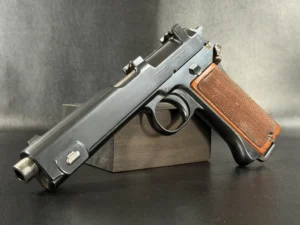
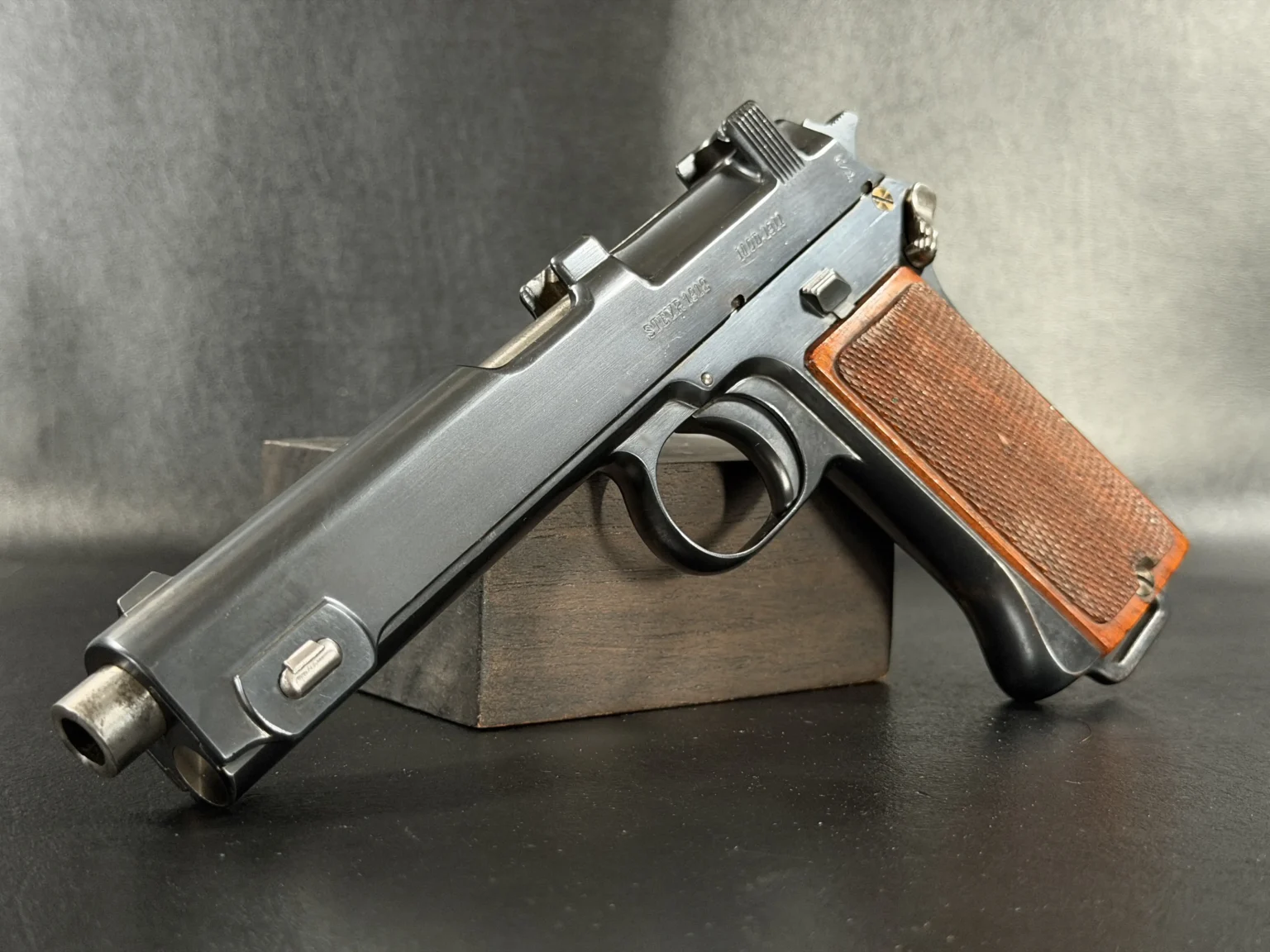
The Steyr M1912 was made by the Oesterreichische Waffenfabriks-Gesellschaft, a joint-stock company with its works at Steyr in Upper Austria. The name was abbreviated ŒWG or OEWG. “Steyr,” the name collectors commonly use for the maker, was the factory’s town and a product marking. The company added it to its legal name only in 1926, years after the pistol entered production.
Origins of the joint-stock company
Josef Werndl and his brother founded “Josef und Franz Werndl & Comp., Waffenfabrik und Sägemühle in Oberletten” on April 16, 1864. On August 1, 1869, the partnership was converted into a stock corporation with the help of the Österreichische Bodencreditanstalt. The new capital was needed to meet growing orders. The new corporation was named Österreichische Waffenfabriks-Gesellschaft. [1] Its headquarters were in Vienna. [2] Werndl remained the company’s general director until his death at Steyr on April 29, 1889. [3]
The firm when the pistol appeared
In the years before the Steyr-Hahn appeared, the ŒWG depended heavily on export work. In 1910, the Steyr factory received no orders from the Imperial and Royal Army administration and had to dismiss workers immediately. Its principal customers were the Balkan states, Turkey, and South America, and it supplied China between 1911 and 1913. As late as spring 1914, the ŒWG and its German cartel partner, Mauser, shipped 200,000 rifles to Serbia. [4]
The company’s range extended well beyond rifles. Before the war, it made Mauser-pattern rifles alongside its Mannlicher designs. It also built Schwarzlose machine guns under license from the inventor and a Pieper-designed pistol under license. Steyr-Hahn offered the Steyr-Hahn commercially in 1911. [2] Between 1912 and 1914, the company moved production to a new and larger site in Steyr, the “Plattner” grounds. [1]
Otto Schönauer was among the company’s senior figures in this period. He joined the ŒWG in 1871, became works foreman in 1875 and technical director in 1896, and developed the Mannlicher-Schönauer rifle’s rotary magazine. He died at Steyr on September 17, 1913. [5]
Wartime production
A company catalog dated November 1914 stated that every arm leaving the works was made on the principle of full parts interchangeability. Company literature put the plant’s capacity at 750,000 arms a year. [2] Figures from the company’s 1939 anniversary history give its output from 1914 to 1918. With a workforce of up to 14,000, it produced 3,000,325 rifles, carbines, and Stutzen; 234,919 pistols; 40,524 machine guns; and 20 million parts and components. The M1912 was one of the main products of those years. [2] In 1916, the company began building motor vehicles, a step that became important after the war. [3][1]
After 1918
The 1919 Treaty of Saint-Germain almost entirely prohibited military arms production at Steyr. [2] Through the 1920s, the company mainly produced passenger cars, buses, and small trucks. [3] On February 9, 1926, the Oesterreichische Waffenfabriks-Gesellschaft took the new name Steyr-Werke AG. [6] In 1934, Steyr-Werke merged with Austro-Daimler-Puchwerke AG to form Steyr-Daimler-Puch AG. [3]
These dates divide M1912 production by corporate entity. Pistols made from 1911 until early 1926 came from the Oesterreichische Waffenfabriks-Gesellschaft; later pistols came from Steyr-Werke AG. M1912 pistols made in the 1930s carried the Steyr bull’s-eye trademark in place of the earlier plain “Steyr” or “OEWG” markings. [2] After the 1938 Anschluss, Steyr-Daimler-Puch was incorporated into the Reichswerke Hermann Göring. [1] During that period, the Steyr works converted M1912 pistols to 9 mm Parabellum. [2]
Frequently Asked Questions
The Oesterreichische Waffenfabriks-Gesellschaft (ŒWG or OEWG) made it at its Steyr works in Upper Austria. “Steyr” was the factory’s town and a product marking, not the company’s legal name during the pistol’s early production.
Josef Werndl and his brother founded the predecessor firm, Josef und Franz Werndl & Comp., on April 16, 1864. It became the joint-stock Oesterreichische Waffenfabriks-Gesellschaft on August 1, 1869.
The Steyr-Hahn was first offered for sale in 1911. During the same period, the company moved production to a new, larger site in Steyr, the “Plattner” grounds, between 1912 and 1914.
According to the company’s 1939 anniversary history, the Steyr works produced 234,919 pistols between 1914 and 1918. The M1912 was one of the main products of those years.
The Oesterreichische Waffenfabriks-Gesellschaft became Steyr-Werke AG on February 9, 1926. In 1934, Steyr-Werke merged with Austro-Daimler-Puchwerke AG to form Steyr-Daimler-Puch AG.
Sources
[1] Steyr Arms GmbH. “History.” Steyr Arms, n.d.
[2] Newland, Samuel J. “A Forgotten Giant: A Brief Look at Military Small Arms Production at Steyr, Austria, 1864–1945.” American Society of Arms Collectors Bulletin, no. 94, 2006, pp. 33–44.
[3] Müller, Thomas. “Werndl, Josef.” Neue Deutsche Biographie, vol. 27, 2020, pp. 811–813.
[4] Rauchensteiner, Manfried. The First World War and the End of the Habsburg Monarchy, 1914–1918. Böhlau Verlag, 2014, p. 45.
[5] Hummelberger, W. “Schönauer, Otto (Karl).” Österreichisches Biographisches Lexikon 1815–1950, vol. 11, 1995, pp. 46–47.
[6] Land Oberösterreich. “1926.” Amt der Oberösterreichischen Landesregierung, n.d.