
Key Takeaways:
- “Close enough” isn’t good enough. Luxury guns are assembled to tight factory tolerances, and that’s respectable. But a masterpiece follows a “one gun, one gunsmith” philosophy where every single component is hand-fitted to micron-level precision by the same craftsman. That’s the difference between a gun that works well and one that feels like a single piece of living metal in your hands.
- Art should be the identity, not the outfit. Gold plating and factory engraving can make a gun look expensive. But on a true masterpiece, the artistry isn’t applied after the fact. It’s woven into the gun’s very structure, from hand-cut scrollwork that took hundreds of hours to materials like a billion-year-old meteorite or exhibition-grade Damascus steel. You can’t peel the art away from a masterpiece because the art is the gun.
- Provenance is the one thing your checkbook can’t solve. You can commission precision. You can pay for beauty. But you can’t manufacture a connection to a pivotal historical moment or a legendary maker who’s been gone for a century. That story, whether it’s tied to a Civil War general, a diplomatic gift between heads of state, or a workshop that only produces single-digit firearms per year, is what separates a purchase from a legacy.
Let’s get started…
There’s a question that comes up at every serious gun show, every collector’s dinner, and every late-night forum thread where people who really care about firearms gather. It sounds simple enough: what’s the difference between a luxury gun and a masterpiece?
Most people assume the answer is money. Spend enough, slap on some gold, box it up in walnut and velvet, and you’ve got yourself a masterpiece. But that’s like saying a Rolex Submariner and a Patek Philippe minute repeater are the same thing because they both tell time. They’re not even in the same conversation.
A luxury firearm is a premium product. A masterpiece is something else entirely. It’s the place where art, engineering, and history collide so perfectly that the result feels almost accidental, as if the universe just decided to allow it. And if you’re a collector or an enthusiast who’s been in this space for any length of time, you already sense that distinction, even if you’ve never quite put it into words.
So let’s put it into words.
The Three Pillars Nobody Talks About (But Everyone Feels)
Here’s the thing. There’s no checklist for “masterpiece.” No certification body stamps a gun with a gold star and says, “Congratulations, you’ve made it.” But when you handle one, you know. There’s a convergence happening, a coming together of three distinct qualities that you almost never find in the same firearm.
The first is artistry. Not decoration. Not embellishment. Artistry.
The second is mechanical precision so refined it borders on obsessive.
And the third is provenance, the story that a gun carries with it, whether it’s linked to a historical moment, a legendary maker, or a singular vision that will never be repeated.
Luxury guns can have one of these. Sometimes two. A masterpiece has all three, and they’re woven together so tightly you can’t separate them. Pull one thread and the whole thing unravels.
Let me walk you through each one, because the details matter more than you’d think.
“One Gun, One Gunsmith” and Why It Changes Everything
You know what separates a tailored Savile Row suit from even the nicest off-the-rack option? It’s not just the fabric. It’s the fact that one person cut it, sewed it, and fitted it to your body. That person knows where every stitch is. They’ve accounted for the way your left shoulder sits slightly higher than your right. Nothing is “close enough.”
That’s the philosophy behind what collectors call “one gun, one gunsmith,” and it’s the backbone of every firearm that deserves to be called a masterpiece.
Luxury firearms, even very expensive ones, are typically high-end production models. They come off a line. Maybe a short line, maybe a very exclusive line, but a line nonetheless. Parts are machined to tight tolerances, sure, and the fit is good. But “good” and “perfect” aren’t synonyms.
A masterpiece is bespoke. From start to finish, a single master craftsman builds it by hand. They select the raw materials, shape the receiver, and hand‑file every engagement surface. The barrel, trigger group, safety, and grip panels, every component, are fitted to tolerances measured not in thousandths of an inch, but in microns.
Let that sink in for a second. Microns.
When Eggerling Bespoke builds a 1911, for example, the gunsmith who starts the project is the same person who finishes it. They often leave their initials hidden under the grip, a quiet signature that says, “I made this. Every piece of it. And I stand behind it.” That’s individual accountability in a way that factory production simply can’t replicate.
And here’s where it gets interesting. When one person fits every component by hand, something almost magical happens to the action. Pick up a factory gun, even a great one, and cycle the slide or break open the action. It’s smooth. It works. Now pick up a hand-fitted masterpiece and do the same thing. The difference is immediate. Collectors describe it as “like a symphony.” There are no gaps. No loose play. No friction where friction shouldn’t exist. Every surface mates with its partner so precisely that the whole mechanism feels like one continuous piece of metal rather than an assembly of parts.
That mechanical harmony isn’t just a nice-to-have. It’s the foundation. Without it, all the engraving and exotic materials in the world won’t save a gun from being merely expensive.
Artistry as the Soul, Not the Suit
This is where many people get confused, so I want to be careful.
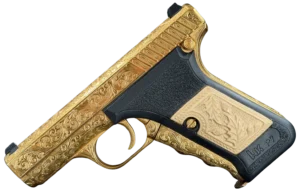
A luxury gun often looks beautiful. Gold plating. Factory engraving. Nice wood. Premium finishes. And there’s nothing wrong with any of that. But decoration is something you add to a finished product. On a masterpiece, the art isn’t added on. It’s part of the gun’s identity. It’s inseparable from the mechanical object underneath.
Think of it this way. A luxury gun wears a nice suit. A masterpiece is the suit.
The Engraver’s Hand
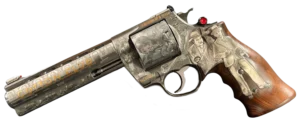
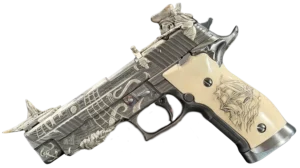
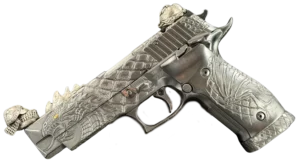
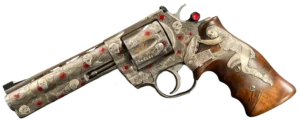
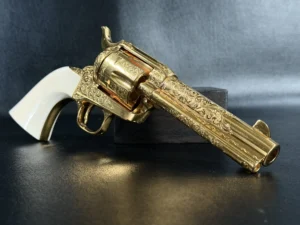
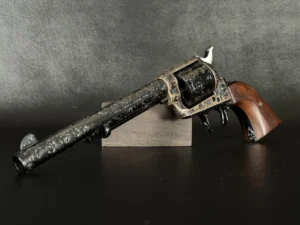
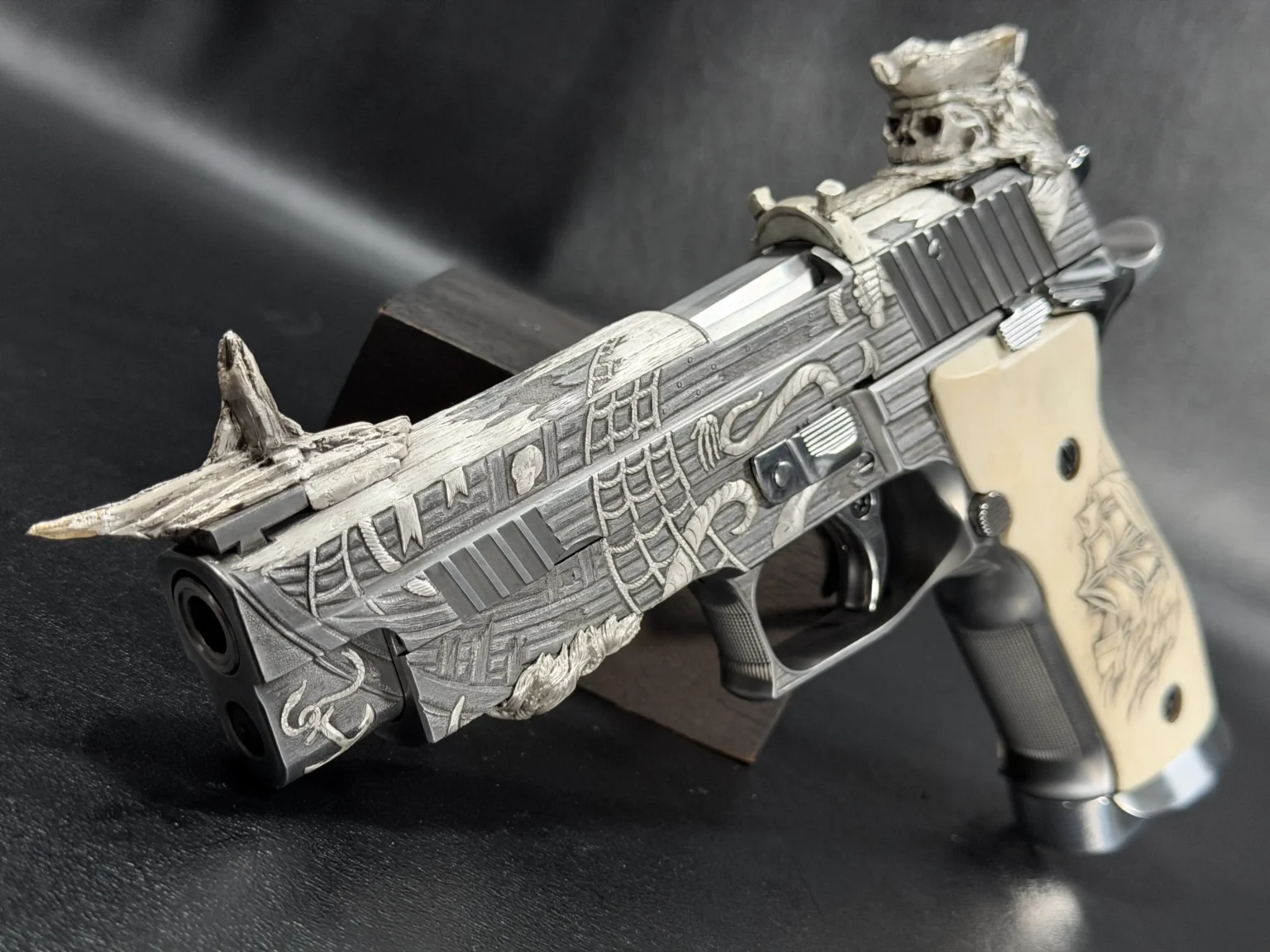
Master engraving is probably the most visible distinction between luxury and masterpiece-level firearms. And I don’t mean the CNC-cut patterns you see on even some very expensive production guns. I’m talking about hand engraving, the kind done with a hammer and chisel by artisans who’ve spent decades perfecting their craft.
Names like Cuno Helfricht still echo through collecting circles, even though his work dates back to the late 1800s and early 1900s. Helfricht’s engraving on Winchester and Colt firearms didn’t just decorate the guns; it told stories. The scrollwork wasn’t repetitive filler. Each panel was a composition, with depth, movement, and line work so crisp it looks like it was cut yesterday.
Modern master engravers carry that tradition forward, and their waiting lists can stretch for years. A single gun might take hundreds of hours of engraving work alone. The engraver isn’t following a template. They’re creating an original piece of art that happens to exist on the surface of a firearm. Every cut is permanent. There’s no “undo” button. One slip, one moment of lost concentration, and months of work can be compromised.
That kind of risk and skill is what separates art from decoration.
Materials That Have Their Own Stories
Here’s where things get really wild. Luxury guns use high-quality materials. Beautiful walnut stocks. Stainless steel. Maybe some carbon fiber or titanium for a modern touch. All perfectly respectable.
But masterpiece-grade firearms sometimes use materials that carry their own narrative weight. Consider a meteorite. Yes, an actual meteorite. Cabot Guns famously crafted a matched pair of 1911 pistols from a single 4.5-billion-year-old Gibeon meteorite. The material is older than the Earth itself. Every component, from the frame to the grips to the trigger, was machined from this extraterrestrial iron. You’re not just holding a gun at that point. You’re holding a piece of the cosmos.
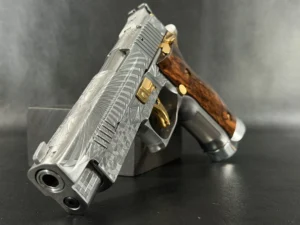
Then there’s Damascus steel, and I don’t mean the mass-produced stuff you see on mid-range knife blades. True masterpiece-level Damascus involves billets that can take years to design and forge. The smith envisions the final pattern before the first fold. Hundreds of layers of different steel alloys are welded, folded, and manipulated to create genuinely unique patterns, each billet a one-of-one. When that steel is shaped into a barrel or receiver, the result is both functional and stunningly beautiful.
Even the wood on a masterpiece-grade firearm isn’t just “nice wood.” It’s exhibition-grade stock wood, selected from blanks that might sit in a climate-controlled warehouse for decades, aging and stabilizing. The grain figure, the color, the density; everything is evaluated. A single blank might be rejected a dozen times before one is found that meets the standard.
The Finish That Can’t Be Faked
Let’s talk about metal finishes for a moment, because this is another area where the gap between luxury and masterpiece becomes obvious.
A luxury gun might have a deep blue or a satin nickel finish, and it’ll look great. But a masterpiece often features finishes that are closer to alchemy than manufacturing.
Mirror polishing, for instance. True mirror polish on a firearm requires hours and hours of progressive hand polishing. Every surface has to be polished until it reflects light so clearly that you can read a newspaper in it. Any imperfection, any tiny scratch left by a previous grit, shows up immediately. It’s painstaking work, and shortcuts reveal themselves ruthlessly.
Then there’s color case hardening, one of the most visually striking finishes in the firearms world. Done properly using traditional bone-and-charcoal methods, color case hardening produces swirling patterns of blue, purple, gold, and straw across the metal’s surface. And here’s the beautiful part: no two case-hardened finishes are identical. Like a fingerprint, each one is unique. The colors depend on the carbon content, the temperature, the quenching medium, and about a dozen other variables that even experienced practitioners can’t fully control. You get what the process gives you. When it gives you something extraordinary, the result is breathtaking.
Provenance: The Story That Money Can’t Buy
You can commission artistry. You can pay for precision. But you can’t purchase provenance. It either exists or it doesn’t.
This is the third pillar, and in some ways it’s the most important, because it’s the one that elevates a firearm from “remarkable object” to “irreplaceable artifact.”
When a Gun Becomes History
Some masterpieces earn their status because of where they’ve been and who held them. A cased Colt Navy revolver that belonged to a Civil War general isn’t just a beautiful antique. It’s a primary historical document, a physical connection to a specific moment in time. The scratches on it tell stories. The wear patterns reveal how it was carried, drawn, and used.
Presentation firearms, guns given as gifts between heads of state or military leaders, occupy a particularly rarefied space. These were often the finest examples a maker could produce, commissioned specifically to impress. They were political tools, diplomatic gestures, and works of art all wrapped into one. And because they were gifts rather than products, they were typically made in quantities of one. There is no other one. There never will be.
Historical provenance does something fascinating to a firearm’s value, too. It decouples the gun from the normal market forces that govern even very expensive luxury pieces. A luxury gun’s value is tied to its brand, its materials, and its condition. A masterpiece with serious provenance? Its value is tied to human history. And human history, as it turns out, only becomes more valuable over time.
The Maker’s Legacy
Provenance isn’t always about famous owners or historic battles. Sometimes it’s about the maker.
When a firearm is built by a recognized master, their name becomes part of the gun’s DNA. Think about what a “Holland & Holland Royal” means to a shotgun collector. Or what a “Fabbri” means to someone who understands Italian over-and-unders. These aren’t just brand names. They represent specific individuals and workshops where knowledge has been passed down through generations, where the standards are so high that production is measured in single digits per year.
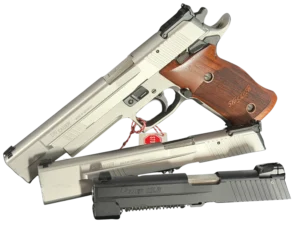
Some modern makers are building that kind of legacy right now. Shops like Cabot Guns, with their obsessive standards for material sourcing and finishing. Or the SIG Sauer Mastershop, which operates almost like a separate entity from SIG’s production lines, handbuilding competition and collector-grade pistols. These makers understand that they’re not just selling guns. They’re creating future heirlooms. Every piece that leaves their shop carries their reputation forward in time.
And honestly, there’s something poetic about that. A gunsmith working alone in a workshop, knowing that the object they’re creating will likely outlive them by centuries. That the quality of their work will be judged by people not yet born. That’s a different kind of pressure than meeting quarterly production targets.
So, How Does This All Come Together?
Let me paint a picture for you.
Imagine two firearms sitting side by side on a velvet-lined table at an auction house. Both are beautiful. Both are expensive. To the casual observer, they might seem equivalent.
The first is a limited-edition luxury pistol from a well-known manufacturer. It features gold accents, engraved slide flats, and premium rosewood grips. It comes in a presentation case with a certificate of authenticity and was produced in a limited run of just 500 units. Retailing for around $5,000, it’s both beautiful and highly functional, a truly exceptional firearm.
The second is a one-off 1911 built over 18 months by a single gunsmith. Every surface has been hand-fitted to sub-micron tolerances. The frame and slide wear a mirror polish that took 40 hours alone. The engraving, executed by a master with a 3-year waiting list, depicts a scene from the American frontier in scroll and relief that took 200 additional hours. The grips are carved from a 10,000-year-old piece of fossilized walrus ivory. The gun was built for a specific client whose family has been commissioning firearms from this maker for three generations.
Both are “expensive guns.” But only one is a masterpiece. And the difference isn’t really about price. It’s about intent, execution, and meaning.
A Quick Comparison (Because Sometimes a Table Helps)
If you’re the kind of person who likes to see things laid out clearly, here’s how the two categories stack up across the dimensions that matter most.
Production approach is the first dividing line. Luxury guns come from small-batch or high-end production runs. Masterpieces are bespoke, often following that one-gun-one-gunsmith model. Related to that, tolerances differ considerably. Luxury guns are tight and precise by factory standards. Masterpieces are hand-fitted to micron-level specs, with every mating surface personally attended to by the builder.
On the aesthetics front, luxury guns feature high-quality materials and attractive trim. Masterpieces are functional sculptures where master-level artistry is woven into the gun’s very structure. And when it comes to purpose, luxury guns serve performance and prestige. Masterpieces serve to preserve art and history.
That last point is worth sitting with. A luxury gun is something you buy. A masterpiece is something you inherit, protect, and eventually pass along to someone who will appreciate it as much as you did. It’s a legacy, not a purchase.
Why This Distinction Matters for Collectors
If you’re reading this, you’re probably not a casual buyer. You care about firearms beyond their utility. And that means the distinction between luxury and masterpiece isn’t academic; it directly affects how you build your collection, what you prioritize, and how you think about value over time.
Luxury guns can be wonderful additions to a collection. They shoot well, they look great, and they hold their value reasonably. But they’re still products. They exist within a market ecosystem of supply and demand that’s fundamentally the same as any other consumer product, just at a higher price point.
Masterpieces exist outside that ecosystem. Their value isn’t determined by what the manufacturer charges or what the next model year brings. It’s determined by their irreplaceability. You can always buy another luxury gun. You cannot buy another one-of-a-kind presentation piece engraved by an artisan who passed away in 1932. That gun is the only one. And “the only one” is a powerful phrase in any collecting field.
For investors, this means masterpieces tend to appreciate in ways that luxury guns simply don’t. Auction records bear this out consistently. The guns that shatter records aren’t the prettiest or the most expensive when new. They’re the ones with the deepest combination of craft, precision, and story.
For collectors motivated more by passion than profit, there’s a different kind of value. There’s the feeling of holding something that represents the absolute pinnacle of what human hands can achieve with metal, wood, and fire. That’s not a marketing claim. It’s something you feel in your bones when you hold the real thing.
The Contradiction Worth Embracing
There’s something almost paradoxical about masterpiece firearms that I think deserves a moment. These are, at their core, tools designed for a violent purpose. They launch projectiles. That’s their job. And yet the finest examples transcend that function so completely that they end up in museums alongside Rembrandts and Faberge eggs.
That tension, between utility and beauty, between weapon and art, is part of what makes masterpiece firearms so fascinating. A purely decorative gun that can’t shoot is just a sculpture shaped like a gun. A purely functional gun with no aesthetic consideration is just a tool. The masterpiece occupies the narrow space where both qualities exist simultaneously, without compromising either. The engraving doesn’t weaken the steel. The hand-fitting doesn’t slow the action. The exotic materials don’t reduce reliability. Everything serves double duty.
That’s remarkably hard to pull off. And it’s why so few firearms in the history of gunmaking have earned the label.
Where Do You Go From Here?
Whether you’re drawn to the antique masterpieces of the 19th century, with their connection to a world that no longer exists, or to modern makers who are pushing the boundaries of what’s possible with contemporary materials and techniques, the path to finding a true masterpiece starts with education.
Handle as many firearms as you can. Visit auction previews. Talk to gunsmiths, not just dealers. Learn to see the difference between CNC engraving and hand-cut work. Train your hands to feel the difference between factory tolerances and a hand-fitted action. Study provenance documentation the way a fine art collector studies certificates of authenticity.
And be patient. Masterpieces don’t show up on your timeline. They reveal themselves when you’ve developed the eye and the understanding to recognize them.
Because, in the end, a masterpiece firearm isn’t defined by its price tag, its gold inlays, or the name on the box. It’s defined by the moment you pick it up, cycle the action, and realize that what you’re holding is something no machine could ever fully replicate and no amount of money could guarantee. It’s the work of human hands at their very best.
And honestly? That’s worth waiting for.
Frequently Asked Questions
A luxury gun is a high-end production model that emphasizes premium materials and aesthetics for a steep price tag. A masterpiece is defined by the rare combination of hand-fitted mechanical precision, master-level artistry, and historical or personal provenance that can’t be replicated.
It means a single master craftsman builds, fits, and finishes the entire firearm from start to finish, often leaving their initials hidden beneath the grip. Every component is hand-filed to micron-level tolerances rather than assembled from factory-spec parts that are “close enough.
Hand engraving by a master artisan is an original work of art with no “undo” button, where a single slip can compromise months of work. CNC-cut patterns on luxury guns look nice, but they lack the depth, spontaneity, and storytelling quality that defines masterpiece-level craftsmanship.
Provenance ties a gun to a specific moment in history, a famous figure, or a legendary maker, and that connection only becomes more valuable over time. It’s the one quality that separates an impressive object from an irreplaceable artifact.
Auction records consistently show that guns with the deepest combination of craft, precision, and story are the ones that shatter price records. Unlike luxury guns, whose value follows typical supply-and-demand dynamics, masterpieces appreciate in value because of their irreplaceability.