
Key Takeaways:
- The word “factory” changes everything. An engraved Colt without factory-provenance might look impressive, but a Colt factory letter confirming the original engraving can turn an $8,000 gun into a $75,000 one. Documentation isn’t a nice-to-have in this category. It’s the foundation that separates admired pieces from pursued ones.
- Know the hand behind the work. Attribution to a recognized engraver like Gustave Young or Cuno Helfricht doesn’t just add historical interest; it acts as a value multiplier. Two guns with similar coverage and condition can sell at wildly different prices depending on whose name is engraved on them. Learning to recognize styles and patterns is one of the most worthwhile investments a collector can make.
- Condition and originality trump coverage. It’s tempting to chase the most heavily engraved gun in the room, but the market consistently rewards quality over quantity. A lightly engraved Colt with original finish, period-correct grips, and a clean factory letter will outperform a fully covered piece that’s been refinished or lacks documentation. The collectors who do best in this space are the ones who learn to value what hasn’t been touched over what’s been added.
Let’s get started…
There’s a moment, if you’ve ever held a factory-engraved Colt, where something shifts. The weight feels different. Not physically, but mentally. You stop seeing a firearm and start seeing intention. Someone, a hundred or more years ago, sat at a bench and carved beauty into steel with nothing but hand tools and extraordinary patience. That’s not manufacturing. That’s art.
And here’s the thing most people miss: not all engraved Colts are created equal. Not even close. The difference between a factory-engraved Colt and one that was prettied up decades later is the difference between a Rembrandt and a reproduction hanging in a hotel lobby. Both might look nice from across the room. But only one carries real weight.
This piece is about that weight. It’s about the engravers who created it, the documentation that proves it, and the market forces that determine what a collector will pay to own it. If you’ve been circling the idea of collecting engraved Colts, or you already own one and want to understand what you’re really holding, this is where we start.
Because factory-engraved Colts don’t just live in gun collections. They sit comfortably alongside fine sculpture, period jewelry, and museum-quality decorative arts. The sooner you see them that way, the sooner the whole category makes sense.
What “Factory Engraved” Actually Means (and Why It Matters)
Let’s get the most important distinction out of the way early, because everything else builds on it.
A factory-engraved Colt is a firearm that was engraved under the authority of the Colt factory, typically at the time of manufacture or very shortly after. This work was performed by engravers employed by or contracted through Colt, usually at the Hartford plant. The engraving was part of the original order, often requested by a dealer, distributor, or individual buyer who wanted something beyond a standard production gun.
Why does that matter? Because factory engraving is recorded. Colt kept ledgers. When a gun was shipped with engraving, that detail was noted alongside the serial number, model, caliber, finish, and destination. Decades later, those records became the foundation for Colt factory letters, issued by the Colt Archive and confirming the firearm’s original configuration at the time it left Hartford.
That letter is everything. Seriously. A Colt Single Action Army with quality scroll engraving and no documentation might bring $8,000 to $12,000 at auction, depending on condition. That same gun, backed by a factory letter confirming the engraving was original, can jump to $40,000, $60,000, or well beyond $75,000 if the right details line up. The letter doesn’t just verify the gun. It validates the story.
Now, contrast that with aftermarket engraving. Plenty of Colts have been engraved after they left the factory. Some of that work is genuinely excellent. Talented engravers have been embellishing firearms for as long as firearms have existed, and there’s nothing wrong with appreciating skilled craftsmanship wherever you find it. But from a collector’s perspective, aftermarket engraving sits in a completely different category. It doesn’t carry the historical connection to Colt’s production legacy. It doesn’t appear in factory records. And in many cases, it actually diminishes the value of what might have been a clean, original gun.
Then there are the “upgraded” guns. These are pieces that were standard-issue when they shipped but had engraving added later, sometimes decades later, to increase their perceived value. Some of these are obvious. Some aren’t. And some are deliberately designed to deceive. We’ll talk more about red flags later, but for now, just know this: the word “factory” does a tremendous amount of heavy lifting in this category.
Modern embellishments are another conversation. Colt has, at various points, offered engraved models through their Custom Shop and through partnerships with contemporary engravers. These are legitimate factory pieces, and some of them are stunning. But they occupy a different aesthetic and market space from a Gustave Young-engraved percussion revolver from the 1850s. Both are factories. Both are collectible. But they’re speaking different languages.
The bottom line is simple. If you’re collecting engraved Colts with any seriousness, the first question is always: can you prove it left the factory that way?
The Masters Behind the Metal
Here’s where the story gets personal. Because behind every factory-engraved Colt is a human being who spent years, sometimes an entire career, developing a visual language in steel. And collectors don’t just buy engraving. They buy names.
Gustave Young is the starting point for most conversations about Colt engraving. Active from the 1850s through the 1860s, Young’s work defined what Colt engraving could be. His scrollwork is bold, deeply cut, and immediately recognizable. There’s an almost aggressive confidence to it. Vines curl with real dimension. Borders frame the work with architectural precision. When you see a Young-engraved Colt, you’re looking at the foundation of an entire artistic tradition. His presentation revolvers, particularly those made for Samuel Colt himself to give as diplomatic and political gifts, are among the most valuable American firearms in existence. Period.
Cuno Helfricht picked up where Young’s era ended and carried Colt engraving into the late 19th and early 20th centuries. Where Young was bold, Helfricht was refined. His patterns show a remarkable sense of balance. Scroll density, border placement, the relationship between engraved and unengraved surfaces; everything feels considered. Helfricht oversaw the Colt engraving shop for decades, and his influence shaped the look of thousands of firearms. Collectors who know what they’re looking at can often spot a Helfricht pattern across a room. That consistency, that identifiable hand, is part of what makes attribution so critical in this market.
And then there are the modern Colt Master Engravers. Names like Dennis Kies, Steve Kamyk, and others who’ve worked through the Colt Custom Shop or under factory authority in more recent decades. Their aesthetic tends to be cleaner, with tighter scroll patterns and sometimes more contemporary design sensibilities. The craftsmanship is extraordinary; make no mistake about that. But the market treats them differently from antique work. A modern Master Engraver piece might be technically flawless, but it doesn’t carry the same historical gravity as something from the 1870s.
So why does attribution matter so much? Because in the collector market, a name is a multiplier. Two guns with similar levels of engraving coverage, in similar condition, from similar periods, can sell at vastly different prices if one can be attributed to a known master and the other can’t. Attribution turns an engraved Colt from “nice” into “significant.” And significance in collecting is where the real value lies.
How do collectors and experts attribute engraving? It comes down to pattern recognition built over years of study. Scroll shapes, border motifs, the depth and angle of cuts, and the way an engraver handled specific areas of a particular model; all of these create a visual fingerprint. Published references, auction records, and museum collections provide points of comparison. It’s not always definitive, especially for shop-pattern work that might have been executed by journeyman engravers rather than the shop master himself. But when a credible attribution sticks, it changes the conversation around the gun entirely.
Levels of Engraving: Coverage and Complexity
If you’re newer to engraved firearms, one of the first things you’ll encounter is a grading system based on coverage. It’s not officially standardized the way, say, coin grading is, but the collecting community generally recognizes a few tiers, and understanding them will save you a lot of confusion.
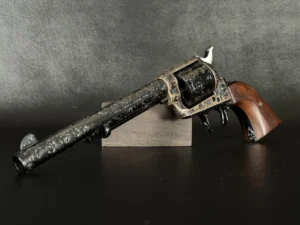
Light coverage typically means about 25 to 50 percent of the gun’s surface is engraved. You’ll see scroll patterns on the frame, maybe some work on the barrel and cylinder, but significant areas of plain metal remain. This is often what you’ll find on guns that were ordered with a modest engraving upgrade. The work can still be beautiful. Don’t mistake “light” for “lesser.” Some of the most elegant pieces out there show restraint, and a skilled engraver can do remarkable things with limited real estate.
Medium coverage runs roughly 50 to 75 percent. More of the gun’s surface is committed to the design. You’ll typically see engraving extending across the frame, barrel, cylinder, trigger guard, and backstrap. The pattern feels more immersive. There’s less breathing room between engraved elements, and the overall visual impact is stronger.
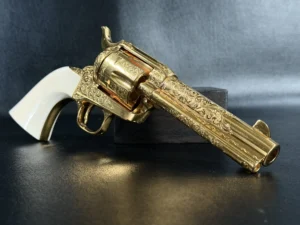
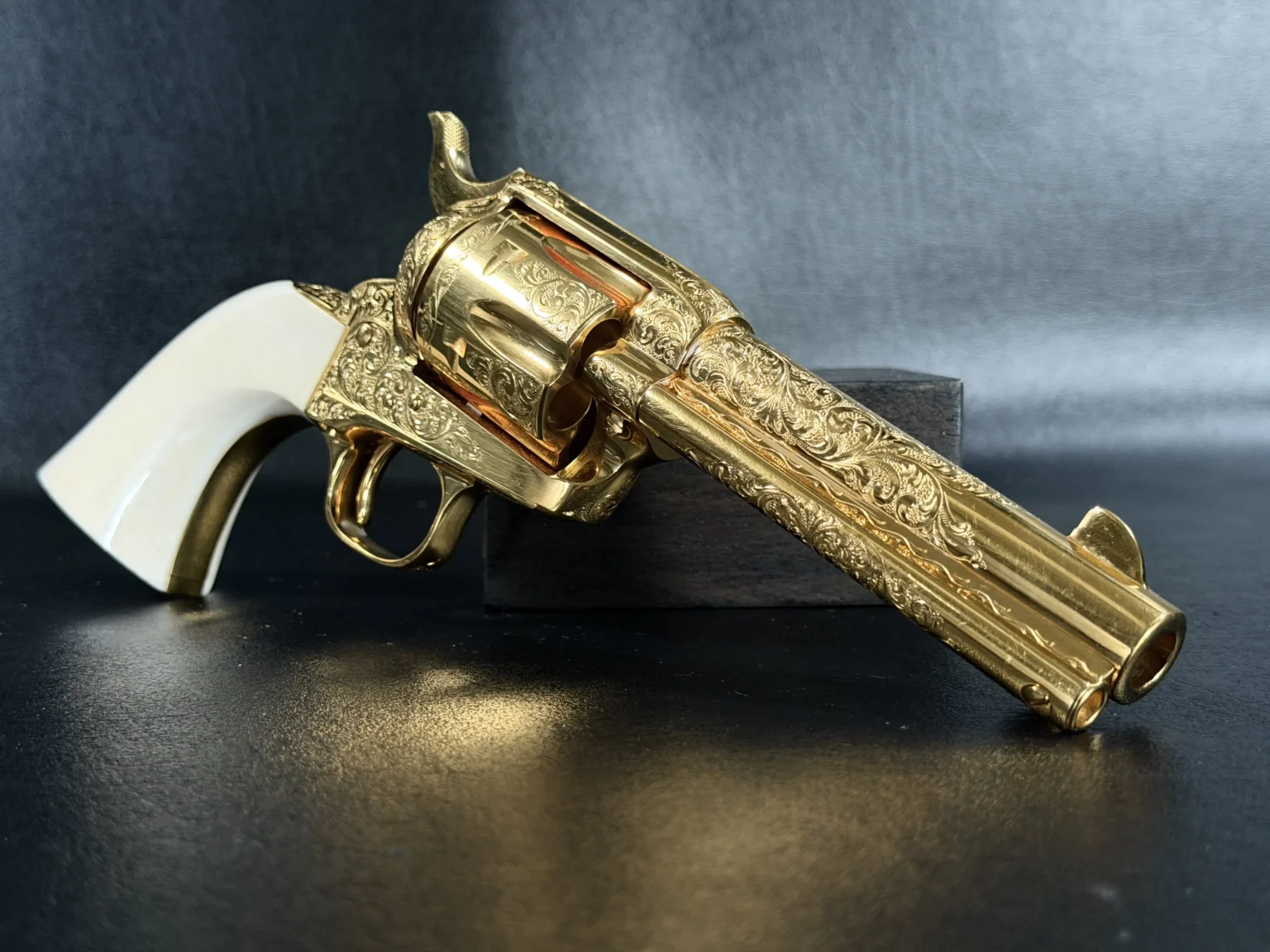
Full coverage pushes into the 75-100% range. Nearly every available surface carries engraving. On a fully covered Single Action Army, even the ejector rod housing and loading gate might be detailed. The gun reads as a unified composition rather than a firearm with decoration added. This is where you start to see pieces that genuinely cross the line from a decorated object to an art object.
Exhibition grade is the top. Sometimes called “no background left” engraving, these are pieces in which every fraction of the available surface has been worked. The background might feature punch-dot texturing or fine crosshatching to create contrast with raised scroll elements. Exhibition pieces are rare, and they were typically made for display at world’s fairs, as corporate presentation gifts, or for extremely wealthy private buyers. When one comes to market, the results tend to be dramatic.
But here’s the nuance that trips people up: more coverage doesn’t automatically mean more value. A lightly engraved Colt by Gustave Young, in original condition with a factory letter, will outperform a heavily engraved gun of uncertain authorship almost every time. Quality of execution matters enormously. The crispness of the cuts, the consistency of the pattern, the way the design flows across the gun’s surfaces; these details separate great engraving from merely extensive engraving.
Beyond scrollwork, you’ll encounter additional elements that add complexity and value. Scene engraving features pictorial elements such as running horses, longhorn cattle, eagles, hunting scenes, and historical vignettes. These are considerably more difficult to execute well than scrollwork, and they command premiums when done by skilled hands. Gold inlay adds another dimension, literally. Gold wire or sheet inlaid into the steel creates visual contrast and a sense of luxury, pushing a piece firmly into the upper tier. Punch-dot backgrounds provide texture and depth behind the primary scroll elements. And relief carving, where the engraving is cut deeply enough that the scroll elements stand above the surrounding surface, gives the work a sculptural quality that photographs simply can’t capture.
Grip materials play a role, too. Factory-engraved Colts often shipped with upgraded grips. One-piece ivory, mother-of-pearl, or carved ivory grips are the most prized. They complement the engraving visually and confirm that the gun was ordered as a premium piece from the start. Original grips in good condition are a significant value driver, and replacement grips, even nice ones, can knock a piece down in the eyes of serious collectors.
The combination of all these elements, coverage, technique, materials, and execution, determines where a particular gun sits in the hierarchy. And while it’s tempting to focus on the most heavily embellished pieces, the real lesson is that thoughtful, well-executed work at any coverage level can be deeply collectible.
Provenance: The Story Is the Value
Let me be blunt about something. You can have the most beautifully engraved Colt ever made, and if you can’t prove where it came from, you’re leaving money and significance on the table. Provenance isn’t a bonus in this category. It’s the backbone.
The Colt factory letter is your first and most important piece of documentation. Issued by the Colt Archive (housed at the Connecticut State Library), these letters draw on original Colt shipping ledgers to confirm what a specific serial-numbered gun looked like when it left Hartford. A letter might confirm the model, caliber, barrel length, finish, grip material, engraving, and the destination to which it was shipped. When a letter comes back confirming factory engraving, it doesn’t just authenticate the gun. It anchors the gun in history.
Not every serial number has surviving records. Colt’s archives are extensive but not complete, and some periods are better documented than others. When a letter exists and confirms the engraving, the effect on value is immediate and substantial. I’ve seen guns double or triple in price when a Colt letter surfaced confirming what collectors suspected but couldn’t prove.
Presentation inscriptions are the next tier of provenance, and they can be explosive. Colt revolvers were frequently given as gifts to military officers, political figures, foreign dignitaries, and business leaders. When a gun bears an inscription like “Presented to General [name] by Col. Samuel Colt” and that inscription can be verified through factory records or historical documentation, you’re no longer looking at a collectible firearm. You’re looking at a historical artifact. Pieces with documented histories of presentation to notable figures routinely reach six figures at auction, and the most significant examples have crossed the million-dollar mark.
Even without a famous name, a clear presentation provenance adds considerable value. A gun inscribed to a frontier sheriff, a railroad executive, or a foreign ambassador tells a story. And stories, in collecting, are currency.
Original boxes, cases, and accessories round out the provenance picture. A factory-engraved Colt that survives in its original case, with the original accessories (cleaning rod, screwdriver, spare cylinder, cap tin for percussion models), represents a time capsule. Complete cased sets are aggressively sought by top collectors because they preserve context. The gun didn’t just survive. Everything that shipped with it survived. That’s remarkable, especially for pieces that might be 140 or 150 years old.
Here’s a line worth remembering: a great engraved Colt without documentation is admired. A documented one is pursued. The difference between those two words, admired and pursued, is where the real market separation happens. Admiration is passive. Pursuit involves checkbooks.
Provenance also has a compounding effect. A factory-engraved Colt with a Colt letter, shipped to a known dealer, with a presentation inscription to an identifiable historical figure, surviving in its original case with accessories; that’s not just a gun. That’s a category killer. Each layer of provenance reinforces the others, and the cumulative effect on desirability and value exceeds the sum of its parts.
Red Flags and Authentication
This is the part nobody loves talking about, but it’s essential. Because, for as long as engraved Colts have been valuable, people have been trying to fake them.
The first thing to train your eye on is age consistency. Engraving wears over time, just like the rest of the gun. The cuts soften slightly. The edges of the scroll elements are rounded off from handling and holster wear. On an antique Colt, the engraving should show the same patina and aging as the surrounding metal. If you pick up a 1870s Single Action Army and the engraving looks crisp and fresh while the rest of the gun shows 150 years of honest wear, something’s wrong. That mismatch between the engraving and the gun’s overall condition is one of the most common tells.
Pattern consistency is the next checkpoint. Every era of Colt engraving has identifiable characteristics. The scroll shapes, border designs, background treatments, and layout conventions changed over time. An experienced collector or appraiser can look at a pattern and place it within a rough timeframe. If the engraving pattern on a gun doesn’t match what was being done at Colt during the gun’s production period, that’s a serious red flag. You’ll sometimes see 20th-century scroll styles on guns that supposedly left the factory in the 1880s. That doesn’t happen by accident.
Missing documentation on high-end pieces should always give you pause. If someone is selling a heavily engraved Colt as a factory piece but can’t produce a Colt letter, or hasn’t sought one, ask yourself why. The letters aren’t free and take time, but for a gun supposedly worth tens of thousands of dollars, the investment in a factory letter is trivial. Sellers who resist documentation or dismiss its importance are waving a flag. Maybe it’s nothing. Maybe it’s everything.
Over-polishing is a subtler problem. Some guns have been aggressively buffed at some point in their lives, either during a refinish or in a misguided attempt at “restoration.” Polishing softens engraving. It rounds sharp edges, reduces depth, and can blur fine details. A gun that’s been over-polished might still show its engraving, but the crispness that makes the work impressive will be compromised. For collectors, this matters. Original, untouched engraving with natural wear is far more desirable than crisp-looking work on a gun that’s clearly been buffed.
Now, let me be honest about something. Even experienced collectors get fooled. The best fakes are done by talented engravers who study period patterns carefully and execute them with real skill. They might artificially age the engraving to match the gun. They might target models with incomplete factory records, making it harder to definitively confirm or deny factory origin. This isn’t a game for amateurs, and it’s not a category where you should rely on your gut alone.
Expert evaluation is your best defense. There are a handful of recognized authorities on Colt engraving who can examine a gun in person, compare its engraving to documented examples, and offer an informed opinion on authenticity. Their assessments carry weight in the market and can make or break a sale. If you’re considering a significant purchase, the cost of an expert opinion is money well spent.
The Colt factory letter, where available, provides another layer of protection. If the letter confirms engraving, you’ve got a strong foundation. If the letter describes a plain gun, and the one in front of you is engraved, you have your answer. The tricky cases are those where no letter is available or records are ambiguous. In those situations, you lean on the experts, the visual evidence, and your own experience.
A practical rule of thumb: if a deal seems too good, if the gun seems too perfect, if the seller seems too eager to skip the documentation step, slow down. The best purchases in this category are the ones where the evidence all points in the same direction. Factory letter confirms engraving. Pattern matches the period. Condition is consistent. Provenance is traceable. When everything lines up, you buy with confidence. When it doesn’t, you walk.
Market Dynamics: What Drives Value Today
Let’s talk money, because that’s part of why you’re reading this.
Factory-engraved Colts have consistently outperformed standard production models as collectibles. That’s been true for decades, and the gap has widened in recent years. The reason is straightforward: supply is permanently fixed, and demand keeps growing. No one is making new 19th-century factory-engraved Colts. Every piece that enters a permanent collection or museum effectively removes it from the available market. And as global interest in American firearms as art and history continues to expand, more buyers are competing for fewer pieces.
Originality has become the dominant value driver. Twenty years ago, a refinished engraved Colt with fresh ivory grips might have sold briskly. Today, the market rewards guns that haven’t been touched. Original finish, original grips, original case, original everything. The premium for untouched condition has never been higher, and it’s reshaping how collectors evaluate and price these guns.
Documentation has followed the same trajectory. A generation ago, many collectors were comfortable buying on visual assessment alone. Today, the expectation is documentation. Factory letters, historical references, auction provenance, exhibition history; buyers want paper, and the market rewards sellers who provide it. Guns with strong documentation sell faster and for more money. Guns without it sit on the shelf longer and sell for less.
In terms of what’s most actively sought, a few trends stand out. Early Colts, particularly percussion-era revolvers (Dragoons, 1851 Navies, 1860 Armies) with factory engraving, occupy the top of the market. These are rare, they’re old, they’re tied to the most romantic period of American expansion, and the best examples are genuinely museum-quality. When a documented Gustave Young engraved Colt from the 1850s surfaces, expect fierce competition.
Single Action Army revolvers from the 1870s through 1890s remain the most popular category overall. There are more of them than percussion Colts, which means the market is more active, but high-grade examples with factory engraving, original finish, and documentation still command strong prices. General value ranges are broad (a lightly engraved SAA with a letter might bring $15,000 to $30,000, while an exhibition-grade example with notable provenance could reach $200,000 or more), but the specifics always depend on the individual gun.
Modern Colt Master Engraver pieces are interesting. They’re purchased new, often at significant prices, and they do appreciate, but their trajectory is different from that of antique pieces. The collector base tends to be different, too. Some buyers treat them as functional art acquisitions. Others view them as long-term investments. The market for these is still maturing, and it’s too early to draw definitive conclusions about long-term performance. What’s clear is that the best modern work, especially limited editions and unique commissions, holds value well.
Cased sets continue to punch above their weight. A single engraved Colt is desirable. A pair of matched engraved Colts in an original case, with accessories, is an event in itself. Complete cased sets are rare enough that when they appear, they attract attention from the highest tier of collectors and institutions. If you ever have the opportunity to acquire one, and the documentation supports it, don’t overthink it.
International interest has grown meaningfully. Collectors from Europe, the Middle East, and Asia have entered the American firearms market with real enthusiasm, particularly for engraved pieces. Colt revolvers carry enormous cultural recognition worldwide, and engraved examples represent a tangible intersection of American industrial history and decorative art. This broadening buyer base has supported prices and, in some cases, pushed them into territory that would have seemed unrealistic a decade ago.
Quick Checklist: How to Evaluate an Engraved Colt in 60 Seconds
Before you dive into the details, a fast first pass can tell you a lot:
- Does the engraving wear match the overall wear on the gun? Consistent aging is a good sign.
- Is the scroll pattern appropriate for the gun’s period of manufacture? Anachronistic patterns are a warning.
- Is there a Colt factory letter, or has one been requested? Documentation should exist or be in process for any significant piece.
- Are the grips original? Look for proper fit, period-correct materials, and aging consistent with the gun.
- Has the gun been over-polished or refinished? Check for rounded engraving edges and loss of detail.
- Does the overall presentation feel “right”? Sometimes your eye catches something before your brain can articulate it. Trust that instinct and investigate further.
This isn’t a substitute for expert evaluation, but it’s a solid starting point when you’re handling a gun at a show or reviewing auction photos.
Why These Guns Endure
There’s something worth stepping back and acknowledging. We live in an era of mass production, computer-guided machining, and laser engraving. You can put almost any pattern on almost any surface with digital precision. And yet, the market for hand-engraved Colts, particularly antique ones, has never been stronger.
Why? Because you can’t replicate what these guns represent. Each one is the product of a specific person, working at a specific moment in time, applying skills developed over years of practice. The tool marks in the engraving aren’t imperfections. They’re evidence of a human hand. That’s not something you can program or automate. It’s not something you can scale.
There’s also the history. A factory-engraved Colt from the 1870s isn’t just a decorated gun. It’s a window into the Gilded Age, into westward expansion, into the social customs of presentation, gifting, and personal adornment that defined 19th-century American culture. Holding one connects you, physically, to all of that. And that connection, that tangible link to a vanished world, is something collectors feel deeply.
These pieces sit at an intersection that’s genuinely rare: mechanical precision, artistic expression, and historical significance, all wrapped into a single object that you can hold in your hand. That’s what moves them from “gun” to “legacy object.” That’s what makes them endure.
They aren’t just collected, they’re preserved, studied, debated, written about, and handed down. A factory-engraved Colt in a collection isn’t static; it’s a living conversation piece in the most literal sense. It sparks stories, provokes questions, and connects generations of owners across time.
And honestly, that might be the best measure of their true value. Not the dollar figure at auction, though that matters. Not the attribution to a famous engraver, though that matters too. It’s the fact that someone, 150 years ago, sat down and turned a piece of industrial machinery into something worth looking at, worth preserving, and worth caring about. That impulse, the drive to make something beautiful that didn’t need to be beautiful, is as human as it gets.
If that doesn’t make it art, nothing does.
Frequently Asked Questions
It can be, but with important caveats. Aftermarket engraving by a recognized, highly regarded engraver (think names with established reputations and collector followings) does have a market. But it’s a different market than factory engraving. The gun’s value as an engraved piece is based primarily on the engraver’s reputation rather than Colt’s factory provenance. In general, aftermarket engraving on a common Colt adds moderate value. Aftermarket engraving on a rare or desirable variant can sometimes diminish the gun’s value to collectors who prize originality.
They can be, but “investment” is a strong word. Modern Colt Master Engraver pieces and Custom Shop guns tend to hold their value well, and the best examples appreciate over time. But the appreciation curve is typically slower and less dramatic than that of documented antique pieces. If you’re buying a modern engraved Colt, buy it because you love it. If it appreciates, consider that a bonus.
Extremely. For antique engraved Colts, a factory letter confirming original engraving is arguably the single most important supporting document. It provides independent, archival verification that the engraving isn’t aftermarket. It confirms the original configuration. And it gives buyers confidence, which translates directly into higher prices. If you’re selling an engraved Colt without a factory letter, expect to leave money on the table. If you’re buying one, consider the absence of a letter in your pricing.