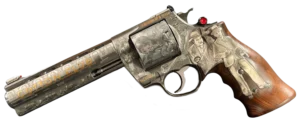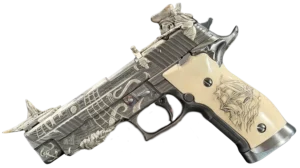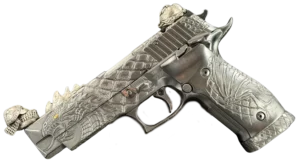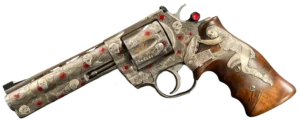

Key Takeaways:
- The Art Lives in the Design, Not Just the Cuts: Technical skill matters, but it’s not the whole story. Plenty of engravers can execute clean scrollwork or precise bulino. What separates a craftsman from an artist is original design and the ability to treat the entire firearm as a single composition. If the engraving could be peeled off and stuck on any other gun without anyone noticing, it’s a decoration. If it feels like it belongs on that specific firearm and nowhere else, that’s art.
- Provenance Can Matter More Than the Metal: Two firearms with nearly identical engraving by the same master can sit at completely different price points, and the reason is the story. Factory letters, commission records, ownership history, exhibition documentation: these things multiply value in ways that aesthetics alone cannot. The collectors who document everything today are building the provenance that future buyers will pay a premium for tomorrow.
- Hand Engraving Exists in a Category of Its Own: Laser work, chemical etching, and machine engraving all have their place, but they’re fundamentally different from what a master engraver does by hand. The depth, the tactile quality, the organic variation that comes from a human guiding a graver across steel in real time: none of that can be replicated by a machine. If you’re evaluating a piece, run your fingernail across the surface. You’ll feel the difference before you see it.
Let’s get started…
The bench is small. Smaller than you’d think. A jeweler’s lamp throws a tight circle of white light across a receiver that’s been stripped and polished to a mirror finish. The engraver leans in, his left hand steadying the piece in a vise lined with leather, his right guiding a hand-push graver across the steel with the kind of pressure you’d use to sign your name. Except this signature takes four hundred hours.
There’s no sound but the whisper of carbide on metal. A curl of steel, thinner than a human hair, peels away. And underneath it, something starts to emerge. A leaf. A vine. The muscled flank of a running stag. What was blank, cold, industrial steel ten minutes ago is beginning to breathe.
That moment, that shift from manufactured object to something alive, is what this whole conversation is really about.
A firearm is one of the few objects where engineering precision and artistic expression occupy the same physical space. The tolerances that make it function are measured in thousandths of an inch. The artistry that makes it unforgettable is measured in the same way. And when both reach their highest expression simultaneously, you’re not holding a weapon anymore. You’re holding a piece of cultural history.
So, when does a firearm stop being a tool and become art? Let’s talk about that.
How We Got Here: A Short History of Steel and Story
Firearms engraving didn’t begin as decoration. It began as information.
In 16th-century Europe, particularly in the gunmaking centers of Suhl, Ferlach, and later London and Birmingham, engraving served a practical purpose: it identified the maker, the owner, and sometimes the occasion. A coat of arms on a wheellock pistol wasn’t vanity. It was a serial number, a warranty, and a calling card rolled into one.
But craftsmen are craftsmen. Once you put a skilled hand near a blank surface and give it a sharp tool, something more than function starts to happen. German and Austrian gunmakers began expanding those maker’s marks into elaborate scenes. Hunting tableaux. Mythological figures. Scrollwork that flowed along barrel flats and curled around lock plates like living vines. The gun was still a gun, but it was also becoming a canvas.
By the 17th and 18th centuries, royal commissions advanced the art. Presentation firearms, the kind given between heads of state or awarded to military heroes, became showcases for the absolute best a workshop could produce. These weren’t meant for the field. They were meant for the cabinet. For the wall. For history.
When American gunmaking came into its own in the 19th century, it brought a new flavor. The scroll engraving that emerged on Colts and Winchesters was different from its European cousins, a bit bolder, a bit more open, less concerned with filling every square millimeter. Gustave Young, working at Colt’s factory, essentially invented what we now think of as the American engraving style. His work on presentation revolvers for figures like the Tsar of Russia and various U.S. military officers set a standard that’s still referenced today.
Here’s the thing people often miss: engraving wasn’t decoration first. It was identity, status, and storytelling. The decoration part came later, almost as an accident of ambition. Craftsmen kept pushing because they could, and because patrons kept asking for more. That tension between function and beauty is woven into the DNA of every engraved firearm ever made.
The Masters: Names That Define the Craft
If you collect engraved firearms, or you’re thinking about starting, these are the names that matter. Some are historical. Some are still working today. All of them represent a standard that separates great from merely good.
The Foundational Names
Gustave Young is probably the most iconic American firearms engraver in history. His work at Colt during the mid-1800s defined what American scroll engraving looks like. The flowing, organic patterns, the confident line weight, the way his designs wrap around a revolver’s cylinder as if the metal grew that way naturally. If you’ve ever seen a high-grade antique Colt and felt something stir in your chest, there’s a good chance Young’s influence is part of the reason.
L.D. Nimschke, working in New York around the same era, took a different approach. His scrollwork is bolder, more architectural. You can spot a Nimschke pattern across a room. Where Young whispers, Nimschke declares.
On the European side, the Ferlach school in Austria produced generations of engravers whose work blended Germanic precision with an almost baroque sense of drama. Deep relief scenes of stags, boar, and alpine landscapes became the hallmark of Austrian and German sporting arms. Franz Pfannl and the broader guild tradition in Ferlach created a lineage that continues to influence European gunmaking today.
The Modern Masters
This is where contemporary collectors really lean in, because these are the engravers shaping what the art looks like right now.
Mueller Murgenthal stands out for a design-driven, almost sculptural approach. The work isn’t just technically brilliant; it tells stories. There’s a narrative depth to each piece that elevates the firearm from an engraved object to something closer to a three-dimensional painting.
Phil Coggan is one of the most respected British engravers working today. His rose-and-scroll work carries the weight of the English tradition while feeling completely modern. There’s a discipline to his designs that rewards close inspection. The closer you look, the more you find.
Ken Hunt is a name that comes up whenever serious collectors discuss bulino work. His game scenes, rendered in microscopic detail using the bulino technique, achieve a photographic quality that’s almost hard to believe is cut into steel. The play of light and shadow in his animal portraits is extraordinary.
Winston Churchill, and no, not that Winston Churchill, is another bullino master whose work has earned a devoted following among collectors who appreciate ultra-fine detail.
Alvin White represents a distinctly American approach to modern engraving. His style is recognizable, confident, and beautifully balanced. Rudolf Kornbrath, meanwhile, bridges old-world European technique with American expression, creating work that feels rooted in tradition while pushing into new territory.
And you can’t talk about the global landscape without acknowledging the Italian masters. Workshops like Bottega Giovanelli and Creative Art continue a tradition of bulino and bas-relief engraving that Italy has cultivated for centuries. The Belgian and German guild traditions, likewise, remain vital forces in the field.
What separates all of these engravers from the thousands of competent craftspeople working on firearms? Originality. Vision. The ability to see the whole firearm as a composition, not just a collection of flat panels waiting to be filled.
The Language of Engraving: Techniques That Matter
If you’re going to appreciate engraved firearms or spend serious money on them, understanding the major techniques is essential. Not because you need to become an engraver yourself, but because knowing what you’re looking at changes how you see it. Completely.
Scroll Engraving
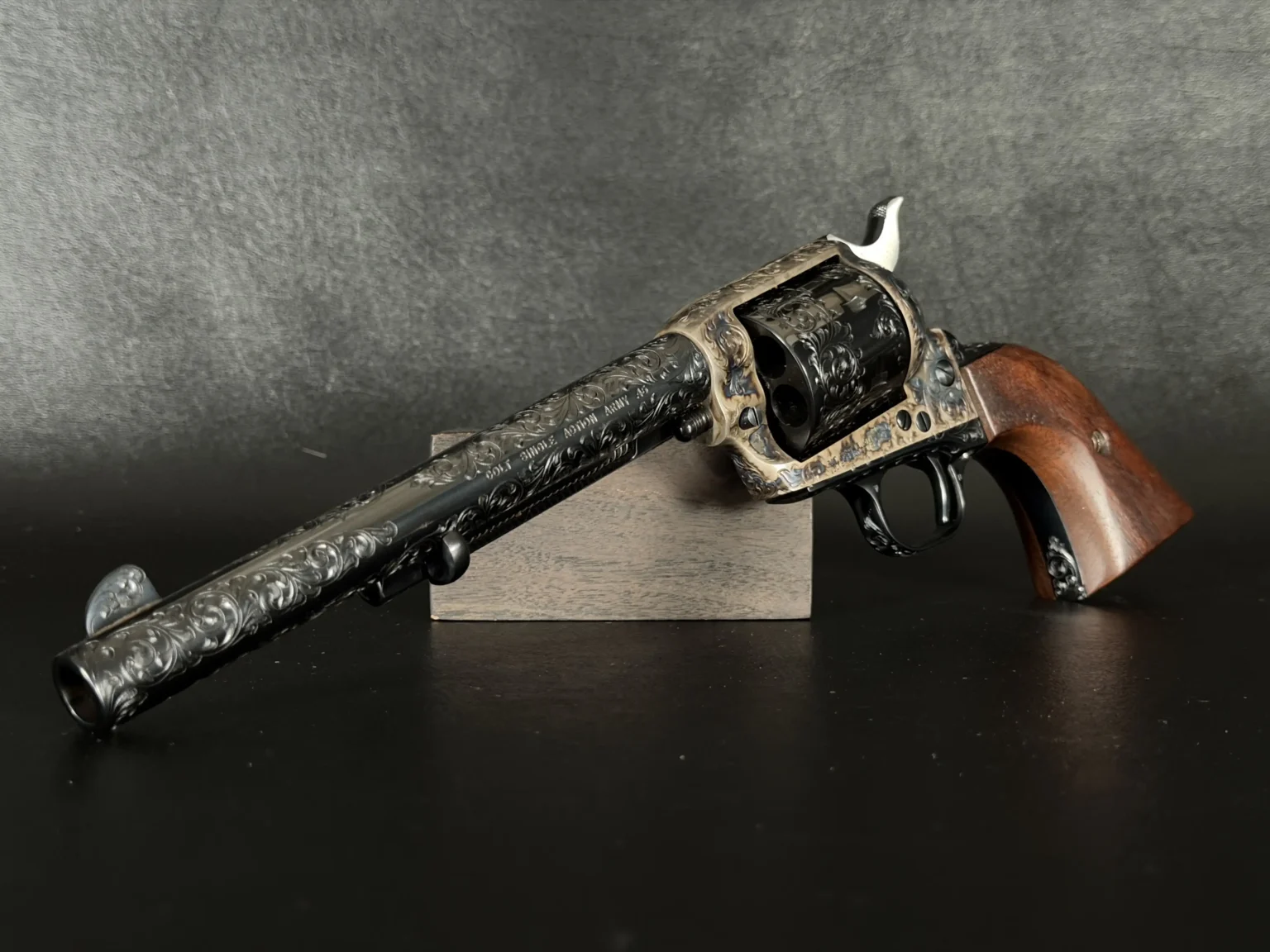
This is the backbone of the craft. Scroll engraving uses flowing, curvilinear patterns, typically vegetal or abstract, to cover the surface of a firearm. Good scroll work has rhythm. It flows. The lines have consistent depth and width, the curves balance one another, and the overall composition feels organic rather than mechanical.
Bad scroll work looks like wallpaper. Good scroll work looks like it’s alive.
The American tradition tends toward more open, airy scrolls with wider spacing. English rose, and the scroll is tighter, more formal, often incorporating floral elements. Both require years of practice to execute well. The symmetry has to be near-perfect, but not so perfect that it looks computer-generated. There needs to be just enough of the human hand visible to keep it warm.
Bulino
If scroll engraving is the backbone, bulino is the eye. This technique uses a very fine graver to create images through thousands of tiny dots and lines, almost like a steel-point etching or a stipple drawing. The results can be astonishing. Detailed animal portraits, landscapes, and even human figures are rendered with a subtlety that approaches photographic realism.
The catch? It’s painfully slow. A single bulino panel on a shotgun receiver might take weeks of work under high magnification. The engraver is essentially building an image one microscopic cut at a time, controlling light and shadow through the density of marks rather than the depth of cut. It’s the engraving equivalent of pointillism, and the best practitioners, people like Ken Hunt and Winston Churchill, achieve results that genuinely defy belief.
Deep Relief
Where bulino creates illusion, deep relief creates reality. In this technique, the engraver carves away the background metal, leaving figures and scenes standing proud of the surface. The result is sculptural. You can feel it with your fingertip. Light catches it differently depending on the angle.
The Germanic and Austrian traditions excel in deep-relief work. A high-grade Ferlach rifle with deep relief game scenes is as much a sculpture as anything you’d find in a gallery. The technical difficulty is considerable. The engraver has to manage depth, perspective, and structural integrity simultaneously. Cut too deep, and you compromise the metal. Too shallow, and the effect falls flat.
Gold Inlay
There’s something about gold on steel that stops people in their tracks. Gold inlay involves cutting channels or pockets into the steel surface and then hammering in 24-karat gold wire or sheet. The gold is held in place mechanically, wedged into undercut grooves that grip it permanently.
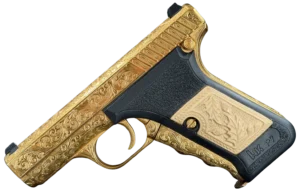
The best gold inlay work is flush with the surrounding steel, polished smooth, and integrated into the overall design as if the gold grew there. Borders, lettering, small accent elements, or entire figures can be rendered in gold. Some pieces incorporate multiple gold colors or combine gold with platinum or silver for added contrast.
It’s one of those techniques that collectors sometimes underestimate. Clean, well-executed gold inlay requires extraordinary precision. The channels have to be cut perfectly. The gold has to be seated without gaps. And the final polish has to bring everything to the same plane without disturbing the surrounding engraving.
Background Treatments
These are the quiet heroes of firearms engraving. Matting, stippling, and other background treatments create contrast that makes the primary design elements pop. A matte background behind polished scroll work creates depth. Stippled areas around a Bulino scene frame it like a museum mounting.
The difference between a good engraver and a great one often shows up here, in the parts you almost don’t notice. Consistent, even background treatment across an entire firearm is much harder than it sounds.
Design vs. Execution: The Difference Between Craft and Art
Here’s where it gets interesting, and where a lot of collectors miss the distinction that matters most.
Technical skill is necessary but not sufficient. There are engravers working today who can execute any pattern you put in front of them with machine-like precision. Their cuts are clean, their scrolls are symmetrical, their bulino is fine-grained. And their work is… competent. Sometimes very competent. But it doesn’t sing.
Then there are engravers whose work stops you cold. The difference? Design.
An engraver who creates original designs, who composes across the entire firearm rather than decorating individual panels, who understands how the engraving relates to the mechanical lines and curves of the gun itself, that’s an artist. Copying a pattern from a book is a craft. Seeing the blank firearm and envisioning something that has never existed before is art.
The greatest engraved firearms feel unified. The scrollwork on the trigger guard connects visually to the scene on the receiver, which flows into the border treatment on the barrel flats. Nothing feels pasted on. The gun and the engraving are one and the same, inseparable.
This is what you should look for when you’re evaluating a piece. Does the design feel like it belongs on this specific firearm? Or could you peel it off and stick it on any other gun without noticing? That question, more than any technical measurement, tells you whether you’re looking at decoration or art.
The Canvas Matters: How the Firearm Shapes the Art
Great engraving doesn’t happen in a vacuum. The firearm itself is half the equation.
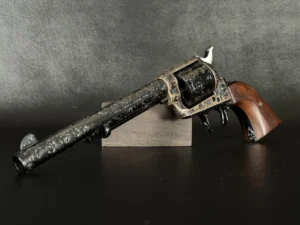
Consider the difference between engraving a Colt Single Action Army and a side-by-side shotgun. The Colt offers small, curved surfaces: a cylinder, a backstrap, a trigger guard, and a small frame. The engraver has to work within tight geometric constraints. A shotgun receiver, by contrast, offers broad, relatively flat panels that invite expansive scenes and elaborate compositions.
European makers have understood this for centuries. The best English, Italian, and German gunmakers design their firearms with engraving in mind from the start. The shapes of the action body, the proportions of the fences, even the sweep of the trigger guard, all of it is designed to receive and complement the engraver’s work.
On the American side, the relationship between maker and engraver has evolved. Colt and Smith & Wesson both have long histories of factory engraving, with specific coverage patterns and styles associated with different grades. A Colt D-grade engraving has a very different character from an A-grade, and knowing those distinctions matters if you’re collecting.
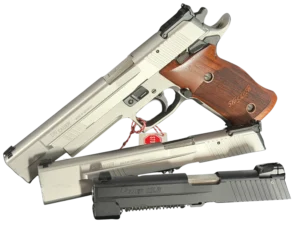
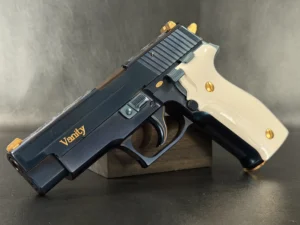
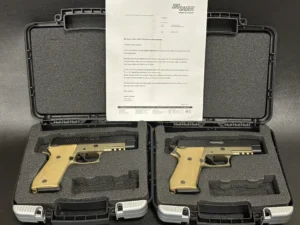
Then there are the modern custom shops. SIG Sauer’s Mastershop produces pieces that blur the line between factory production and bespoke artistry. The difference between Mastershop level work and standard factory embellishment is like the difference between a hand-tailored suit and something off the rack. Same basic shape, completely different experience.
The point is this: the gun is the canvas, but it’s also part of the composition. Great engravers know this instinctively. They don’t fight the firearm’s lines. They work with them.
Provenance: When the Story Changes Everything
Two firearms can carry virtually identical engraving by the same master engraver, in the same style, with the same coverage and technique, and still sell for wildly different prices. The reason? Story.
Provenance is the narrative thread that connects a firearm to history. A factory letter confirming the original order, a commission history linking the piece to a notable figure, documentation of exhibition or publication, these things multiply value in ways that pure aesthetics alone cannot.
A presentation Colt engraved by Gustave Young is valuable. A presentation Colt engraved by Young and documented as having been given to a Civil War general? That’s a different category entirely. The engraving is the same. The story is not.
This applies at every level of the market. A modern custom piece by a living master engraver gains value when it comes with documentation of the commission: who ordered it, why, what design brief the engraver worked from, and photographs of the work in progress. Collectors increasingly understand that buying the story alongside the object is part of what makes the investment meaningful.
One-of-one pieces, firearms that represent a unique collaboration between maker and engraver with no duplicates, carry an inherent premium. Limited runs, particularly those associated with specific events or commemorations, can also appreciate significantly, though the market tends to reward genuine rarity over manufactured exclusivity.
The lesson for collectors is straightforward: document everything. Keep the factory letters. Save the correspondence. Photograph the piece regularly. The story you preserve today is the provenance that multiplies value tomorrow.
Engraved Firearms as Fine Art: The Investment Perspective
Let’s talk about something that the traditional art world has been slow to acknowledge, but that collectors have long known: the finest engraved firearms belong in the same conversation as sculpture, fine watches, Fabergé, and museum-quality jewelry.
Think about what a master-engraved firearm actually is. It’s a precision-engineered mechanical object that has been transformed by hundreds of hours of handwork into a unique piece of decorative art. The materials are precious or semi-precious. The craftsmanship is at the absolute pinnacle of what human hands can achieve. The cultural and historical significance is often profound.
Now compare that to a high-end mechanical watch. The Swiss watch industry has successfully positioned itself as a fine art, and rightfully so. But consider: a Patek Philippe with hand-engraved case decoration uses many of the same techniques and tools, and often has less total engraving coverage than a fully engraved shotgun or revolver. Yet the watch sells in a market that broadly recognizes its artistic merit, while the firearm often does not.
That’s changing. Auction houses have seen consistent appreciation in master-engraved firearms over the past two decades. The collector base is global and growing. And as the market matures, the distinction between “gun collecting” and “fine art collecting” continues to blur.
From a pure investment standpoint, engraved firearms by recognized masters have demonstrated remarkable stability. They neither track the stock market nor follow real estate cycles. Instead, they exist in a distinct ecosystem governed by three key factors: rarity, condition, and the engraver’s reputation. A piece by a deceased master in excellent condition is, almost by definition, a finite resource whose supply can only diminish over time.
The best engraved firearms aren’t just collectible. They’re cultural artifacts, objects that carry forward a tradition of craftsmanship that stretches back five centuries. And cultural artifacts, historically, tend to hold their value rather well.
The Collector’s Eye: How to Evaluate an Engraved Firearm
If you’re going to buy, you need to know how to look. Here’s what separates an informed purchase from a hopeful one.
Start with the design. Is it original, or is it copied from a pattern book? Original designs by known engravers carry significantly more value. Look at the overall composition. Does the engraving flow across the entire firearm as a unified piece, or does it feel like a series of disconnected panels? The best work treats the gun as a single canvas.
Next, examine the execution. Get a loupe, a good one, and look at the cuts. They should be clean and confident, not scratchy or hesitant. Depth should be consistent across similar elements. Scroll lines should maintain their width. Backgrounds should be even. Any gold inlay should be flush, without visible gaps or lifting.
Check the coverage. Is it appropriate for the firearm? Over-engraving is a real thing. Some pieces suffer from too much coverage, with every surface filled, leaving no breathing room. The negative space, the areas left undecorated, is as important as the decorated areas. Great engravers understand restraint.
Look at how the engraving interacts with the firearm’s mechanical features. Does the scroll flow around the screw heads, or crash into them awkwardly? Does the design acknowledge the safety, the loading gate, and the action release? These details reveal whether the engraver was working with the gun or just working on it.
Consider the engraver. Is the work signed? Can it be attributed to a known hand? Documentation of who performed the engraving and when is critical to both authenticity and value.
And finally, provenance. What’s the paper trail? Factory letters, commission records, exhibition history, and published references all contribute to the piece’s story and its market position.
One more thing, and this matters: trust your gut. After you’ve done all the analytical work, step back and just look at the piece. Does it move you? Does it feel alive? The best engraved firearms have a quality that transcends checklist evaluation. They have presence. If a piece has that, and the fundamentals check out, you’re probably looking at something worth owning.
Red Flags: What to Watch For
While we’re on the subject of evaluation, it’s worth flagging some common mistakes, both in engraving itself and in how it’s marketed.
Over-engraving is probably the most frequent issue on custom pieces. More coverage doesn’t always mean more value. Some of the most breathtaking engraved firearms in history have relatively modest coverage, but what’s there is perfect. When every surface is filled to bursting, the eye has nowhere to rest. The design becomes noise instead of music.
Poor proportions are another giveaway. Scroll elements that are too large for the surface, or too small to read clearly, suggest an engraver who isn’t thinking compositionally. The relationship between the size of the design elements and the area they occupy should feel natural, almost inevitable.
Shallow cuts are a technical red flag. Hand engraving should have depth you can feel. If the work looks detailed under magnification but feels nearly flat to the touch, something’s off. Similarly, inconsistent cut depth across a piece suggests either rushed work or an engraver still developing their control.
Mismatched themes are subtler but important. A Western-themed revolver with English rose and scroll? A German drill with American-style open scroll? These combinations can work in the hands of a brilliant designer, but more often they suggest a lack of coherent vision.
A Word on What Engraving Is Not
It’s worth taking a moment to distinguish true hand engraving from its imitators, because the market is full of objects that look similar to the untrained eye yet are fundamentally different.
Laser engraving uses a computer-controlled beam to remove metal. It can produce detailed images and has legitimate applications, but it lacks the depth, character, and tactile quality of hand-cut work. Run your fingernail across the laser engraving, and it feels flat. Run it across hand engraving, and you feel the valleys and ridges. The difference is immediately apparent once you know what you’re feeling for.
Chemical etching uses acid to eat away unmasked areas of metal. It can produce attractive patterns and is commonly used for factory-level decoration. But it’s not engraving. The lines lack the crisp, V-shaped profile of a graver cut. The depth is uniform rather than varied. And the artistic input is largely in the mask design, not the execution.
Machine engraving, sometimes called pantograph engraving, uses a mechanical system to copy a master pattern. It’s efficient and consistent, which is precisely why it can’t match handwork. The slight variations in hand engraving, the organic quality, and the evidence of a human being guiding the tool in real time are exactly what give handwork its soul.
None of this means laser, chemical, or machine work is bad. They’re just different. The problem arises when they’re represented as, or confused with, master hand engraving. If you’re paying hand-engraving prices, make sure you’re getting hand engraving.
Regional Styles: A World of Difference
One of the fascinating aspects of firearms engraving is how geography shapes aesthetics. The major regional traditions are as distinct as the cultures that produced them.
American scroll engraving, the lineage running from Gustave Young through Alvin White and into today’s masters, tends to be open and flowing. There’s space in the design. The scrolls breathe. Coverage patterns are often categorized by grade, from minimal to full, and even full-coverage American work typically maintains a sense of air and movement.
English rose, and the scroll is tighter, more formal, more disciplined. The patterns are precise and often incorporate specific floral elements, roses, thistles, and acanthus leaves, arranged with almost architectural balance. London’s “best” guns from makers like Purdey and Holland & Holland represent the pinnacle of this tradition.
Italian bulino work, particularly from the workshops of Brescia and Gardone, achieves levels of pictorial detail that are genuinely breathtaking. The Italian tradition prizes fineness above all, and the best Italian engravers produce game scenes and portraits that function as miniature masterworks.
Germanic deep relief, rooted in the Ferlach and Suhl traditions, is bold and three-dimensional. Stags, chamois, boar, and alpine scenes carved in high relief against stippled or matted backgrounds create a dramatic, almost theatrical effect. These pieces demand attention in a way that quieter styles don’t.
Belgian engraving, particularly the guild work from Liege, occupies its own space, technically rigorous, stylistically versatile, and often bridging the gap between English formality and Continental expressiveness.
Each tradition has its collectors, its advocates, and its masterpieces. There’s no “best” style, only different expressions of the same fundamental impulse: to make something functional into something beautiful.
The Weight of Hours
Something that collectors and non-collectors alike tend to underestimate is time. The sheer number of hours that go into a master-engraved firearm is staggering.
A fully engraved and gold-inlaid shotgun by a top-tier engraver can take six months to a year of full-time work. That’s five or six days a week, eight or more hours a day, under magnification, making cuts that must be perfect because there’s no “undo” on steel. A slip of the graver, a moment of lost concentration, and days of work can be ruined.
Consider what that means. While you might commission a custom painting and have it finished in weeks, a custom-engraved firearm is a commitment measured in seasons. The engraver is spending that time not just cutting metal but also thinking about composition, making design decisions, and solving visual problems as the work progresses. It’s a collaboration between the artist and the material, unfolding slowly.
And here’s the part that really gets collectors: you can’t rush it. You can’t throw more money at it and speed it up. The only way to get a master-engraved firearm is to wait while a master engraver does what only they can do, one cut at a time.
This time investment is part of what makes master engraving so rare and so valuable. There are only so many hours in a career, and a top engraver might complete only a handful of truly extraordinary pieces in their lifetime. When you buy one of those pieces, you’re buying a significant portion of someone’s creative life.
Steel, Story, and Legacy
Let’s bring this back to where we started. That small bench. That circle of light. The whisper of carbide on steel.
Every engraved firearm begins as a manufactured object. Machined, assembled, and finished to specification. It’s precise. It’s functional. And it’s anonymous. It could be any gun off the line.
Then a human being sits down with hand tools and begins to change it. Cut by cut, hour by hour, the metal transforms. Patterns emerge. Scenes take shape. Gold settles into channels. And somewhere in that process, the object crosses a threshold. It stops being a product and becomes a piece of art, carrying the vision of the engraver, the intent of the commissioner, and the weight of a tradition that stretches back centuries.
A well-engraved firearm isn’t just owned. It’s stewarded. The collectors who understand this, who appreciate not just the visual beauty but the cultural significance, the craftsmanship, and the story, are the ones preserving something irreplaceable.
Because the master engravers won’t be here forever. Their techniques are taught to new hands, yes, but each master’s individual voice, their particular way of seeing and cutting, dies with them. Every piece they create is a record of a moment in the life of the art. And the collectors who recognize that, who buy thoughtfully and preserve carefully, aren’t just building collections.
They’re keeping a five-hundred-year conversation alive.
Frequently Asked Questions
Hand engraving produces deep, V-shaped cuts with organic variation you can actually feel with your fingertip, while laser and machine work tends to feel flat and uniform. The slight imperfections and human touch in hand-cut work are exactly what give it soul and collectible value.
A top-tier, fully engraved and gold-inlaid shotgun or revolver can take anywhere from six months to over a year of full-time work. There’s no shortcut, because every cut has to be right the first time since there’s no “undo” on steel.
Look at the design first, specifically whether it feels like a unified composition across the entire firearm rather than disconnected decorative panels. After that, check for documentation: a signed piece by a known engraver with solid provenance will almost always outperform an anonymous one.
Not necessarily. Over-engraving is a common issue, and some of the most valuable engraved firearms in history have modest coverage, with every element perfectly placed and the negative space doing its own work.
Two nearly identical pieces by the same engraver can sell at wildly different prices based solely on their documented histories. Factory letters, commission records, and ownership history transform a beautiful object into a piece of cultural narrative, and collectors pay a real premium for that story.