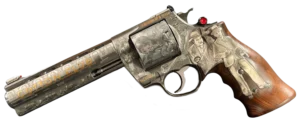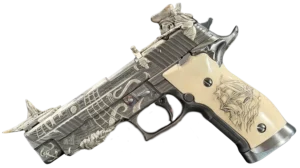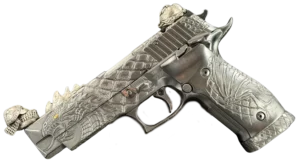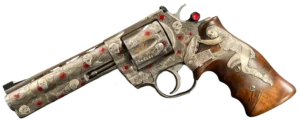

Key Takeaways:
- Post-War Craftsmanship Over Mass Production: Willi Korth saw an opening in the 1950s firearms market that most manufacturers missed. People were tired of wartime mass production and wanted guns built to last generations, not just campaigns. His answer? Hand-fitted pistols that took forever to make but were worth the wait.
- Precision Engineering Meets Stubborn Philosophy: Korth’s background in precision mechanical systems wasn’t just a fun fact. It shaped everything about how he approached firearms. Where other manufacturers were happy with “close enough,” Korth obsessed over tolerances and fit the way someone who worked with industrial machinery would. That stubbornness created guns that still set standards seventy years later.
- Historical Originals vs. Modern Descendants: Here’s where it gets interesting: the early Ratzeburg-era Korth semi-autos and modern Korth pistols like the PRS aren’t the same gun. They’re separated by decades and different manufacturing realities. But they share the same DNA – that uncompromising commitment to quality over profit. Modern Korths carry forward the philosophy even if the methods evolved.
Look, there are guns, and then there are guns. The early Korth semi-automatics fall squarely in the second category.
You’ve probably never held one. Most people haven’t. But if you’re into firearms at all, you’ve heard the name whispered with a kind of reverence usually reserved for vintage Ferraris or Swiss watches. And honestly? The mystique is earned.
This is the story of how a German engineer trained in precision mechanical engineering through railway and industrial systems looked at the firearms industry in the 1950s and thought, “I can do this better.” Spoiler: he absolutely could.
Willi Korth and His Peculiar Obsession
After World War II ended, Europe was rebuilding. The firearms market was flooded with mass-produced guns that did the job, but rarely did they do it beautifully. Functionality over finesse, you know? Willi Korth saw an opening.
Here’s a guy whose background in precision mechanical engineering and tooling meant he understood tolerances in ways most people never would. That mindset doesn’t just disappear. Korth looked at handguns the way he looked at industrial machinery: if it’s worth doing, it’s worth doing perfectly.
In 1954, he founded Korth Waffen in Ratzeburg, a small town that probably seemed like an odd choice for a firearms manufacturer. But Korth wasn’t interested in being close to industry hubs or supply chains. He wanted a place where he could build guns the way he wanted, without compromise.
His early semi-automatic pistols were born from that stubbornness.
What the Post-War Market Actually Wanted
Here’s the thing about the late 1940s and 1950s: people were tired of wartime manufacturing. During the war, guns were churned out by the millions. Speed was everything. Tolerances were loose. If a rifle lasted long enough to get through a campaign, it was good enough.
But peacetime shifted the calculus. Suddenly, shooters weren’t just soldiers who needed something that worked most of the time. They were sportsmen, collectors, people who wanted a firearm that wouldn’t let them down in year five or year fifty. The demand for quality surged.
Korth understood this better than most. His firearms weren’t designed to be replaced. They were designed to be inherited.
The Early Korth Semi-Autos Take Shape
The Ratzeburg-era Korth semi-automatics evolved over time, each iteration refining what came before. These weren’t standardized production models in the modern sense. Each gun was hand-fitted, low-volume, and almost experimental in how Korth approached continuous improvement.
This wasn’t about flashy redesigns or marketing gimmicks. Korth made changes because they improved the gun’s performance or the shooter’s experience. Period.
Design Philosophy: Function Meets Art
Let’s talk about what made these early pistols special.
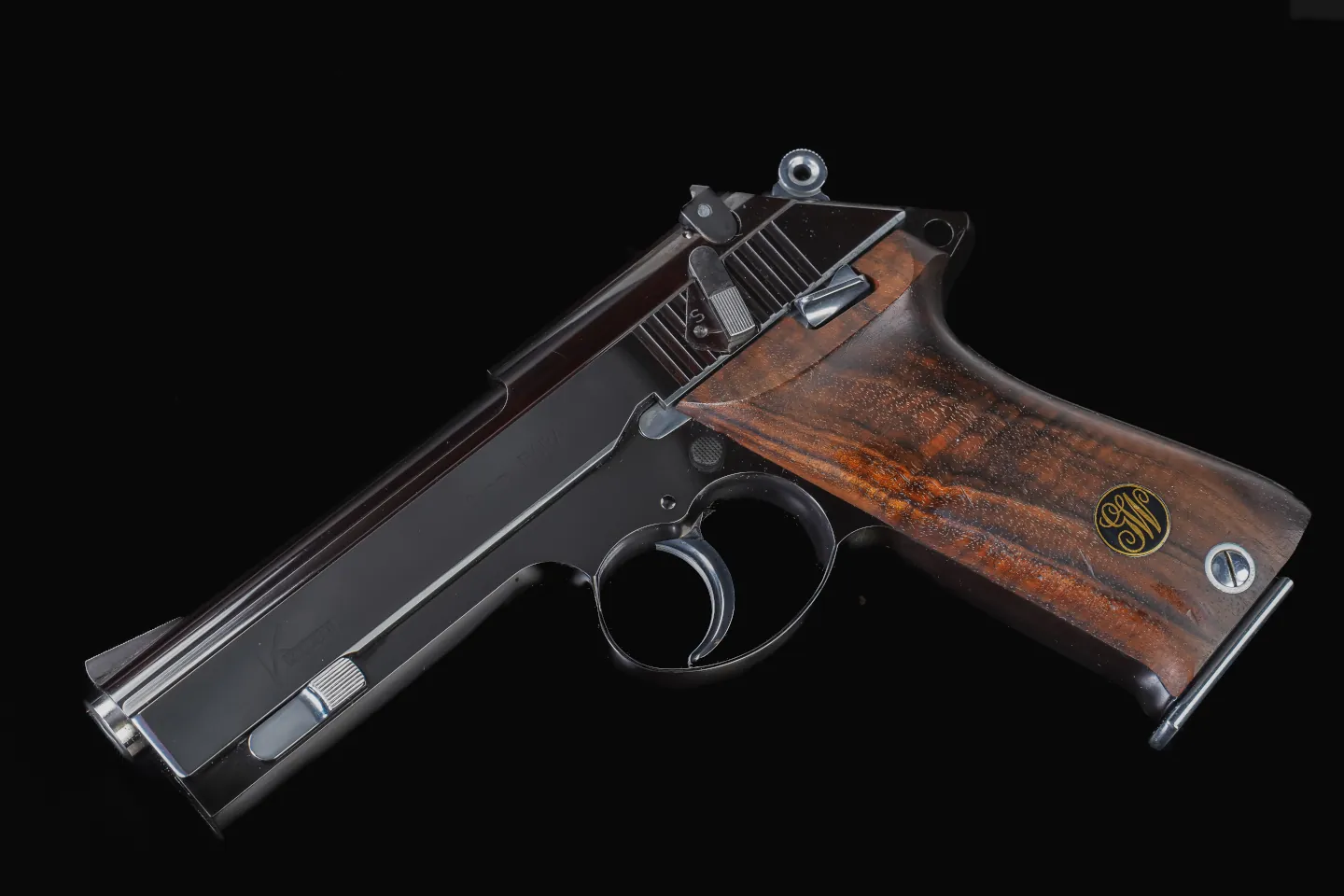
First, the lines. Sleek without being showy. The curves flow naturally into each other. There’s nothing tacked on for looks. Every angle serves a purpose, whether it’s helping with the draw or improving balance.
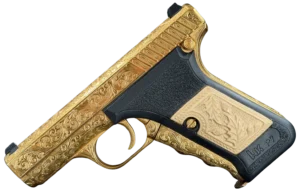
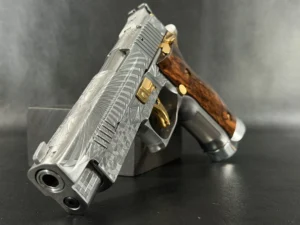
The grip is where you really notice the hand-fitting. It’s not molded plastic stamped out by the thousands. Each grip was shaped, fitted, refined until it sat in your hand like it was made specifically for you. Because, in a way, it was. When you’re hand-fitting each piece, you’re not making a generic product for a generic customer. You’re making a tool for someone who cares.
The trigger pull? Smooth doesn’t quite capture it. It’s like butter, except butter doesn’t help you place rounds accurately. The slide action has this seamless quality that you don’t fully appreciate until you’ve handled lesser guns. Everything just… works together.
Balance is huge with these pistols. Korth’s approach involved obsessing over weight distribution. The gun sits in your hand without feeling front-heavy or awkward. This isn’t luck. It’s the result of countless hours tweaking internal mechanics and component placement until everything aligned.
Breaking Down the Specs (Without Getting Too Deep)
Okay, technical stuff can get tedious fast, so let’s keep this simple.
Caliber options: The early Korth semi-autos were primarily chambered in 9mm. You’d occasionally see other calibers, including .45 ACP, but those were far rarer. The 9mm made sense for most shooters. Manageable recoil, decent power, practical for the era.
Barrel length: The early models varied more than modern pistols do. Korth wasn’t locked into standardized dimensions the way manufacturers are today. Each generation brought subtle changes as he refined his thinking.
Capacity: Modest by modern standards, reflecting Korth’s emphasis on control and balance over volume. Remember, this isn’t about spraying bullets. It’s about placing them where they need to go.
The capacity thing bugs some modern shooters. “Why not more rounds?” Fair question. But Korth prioritized other things: the feel in your hand, the smoothness of the action, the overall elegance of the design. Adding more rounds means a thicker grip, more weight, different balance. Trade-offs everywhere.
Two Expressions of the Korth Philosophy, Separated by Decades
Funny enough, when people talk about Korth pistols today, there’s often confusion about which gun they mean.
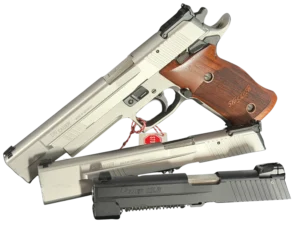
The modern Korth PRS represents a later chapter in the Korth story. It’s a competition-focused design built with modern CNC refinement and contemporary manufacturing methods. But it shares that same uncompromising philosophy Willi Korth established in the 1950s.
What Makes the PRS Different
The PRS is heavier. It’s longer. This contributes to accuracy because you’ve got less movement, better control, more stability when you’re taking that careful shot at a distant target. Competition shooters love it for exactly these reasons.
The sights are adjustable. You can customize the grips. Basically, it’s built for people who want to fine-tune everything to match their shooting style perfectly. If you’re serious about competition shooting, these features matter.
But here’s the thing: comparing the PRS to the original Ratzeburg semi-autos is like comparing a modern Porsche to a 1950s 356. Both are exceptional. Both share DNA and philosophy. But they’re products of different eras with different technologies and manufacturing realities.
Understanding the Lineage
The early Korth semi-automatics were hand-fitted experiments in perfection, built in small numbers with methods that couldn’t scale.
Modern Korth pistols like the PRS carry forward that philosophy of uncompromising quality, but they’re not the same gun. They represent what happens when Willi Korth’s obsessive standards meet contemporary engineering and manufacturing capabilities.
Neither is cheap, let’s be clear. These are high-end firearms across every generation. But they serve slightly different purposes and come from different manufacturing realities.
Why Those Early Pistols Still Matter
The Ratzeburg-era Korth semi-automatics aren’t just some vintage guns that were cool once upon a time. They’re still revered today, and that’s saying something in an industry that constantly pushes new models and “improvements.”
Hand-Fitted in an Era of Mass Production
Every early Korth semi-auto was hand-fitted and finished to standards few manufacturers attempted. Precision machining was involved, sure. But then skilled craftspeople spent hours on each firearm, fitting components, refining surfaces, testing, and retesting until everything met Korth’s standards.
This is weirdly uncommon today. Most firearms are made in factories with impressive efficiency and tight computer-controlled tolerances. They’re good guns. But they’re not this.
There’s something about holding a hand-fitted tool that’s hard to explain if you haven’t experienced it. You can feel the attention in the weight, the action, the way it responds. It’s the difference between wearing a mass-market watch and a handmade timepiece. Both tell time. One feels different on your wrist.
Reliability That Actually Means Something
“Reliable” gets thrown around constantly in gun marketing. Every manufacturer claims their product is reliable. But those early Korth pistols have decades of performance backing up the claim.
These guns work. They work in different conditions, after thousands of rounds, year after year. Owners report levels of consistency that are genuinely rare. Failures are so uncommon they’re noteworthy when they happen.
Part of this comes down to the hand-fitting. When a person is personally responsible for fitting your firearm, they tend to care more about whether it works perfectly. There’s no hiding behind statistical quality control or acceptable failure rates. Each gun has to be right.
The Exclusivity Factor
Korth never mass-produced firearms in the Ratzeburg era. Production numbers were limited, partly by choice and partly because hand-fitting guns is inherently slow.
This makes the early semi-autos genuinely rare. Not artificially scarce. Genuinely uncommon. Owning one means you’re part of a small group. Collectors value this. But even non-collectors appreciate the uniqueness.
It’s not just about bragging rights (though, let’s be honest, there’s some of that). It’s about owning a piece of firearms history that most people will never hold.
What This Gun Represents
Look, you can buy a perfectly functional handgun for a fraction of what an original Korth semi-auto costs. Nobody’s arguing otherwise. This isn’t about pure functionality. It never was.
Those early Korth pistols represent a philosophy. It’s what happens when someone decides that “good enough” isn’t actually good enough. When precision and craftsmanship matter more than profit margins and production speed.
In a world that increasingly values efficiency over excellence, they’re almost defiant. They refuse to compromise. Every component was made to last not years but decades. The design prioritized the shooter’s experience over manufacturing convenience.
Willi Korth could have built cheaper guns. Faster guns. Guns that would have made him more money. He chose not to. That choice, that stubbornness, created something that still commands respect seventy years later.
The Human Element
There’s a tendency in firearms writing to focus purely on specs and performance. But guns aren’t just mechanical objects. They’re tools made by people for people.
Every early Korth semi-auto has a story. The craftsman who fitted the grip learned their trade over the years. The person who refined the trigger mechanism probably tested hundreds of variations. Someone made specific choices about angle and weight and feel, based on experience and expertise and, yeah, some amount of intuition.
When you hold an original Korth semi-auto, you’re holding the result of all those human decisions. That’s what makes it different from a gun that was designed by an algorithm and assembled by robots. Not that there’s anything wrong with modern manufacturing. But it produces a different product.
The craftsmanship isn’t just about quality, though quality matters. It’s about connection. The person who built your gun cared whether it worked perfectly. They had pride in their work. That matters more than you’d think.
Where Things Stand Today
The firearms industry has changed dramatically since 1954. Computer-aided design, CNC machining, and advanced materials. You can build incredibly precise firearms with modern technology.
Korth today builds firearms inspired by the same uncompromising philosophy, even as methods and ownership evolved. Modern Korth pistols carry forward that obsession with quality, adapted to contemporary manufacturing realities and competitive shooting demands.
Collectors still hunt for vintage Korth semi-autos from the Ratzeburg era. Modern shooters still save up for new Korth pistols. The waiting list exists for a reason.
Final Thoughts
The early Korth semi-automatics aren’t for everyone. They’re expensive, hard to find, and honestly, most shooters will never need this level of precision and hand-fitted craftsmanship.
But they existed. And that matters.
In a marketplace driven by quarterly earnings and production efficiency, Willi Korth was building guns the hard way, the slow way, the right way. Each one was a middle finger to the idea that everything should be faster, cheaper, more streamlined.
His background in precision mechanical engineering gave him an appreciation for tolerances that most people never develop. He brought that mindset to firearms and created something that still sets the standard. Not the most popular standard, maybe. Not the most practical one. But a standard nonetheless.
If you ever get the chance to hold an original Korth semi-auto from the Ratzeburg era, take it. You’ll understand what all the fuss is about. The balance, the action, the feel of something made right.
And if you never hold one? That’s okay too. Just knowing they existed, that someone cared enough to build firearms like this when it made no economic sense, is weirdly comforting.
Some things shouldn’t be compromised on. The early Korth semi-automatics prove it’s possible to hold that line.
Frequently Asked Questions
What is the Korth Semi?
The Korth Semi is a high-end, semi-automatic pistol that combines precision engineering with ergonomic design.
Who developed the Korth Semi?
Willie Korth, a renowned German firearms designer, conceived the Korth Semi to elevate both craftsmanship and performance.
Why is the Korth semi-significant?
It is a limited-production firearm sought by collectors and shooters for its rarity and exceptional quality.
How rare are these pistols?
Only a few hundred units were produced, adding to their value and exclusivity.
What calibers are available for the Korth Semi?
The Korth Semi is typically available in calibers such as 9mm, offering versatility for enthusiasts.
Who is the target audience for this firearm?
The Korth Semi appeals to severe collectors, shooting enthusiasts, and those seeking high-performance European firearms.