
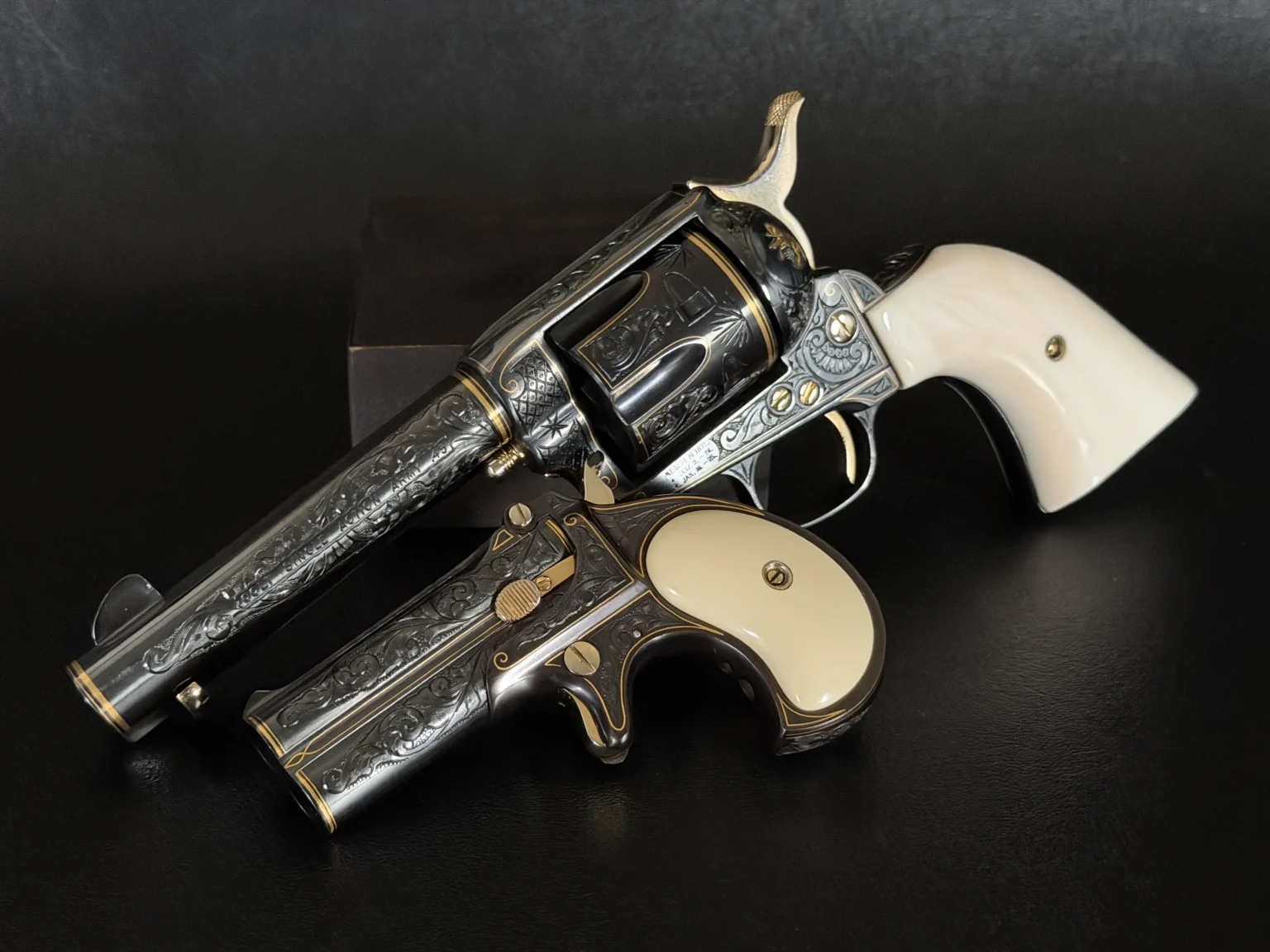
Key takeaways
- Paper drives value more than the material does. A Colt or Smith & Wesson factory letter confirming ivory or pearl at the time of shipment turns nice grips into documented history, and undocumented claims should be priced as unproven.
- A large share of the “ivory” at gun shows is actually celluloid. Schreger lines, the slow-warming feel of real ivory, and a small UV flashlight will catch most imitations. Celluloid matters for another reason: as it decays, it releases acidic gases that pit the surrounding steel.
- Federal law allows the sale of qualifying antiques and de minimis items containing African elephant ivory, but states including California, New York, New Jersey, Hawaii, Washington, and Oregon have their own bans, and several also cover mammoth ivory. Check both layers of law before any transaction.
In 1945, a newspaper man described General George S. Patton’s sidearm as a pearl-handled revolver. Patton set him straight, and not gently. The grips were ivory, he said, and only a pimp in a cheap New Orleans establishment would carry pearl. The exact wording shifts depending on who’s telling the story, but the attitude comes through in every version.
That one exchange explains most of what this corner of collecting is about. Grip material was a statement about who you were, or who you wanted people to think you were. Ivory said officer, rancher, serious man. Pearl said gambler, sport, showman. And more than a century later, collectors still pay real money for both, while picking their way through fakes, cracked originals, and a legal situation that changes depending on which state you’re standing in.
Sorting it out takes a little history, a little chemistry, and a fair amount of law. Start with the history, because that’s where the money and the mythology both come from.
Why anyone put pearl on a pistol in the first place
Walnut works fine. It always has. So the whole story of fancy grips is really a story about status, and it starts with Samuel Colt himself.
Colt understood something his competitors didn’t: a revolver could be a gift, and a gift could be advertising. He handed out engraved, ivory-stocked presentation revolvers to politicians, army officers, newspaper editors, and foreign royalty the way other businessmen handed out cigars. Those guns opened doors, and they set a template. A plain gun was a tool. A gun with ivory or pearl was a possession, something closer to a pocket watch or a signet ring.
By the time the Single Action Army arrived in 1873, ivory and pearl grips were regular special-order items in the Colt ledgers, available for a modest upcharge over standard stocks. Smith & Wesson, Remington, and Merwin Hulbert offered the same kind of thing. A working cowboy carried walnut or hard rubber. The saloon owner, the successful gambler, the town marshal who liked being noticed they carried something that caught the light.
The frontier gave us the famous examples. Wild Bill Hickok carried a pair of ivory-stocked 1851 Navy Colts, worn butt-forward, and contemporaries commented on them. Decades later, Hollywood picked up the visual shorthand and ran with it. Tom Mix and the screen cowboys who followed him wore carved and polished show grips because the camera loved them. By mid-century, the association was fixed: exotic grips meant personality.
Patton fit that tradition exactly. His ivory-stocked Colt Single Action Army, bought in 1916 when he was a young lieutenant, went with him through the Punitive Expedition in Mexico and both world wars. He knew precisely what the ivory said about him. That was the point.
Ivory first, because Patton was right about the hierarchy
Elephant ivory sits at the top of the traditional pecking order, and there are honest physical reasons for it, beyond snobbery.
Ivory is dentine, tooth material, and it behaves like nothing else. It’s dense enough to take fine carving and checkering. It has a warmth in the hand that plastic never quite matches. And it ages beautifully. New ivory is nearly white. Give it fifty years of handling and light, and it mellows toward cream, then a soft honey yellow. Collectors call that color patina, and on an original set of grips, it’s worth protecting rather than polishing off.
Ivory also has a built-in signature. Cut it across the grain, and you’ll see fine intersecting arcs, a crosshatch pattern called Schreger lines. Elephant and mammoth ivory show them; bone and plastic don’t. On a set of grips, look at the butt end or inside the grip panels where the surface was cut rather than polished. If the crosshatch is there, you’re looking at real elephant-family ivory.
The material has one serious flaw. Ivory moves. It absorbs and releases moisture with the seasons, and over decades of swelling and shrinking it cracks, usually starting at the screw hole or the escutcheon where the material is thinnest and pinned in place. Walk any major gun show, and you’ll see century-old ivory grips with a hairline running through the screw hole. That’s not abuse. That’s just what ivory does when it lives in Arizona for a while, or next to a radiator.
Elephant isn’t the only ivory on old guns, either. Walrus ivory turns up, particularly on guns with West Coast and Alaska histories. It’s identifiable by its core, which has a mottled, crystalline look quite different from the clean grain of elephant tusk. Mammoth ivory, dug from permafrost and riverbanks, shows the same Schreger crosshatch as elephant (the angles differ, which matters to labs and customs agents) and often carries mineral staining in browns, blues, and greens that carvers prize. Hippo tooth is whiter, harder, and finer-grained; it shows up more in 19th-century dental work and cutlery than on grips, but it exists in the wild, so to speak.
Each of those materials now sits in a different legal box, which we’ll get to. For now, the takeaway from the collecting is simple: “ivory” on an auction tag can mean five different animals and three different centuries, and the differences matter.
Pearl, the gambler’s choice
Mother of pearl isn’t pearl at all. It’s nacre, the iridescent inner lining of certain shells, and grip-sized pieces have to be sawn from big, thick shell. Much of the material used in the American trade came from Pacific pearl oyster shell, with domestic freshwater mussel shell feeding the button industry and some smaller work.
Nacre is genuinely beautiful in a way photographs undersell. The iridescence shifts as the gun moves, white to silver to faint rainbow. It’s cool to the touch and stays that way, one of the old tricks for spotting it. Colt offered pearl grips on the Single Action Army and its smaller revolvers for decades, plain or carved, and the carved examples (steer heads, eagles, Mexican-style relief work) are some of the most recognizable grips ever made.
The catch is that pearl is brittle. Far more brittle than ivory. It chips at the edges, cracks if a grip screw gets over-tightened, and flakes if the panels don’t sit flat against the frame. Finding a pre-war pearl-gripped revolver without at least a small chip at the toe or heel takes patience. Condition separates ordinary examples from exceptional ones faster with pearl than with any other material.
As for the reputation, Patton didn’t invent it. Pearl had a whiff of the sporting life about it well before he weighed in. It was flashier than ivory, cheaper in some grades, and popular with exactly the crowd respectable people enjoyed disapproving of. None of that stopped anyone from ordering it. Colt shipped pearl-gripped guns to bankers and sheriffs alike, and today the market has no such prejudice. Documented factory pearl brings strong money, full stop.
Stag, horn, tortoiseshell, and the woods
Below ivory and pearl sits a second tier of natural materials, each with its own following.
Genuine stag means sambar stag, antler from a large deer native to India. It’s denser than American deer or elk antler, solid nearly through the core, with a deep, gnarled surface texture and amber tones that domestic antler can’t match. For most of the 20th century, it was the standard material for stag grips and knife handles. Then India restricted and eventually shut down exports, citing disturbance to tiger habitat where the shed antlers were gathered, and the supply dried up. Old stock still circulates, and makers like Eagle Grips have sold from limited supplies when material surfaces, but genuine sambar now costs several times what it did, when you can find it. Most “stag” sold today is elk antler or dyed, jigged bone, which is fine as long as it’s described honestly.
Buffalo horn appears on grips in a deep, glossy black. It’s keratin, the same protein as fingernails, which brings two problems: it can warp or delaminate in dry conditions, and insects will literally eat it. Dermestid beetle damage on horn grips is a real thing. Inspect old horn closely.
Tortoiseshell, from the hawksbill sea turtle, is rare on firearms, more common on 19th-century pocket knives and combs. It’s also about as restricted as a material can get, with international trade essentially closed for decades. If you encounter it on a gun, assume documented antique status is the only path to a lawful sale, and verify before money moves.
Then there are the woods. Select walnut was the factory standard everywhere, but rosewood and ebony appeared on higher-grade guns, and both carve and polish beautifully. Worth knowing: rosewoods of the genus Dalbergia have come under international trade protections in recent years, which complicates cross-border shipping even for finished goods, though rules for finished items have been loosened since the initial listing. For domestic buying and selling of old grips, wood is the least complicated category on this list.
The plastics that fooled everybody
Here’s where a lot of collectors get burned, so slow down here.
The 19th century produced several early plastics, and gunmakers adopted them fast. The one you’ll hear named most often at shows is gutta-percha, a natural latex material used in the 1850s for cases and small goods. Collectors use the term loosely, and usually incorrectly, for what is actually hard rubber: vulcanized rubber, also called vulcanite or ebonite. Colt put checkered hard rubber grips with the rampant Colt motif on the Single Action Army starting in the early 1880s, and on the double-action Lightning and Frontier models. Those grips are correct, original, and collectible in their own right. They’re not gutta-percha, whatever the man at the table says.
The troublemaker is celluloid. Invented in the late 1860s and commercialized through the 1870s, celluloid was the first plastic that could really imitate ivory, and manufacturers leaned into it hard. They sold it as “French ivory” or “ivorine,” complete with faint parallel lines molded in to mimic the grain of ivory. Millions of straight razors, dresser sets, and yes, grips were made from it. A very large share of the “ivory” grips floating around gun shows today are celluloid, and some of the sellers genuinely don’t know.
Celluloid has two nasty habits. First, it’s dangerously flammable, so nobody should ever try the old hot-pin test on grips that might be celluloid. Second, it decays. As celluloid breaks down, it releases acidic gases that corrode the steel it touches or even shares a case with. If you’ve ever seen a revolver with a strange band of frosted pitting exactly where the grips sat, you’ve seen celluloid outgassing damage. Store suspect grips off the gun and away from other guns.
None of this makes early plastics worthless. Original hard rubber in fine condition has a real following, and even celluloid grips can be period-correct on the right gun. The problem is only when plastic gets sold as ivory, at ivory prices.
Factory, aftermarket, or Tiffany
Two sets of pearl grips can look identical and be worth wildly different money. The difference is paper.
Colt kept shipping records, and the Colt Archive will still research a serial number and issue a letter stating how the gun left the factory: caliber, barrel length, finish, grip material, destination. A Single Action Army that lettered with factory pearl or ivory is a different animal than the same gun wearing grips somebody added in 1955. The grips might even be the same age. Without documentation, they add charm; with it, they add serious value. Smith & Wesson offers similar historical letters through its historical foundation.
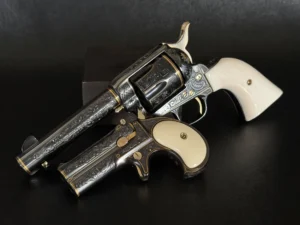
The high end of this world overlaps with the great engravers. Colt ran an in-house engraving shop under Cuno Helfricht for half a century, and before him, Gustave Young cut some of the finest Colt percussion work ever done. L.D. Nimschke worked independently in New York and engraved for whoever paid, which is why his style appears on many makers’ guns. Engraved guns very often shipped with ivory or pearl, since nobody commissioned scrollwork and then asked for plain walnut.
And then there are Tiffany grips, which are their own small obsession. In the Civil War era and after, cast metal grips in silver or plated white metal, with relief scenes of battles, eagles, and allegorical figures, were fitted to Colt and Smith & Wesson revolvers. Some were retailed through Tiffany & Company, others through different New York houses, so careful catalogers say “Tiffany-style” unless there’s proof. Originals are scarce and heavily faked. Modern reproduction castings exist and sometimes get artificially aged, so this is deep water best entered with a specialist’s help.
Telling real from imitation
You don’t need a lab for a first pass. You need light, patience, and a little skepticism.
For ivory, start with the Schreger lines. Find an end-grain surface, often the butt of the grip or the inside face, and look for that crosshatch of intersecting arcs under magnification. Bone, the most common honest substitute, shows instead tiny pits and dark streaks, the channels that carried blood vessels in life. Celluloid shows neither, just suspiciously regular parallel lines that never vary or intersect.
Temperature helps. Real ivory and real pearl feel cool at first touch and warm slowly. Plastic warms almost immediately. Rub celluloid briskly with your thumb, and you may catch a faint camphor smell, a leftover from its manufacture. It’s not a courtroom test, but at a gun show it settles a lot of arguments.
A small ultraviolet flashlight earns its place in the range bag here. Ivory tends to fluoresce a bright bluish-white, letting you spot filled cracks and repairs that vanish under normal light. Plastics respond inconsistently, which is informative in itself.
For pearl, tilt the piece under light. Real nacre has depth; the iridescence lies in layers and shifts with the angle. Imitation pearl, whether old celluloid or modern acrylic, has a swirl pattern that sits on the surface and often repeats, since it was mixed rather than grown. Check the back of the panels too. Sawn shell looks like sawn shell. Molded plastic looks molded, sometimes with a visible seam or a too-perfect fit.
When real money is on the line, none of this replaces an expert opinion. But it will keep you from paying ivory prices for a razor-handle material at a Saturday show.
The legal part, and please read it before you buy
Fair warning: I’m not a lawyer, this isn’t legal advice, and this is an area where the rules genuinely differ by species, by state, and by year. Verify current law before any transaction. That said, here’s the landscape as it stands.
At the federal level, the big change came in July 2016, when a near-total ban on commercial trade in African elephant ivory took effect. Two exceptions matter to gun collectors. The first is the ESA antique exemption: items more than 100 years old can still be sold, including across state lines, but the burden is on the seller to document the item’s age and show that it wasn’t repaired or restored with ivory after 1973. The second is the de minimis exception, which the Fish and Wildlife Service wrote with items like gun grips specifically in mind. In broad strokes, a manufactured item can qualify if the ivory is a fixed component, isn’t the main source of the item’s value, weighs under 200 grams total, came from ivory harvested before 1976, and the item was made before July 2016, among other criteria. A revolver with ivory stocks can clear that bar. A pair of loose ivory grips sold as ivory, where the ivory is the whole value, is a much harder case. Asian elephant ivory gets no de minimis exception at all, and the federal rule doesn’t regulate mammoth, walrus, or whale ivory.
Then come the states, and they don’t agree with the federal government or each other. California, New York, New Jersey, Hawaii, Washington, and Oregon have their own bans, and several state laws sweep in mammoth ivory precisely because it looks so much like elephant. Mammoth is legal to trade federally, since the species has been extinct for thousands of years, but that won’t help you in a state that bans it by name. Illinois and Nevada have their own restrictions, other states have partial ones, and bills keep moving. Walrus ivory answers to yet another law, the Marine Mammal Protection Act, with allowances for pre-1972 material, fossil walrus, and Alaska Native handicrafts.
The practical upshot for a collector is this: paper is everything, and geography matters. A documented, lettered, century-old Colt with factory ivory can change hands lawfully in most of the country. The identical grips, undocumented, offered across state lines or inside a strict-ban state, can be a genuine legal problem. Get provenance in writing, keep every receipt and letter, pass the file to the next owner, and when in doubt, read the current Fish and Wildlife Service guidance and your own state’s law before you list anything for sale.
One more note, since it comes up constantly: in most states, simply owning inherited ivory remains lawful. The restrictions overwhelmingly target buying and selling. Grandpa’s ivory-gripped Smith is not contraband sitting in the safe. Selling it is where the homework starts.
Living with the fragile stuff
Old grips fail more due to the environment than to use, and the fixes are cheap.
Ivory wants stable, moderate humidity, somewhere in the middle of the range, and it wants it year-round. The classic mistake is a gun safe with a heating rod that drives humidity way down, which is great for steel and slow death for ivory. So is a display case in direct sun, which both dries and bleaches. If a house is comfortable for a piano, it’s about right for ivory.
Mechanical stress is the other killer. Grip screws should be snug, never tight. Over-torquing has cracked more pearl and ivory than any drop ever did. If panels don’t sit perfectly flat on the frame, shim or fit them rather than crushing them into contact. And if an old set already has a hairline, leave it alone. Amateur glue repairs show under UV and hurt value more than the crack does.
Beyond that, less is more. Handle grips with clean, dry hands; wipe them with a soft cloth; and skip solvents and gun oil, which can permanently stain ivory and pearl. Many collectors apply a very thin coat of microcrystalline wax once in a while, which is reasonable. What patina the years put on, leave on. A set of yellowed, glowing ivory grips that some helpful soul sanded back to white has lost a century of character and a chunk of its worth in one afternoon.
Celluloid, as covered above, gets stored apart. Horn gets checked for insect damage. Pearl travels padded. None of this is complicated. It just has to actually happen.
What matters when you’re buying
Strip away the romance and a handful of questions decide almost everything.
First, what is it, really? Material identification comes before any talk of price. Ask the seller directly, and get the answer written on the receipt. “Ivory grips” on a bill of sale means something later; “grips” does not.
Second, is it factory? A Colt or Smith & Wesson letter confirming the grip material at the time of shipment transforms the gun. Letters cost money and take time, but on any significant piece the research pays for itself. If a seller claims factory ivory without a letter, price the claim as unproven.
Third, condition. With pearl and ivory, cracks and chips are the whole ballgame. A hairline at the screw hole is common and priced in; missing chunks, warped panels, and repairs are another matter. Examine the grips off the gun when possible, since the inside faces reveal cracks, old glue, and authenticity all at once.
Fourth, if the grips were replaced, where are the originals? A gun wearing modern imitation ivory isn’t ruined, but the original stocks in a labeled envelope restore both history and value. Always ask.
And if what you want is simply the look on a working gun, the modern market has you covered without any legal homework. Elk antler, quality mother of pearl (still legally produced, since the shellfish involved aren’t endangered), mammoth ivory where state law allows, and honest modern synthetics like Kirinite and ivory-look polymers all exist, and outfits like Eagle Grips, Ajax, and Altamont will fit them. There’s no shame in it. Patton’s ivory was brand new once, too.
The last word, which Patton didn’t actually get
Patton’s crack about pearl handles is one of the most repeated lines in American gun lore, and it settled nothing. Pearl-gripped Colts kept selling in 1945, and they command respect at auction today, sometimes right alongside ivory-stocked guns with half the flash and twice the paperwork. The materials tell different stories, and that’s exactly why both survive.
What has changed is the responsibility that comes with the elephant in the room, literally. Ivory collecting now runs on documentation, and that’s not a burden to resent. The paper trail that keeps a sale legal is the same trail that proves the history collectors care about in the first place. Buy carefully, write everything down, and the grips will outlast us all. They’ve already outlasted everyone who argued about them the first time around.
Frequently Asked Questions
Sometimes, and the details decide it. Federal law permits the sale of documented antiques and certain items containing small amounts of pre-1976 African elephant ivory, but several states ban ivory sales almost entirely, so verify current federal and state rules before listing anything.
In most states, yes, since the restrictions target buying and selling rather than possession. The homework starts when you try to sell.
Look for Schreger lines, the fine crosshatch pattern on cut surfaces that elephant and mammoth ivory show and plastic doesn’t. Real ivory also feels cool and warms slowly, while celluloid warms fast and can give off a faint camphor smell when rubbed.
No, they’re mother of pearl, the iridescent nacre lining of large shells, sawn into panels. It’s beautiful and brittle, which is why chip-free antique pearl grips are hard to find.
The preferred material is sambar stag antler from India, and India restricted, then effectively ended, exports years ago. What circulates now is old stock, so most “stag” grips sold today are elk antler or jigged bone.
Yes, though a hairline at the screw hole is so common on century-old ivory that the market largely prices it in. Avoid amateur glue repairs, which show under UV light and usually hurt value more than the crack itself.