
Key Takeaways:
- Historical importance does not automatically make every example rare or valuable.
- Factory records, serial numbers, markings, and original components are central to accurate identification.
- Provenance is credible only when documentary records support the firearm’s physical evidence.
Ten Landmark Firearms Every Collector Should Know
Collectible firearms should be evaluated as historical objects, not simply as old weapons. Design, manufacturing history, military service, originality, condition, and documented provenance determine significance. The following ten firearms are not a ranking or a universal acquisition list. They are reference points that shaped firearms development and remain important to collectors and historians.
1. Colt Single Action Army
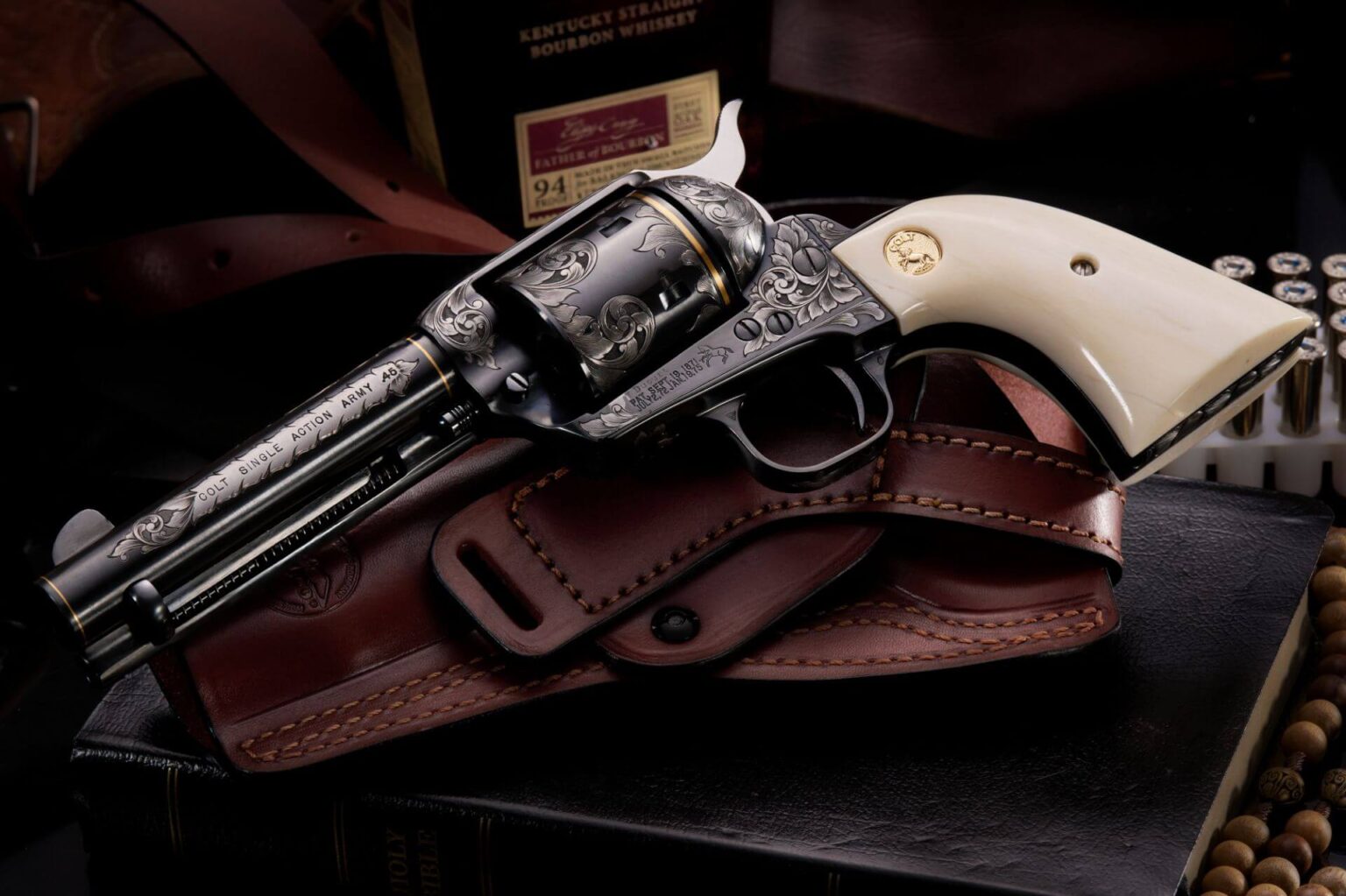
Colt introduced the Single Action Army in 1873 and secured a U.S. government contract establishing it as the standard military revolver. According to Colt’s historical records, the company delivered more than 30,000 examples to the government between 1873 and 1891.[1]
The revolver’s single-action mechanism requires the hammer to be cocked before each shot. Its straightforward operation, durable solid frame, and extensive military and commercial production helped establish its reputation. Later appearances in Western films and television cemented the “Peacemaker” as a symbol of the American frontier.
Collectors must evaluate individual examples carefully. Military inspection marks, serial-number range, caliber, barrel length, finish, factory configuration, and provenance can materially affect historical importance. A refinished or substantially altered revolver should not be treated as equivalent to an original example.
2. Winchester Model 1873
The Winchester Model 1873 became closely associated with the nineteenth-century American West. Its familiar nickname, “The Gun That Won the West,” originated in promotion and popular culture rather than in a measurable historical judgment. Nevertheless, surviving rifles, factory records, period documentation, and archaeological discoveries firmly establish the model’s frontier presence.[2]
The Model 1873 used a lever-operated repeating action and was produced in several configurations and calibers. One documented example discovered at Great Basin National Park was manufactured in 1882. A cartridge found in its buttstock was identified as .44 Winchester Center Fire, commonly called .44-40.[3]
The surviving Winchester factory ledgers are particularly valuable to collectors. Depending on the firearm and serial number, the records may identify caliber, barrel type, trigger, special-order features, warehouse dates, and shipment information.[4]
3. U.S. Rifle, Caliber .30, M1
Designed by John C. Garand and adopted by the U.S. Army in 1936, the M1 was a semiautomatic, .30-caliber service rifle loaded with an eight-round en bloc clip. Springfield Armory began production in 1937. Springfield and Winchester produced more than four million M1 rifles during the Second World War, and the design remained the standard U.S. service rifle through the Korean War.[5]
General George S. Patton’s famous description of the M1 as “the greatest battle implement ever devised” is documented in official Army history and dates to January 1945.[6]
Many surviving M1s underwent military inspection, repair, or arsenal rebuilding. Parts were routinely replaced as necessary. A historically authentic service rifle therefore may not retain its original factory components. Manufacturer, serial number, barrel date, stock markings, rebuild stamps, and component compatibility must be examined together.
4. Mauser C96
The Mauser C96 was patented in 1895 and entered service in 1896, placing it among the earliest successful self-loading pistols. Although Paul Mauser patented and manufactured the weapon, much of its design work was performed by the Feederle brothers at the Mauser factory in Oberndorf.[7]
Its distinctive features include a magazine positioned ahead of the trigger, a narrow “broomhandle” grip, and a detachable wooden shoulder stock that could also serve as a holster. Early production was principally chambered for the 7.63×25 mm Mauser cartridge, although numerous later chamberings and configurations appeared.
The C96 is a complicated collecting field. Commercial pistols, military contracts, shortened models, wartime production, Chinese-made examples, and selective-fire variants may appear superficially similar. Chambering, markings, sight graduations, magazine type, hammer configuration, and matching serial numbers are essential to accurate identification.
5. Thompson Submachine Gun
The Thompson was developed after the First World War as a commercially produced automatic weapon chambered principally in .45 ACP. The U.S. Navy adopted a version in 1928, the Army accepted it as a limited-procurement weapon in 1932, and it became a standard Army weapon in 1938.[8]
Its public reputation was shaped partly by Prohibition-era crime, but its military history is more substantial. The Thompson became one of the principal American submachine guns available at the beginning of the Second World War. Production continued through several increasingly simplified military variants before the less expensive M3 submachine gun supplanted it as a production item in 1944.[8]
“Thompson” describes a family of related firearms rather than a single configuration. Commercial Model 1921 guns, Navy-overstamped examples, M1928 and M1928A1 models, and wartime M1 and M1A1 variants have different features and histories. Manufacturer, receiver markings, controls, barrel configuration, serial number, and documented legal history are fundamental to classification.
6. Pistole 08 Luger
Georg Luger developed the Parabellum pistol from Hugo Borchardt’s earlier self-loading design. Switzerland adopted a 7.65 mm version in 1900, and the German Navy followed with its own model in 1904. The German Army adopted the 9×19 mm Pistole 08 in 1908.[7]
The Luger’s exposed toggle-lock mechanism gives the pistol its unmistakable profile. It was precisely manufactured, but the close fit of the mechanism could make it sensitive to dirt, wear, or inadequate maintenance. The design was also comparatively expensive to produce.
Collectors must distinguish among military P08s, commercial pistols, naval models, long-barreled LP08s, police alterations, foreign contracts, and later production. Manufacturer, date, chamber marking, proof and acceptance stamps, unit markings, magazine, and matching numbered components all matter.
7. U.S. Model 1903 Springfield
The Model 1903 Springfield emerged from the U.S. Army’s experience with the Krag-Jørgensen rifle during the Spanish-American War. Its action drew heavily upon the Mauser system. The adoption of a 24-inch barrel allowed one rifle pattern to replace separate infantry-rifle and cavalry-carbine configurations.[9]
Production began in 1903. Springfield Armory manufactured more than one million rifles by 1936, while Rock Island Arsenal produced approximately another third of a million. Remington and Smith-Corona later manufactured M1903-series rifles during the Second World War.[9]
The designation encompasses several materially different firearms. Early rod-bayonet rifles, later heat-treated receivers, Mark I rifles, National Match examples, M1903A3 rifles, and M1903A4 sniper variants require separate treatment. Manufacturer, serial number, receiver type, barrel date, stock markings, sights, and evidence of arsenal alteration should be verified before classification.
8. Remington Model 870
Remington introduced the Model 870 pump-action shotgun in 1950. Company records report production exceeding ten million and list original chamberings in 12, 16, 20, and 28 gauge, as well as .410 bore.[10]
The Model 870 became significant through sustained production and adaptability rather than inherent rarity. The action has been used for field, target, defensive, and law-enforcement configurations, with numerous grades, barrel lengths, finishes, and stock arrangements.
Most older Model 870 shotguns are not scarce merely because of age. Early production, unusual factory configurations, high-grade target models, commemorative editions, and institutionally documented examples may deserve special attention. Exact variant and original configuration are more meaningful than the broad Model 870 designation.
9. Smith & Wesson Model 29
At the urging of handgun experimenter and writer Elmer Keith, Smith & Wesson developed a revolver for the .44 Magnum cartridge. The company completed the revolver in 1955 and initially offered it with 4-inch and 6½-inch barrels. An 8⅜-inch version followed.[11]
The revolver’s commercial profile changed dramatically after the release of Dirty Harry in 1971. Smith & Wesson records that demand, which had declined during the 1960s, rose sharply following the film’s release.[11]
Collectors should distinguish early revolvers produced before Smith & Wesson began stamping model numbers from later Model 29 engineering variations. Barrel length, finish, serial-number range, original stocks, presentation case, mechanical changes, and factory documentation can all affect desirability. A generic description such as “early Model 29” is not sufficiently precise for valuation or authentication.
10. Browning Hi-Power
The Hi-Power was the product of work by both John Moses Browning and Dieudonné Saive. Browning began the design for Fabrique Nationale but died at the FN factory in 1926 before completing it. Saive continued the project and completed the High Power design in 1934, when FN began production.[12]
The 9×19 mm pistol combined a locked-breech, single-action mechanism with a 13-round double-column magazine. That capacity was unusually large for a service pistol of its era and became central to the High Power name.[12]
Wartime German-controlled production, Canadian Inglis manufacture, postwar FN production, military contracts, and commercial Browning-marked pistols created a broad collecting field. National markings, military acceptance stamps, serial numbers, sights, extractor type, safety configuration, finish, and magazine details should be examined carefully.
Collecting the Individual Firearm
A celebrated model name does not by itself establish rarity, originality, or value. Collectors should begin with the physical firearm and work outward: identify the manufacturer and variant, confirm the serial-number range, examine markings and components, assess the finish, and compare the observed configuration with reliable factory or archival records.
Documentation must also be judged on its merits. A factory letter can confirm recorded shipping details, but it may not establish every event in a firearm’s later history. An inscription or family story is not provenance unless supported by credible records. The strongest collectible firearms are those in which the physical evidence and documentary record agree.
Frequently Asked Questions
Collectibility generally depends on historical significance, rarity, originality, condition, configuration, and documented provenance.
No. Age alone does not establish rarity, historical importance, or market value.
Factory records may confirm original configuration, caliber, shipment dates, and special-order features. Their contents vary by manufacturer and firearm.
No. Military firearms were routinely repaired and rebuilt during service, but replacement parts can affect originality and collector classification.
Reliable provenance connects a firearm to a person, event, or institution through credible documentation. Family stories and inscriptions are not conclusive without supporting evidence.
Sources
- Colt’s Manufacturing Company. “Timeline.”
- House, Marguerite. “Winchester: More Than Guns.” Buffalo Bill Center of the West, December 14, 2014.
- McClure, Nancy. “Forgotten Winchester Visits the Center of the West’s Cody Firearms Museum.” Buffalo Bill Center of the West, July 2, 2015.
- Cody Firearms Records Office. “Winchester Factory Records.” Buffalo Bill Center of the West.
- U.S. Army Center of Military History. “Army History and Heritage.”
- Hoffman, Jon T., ed. “A History of Innovation: U.S. Army Adaptation in War and Peace.” U.S. Army Center of Military History, CMH Publication 40-6-1.
- Royal Armouries. “Arms of the First World War.”
- Thomson, Harry C., and Lida Mayo. “The Ordnance Department: Procurement and Supply.” United States Army in World War II, Office of the Chief of Military History, Department of the Army.
- Springfield Armory National Historic Site. “The 1903 Springfield Rifle.” National Park Service.
- Remington. “Model 870 History.”
- Smith & Wesson. “The History of Smith & Wesson.”
- FN America. “About FN.”