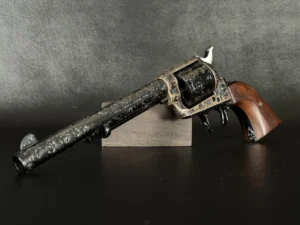

Key Takeaways:
- Documentation turns a firearm into a verifiable asset: Factory letters, original sales records, professional appraisals, and credible provenance replace assumptions with evidence. Without documentation, even rare or historically interesting guns are valued conservatively by serious collectors.
- Not all “history” adds value; only what can be proven: Family stories, verbal claims, and internet anecdotes do not move market value unless they are directly supported by records, photographs, or contemporaneous documents. Collectors pay premiums for verification, not narratives.
- Good documentation protects more than resale value: Detailed records support insurance claims, estate transfers, and long-term preservation of value across generations. A well-organized provenance package ensures the firearm’s history survives even when memories and original owners do not.
So you’ve got a collectible firearm sitting in your safe. Maybe it’s a limited-edition Colt, a pre-war Winchester, or something your grandfather handed down that’s been in the family for decades. You know it’s valuable, or at least, you think it might be. But here’s the thing: without the right paperwork, that gun might be worth significantly less than it could be.
Documentation isn’t just bureaucratic nonsense. It substantiates your firearm’s history and market value in ways that verbal claims simply can’t. Think of it like this: would you rather buy a vintage car with a complete service history and original bill of sale, or one where the seller just says, “Trust me, it’s all original”? The same principle applies to collectible firearms.
Let me walk you through exactly what documentation you need, and how to get it if you don’t already have it.
What Moves Value the Most
Before we get into the details, if you’re going to prioritize just three things, focus on these:
Factory letter (when available) – Confirms original specifications and shipping details directly from the manufacturer’s records. This is your strongest proof of authenticity and originality.
Complete photo documentation with condition notes – Dated photographs showing all angles, markings, and condition create a visual record that proves your gun’s state at specific points in time.
Verifiable provenance documents – Papers that directly connect the gun to historical claims or previous owners. The keyword is “verifiable”, documentation that can be independently confirmed.
Everything else supports these three pillars. Now let’s talk about what documentation you should have and how to get what’s missing.
Documentation You Should Already Have (Or Can Obtain)
If you purchased your firearm through legitimate channels, you likely have some paperwork. Often, there’s documentation, especially through dealers or auctions, or at least a receipt or bill of sale. Let’s start with what you might already possess.
Original Sales Records and Transfer Documents
When firearms change hands through licensed dealers or established auction houses, there’s a paper trail. This typically includes:
- Dealer receipt or invoice
- Bill of sale (from private transfers, where applicable)
- Auction invoice and lot documentation
- FFL transfer receipt (the transfer was completed through an FFL; the dealer retains the Form 4473 as required by law)
- State-required forms or permits (varies by jurisdiction)
- Shipping or transfer confirmation
These documents create a documented chain of custody. They prove when you acquired the gun, from whom, and under what circumstances. For collectibles, this matters enormously. A complete chain of documented transfers from the factory to you establishes legitimacy and helps verify the gun hasn’t been stolen or illegally modified.
Keep every scrap of paper from every transaction. Even informal bills of sale from private transfers have value as documentation.
The Original Box and Factory Materials
If your gun came in its original box with factory materials, manual, warranty card, test target, and accessories, guard these carefully. On high-condition collectible pieces, correct original packaging can command a meaningful premium. Sometimes it’s modest; sometimes it’s significant, depending on scarcity, condition, and whether the packaging is correct for the gun.
Why? Because original packaging proves the gun hasn’t been heavily circulated or abused. It suggests careful ownership and often confirms originality. Collectors love complete packages. The box itself tells them something about how the gun was cared for.
But the packaging only adds value if it’s correct. Mismatched boxes or materials from different production runs can actually raise red flags. Serial numbers should correspond. Models should match exactly. The end labels, including tools and paperwork, should all be period-correct to that specific gun.
Maintenance Records
Every time work is done on a collectible gun, document it. Who did the work? When? What exactly was done? Keep receipts, work orders, and notes from the gunsmith.
This matters because collectors need to know what’s original and what’s been changed. A professional restoration by a respected gunsmith, properly documented, can actually maintain or increase value. Undocumented modifications? That’s a red flag that’ll have buyers wondering what else has been done.
Here’s something a lot of people get wrong: they think any change is bad. That’s not always true. Appropriate period-correct restoration can preserve value. But you’ve got to prove it was done right, by the right people, with the right parts. Documentation makes that possible.
Documentation You Should Seek
Now, let’s talk about paperwork you might not have but should actively pursue. These documents can add substantial value to collectible firearms.
Factory Letters and Manufacturing Records
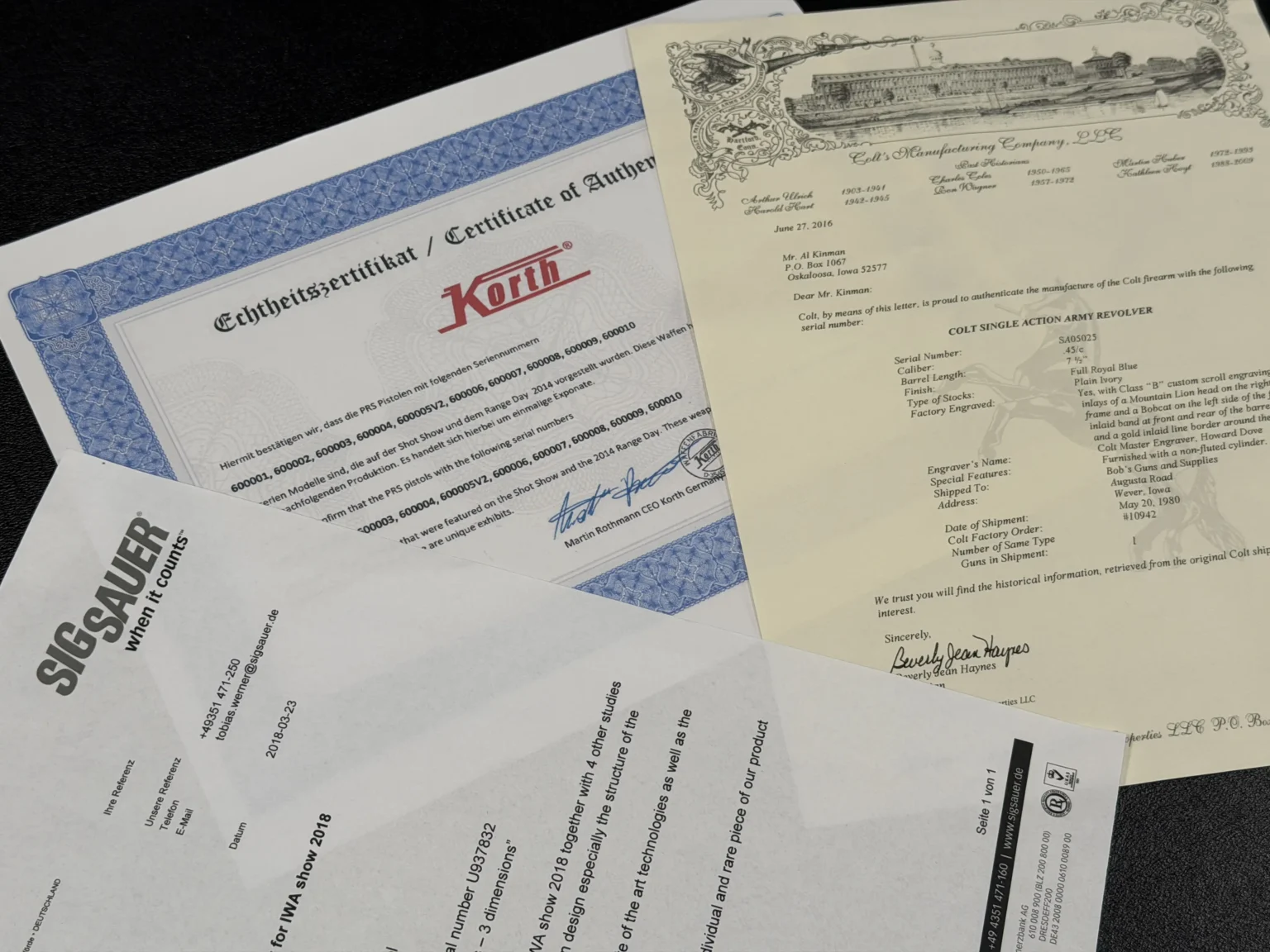
A factory letter from the manufacturer is one of the most valuable pieces of documentation you can obtain. Companies like Colt, Smith & Wesson, and Winchester maintain historical archives and will research their records for a fee.
But let’s be clear about what factory letters actually verify: they document the gun’s specifications as it left the factory and the original shipping destination. This includes production date, original configuration, barrel length, finish, special features, and the initial dealer or distributor who received it.
What factory letters don’t do is track ownership history after that first sale. If you’re hoping to prove your gun was owned by someone famous or served in a specific military unit, the factory letter alone won’t establish that. It confirms what the manufacturer made and where it went initially, nothing more.
For many collectibles, though, this information is invaluable. It proves originality. If someone claims a Colt SAA is an original .44-40 with a 7.5-inch barrel, the factory letter either confirms or refutes that claim definitively.
Turnaround times vary by maker and backlog; expect weeks to months. Costs typically range from $75 to $200, depending on the manufacturer. For a valuable collectible, it’s money well spent.
Professional Appraisals
An appraisal from a qualified expert serves multiple purposes. It gives you a documented baseline value for insurance. It provides independent verification of the gun’s condition and authenticity. And it establishes market position at a specific point in time.
Not all appraisals are created equal, though. You want someone with specific expertise in your type of firearm. The guy who knows modern tactical rifles might not be the best choice for evaluating a turn-of-the-century double-barreled shotgun. Look for appraisers certified by organizations like the American Society of Appraisers or those with established reputations in specific collecting niches.
Now, about updating appraisals: there’s a difference between a full formal appraisal and a condition check or market valuation update. A complete appraisal is a detailed document you might receive initially or when circumstances change significantly. For insurance purposes, many collectors get condition updates or market valuations every few years without commissioning entirely new appraisal letters. This keeps insurance coverage current without the expense of repeated formal appraisals.
Work with your insurance agent to determine what level of documentation they need and how frequently updates are required.
Documented Provenance, When It’s Verifiable
Provenance means ownership history. Who owned this gun before you? Can you trace it back through time? But the critical part is this: provenance only adds value when it’s credible and verifiable.
Let’s say you inherited a 1911 that your grandfather carried in World War II. If you’ve got his discharge papers, letters specifically mentioning the pistol, photographs of him with it, military documentation showing issuance, or unit records, that verifiable provenance can add enormous value. It transforms the gun from “old pistol” into “documented historical artifact.”
But anecdotal claims without supporting evidence don’t work. Someone telling you “this belonged to a famous lawman” without documentation means nothing to serious collectors. They’ve heard it all before. Claims without proof don’t move the needle on value.
When provenance involves famous ownership or significant historical events, collectors will pay substantial premiums, but only when documentation directly connects the firearm to the claim. Auction records show that guns with traceable, well-documented connections to historical figures or events can sell for multiples of their base value. A standard military 1911 might bring $1,500. The same model with documented provenance showing it was carried by a Medal of Honor recipient? That could bring $15,000 or more.
The documentation makes all the difference.
Authentication Certificates
For high-end collectibles, especially military firearms with interesting histories, third-party authentication can be crucial. Organizations such as manufacturer-specific collector associations can issue authentication certificates after examining the gun.
These certificates verify that the gun is genuine, not a reproduction or, as collectors call it, a “franken-gun” (a firearm assembled from mismatched parts, often from different production periods or models, to create something that appears more valuable than it actually is). In the world of collectible firearms, where fakes and “improved” guns are common, independent authentication provides assurance to buyers.
Good authentication should detail specific features, markings, and characteristics that confirm authenticity. It’s not just a stamp of approval—it’s documentation of the verification process.
Research Methods for Verification
So how do you actually verify information about your firearm, especially if it’s unusual or documentation is sparse? Let’s walk through the legitimate research methods.
Standard Reference Works
Start with authoritative published references. The 2026 Standard Catalog of Firearms, now in its 36th edition, covers over 18,000 models from more than 1,200 manufacturers. It includes rare firearms dating back to the early 1800s.
The Blue Book of Gun Values specializes in dating firearms through serial number analysis. It’s incredibly detailed when it comes to variations and manufacturing dates.
Gun Digest 2026 is in its 80th edition and offers expert coverage of niche and historical firearms.
These aren’t just price guides. They’re verification tools. When you can cite a specific entry that matches your gun’s features and serial number range, that’s documented evidence of authenticity and production period.
Government Manufacturing Data, With Limitations
The ATF publishes an Annual Firearms Manufacturing and Exportation Report (AFMER). These reports show total units distributed into commerce or exported during the reporting year by all federally licensed makers. Note that this reflects the distribution that year, not necessarily production that year, an important distinction when arguing production scarcity.
This data is useful for understanding overall production volume. If AFMER shows only 500 units of a particular model were distributed in a given year, that’s evidence of rarity.
But AFMER shows big-picture production numbers. It doesn’t always break down specific variants, configurations, or serial number ranges. A manufacturer might have distributed 10,000 of a model in one year, but if only 200 had a specific finish or barrel length that makes yours special, AFMER won’t tell you that.
Use AFMER for general production context, not as definitive proof of specific variant rarity. You’ll need to combine it with other research.
For long-run production and import trends, compiled ATF historical production, import, and export datasets can provide helpful context on firearms commerce trends over extended periods.
Specialized Collector Groups and Forums
Sometimes the best information comes from people who’ve spent decades studying specific manufacturers or models.
Manufacturer-specific collector associations, such as the Colt Collectors Association, the Smith & Wesson Collectors Association, and similar groups, maintain extensive research databases. They can identify minute production changes, such as variations in screw count, finish differences, or marking changes, that indicate specific production runs or military contracts.
Online communities like Reddit’s r/ForgottenWeapons, r/Milsurp, and r/AntiqueGuns include knowledgeable collectors who can identify obscure markings and transitional models (firearms produced during periods when manufacturers were changing designs or specifications, often with features from both old and new production runs).
When you get information from these sources, document it carefully. Save forum posts, take screenshots, and note who provided the information and their credentials. This becomes part of your research documentation, though it carries less weight than factory letters or published references.
Auction Records and Market Research
Specialized auction houses like Rock Island Auction Company, James D. Julia, and Morphy Auctions handle high-end collectible firearms. Their catalogs and results are research goldmines.
Study past auction results for firearms similar to yours. Auction descriptions are often written by experts and include a detailed analysis of features, condition, and rarity. Realized prices show actual market value, not speculative asking prices.
Sites like GunsInternational and GunsAmerica host both current listings and completed sales. While these aren’t authoritative research sources, they serve as informal market indicators. You can see what similar guns have sold for and how sellers describe features and variants.
But don’t confuse market aggregators with research tools. Sites like WikiArms and GunDeals compile listings from various dealers; they’re useful for price comparison and seeing what’s currently available, but they’re not documentation sources for establishing provenance or rarity. Think of them as informal market indicators rather than authoritative references.
Understanding Markings and Variations
Firearm markings tell stories, but you need to know which stories actually matter to collectors.
Inspector Marks and Proof Stamps, Which Ones Matter
Military firearms carry various stamps, cartouches, and inspector marks. But not all markings increase value.
Collectors seek significant markings linked to specific units, contracts, or historical contexts. A Springfield 1903 with markings indicating it was produced for a specific military contract and accepted by a particular inspector can be valuable, especially if those markings connect to documented historical events or elite units.
Common inspector stamps that appear on thousands of guns? Those don’t add much. Some proof marks or inspector stamps may indicate rework, repair, or an arsenal rebuild, which can decrease collector value depending on the specific firearm and collecting category.
The key is understanding which markings are historically significant. A generic acceptance mark means the gun passed inspection. A mark indicating issuance to an elite unit or export for a specific foreign contract? That’s potentially valuable.
Research each marking individually. Cross-reference with military records, manufacturer data, and collector references. Document what each marking signifies.
Serial Number Analysis
Serial numbers aren’t just for tracking. They reveal production dates and assembly sequences. Manufacturers like Colt and Winchester have extensively documented serial number ranges.
Let’s say you’ve got a pre-1964 Winchester Model 70. By cross-referencing the serial number against production records, you can establish the exact year, sometimes the exact month, of manufacture. You can determine whether it falls within a particularly desirable production period, such as the “pre-war” years collectors prize.
Serial numbers help establish the production period and confirm the gun falls within the correct range for its purported model and configuration. The original destination is typically confirmed via factory records or factory letters, when available, not solely from the serial number.
Serial numbers also help identify transitional periods and special production runs. Certain ranges might indicate military contracts, export models with different specifications, or production during manufacturing process changeovers.
Transitional and Variant Models
Transitional models exist during periods when manufacturers were changing designs. They might have features from both old and new models, or unusual combinations that only existed briefly during the changeover.
These guns often aren’t documented in standard catalogs because they weren’t official model variations; they’re manufacturing anomalies that occurred during transition periods. But to collectors, they’re fascinating and can be quite valuable.
Documenting transitions requires comparative research. You need to examine your gun against known examples from before and after the transition, noting which features match which era. This is where collector associations and expert authentication become essential.
Recording and Storing Your Documentation
You’ve gathered documentation; now protect it properly.
Comprehensive Photographic Documentation
Take detailed photographs of your firearm. Document every angle, every marking, every proof stamp, serial number, and distinguishing feature. Photograph any defects, wear patterns, and unique characteristics.
Use good lighting and get close-ups of important details. Take photos with a ruler or scale reference to show actual dimensions. Date your photos, either with camera metadata or by including a dated note card in the frame.
Store these in multiple locations, on a local hard drive, in cloud storage, and on an external backup drive kept in a separate location. Digital files can be corrupted or lost. Multiple backups protect against single points of failure.
Why go to this trouble? Because condition is everything in collectibles. Having dated photographs proves the gun’s condition at specific points in time. If you later restore or modify something, those before-and-after photos become part of the provenance.
Plus, if your gun is stolen, detailed photos dramatically increase recovery chances.
Multiple Backup Locations
Keep original documents in a fire-resistant safe or bank safety deposit box. Make high-quality scans of everything, and I mean everything. Every receipt, every letter, every certificate.
Store digital copies in at least three locations: local hard drive, cloud storage (Google Drive, Dropbox, etc.), and an external backup drive kept at a different physical location.
Why the redundancy? Because houses burn down. Hard drives fail. Cloud services can change or disappear. Your documentation is irreplaceable. Treat it accordingly.
Creating a Provenance Package
Some collectors create a “provenance package” that travels with the gun. This is a physical binder or digital file containing all documentation, research, photos, and ownership history.
Include:
- Original sales receipts and transfer documents
- Factory letters and authentication certificates
- Professional appraisals
- Maintenance and gunsmith records
- Research documentation (catalog references, forum posts, expert opinions)
- Dated photographs showing the condition
- Ownership history with dates and names
- Any relevant historical documentation
When you sell or transfer the gun, the package goes with it, preserving the documented history for future owners.
Share Strategically
Give copies of key documents to trusted family members or your attorney, especially if the guns have significant value or family history. If something happens to you, the next owner needs this information to maintain value.
Update your documentation as new information comes to light or as condition changes. This is a living record, not a one-time project.
What Not to Rely On
Let’s talk about what doesn’t constitute solid documentation.
Verbal Claims and Family Stories
“Grandpa said this was carried at Gettysburg” is a story, not documentation. Family legends are wonderful, but collectors won’t pay premiums for unverifiable claims.
If there is a family history, try to document it. Look for photographs, letters, military records, or contemporary accounts that corroborate the story. Without supporting evidence, verbal claims carry no weight in the market.
Online Forum Posts Without Verification
Information from online forums can point you in research directions, but a random forum post isn’t documentation. Even when knowledgeable collectors provide information, verify it through authoritative sources.
Save the forum discussion as part of your research trail, but don’t present it as definitive proof. It’s a lead, not a conclusion.
Undocumented Restorations or Modifications
If work has been done on your gun but you can’t document who did it, when, or exactly what was done, that’s a problem. Undocumented changes raise red flags about originality and can significantly decrease value.
If you acquire a gun with obvious restoration or modification, try to trace who did the work. Contact previous owners. Research gunsmith markings. The more you can document, the better.
Informal Price Aggregators as Research Sources
Remember those price aggregator sites we mentioned? WikiArms, GunDeals, and similar platforms show you what dealers are currently asking. They’re useful for gauging market prices and availability.
But they’re not authoritative documentation sources. They won’t establish rarity, provenance, or authenticity. Use them to understand market dynamics, not to document your gun’s history.
Legal Considerations: A Critical Distinction
Let’s separate two different types of documentation that people often confuse: legal compliance documentation and collectible provenance documentation.
Legal Documentation Requirements
Firearms are heavily regulated. The documentation required for legal compliance varies by state and local jurisdiction. This includes:
- Dealer receipts and FFL transfer records (the FFL retains Form 4473)
- State-required purchase permits or registration
- Concealed carry permits (if applicable)
- NFA paperwork for Title II firearms (short-barreled rifles, suppressors, etc.)
- Import documentation for foreign-manufactured firearms
These documents prove legal ownership and compliance with regulations. They’re absolutely essential, but they’re separate from the collectible documentation we’ve been discussing.
Estate Transfers and Inheritances
Transferring firearms through estates involves legal requirements that vary significantly by state. Some states require all transfers, even to family members, to go through a licensed dealer. Others allow direct inheritance with minimal paperwork.
If you’re inheriting collectible firearms or planning your estate, consult with an attorney who specializes in firearms law in your state. Also, work with an FFL dealer familiar with collectible transfers. The rules are complex, penalties for non-compliance are severe, and what’s legal in one state may be prohibited in another.
Don’t assume that because firearms are part of an estate, normal transfer rules don’t apply. In many jurisdictions, they absolutely do.
This Article Is Not Legal Advice
This article discusses documentation for collectible value, not legal compliance. Laws change frequently and vary by jurisdiction. Nothing here should be taken as legal advice.
Always consult qualified legal professionals and licensed dealers when transferring, purchasing, or selling firearms. State and federal regulations are complex, and penalties for violations are serious.
The Insurance Factor
Documentation isn’t just about resale value. It’s about being able to replace what you’ve got if disaster strikes.
Standard homeowner’s insurance typically has low coverage limits for firearms, often just a few thousand dollars total. For a serious collection, that’s inadequate. You need specialized firearms insurance or a rider on your homeowner’s policy.
But to get appropriate coverage, you need documentation proving value. Appraisals, receipts, photos, and authentication certificates, insurers want to see all of it. Without documentation, you’re stuck accepting whatever the insurance company says your guns are worth.
Update your insurance documentation regularly. As values change and your collection grows, adjust coverage accordingly. And don’t keep the only copy of your insurance documentation with the guns themselves; that’s a recipe for disaster.
Your Documentation Checklist
Here’s a practical checklist to help you organize documentation for each collectible firearm:
Essential Documents:
- [ ] Original bill of sale, dealer receipt, or auction invoice
- [ ] Transfer documentation (FFL receipt, state permits if applicable)
- [ ] Original box and factory materials (if applicable)
- [ ] Factory letter from manufacturer
- [ ] Professional appraisal (dated within 3-5 years)
- [ ] Current photographs (all angles, close-ups of markings)
Supporting Documentation:
- [ ] Maintenance and gunsmith records
- [ ] Authentication certificates
- [ ] Historical provenance documents (if applicable and verifiable)
- [ ] Research documentation (catalog references, serial number verification)
- [ ] Previous appraisals showing value history
- [ ] Insurance documentation
Storage Checklist:
- [ ] Originals in fire-resistant safe or safety deposit box
- [ ] Digital scans in cloud storage
- [ ] Backup copies on external drive (stored separately)
- [ ] Copies with a trusted family member or attorney
- [ ] Provenance package ready to travel with gun if sold
When Documentation Goes Missing
What if you’ve already got a gun but zero paperwork? Maybe you inherited it, and nobody kept records. Maybe it changed hands multiple times in private sales. Is the game over?
Not necessarily, but you’ve got work to do.
Start by requesting factory letters if the manufacturer offers them. Even if the records aren’t complete, you might still get verification of basic specifications.
Document everything you know. Who did you get it from? When? What did they tell you about it? Even oral history has value if you document it properly, write it down, date it, and, if possible, get written statements from the source.
Have it examined by recognized experts. Their written opinions, while not as definitive as original documentation, carry weight in the collecting community. Some experts will provide letters of authenticity or condition reports that become part of the gun’s documented history going forward.
Join manufacturer-specific collector groups and ask around. Post clear photographs. Someone might recognize your gun or have information about the production run. You’d be amazed at what dedicated collectors know.
The key is starting now. Every day that passes is a lost opportunity to gather information from people who might have knowledge. Previous owners die. Memories fade. Documentation assembled today might be impossible to recreate tomorrow.
The Bottom Line
Proper documentation substantiates your firearm’s history and market value in ways that verbal claims simply cannot. It’s the difference between guessing at value and knowing exactly what you have based on verifiable evidence.
Yes, it’s work. Tracking down factory letters takes time. Researching markings requires patience. Maintaining detailed records is tedious. But if you’re serious about collecting, if you want your guns to hold maximum value and be appreciated for what they truly are, documentation isn’t optional.
Start today. Photograph your guns. Request factory letters. Get professional appraisals. Join collector groups. Document everything you learn. Create organized provenance packages. Back up everything in multiple locations.
Future you (or your heirs) will be very glad you did.
Because a gun without documentation is just another firearm. A gun with complete, verified documentation? That’s a collectible with established value and documented authenticity.
Legal Disclaimer: This article provides general information about documentation for collectible firearms and is not legal advice. Firearm laws vary significantly by state and local jurisdiction and change frequently. Always consult qualified legal professionals, licensed firearms dealers (FFLs), and relevant authorities regarding legal requirements for firearm ownership, transfer, and documentation in your specific jurisdiction. The author and publisher assume no liability for actions taken based on this information.
Frequently Asked Questions
Yes, because it replaces assumptions with verifiable facts about originality, condition, and history. Collectors pay premiums for certainty, not stories.
A factory letter, when available, confirms how the firearm left the manufacturer. It establishes originality, which is the foundation of collectible value.
Only when they are correct for the firearm and match the model and production period. Mismatched boxes or incorrect accessories can raise concerns rather than add value.
No. Provenance only affects value when documentation directly connects the firearm to the claimed person, event, or history.
Yes, if it is undocumented or improperly done. Period-correct restoration by a respected specialist, when fully documented, can preserve or sometimes maintain value.
They are research leads, not proof. Information from forums should be verified through factory records, published references, or recognized experts.